Does your purchase order process feel like herding cats right now? I know how frustrating it gets when papers pile up, emails get lost, and nobody knows the status of an order. Manual systems waste your team’s time and make it incredibly hard to track spending. You spend hours on tasks that a simple software program could handle in minutes. Here is a fact that changed my perspective on this. A 2026 Artsyl report found that companies automating their workflow cut processing time by up to 85 percent.
That is the difference between drowning in paperwork and having time to do your actual job. Welcome to how to automate purchase order process. You will learn what this technology really means, the specific problems it solves, and the exact steps to put it in place at your company.
What is Purchase Order Automation?
Now that you understand why this shift matters, let us talk about what it actually entails. Purchase order automation uses software to handle your entire buying process without manual work.
This technology takes your purchase requisition, your approval workflows, and your invoice processing, and it streamlines them into one smooth operation. Instead of shuffling papers or sending emails back and forth, the system moves everything forward automatically.
A 2025 Glean report found that 75% of US purchase orders still run through email or fax. That is a massive opportunity for your team to get ahead of the curve.
Automation connects your procurement team, accounting department, and suppliers in real time. The software generates purchase orders, routes them for approval, and tracks every single step until the invoice arrives.
Here are a few immediate benefits you will notice:
- Fewer errors: The system catches mistakes before they happen.
- Faster vendor management: Suppliers get clear, instant communication.
- Clear visibility: You see exactly where your money goes.
Think of this technology as your team’s extra set of hands. The system enforces budget controls automatically, so nobody accidentally overspends.
Real-time analytics let you identify cost reduction opportunities fast. Supply chain optimization becomes much easier when data flows freely between your systems.
Your accounts payable team stops chasing down missing documents because the digital workflow keeps everything organized. The result is faster processing, better supplier collaboration, and a crystal-clear audit trail.
Overcoming Challenges in Manual Purchase Order Processes
Manual purchase order processes create real problems that slow down your US business and drain your team’s time. You lose money, you miss deadlines, and you struggle to keep track of what is happening across your organization.

Tracking Issues in Decentralized Systems
Decentralized systems create significant challenges for most companies. Different departments use separate tools, spreadsheets, and databases to manage their orders.
Nobody communicates, so purchase orders easily get lost in the shuffle. Your finance team cannot see what procurement just approved, and your warehouse staff has no idea what vendors shipped yesterday.
“Manual purchase order processing typically costs between $125 and $200 per purchase order in the US, according to 2026 data from Hyperbots.”
That high cost comes from process inefficiency and supplier collaboration problems that you could easily prevent. Tracking order status becomes nearly impossible across multiple platforms.
One person enters data into Excel, another uses an old accounting system, and a third relies on email chains nobody reads anymore. Discrepancies pop up everywhere, creating audit trail challenges that keep compliance officers awake at night. Addressing these challenges requires a centralized approach that connects all your systems together.
Delays in Manual Approval Processes
Manual approval processes move at a painfully slow pace. Managers shuffle papers from desk to desk, waiting for signatures that take days or weeks.
A 2025 Netguru report found that 49% of US businesses need at least two people to approve each document. Each person in that chain holds the order hostage, creating bottlenecks that slow your entire supply chain management.
Your team watches opportunities slip away while approvals crawl through email threads. This workflow gap costs you real money and real time.
Automation sweeps away these delays instantly. Digital systems route purchase requisitions to the right people, cutting approval times from weeks to hours.
Your accounts payable team no longer chases down signatures. Real-time notifications push approvals forward, keeping your procurement process moving at lightning speed.
Absence of Audit Trails in Manual Systems
Manual processes leave your company flying completely blind. You cannot track who approved what, when they approved it, or why they made that decision.
This lack of visibility creates serious problems for your accounts payable team. Without audit trails, you lose the ability to answer critical questions about your spending history.
Research from the Hackett Group shows that companies with high levels of automation have 47% lower error rates in their procurement processes. Digital transformation solves the visibility problem completely.
Automated systems create detailed records of every action taken in your workflow. Each approval, rejection, and modification gets logged with precise timestamps.
Your team gains complete visibility into the entire process from start to finish. Auditors receive the exact documentation they need, and your business optimization efforts show real results.
Challenges with Siloed Organizational Tools
Siloed organizational tools make all of these problems much worse. Different departments often use separate software systems that simply do not talk to each other.
Your procurement team might use one platform, while accounting uses another. This fragmentation creates serious bottlenecks in your vendor management.
Teams waste hours copying data between systems instead of focusing on strategic decisions. Errors multiply when people manually transfer information. Common issues include:
- Typing the wrong item quantities.
- Entering incorrect vendor billing codes.
- Losing email attachments containing invoices.
Siloed tools also destroy your ability to enforce consistent business rules across the organization. One department might approve a request in minutes, while another department still processes it manually.
Integrated e-procurement solutions break down these walls. They connect your entire US operation, allowing data to flow freely and keeping everyone on the exact same page.
Exploring the Benefits of Purchase Order Automation
Automation transforms your purchase orders from slow, error-prone paperwork into a smooth, fast-moving machine. You will cut processing time, slash mistakes, manage costs better, and build stronger supplier partnerships.
Enhancing Processing Speed
Manual processes move far too slowly. Your team spends hours entering data, routing approvals through email chains, and chasing down signatures.
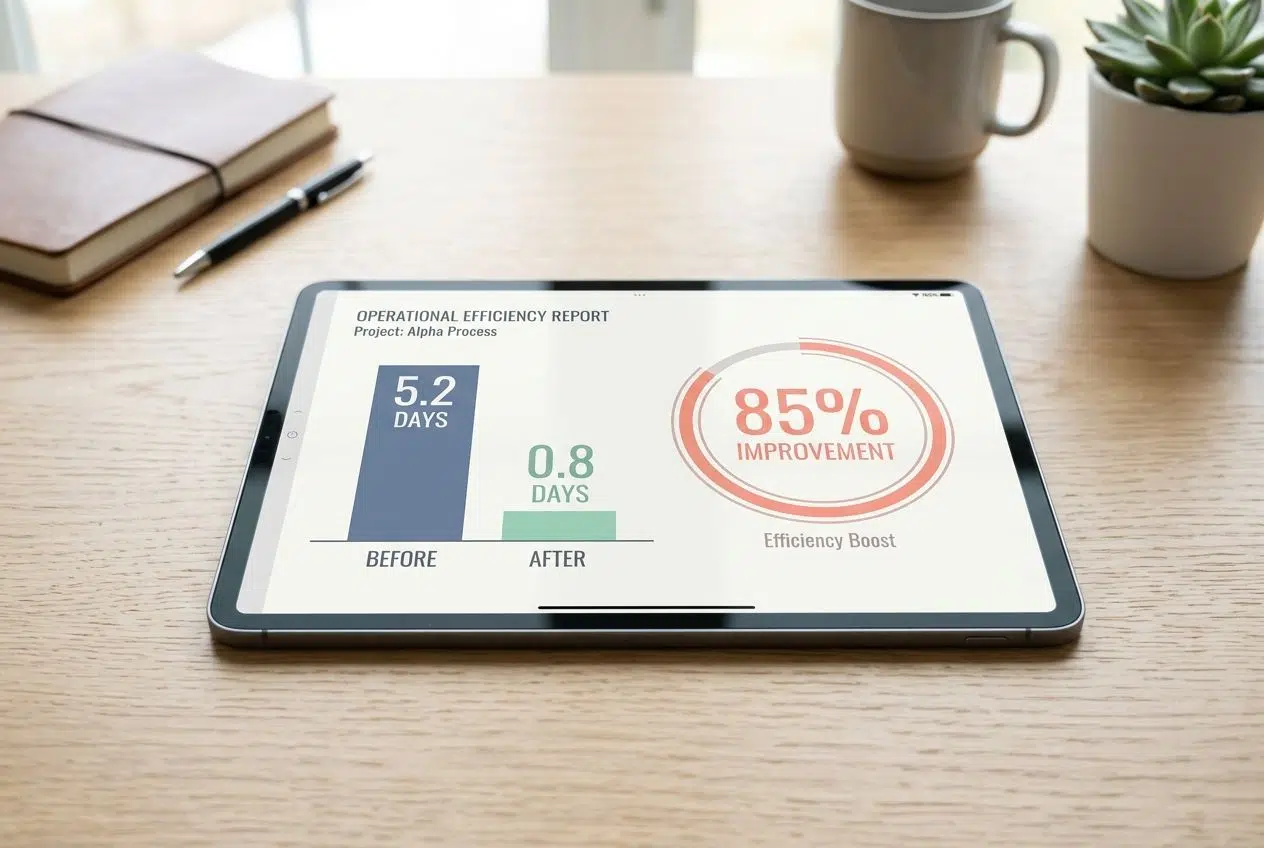
“A 2026 Artsyl study found that automated workflows drop processing time from an average of 5.2 days to just 0.8 days.”
That is an 85% improvement. Your procurement team shifts from pushing paper to focusing on strategic spend management.
Speed gains compound across your entire supply chain. Faster PO generation means suppliers receive orders sooner, which improves your inventory control.
Cost reduction follows naturally when your software cuts processing time so dramatically. Your staff gets to handle complex negotiations instead of administrative grunt work.
Boosting Data Accuracy
Automated systems eliminate the human errors that plague manual data entry. Your team stops typing the same supplier information over and over.
Digital Purchase Orders’ 2025 data shows that 1% to 3% of all manual POs contain critical mistakes. These mistakes include wrong supplier codes, pricing errors, or missing approvals.
The system pulls data from a single source of truth, so everyone works with current, accurate information. This cuts down invoice processing mistakes dramatically.
Real-time analytics show you exactly where errors happen, so you can fix problems before they cost money. When your purchase requisition data stays clean, three-way matching catches discrepancies instantly. Vendors appreciate getting correct orders the first time. This strengthens your collaboration and builds long-term trust.
Strengthening Cost Management
Purchase order automation stops spending leaks before they happen. Your system tracks every dollar moving through the supply chain, so you spot overspending immediately.
According to a 2025 Ascend Software report, the average cost to process a single invoice manually in the US ranges from $10 to $20. Automation cuts costs significantly by removing repetitive labor.
Real-time visibility means you catch budget violations the moment they occur, rather than months later during an audit. Teams gain control over procurement costs through automated workflows that enforce your specific rules.
Automation helps you control costs by:
- Catching budget violations instantly.
- Preventing unauthorized, rogue purchases.
- Tracking spending patterns by department.
You see exactly where money goes, which vendors drain your budget, and which purchases break your policies. Your accounts payable team transforms from simple paper pushers into strategic partners who actively shape your bottom line.
Improving Supplier Relationships
Cost savings matter, but your supplier relationships matter just as much. Automation tools help you pay vendors faster and more accurately. A 2025 Glean report highlights that 98% of suppliers need better communication from their largest customers. Automation delivers exactly that level of clarity.
Your suppliers notice when you process invoices on time and communicate clearly. They often reward this reliability by offering better pricing, priority service, and flexibility.
Automated systems create transparency that suppliers truly appreciate. They can track order status in real time and understand exactly when they will get paid.
This approach reduces friction and strengthens collaboration. Workflow automation lets you spend less time on paperwork and more time building connections that drive your business forward.
Implementing Purchase Order Automation Steps
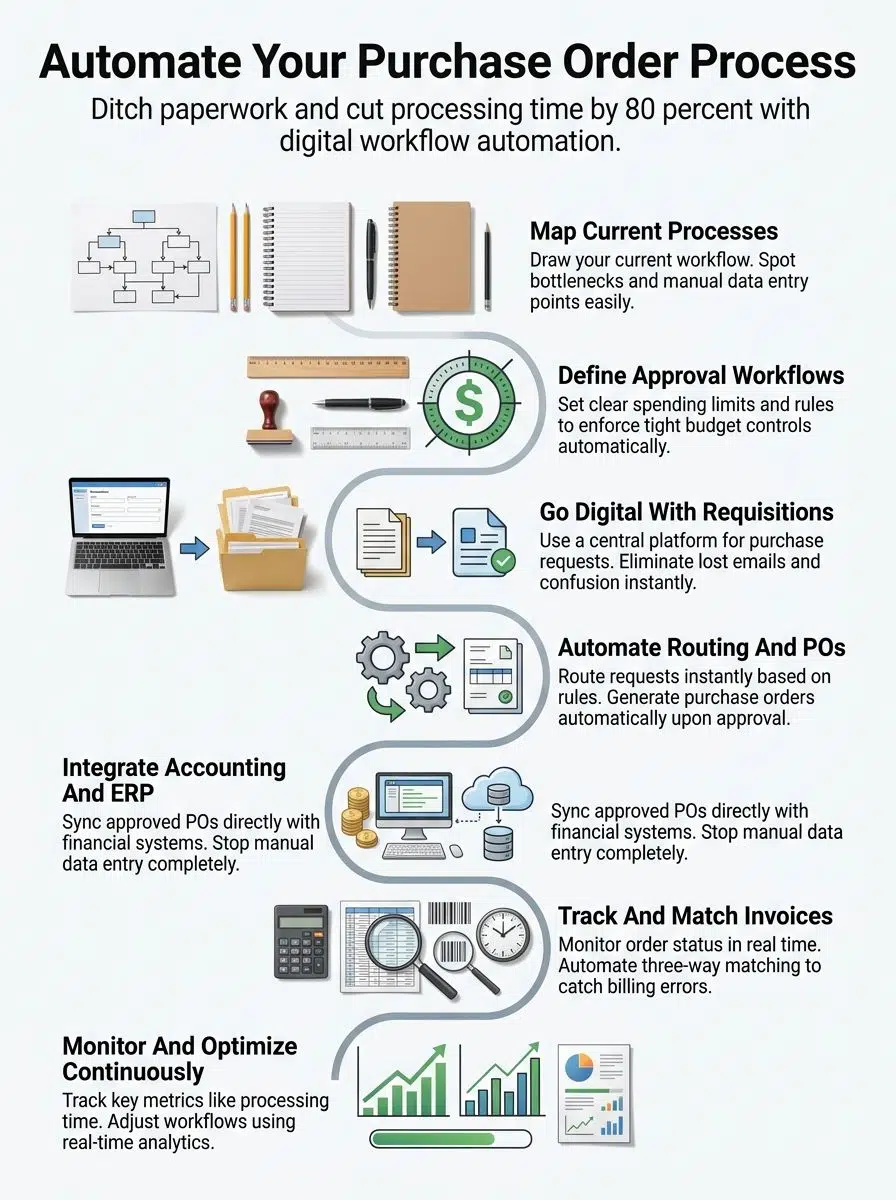
You will move through seven key steps that transform your process from a manual headache into a smooth workflow.
Map Current Processes
Start by documenting exactly how your team handles purchase orders right now. Walk through each step, from the moment someone requests an item to the final payment.
Talk to your procurement staff, accounts payable team, and department heads. Ask them what works, what slows them down, and where mistakes happen.
Moxo’s 2026 insights show that mapping is critical because basic automated approval workflows take just a few days to build, while complex ERP setups take two to four weeks. You need to know your exact requirements upfront.
Create a visual map of your current workflow. Draw out who approves what, where documents sit waiting, and how long each stage takes. This snapshot becomes your baseline for measuring improvement after you implement your new software.
Define Procurement Policies and Approval Workflows
Your procurement policies form the backbone of your entire automation system. You need to spell out exactly who can approve what, at what dollar amounts, and under which conditions.
Think of it like setting the rules for a game. Everyone plays better when they know the boundaries.
Your policies should always cover:
- Spending limits for different departments.
- Required documentation for each purchase type.
- Specific steps for final financial sign-off.
Approval workflows are where your policies come to life. Map out the exact path a purchase requisition takes from request to final approval.
A small office supply order might need just one manager’s sign-off, while a major equipment purchase requires multiple reviews. Your software routes these intelligently based on your rules.
Set Up a Digital Purchase Requisition System
A digital purchase requisition system is your starting point. This system lets employees submit purchase requests through a centralized platform instead of using scattered emails.
The platform captures all necessary details like item descriptions, quantities, and budget codes in one single place. Employees fill out forms that route automatically to the right approvers.
For US companies, user-friendly tools like Procurify or Precoro are excellent choices for setting up these digital requests. They require minimal training and offer clean interfaces.
This centralized approach eliminates confusion, reduces lost requests, and creates a clear audit trail. Your team gains visibility into every purchase request from start to finish.
Automate Approval Routing and PO Generation
Your digital system now holds all the data you need. The next step focuses on moving those requests through approval channels fast.
“As Artsyl’s 2026 data shows, pre-approving low-risk transactions cuts approval cycles to under 24 hours for 68% of orders.”
Your system checks each request against your procurement policies and spending limits. This smart filtering means approvers only see requests that genuinely need their attention.
The software generates purchase orders automatically once approvals come through, turning what used to take days into minutes. Your suppliers receive clear orders instantly, and your inventory control stays strictly on track.
Integrate with Accounting and ERP Systems
Once your system generates purchase orders, those documents need to flow seamlessly into your accounting tools. This step eliminates manual data entry completely.
Your accounting team stops wasting hours transferring information from one system to another. Ensure your chosen software integrates with popular US platforms like QuickBooks, NetSuite, or Xero.
Connecting your automation software to your ERP creates a single source of truth. The moment a PO gets approved, it automatically syncs with your accounts payable processes and your general ledger.
This direct connection transforms how you handle cost reduction strategies. Real-time visibility means your finance team catches discrepancies immediately.
Track Order Status and Perform Three-Way Matching
Your automated system tracks every order from the moment you send it out. Real-time visibility shows you exactly where each purchase order sits in the supply chain. You can easily see if vendors shipped items, if they arrived at your warehouse, or if they are stuck somewhere in between.
Three-way matching is where this technology really shines. Your system compares three key documents:
- The original purchase order.
- The receiving document shows that the items arrived.
- The final invoice from your supplier.
If all three match up perfectly, the payment processes automatically. Mismatches get flagged instantly, protecting your budget and ensuring everyone plays by the same rules.
Monitor and Optimize the Process Continuously
Continuous monitoring transforms your system from a static tool into a living operation. Track key metrics like processing time, approval delays, and cost savings.
Real-time analytics reveal which suppliers perform well and which ones lag behind. Data dashboards show you exactly where bottlenecks hide.
Track key metrics like:
- Average processing time per order.
- Frequency of approval delays.
- Total cost savings by department.
Optimization never stops. Pull reports monthly to see what works and what needs tweaking. Test small changes in your system, measure the results, and then scale your successes. This keeps your process incredibly lean and highly efficient.
Best Practices for Successful Purchase Order Automation
Smart practices separate companies that save money from those that waste it. You will want to focus on standardizing how you work, controlling spending, and using live data.
Standardizing Vendor Onboarding Processes
Standardizing your vendor onboarding process cuts through the chaos that slows down procurement. You set clear rules for how suppliers join your system.
According to SenseTask’s 2025 research, 70% of logistics companies are now adopting document processing automation to streamline their vendor paperwork. This massive shift proves how crucial digital onboarding is today.
This standardization means every vendor follows the exact same path. Your team spends less time hunting for missing documents, and vendors get onboarded much faster.
Consistent onboarding builds stronger supplier collaboration from day one. Your vendors know exactly what you expect, preventing misunderstandings that can derail orders.
By automating this through your software, you create a perfect audit trail. Supply chain optimization starts with vendors who understand your requirements.
Enforcing Budget Controls
Budget controls act as your financial guardrails. Your team sets spending limits before approving any orders, which prevents overspending entirely. The 2025 Deloitte Global Chief Procurement Officer Survey reveals a powerful fact.
“An impressive 96% of leaders who invest in digital procurement tools meet or exceed their cost-saving targets.”
Automation software flags purchases that exceed your limits, stopping unauthorized spending in its tracks. You gain real-time visibility into what your organization spends across all departments.
Your accounts payable team can enforce these controls consistently, without relying on manual checks. You simply define your spending thresholds by department, cost center, or vendor category.
Your finance team receives immediate alerts when spending approaches budget caps, giving you time to adjust course. This transforms spend management from complete guesswork into a data-driven strategy.
Utilizing Real-time Analytics for Decision Making
Real-time analytics completely transform how you make spending decisions. Your team gains instant visibility into supplier performance and organizational spending patterns.
This immediate access to information helps you spot trends before they become serious problems. You catch overspending quickly and identify which vendors deliver the best value.
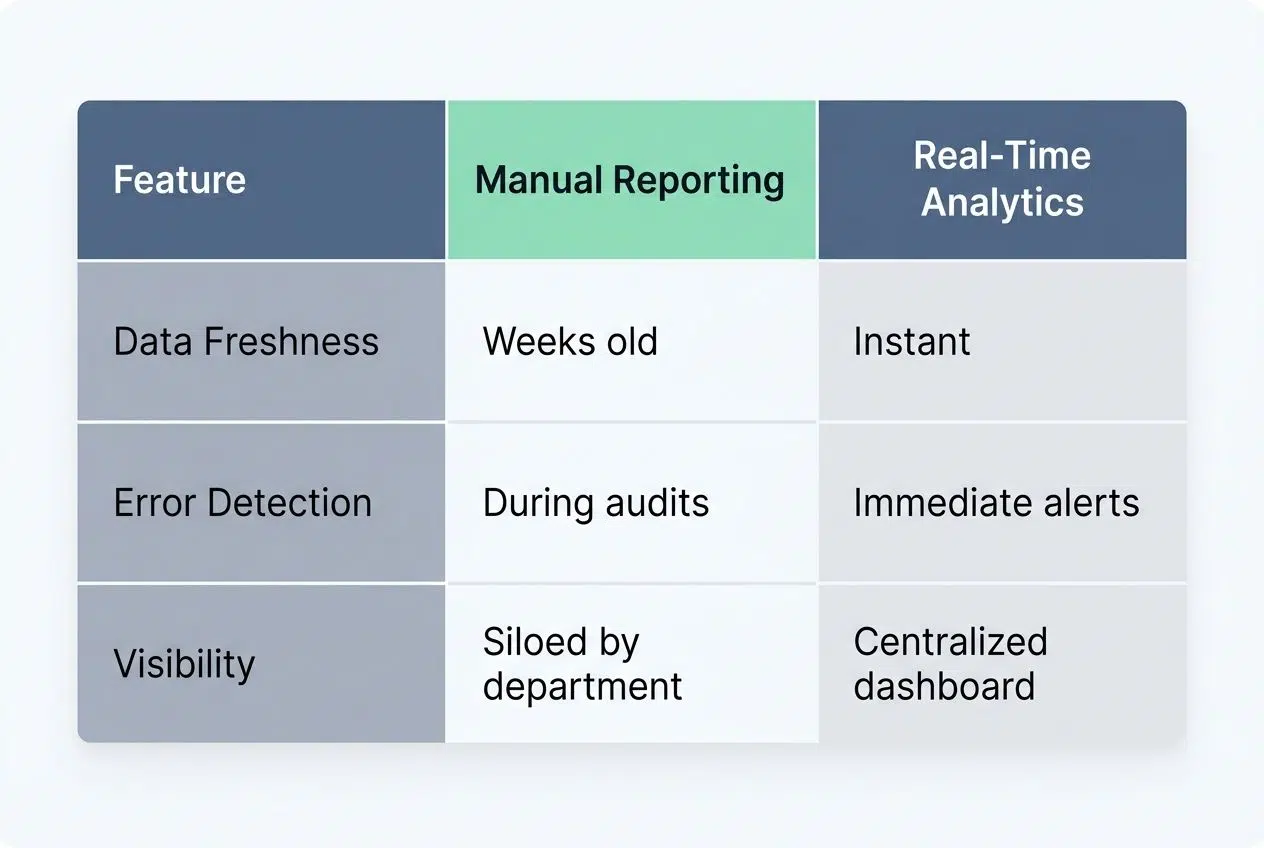
Here is how real-time analytics compares to manual reporting:
| Feature | Manual Reporting | Real-Time Analytics |
|---|---|---|
| Data Freshness | Weeks old | Instant |
| Error Detection | During audits | Immediate alerts |
| Visibility | Siloed by department | Centralized dashboard |
Data flows from your procurement system directly into dashboards that your team can easily read. This transparency supports better accounts payable processes and stronger vendor management.
You measure what actually matters and act on hard facts. Your bottom line improves because every decision rests on current data.
Selecting the Ideal Purchase Order Automation Solution
Picking the right software makes or breaks your success. Let us explore what separates the top options from the rest.
Assessing Software Compatibility
Your chosen software must work smoothly with your current systems. Check if the solution connects directly with your accounting software and existing vendor tools.
Most companies run multiple platforms at once, so compatibility matters immensely. Test the software thoroughly before you buy it to ensure data flows correctly.
Always look for pre-built connectors. Solutions that natively integrate with your tools save you significant time and money during setup.
Share your current tool list with vendors so they can confirm compatibility upfront. A smooth integration prevents headaches later and keeps your workflow running without hiccups.
Considering Scalability and Customization Options
Your solution absolutely needs to grow with your business. As your US company expands, you will handle more vendors and process much higher order volumes.
A scalable system handles these increases smoothly. Look for platforms that let you add new features and connect more suppliers without requiring expensive upgrades.
Customization matters just as much. Every organization runs differently, so your tool should bend to fit your workflow, not the other way around.
To help you choose, here is a quick comparison of top-rated US options based on 2025 G2 and Capterra data:
| Software Platform | Best Use Case | 2026 User Rating |
|---|---|---|
| SAP Ariba | Large enterprises need end-to-end global spend management. | 85/100 (G2) |
| Procurify | Mid-market teams want an incredibly easy-to-use interface. | 90/100 (G2) |
| Spendwise | Small businesses need an affordable starting point. | 4.6/5 (Capterra) |
The right solution adapts completely to your procurement policies and supports your unique vendor management approach.
Ensuring Ease of Use and Support for Training
Your software choice affects your entire staff. Pick a platform that your team can actually use without extensive technical skills.
A good solution has a clean interface and intuitive navigation. Capterra’s 2025 data shows tools like Spendwise starting around $9 per month, proving that user-friendly software does not have to be expensive.
Staff members spend less time figuring out the system and more time doing their actual jobs. Look for vendors who offer hands-on training sessions and clear documentation.
Strong support teams answer questions fast, so your team gets unstuck quickly. When staff members trust their tools, they adopt new processes faster and make far fewer mistakes.
The best e-procurement solutions combine smart design with dedicated support. They turn a painful process into something your team genuinely enjoys.
The Bottom Line
Automating your process completely transforms how your organization handles spending and supplier relationships. You cut processing time, reduce errors, and gain real-time visibility into your entire supply chain. The shift from manual workflows to digital systems puts control directly back in your hands. Your team can finally focus on strategy instead of drowning in paperwork.
Software solutions that integrate with your accounting tools create a seamless flow from requisition to payment. This eliminates the friction that slows traditional procurement down. Making this move requires planning, but the payoff absolutely speaks for itself. Cost reduction strategies kick in immediately as you enforce budget controls across departments.
Three-way matching catches discrepancies before they ever become real problems. Real-time analytics show you exactly where your money goes, helping you make smarter decisions.
Organizations that take action gain a massive competitive edge. They spend less time on administrative tasks and more time building strong vendor relationships that drive true business growth.
FAQs on How to Automate Purchase Order Process
1. What does it mean to automate purchase order process?
Automating your purchase order process means swapping out slow spreadsheets for smart software that instantly creates, routes, and tracks your orders. Tools like Procurify or Ascend Software do the heavy lifting to eliminate tedious paperwork and manual data entry. By making this switch, many US businesses cut their processing time from a sluggish two days down to just a few hours.
2. How can automating my purchase orders help my business?
It directly saves your business serious time and money by catching costly human errors before they happen. Recent American Productivity and Quality Center data shows that a manual US purchase order costs around $50 to process. Automated systems drop that expense down to just $5 per order.
3. Is it hard to set up an automated system for purchase orders?
Not at all, because modern platforms are built with simple features that guide you right through the setup process.
4. Can automation make tracking purchases easier for everyone involved?
It completely changes the game by giving both your team and your suppliers a shared, real-time dashboard to see exactly where an order stands. Your vendors get automatic status updates, and your finance department stops chasing down missing receipts at the end of the month. Everyone stays on the same page with far less confusion.