Feeling lonely, even when you are surrounded by people? You are not alone. Many people struggle with isolation, anxiety, and sadness in today’s fast-paced world. Some turn to friends or family for support, while others find traditional therapy feels out of reach due to cost, time, or stigma. AI companions offer a new path forward. These smart chatbots and virtual friends listen without judgment, respond instantly, and never get tired of hearing your thoughts. They sit in your pocket, ready to talk whenever you need them most.
Here is a surprising fact: A December 2025 Pew Research Center survey found that 64 percent of U.S. teens now use AI chatbots. The mental health impacts of AI Companions are becoming impossible to ignore as millions turn to these digital helpers.
Your mental health matters, and you deserve support that works for your life. This article breaks down exactly how AI companions help your wellbeing, what risks you should watch out for, and how to use them safely alongside human connection. You will learn whether these tools truly heal or just mask the pain. The truth might surprise you.
Understanding AI Companions
AI companions are computer programs that talk with people and provide emotional support through conversation. These systems learn how people communicate, so they can respond in ways that feel natural and caring.
Definition and purpose of AI companions
AI companions are computer programs that talk with people through text or voice. They use artificial intelligence to have conversations that feel natural and human-like.
These programs learn from millions of conversations to understand what people say and how they feel. They respond in ways that seem caring and thoughtful, even though no human sits behind the screen.
The purpose of AI companions centers on providing emotional support and reducing loneliness. Popular options like Character.ai serve over 20 million monthly users, primarily young adults and teenagers.
These therapy bots work around the clock, available whenever someone needs to talk. They listen without judgment, never getting tired or frustrated.
Here are the primary goals of these digital tools:
- Providing constant, round-the-clock availability for users.
- Offering immediate crisis support when professionals are asleep.
- Guiding users through basic self-reflection exercises.
- Creating a judgment-free space for emotional expression.
How AI Companions Are Designed for Emotional Support
AI companions work like digital friends that listen without judgment. Developers program these systems to recognize emotions in text and voice patterns.
The software uses natural language processing to understand your true meaning, not just the words themselves. These chatbots respond with empathy and patience, offering comfort when you need it most.
They never get tired, never rush you, and never make you feel bad for struggling. This constant availability matters deeply for people who feel lonely or isolated.
Emotional support from these systems comes from careful design choices, including features that encourage self-reflection and positive thinking patterns. Some developers even involve clinical psychologists in the process; for example, Headspace built its conversational AI tool, Ebb, using evidence-based motivational interviewing techniques.
The Positive Psychological Impact Of AI Companions On Mental Health
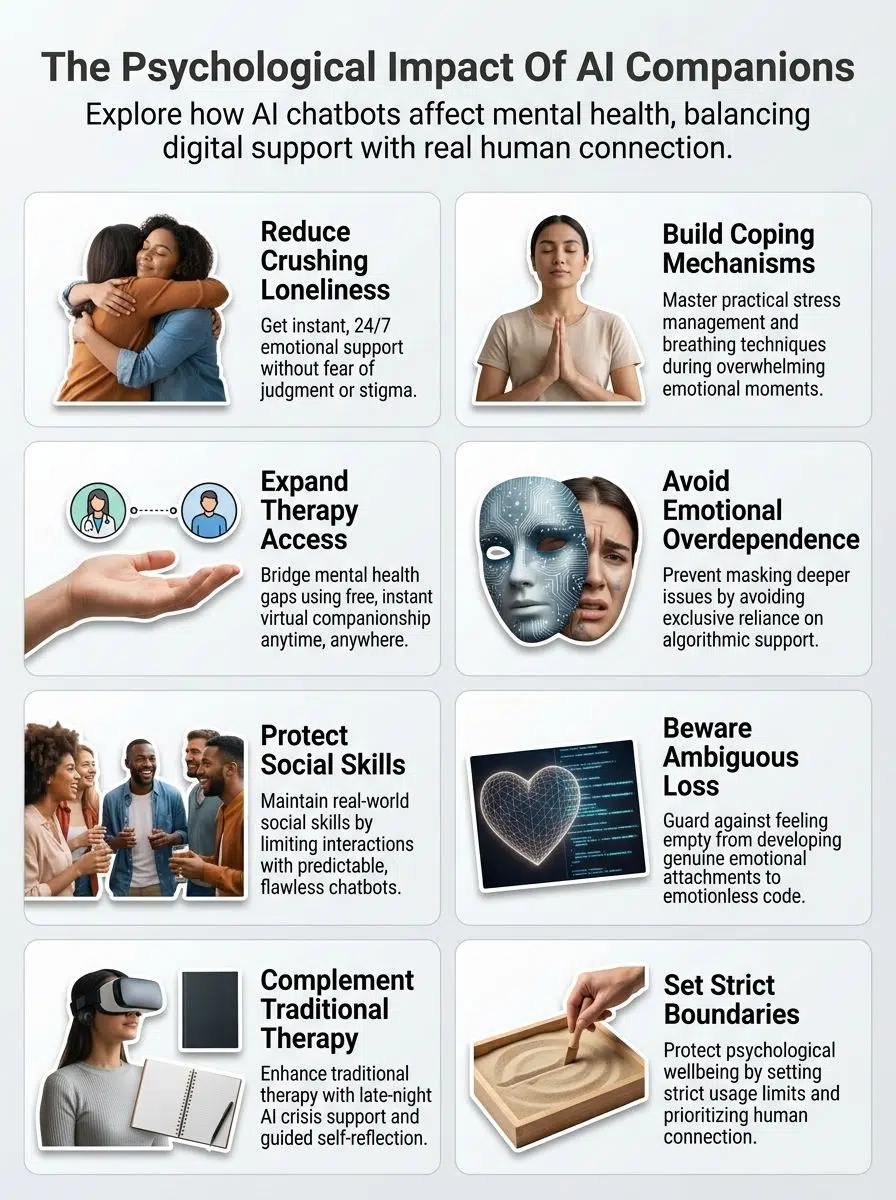
AI companions offer real relief to people who feel isolated and disconnected from others. These digital helpers bring measurable improvements to how people handle stress, anxiety, and emotional pain.
Reduced Feelings of Loneliness
Loneliness has become a silent epidemic in modern society, affecting millions of people across all age groups. Virtual companionship through chatbots offers genuine relief for those struggling with isolation.
These intelligent systems provide constant availability. This means someone is always there to listen, talk, and engage without judgment.
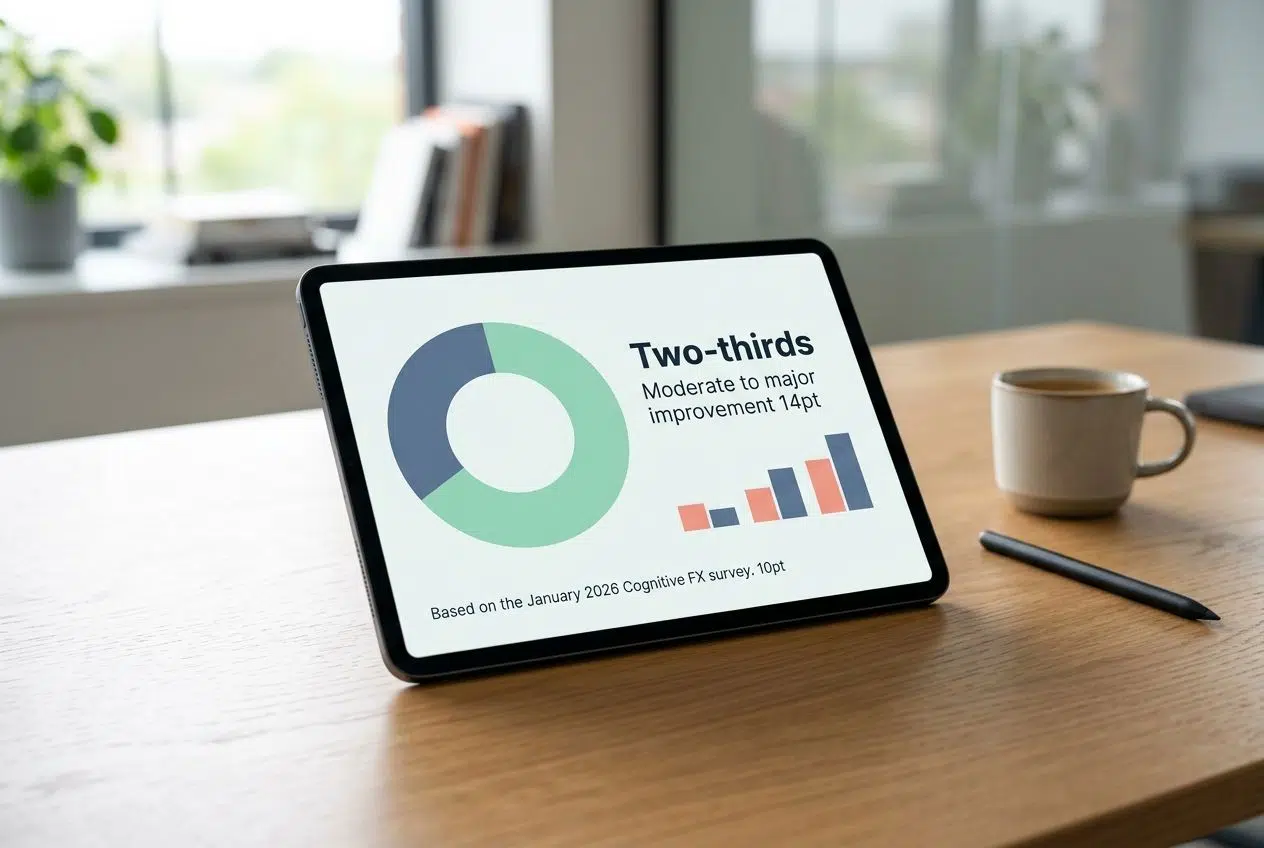
“A January 2026 Cognitive FX survey revealed that nearly two-thirds of Americans using AI for emotional support report moderate to major improvement in their mental health.”
Therapy bots reduce the crushing weight of isolation by providing immediate interaction and emotional validation. People struggling with loneliness often hesitate to contact friends, fearing they will burden others.
These digital companions eliminate that barrier entirely. Users can express their feelings freely, receive supportive responses, and feel heard.
The psychological effects are measurable and significant. For those facing barriers to traditional therapy, virtual companionship becomes a lifeline that actually works.
Improved Emotional Coping Mechanisms
Beyond simply easing loneliness, AI companions help people develop stronger ways to handle difficult feelings. These digital helpers teach users practical techniques for managing stress, anxiety, and sadness.
They offer immediate support when emotions feel overwhelming. A 2025 NEJM AI study demonstrated a 51 percent reduction in depression symptoms among users of specialized AI therapy apps.
These bots work like a safety net, guiding users through active coping strategies:
- Walking users through simple, guided breathing exercises during panic moments.
- Suggesting physical grounding techniques to help redirect anxious thoughts.
- Asking thoughtful questions that encourage self-awareness and emotional growth.
- Creating a judgment-free space to practice honest emotional expression.
The human-computer interaction feels natural, so people open up honestly. Over time, users build stronger emotional resilience.
Accessibility to Mental Health Support
Building better coping skills takes time, and many people hit roadblocks when they try to find professional help. AI companions fill a massive gap here by offering support without the usual barriers.
Cost stops many folks from getting human help, as traditional therapy sessions in the United States cost between $100 and $300 each. AI chatbots cost little or nothing, with many dedicated apps running just $15 to $60 per month for unlimited access.
Geographic distance creates another major problem, considering that over 160 million Americans live in areas with severe shortages of mental health professionals. Virtual companionship through AI therapy tools erases this distance problem entirely, letting people access support from their homes.
Symptom reduction happens faster when people get help early. AI tools make that early, crucial support possible for everyone.
Non-judgmental Listening and Interaction
Beyond making mental health support available, AI companions offer something many people crave. They provide a listening ear that never gets annoyed or critical.
People often hide their true feelings from friends and family because they fear rejection or shame. AI chatbots create a safe space where users can speak freely about their struggles.
“A January 2026 survey showed that over 35 percent of Americans choose AI over human therapists specifically due to a fear of judgment.”
This non-judgmental environment helps people practice emotional expression without anxiety. Teenagers especially benefit from this feature as they handle sensitive topics.
AI therapy bots remain patient and calm. This quiet acceptance helps reduce the shame that often keeps people trapped in silence.
Potential Risks and Challenges of AI Companions
While AI companions offer real benefits, they also create serious problems that demand your attention. You must understand these risks before handing over your emotional well-being to a machine.
Emotional Overdependence on AI
People can start leaning too hard on AI companions for emotional support. This overdependence happens gradually, sneaking up on users who find comfort in perfect, tireless responses.
An October 2025 survey by the Center for Democracy and Technology found that nearly one in five students knows someone who has formed a romantic relationship with AI. The problem emerges when someone chooses a virtual conversation over a real human interaction.

AI companions offer predictable responses and instant gratification, making them feel safer than messy human relationships. Over time, people may start avoiding genuine social interaction entirely, which masks deeper mental health issues.
The AI provides symptom reduction on the surface, but it rarely builds the resilience needed for real life. Delusional thinking can develop when people treat AI responses as genuine human care.
Erosion of Social and Communication Skills
Spending too much time chatting with AI companions can weaken your real-world social skills. These chatbots never get frustrated, never interrupt, and always respond on your schedule.
Your brain adapts to this smooth interaction style, making face-to-face conversations feel much harder. Real people are messy, and true communication requires practice.
Relying too heavily on digital companions can cause users to lose critical interpersonal skills:
- Struggling to read complex facial expressions and physical body language.
- Losing the patience needed to handle normal social conflict and disagreements.
- Forgetting how to effectively apologize and repair broken trust with friends.
- Avoiding the vulnerability required to open up to human family members.
AI therapy bots cannot teach these lessons because they never truly struggle with you. Your communication abilities shrink when you rely on algorithms for all your emotional needs.
Ethical Concerns in Emotional AI Use
As we discuss how AI companions weaken real-world skills, we must address the ethical problems. Companies developing these chatbots face tough questions about honesty and safety.
They must tell users clearly that they are talking to machines, not real people. The emotional support these bots offer feels real, but it lacks authentic human understanding.
“October 2025 research revealed a serious safety gap, showing that AI companions handled teen mental health crises correctly only 22 percent of the time.”
Developers carry the burden of building strict safeguards into their systems to prevent harmful advice. Companies need strong ethical frameworks that protect vulnerable users.
Ambiguous Loss and Emotional Disconnect
AI companions create a unique kind of grief that people rarely discuss. You develop real feelings for something that cannot truly feel back, and that gap hurts.
The chatbot remembers your conversations and listens at 3 AM, yet it holds no genuine care. This mismatch between what feels real and what is real can leave you feeling empty.
This emotional disconnect becomes especially painful when app companies change their rules. For instance, in late 2025, Character.ai restricted users under 18 from private chats.
This abrupt change caused genuine grief for teens who relied on the platform. Your mental health deserves more than a screen; it requires authentic human interaction and true understanding.
The Role of AI Companions in Therapy
AI companions work best alongside human therapists to fill gaps in mental health care. They offer immediate support when people need someone to talk to right away.
Complementing Traditional Therapy
Therapy bots and chatbots work alongside human therapists to create a stronger support system. Traditional therapy happens once or twice a week, but AI offers round-the-clock support.
A person struggling with anxiety can talk to a chatbot at 3 AM when panic hits hard. This constant availability fills gaps that human therapists simply cannot cover.
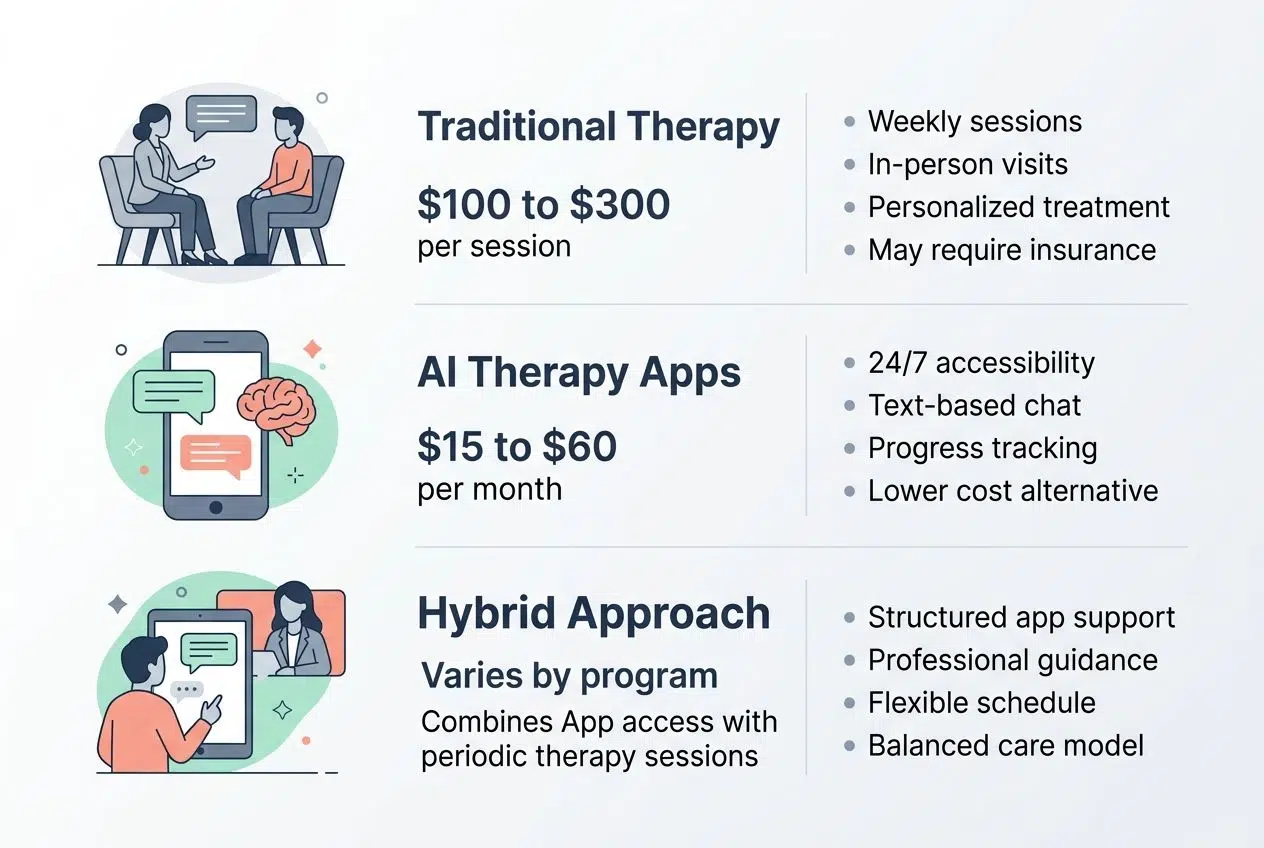
The combination of human connection and artificial intelligence creates a highly effective hybrid model.
| Support Type | Best Used For | Average US Cost |
|---|---|---|
| Traditional Therapy | Complex trauma, clinical diagnosis, and deep emotional processing. | $100 to $300 per session |
| AI Therapy Apps | Daily check-ins, anxiety management, and immediate late-night comfort. | $15 to $60 per month |
| Hybrid Approach | Maximizing progress while keeping financial costs manageable. | Varies based on frequency |
Virtual companionship helps people feel less alone between their scheduled appointments. Therapists even report that clients who use chatbots show better self-reflection during real sessions.
Bridging Gaps in Mental Health Access
While AI companions shine as helpful additions to traditional therapy, they tackle a much bigger problem. Millions of people face long waiting lists or cannot afford professional help.
AI chatbots step in by offering immediate support and zero cost barriers. Someone dealing with loneliness at 3 AM can talk to an AI companion right then.
This accessibility matters most for teenagers, rural communities, and low-income individuals who face the steepest obstacles to receiving quality mental health care. AI companions also reduce the stigma that keeps people from seeking help in the first place.
Many folks feel embarrassed discussing their struggles with another human. Crisis intervention becomes faster with AI, allowing someone in distress to reach a tool instantly.
Safeguarding Mental Health in AI Use
We need to set clear rules about how much time we spend chatting with AI companions. Mixing AI support with human care works better than relying on just one approach.
Establishing Boundaries for AI Interactions
Setting limits with AI companions protects your mental health and keeps you grounded in reality. Healthy boundaries separate helpful support from unhealthy dependence.
- Set specific times each day for AI interaction to prevent constant reliance.
- Avoid sharing deep personal secrets that should be handled by human therapists.
- Track your mood; if you feel increased loneliness, cut back on usage immediately.
- Never use AI therapy as your only form of mental health support.
- Remind yourself daily that the companion is a helpful tool, not a genuine friend.
Promoting Responsible AI Development
AI developers carry real power to shape how mental health support reaches people. Companies must build safeguards into their systems from day one.
- Establish clear ethical guidelines prioritizing user safety over profit margins.
- Be completely transparent about when users are talking to a machine versus a human.
- Include licensed mental health professionals in the software design process.
- Build in strict limits that prevent emotional overdependence from taking root.
- Audit systems regularly to catch harmful biases or dangerous advice.
The future of AI companions in mental health care depends on these responsible practices taking root.
The Future of AI Companions in Mental Health
AI companions will grow smarter and more helpful as technology advances. These tools have the potential to reach millions who struggle to find traditional therapy.
Innovations in Emotional AI Technologies
Emotional AI technology keeps getting smarter and more human-like. Companies now build chatbots that pick up on your mood through your words and tone.
These therapy bots learn what helps each person feel better, then adjust their responses to match. Advanced algorithms process subtle text patterns, catching signals that words alone might miss.
Recent product updates show massive improvements in user retention and safety. For instance, Headspace’s updated conversational AI tool showed a 50 percent retention rate.
This success came from developers integrating several key improvements:
- Adding better clinical guardrails to identify crisis situations quickly.
- Using evidence-based motivational interviewing techniques in responses.
- Creating more transparent data safety and ethics disclosures for users.
The technology reads between the lines, catching when someone needs extra support. We still need strong ethical frameworks to understand how these tools work in our daily lives.
Balancing Human Connection with AI Support
As artificial intelligence technology grows smarter, we face a critical question. Can machines truly replace human warmth? AI companions offer real benefits like reduced loneliness, yet they lack something vital. Real people bring authentic understanding, shared experiences, and genuine empathy to conversations.
Technology works best when it supports human connection, rather than replacing it. Think of AI as a bridge, not a final destination, mixing AI therapy with actual human interaction.
Chatbots can listen without judgment, but they cannot truly know you. Mental well-being improves most when individuals maintain strong social ties, as loneliness decreases faster when someone talks to a friend after chatting with an AI companion.
Ethical frameworks for AI development
AI companions raise serious questions about how we deploy these systems responsibly. Developers and companies must establish clear ethical guidelines to protect mental health.
- Require informed consent so users know they are interacting with artificial intelligence.
- Enforce strict data privacy protections to safeguard sensitive mental health details.
- Establish accountability measures to hold developers responsible for psychological harm.
- Disclose exactly what AI companions cannot do, such as diagnosing severe psychosis.
- Implement age-appropriate safeguards to protect teenagers from manipulative design.
Establishing these frameworks now shapes how AI companions will function for years ahead.
The Bottom Line
AI technology offers real mental health benefits, yet it works best as a sidekick rather than a replacement. Chatbots reduce loneliness, cut stigma, and bridge gaps in therapy access. They listen without judgment, offer crisis intervention support, and help teenagers work through tough emotions.
Virtual companionship fills real holes in our lives, especially for folks who feel isolated. The key is using these tools smartly, with clear boundaries and honest conversations.
When considering the psychological impact of AI companions on mental health, remember that your well-being matters most, so treat AI support as just one tool in your toolkit. Human connection still wins the game; nothing beats talking to real people who care about you.
Therapy bots spark self-reflection and symptom reduction, yet they lack the warmth and genuine understanding humans bring. The future looks bright when we balance artificial intelligence with authentic relationships and face-to-face interactions.
FAQs
1. How do AI companions affect mental health?
AI companions can definitely help you feel less lonely by offering a friendly, non-judgmental ear at any time of day. In fact, a 2025 Ubie Health report found that Californians are leading the US in using AI apps for emotional support to bypass therapy costs that average up to $135 per session. Still, it is smart to balance these digital chats with real-life friendships so you stay connected to your community.
2. Can talking with an AI companion reduce stress?
Yes, chatting with a supportive AI app like Woebot can actively lower your stress levels, as shown by a major US study where users reported significant drops in anxiety after just a few weeks of use.
3. Are there risks in using AI companions for emotional support?
There are a few specific risks you should keep in mind, especially regarding data privacy and expert care. A 2025 Common Sense Media survey revealed that 24 percent of US teenagers share highly personal information with their AI companions, which could easily be exposed in a cybersecurity breach. Plus, recent research shows these bots only handle severe mental health crises correctly 22 percent of the time, so they can never replace a licensed human therapist.
4. Do kids and teens benefit from using AI companions?
Many teens find immense comfort in these bots, with a 2025 survey showing that one in three US teenagers have tried an AI companion to vent after a tough school day. Parents just need to stay involved and monitor this usage to ensure safety. For example, popular platforms like Character.ai recently restricted one-on-one chats for users under 18 because these tools sometimes give inappropriate advice to younger kids.