A lot of firms can file a trademark. Far fewer can clear a brand in one market, map a Madrid filing across several more, handle an EUIPO opposition, respond to a USPTO office action, and keep the whole strategy tight enough that your portfolio still makes sense a year later. That’s why a list of global trademark law firms in 2026 matters right now. The market is busy. WIPO says Madrid filings for 2024 rose to about 65,000, with more than 915,000 international registrations in force. EUIPO said 2025 brought a record 327,735 new EU trade mark and design applications, while the USPTO reported more than 824,000 new classes filed in FY2025.
This roundup is not a beauty contest and it’s not based on ad spend. It’s a practical shortlist built from the latest public ranking signals and firm-side proof points: Chambers Global 2026, WTR 1000 2026, selective official firm announcements, and real indicators of cross-border trademark capability. WTR says its guide focuses exclusively on trademark practice, while Chambers says its global guide is built on in-depth independent research.
Why global trademark work feels more demanding in 2026
Filing volume is still high
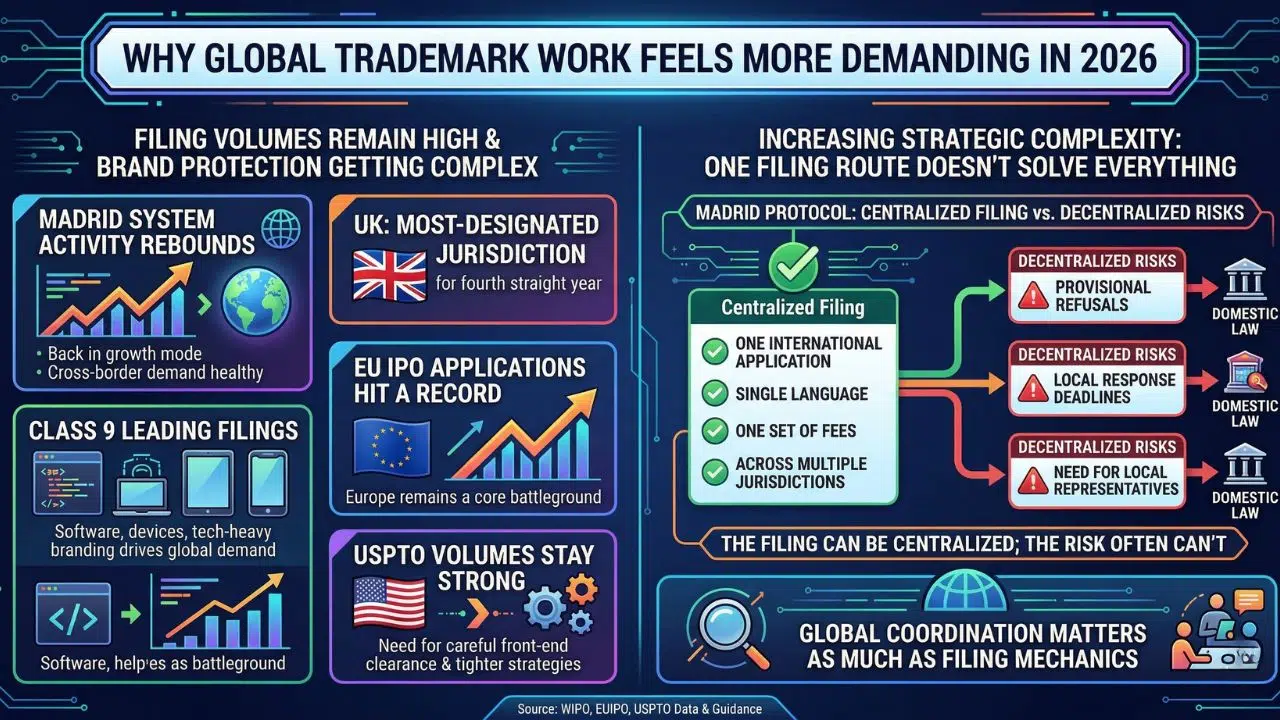
Brand protection is not getting simpler. Madrid activity is back in growth mode, the UK remained the most-designated jurisdiction in international applications for the fourth straight year, and Class 9 kept leading filings, which tells you software, devices, and tech-heavy branding still drive global demand. On the EU side, application volume hit a record in 2025. In the U.S., the USPTO improved speed and quality, but volumes stayed strong enough that businesses still need careful front-end clearance and tighter filing strategy.
One filing route doesn’t solve everything
Madrid is useful because it lets applicants file one international application, in one language, with one set of fees, across a big pool of jurisdictions. But WIPO is very clear about the catch: each designated office still decides protection under its own domestic law, and provisional refusals can trigger local response deadlines or local representative issues. In plain English, the filing can be centralized; the risk often can’t.
| 2026 market snapshot | What it tells brands |
| Madrid filings rebounded | Cross-border filing demand is still healthy |
| EUIPO hit a record application year | Europe remains a core filing battleground |
| USPTO volumes stayed strong | U.S. clearance and prosecution still need scale |
| Local law still controls outcomes | Global coordination matters as much as filing mechanics |
The table above is based on WIPO, EUIPO, and USPTO data and guidance.
How this list was built
The shortlist criteria
I weighted four things most heavily: multi-jurisdictional ranking strength, trademark-specific recognition, actual portfolio-management capability, and geographic reach. Chambers Global 2026 is the cleanest public signal for cross-border IP strength. WTR 1000 matters because it is trademark-only. Official firm materials then help fill in what rankings don’t always spell out: office network, prosecution depth, renewals, watch services, anti-counterfeiting, and whether the firm can actually run a portfolio day to day.
What I did not use
I did not rank firms by revenue, general prestige, or patent-heavy reputation alone. That would muddy the picture. A great patent shop is not automatically the best choice for cross-border trademarks. I also wouldn’t treat this list as a rigid “1 beats 2 beats 3” league table. Once you reach the top tier, fit matters a lot: luxury brands, SaaS companies, pharma groups, and consumer-goods multinationals often need different bench strengths.
| Ranking filter | Why it matters |
| Chambers Global 2026 | Best public signal for multi-jurisdictional IP depth |
| WTR 1000 2026 | Trademark-only recognition |
| Official capability pages | Shows whether the team really handles filings, renewals, oppositions, and enforcement |
| Global reach | Critical for coordinated brand protection |
This method leans on public rankings plus firm-level trademark evidence, not on marketing claims alone.
Top 10 global trademark law firms in 2026
Below is the working shortlist I’d trust first if I were hiring outside counsel for serious cross-border trademark registration and brand protection in 2026.
| Rank | Firm | Best known for | Best fit |
| 1 | Baker McKenzie | Global trademark coordination at scale | Multinationals and regional portfolio consolidation |
| 2 | Bird & Bird | Deep cross-border brand and enforcement bench | Europe-heavy and tech-led brands |
| 3 | Hogan Lovells | Massive active portfolio management and strategy depth | Complex global portfolios |
| 4 | DLA Piper | Very broad country coverage and outsourced portfolio support | Large consumer and enterprise portfolios |
| 5 | Jones Day | Full-spectrum global brand support | Cross-border disputes plus prosecution |
| 6 | Morrison Foerster | Premium trademark counseling with strong disputes bench | Tech, media, lifestyle, regulated sectors |
| 7 | Kilpatrick Townsend & Stockton | Elite trademark depth, especially in the U.S. | Brand-heavy companies that need firepower |
| 8 | Taylor Wessing | Strong European brand practice | Fashion, luxury, media, and digital brands |
| 9 | CMS | Large trademark team across many jurisdictions | Mid-market to large international filers |
| 10 | A&O Shearman | Full-service trademark portfolio management inside a global platform | Corporates that want one firm across wider legal needs |
This comparison draws from Chambers Global 2026, WTR 1000 2026, and official firm materials.
1) Baker McKenzie
Baker McKenzie gets the top spot because it has both the ranking strength and the trademark footprint to back it up. Chambers Global 2026 places it in Band 1 for Global: Multi-Jurisdictional IP and specifically highlights trademark registration, enforcement, and brand management. Baker’s own 2026 WTR announcement says the firm was recommended for international trademark work globally and recorded 50 local practice rankings across 36 jurisdictions, which is hard to ignore if you need one coordinator across a big portfolio.
Positives:
Baker McKenzie is one of the strongest all-round choices for multinational trademark work. Chambers places it in Band 1 for global multi-jurisdictional IP, and Baker says it has 300+ dedicated IP professionals plus deep portfolio-management capability for large brand owners. That makes it especially strong for companies that want one firm to centralize registration, maintenance, and enforcement across many markets.
Negatives:
Because Baker positions itself around large, complex, international portfolios, it may feel heavier than necessary for a startup or a business filing in only a few countries. In practical terms, it looks best suited to brands that actually need cross-border coordination at scale, not just a few low-cost filings.
2) Bird & Bird
Bird & Bird is a serious pick for brands that live or die by European and cross-border trademark strategy. Chambers puts it in Band 1, pointing to multinational trademark prosecution, while the firm says it has 1,600+ lawyers across 33 offices. Its trademark practice pages lean hard into cross-border enforcement and organized portfolio management, and that lines up with how brand owners actually buy this work.
Positives:
Bird & Bird is a very strong pick for brands that need coordinated trademark support across Europe and beyond. Chambers places it in Band 1, and the firm says it offers trademark services across 26 offices and beyond, with a wider footprint of 33 offices globally. It is especially attractive for tech, digital, media, and consumer-facing brands that want sharp cross-border brand management.
Negatives:
Its network is global, but it still reads as more Europe-centered than some U.S.-anchored rivals. So if a buyer wants a team that feels primarily built around the U.S. market first, Bird & Bird may not be the most natural fit, even though it clearly handles international brand work well.
3) Hogan Lovells
Hogan Lovells stands out for scale and real portfolio data, not just glossy positioning. Chambers ranks it Band 1 globally for IP, and the firm says its trademark platform handled 150,400+ active trademark applications in 235 jurisdictions in 2024, backed by 230 design, trademark, and domain name professionals. That is the kind of operating depth that matters when your issue is not one filing, but ten years of portfolio hygiene.
Positives:
Hogan Lovells is a strong choice for companies that need a serious global platform with sophisticated trademark and IP counseling. Chambers ranks it Band 1, and the firm describes its IP team as market-leading, covering portfolio management, trademark monitoring, availability searches, enforcement, and litigation. Its comparative trademark tools and cross-jurisdictional resources also suggest real depth in international coordination.
Negatives:
Hogan Lovells looks best for clients with complex needs, especially in regulated or high-stakes sectors. That also means it may be more firm than some buyers need if the brief is mostly routine filing and maintenance rather than strategy-heavy global portfolio work.
4) DLA Piper
DLA Piper is a practical choice for companies that want very wide country coverage and a team used to acting as central coordinator. Chambers ranks it Band 2 for Global: Multi-Jurisdictional IP. DLA’s 2026 WTR release says 57 lawyers were ranked globally, and its trademark group says it manages trademarks in more than 150 countries, with some clients outsourcing their entire trademark function to the firm. That’s a big signal for registration-heavy portfolios.
Positives:
DLA Piper stands out for scale and operational coverage. Chambers ranks it Band 2 globally, and DLA says its lawyers manage trademarks in more than 150 countries, with some clients outsourcing their entire trademark function to the firm. That makes it a strong fit for large portfolios that need steady filing, renewals, reporting, and enforcement support in many jurisdictions.
Negatives:
Because DLA’s pitch is broad and operational, it may feel more like a large trademark-management platform than a boutique specialist team. For some companies, that is exactly the point. For others, especially founder-led brands that want a narrower senior team, it may feel more institutional than ideal.
5) Jones Day
Jones Day is one of the better fits when prosecution, portfolio advice, and disputes all have to work together. Chambers places it in Band 2. Jones Day’s 2026 WTR announcement says the firm and its lawyers were ranked in nine regional tables, and the firm describes its practice as covering domestic and global trademark portfolios, enforcement, and litigation. It also notes a 2,500-lawyer, 40-office, five-continent platform, which gives it genuine reach.
Positives:
Jones Day is a strong option for buyers who want prosecution, enforcement, and litigation to sit under one integrated platform. Chambers places it in Band 1, and Jones Day says its lawyers advise on domestic and global trademark portfolios with teams across the United States, Europe, Asia, and Australia. Its “One Firm” model is a real plus for clients that dislike fragmented local-counsel management.
Negatives:
Jones Day looks strongest when trademark work overlaps with broader disputes or wider business issues. If a company mainly wants a heavily process-driven trademark prosecution shop or a pure brand-protection boutique feel, some other firms on the list market that more directly.
6) Morrison Foerster
Morrison Foerster is not the broadest network on this list, but it is one of the sharper trademark choices for high-value brands. Chambers ranks MoFo Band 2 globally for IP, while the firm’s trademark page describes a Chambers Band 1 trademark practice covering clearance, registration, portfolio management, enforcement, and contentious matters. MoFo’s 2026 WTR notice also confirms recognition for both prosecution/strategy and enforcement/litigation in California, and the firm now has 19 offices globally.
Positives:
Morrison Foerster is a high-quality choice for strategic trademark counseling and contentious brand work. Chambers ranks it Band 2 globally, and MoFo describes its trademark team as a Chambers Band 1 trademark practice handling clearance, registration, portfolio management, and disputes. The firm also says it has represented nearly 1,000 companies in recent years, which points to strong practical experience.
Negatives:
MoFo has a strong international platform, but its footprint is still smaller than the biggest mega-firms, with 19 offices globally. So for a buyer that wants the broadest possible office network under one brand, Baker McKenzie, DLA Piper, or Bird & Bird may look more expansive.
7) Kilpatrick Townsend & Stockton
Kilpatrick is the specialist-heavy option on this list. It does not have Baker-style global breadth, but few firms can match its trademark depth. In its 2026 WTR release, Kilpatrick said it earned gold-level recognition for its U.S. national trademark practice, had 38 U.S. attorneys ranked, and was the only gold-level U.S. national firm ranked in China: Foreign. The firm also says it has 22 offices worldwide and serves clients across the U.S., Europe, and Asia.
Positives:
Kilpatrick is one of the clearest specialist-heavy trademark names on this list. The firm says it has more than 125 dedicated attorneys in trademark, copyright, and advertising, and more than 250 IP attorneys overall. That gives it serious depth for prosecution, counseling, and brand protection, especially for clients that value a firm with a strong trademark identity rather than a general full-service profile.
Negatives:
Kilpatrick has international capability, but its public footprint is still narrower than the very largest global firms, with work centered across the U.S., Europe, and Asia. For companies that want one mega-platform with very broad office coverage in more regions, it may not feel as wide as Baker, DLA, or Bird & Bird.
8) Taylor Wessing
Taylor Wessing is especially strong for brand-led businesses that care about Europe first and the rest of the world second. Chambers ranks it Band 3 globally, but its real draw is brand-side experience: the firm says its portfolio-management work helps clients build and protect brands worldwide, and it has rolled out an online brand protection tool for scaled enforcement. Its lawyers also show deep hands-on experience in portfolio management, anti-counterfeiting, and international enforcement.
Positives:
Taylor Wessing is a strong brand-side choice, especially for Europe-led trademark strategy. The firm highlights portfolio-management expertise and points to major global client work, including managing Orange’s portfolio of 4,500+ marks in 190+ jurisdictions. That makes it especially attractive for brand-rich sectors like consumer, media, lifestyle, and tech.
Negatives:
Taylor Wessing feels more Europe-first than some of the broader global generalists on this list. That is not a weakness in itself, but companies wanting a more U.S.-centric operating model or a giant all-services platform may lean toward other firms.
9) CMS
CMS is a strong choice for companies that want broad European strength with a lot of formalities and dispute capacity under one roof. Chambers ranks it Band 3 globally. CMS says it has more than 450 specialist lawyers, patent and trade mark attorneys, and scientists in 47 jurisdictions, and its trademark materials highlight global registrations, renewals, oppositions, and cross-jurisdictional disputes. It also says it handled the second largest number of UK Trade Mark hearings over the last three years.
Positives:
CMS is a solid choice for companies that care about portfolio operations as much as litigation. Its trademark materials emphasize audits, onboarding, renewals, recordals, oppositions, and broader portfolio management, and CMS says it can support clients through its network and partner firms in every jurisdiction. That makes it useful for businesses that want structured portfolio housekeeping, not just filings.
Negatives:
Because CMS relies on both its own network and partner firms across jurisdictions, the delivery model can be more distributed than a tighter single-team setup. Buyers should therefore check who will actually run day-to-day trademark work, especially if they want one small core team handling everything directly.
10) A&O Shearman
A&O Shearman makes this list because it offers the kind of one-firm model some corporates want: trademark work inside a much wider international legal platform. Chambers ranks it Band 3 globally. The firm says its trademark and design team handles everything from initial clearance and selection to filing, international portfolio management, enforcement, and disputes, and it does that with specialist administrators and trademark attorneys alongside IP lawyers. Its platform includes nearly 4,000 lawyers and specialists globally.
Positives:
A&O Shearman is a strong option for corporates that want trademark support inside a broader international legal platform. The firm says its trademark and design team handles everything from clearance and filing to complex international portfolio management, enforcement, and disputes, and it markets itself as a global firm equally fluent in U.S. law, English law, and other major markets.
Negatives:
A&O Shearman looks most attractive for larger companies that already value a full-service global firm. If the need is narrower — say, lean trademark prosecution, renewals, or a specialist boutique feel — the platform may be broader than necessary.
Which kind of firm fits which kind of company?
Startups and fast-growth brands
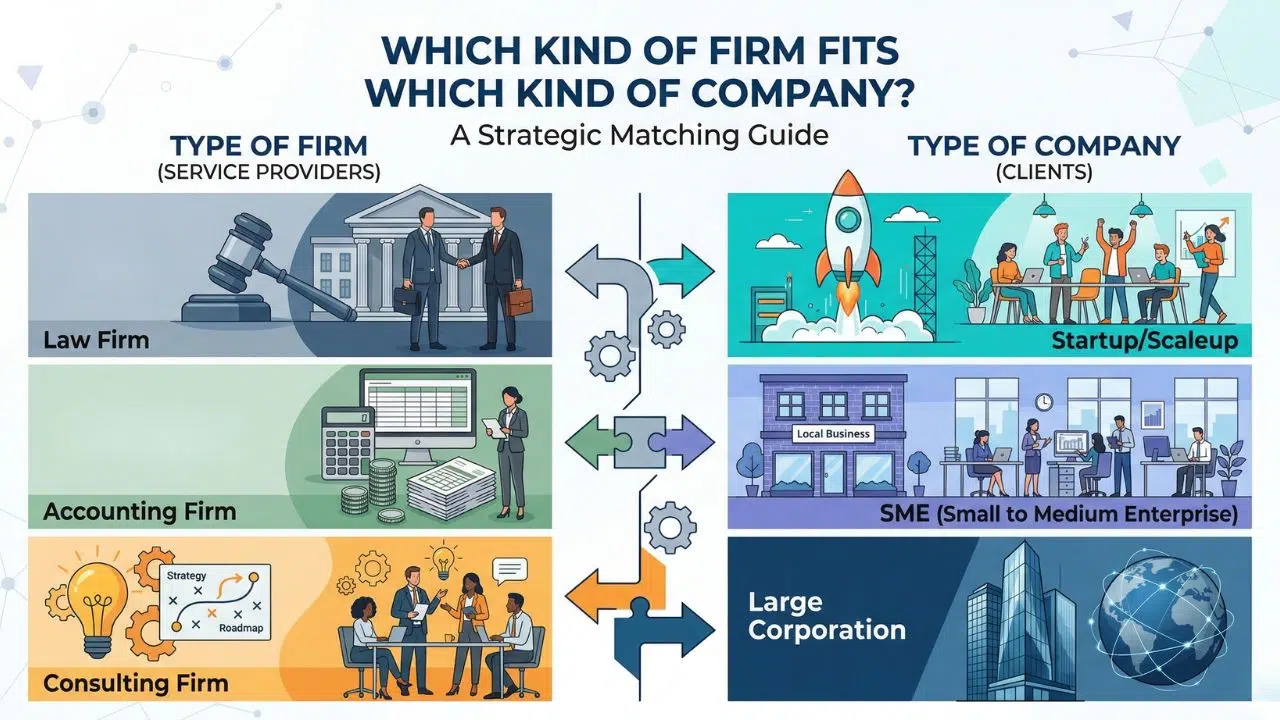
A startup usually does not need the biggest network on day one. It needs clean clearance, sensible filings, and a firm that won’t overbuild the portfolio. In that lane, a focused team like Kilpatrick, Taylor Wessing, or a leaner wing inside a bigger platform can make more sense than a sprawling global machine. The trick is choosing counsel that can grow with you once the brand starts entering more countries.
Mid-market exporters and regional brands
If you’re active across Europe, North America, and a few Asia-Pacific markets, the sweet spot is usually a firm that has both central coordination and strong local handoff. Bird & Bird, DLA Piper, CMS, and Jones Day look especially good here because their materials point to consistent cross-border management, not just isolated local filings.
Enterprise portfolios
Once you are managing dozens of marks, local counsel in many countries, renewals, watch notices, oppositions, and enforcement, scale becomes a feature rather than a luxury. Baker McKenzie, Hogan Lovells, and DLA Piper sit near the front of the queue because they pair ranking strength with proof that they can run large, long-cycle trademark portfolios.
| Business type | Best shortlist |
| Startup / early brand | Kilpatrick, Taylor Wessing |
| Mid-market international | Bird & Bird, CMS, Jones Day, DLA Piper |
| Enterprise / global portfolio | Baker McKenzie, Hogan Lovells, DLA Piper |
| Brand-led consumer business | Bird & Bird, Taylor Wessing, MoFo |
| Complex disputes + prosecution | Jones Day, Hogan Lovells, MoFo |
This fit table is an editorial judgment built from the firms’ public trademark capabilities and ranking signals.
Questions to ask before you hire a trademark firm
The short checklist
Before you sign an engagement letter, ask how the firm handles clearance, office actions, local counsel, renewals, customs, online enforcement, and reporting. A firm can be impressive in litigation and still be clunky on renewals. Another can be brilliant at filings but too thin on anti-counterfeiting. You want the operating model, not just the logo.
- How many jurisdictions can you coordinate directly?
- Who handles office-action responses and local counsel?
- Do you run renewals, watches, and audits in-house?
- Can you manage both prosecution and enforcement?
- What does reporting look like for a 50-plus mark portfolio?
- Do you have industry-specific experience in our class mix?
| Question | Why it matters |
| Can you centralize filings? | Saves time and reduces drift in strategy |
| Who owns renewal tracking? | Missed deadlines are expensive |
| How do you handle provisional refusals? | Madrid does not eliminate local law issues |
| Can you enforce online and offline? | Modern brand abuse is multi-channel |
| What sectors do you know best? | Class overlap and market practice matter |
WIPO’s own guidance shows why these questions matter: centralized filing is useful, but each designated office still applies local law and refusals can require specific local steps.
Final thoughts on global trademark law firms in 2026
The best global trademark law firms in 2026 are not just filing shops. They are coordination engines. They clear brands before launch, structure smarter filings, keep renewals from slipping, manage refusals, line up local counsel when needed, and make enforcement less chaotic than it usually is. That’s the real job.
If you want the safest all-round shortlist, start with Baker McKenzie, Bird & Bird, Hogan Lovells, and DLA Piper. If you want sharper specialist energy, look closely at Kilpatrick Townsend, Morrison Foerster, and Taylor Wessing. And if your business wants one wider corporate platform that can absorb trademark work alongside everything else, Jones Day, CMS, and A&O Shearman are credible names to keep in the room. That’s the practical takeaway from this 2026 market, and it’s the cleanest way to approach global trademark law firms in 2026 without getting lost in generic rankings.
FAQs about global trademark law firms in 2026
Can one Madrid filing replace a country-by-country trademark strategy?
No. Madrid is a smart filing and management tool, but it is not a magic pass. WIPO says each designated office still decides protection under its own domestic law, and provisional refusals can require jurisdiction-specific responses. For broad portfolios, the best firms use Madrid where it works and local national or regional filings where it doesn’t.
Is a Chambers rank or a WTR rank more useful for trademarks?
For pure trademark buying decisions, WTR usually tells you more because it is trademark-only. Chambers is still crucial because it shows broader multi-jurisdictional depth and cross-border execution. The smartest read is to use both together: Chambers for platform strength, WTR for trademark sharpness.
Do you still need local counsel if you hire a global coordinator?
Often, yes. Even firms with huge international networks still rely on local offices or trusted local firms where they do not have boots on the ground. Hogan Lovells says that directly on its locations page, and WIPO’s Madrid materials also point to local representative issues in designated jurisdictions.
When does a watch service become worth the money?
Usually earlier than founders think. CMS explicitly frames watch services as the start of an enforcement policy, because spotting conflicts early is cheaper than fighting a bigger dispute later. For brand owners with multiple marks or multiple markets, watch coverage is basic maintenance, not an add-on.
Should a company hire one global firm or separate local boutiques?
If you file in only one or two countries, local boutiques can be perfectly sensible. Once you start building in several markets, a central coordinator usually wins on consistency, renewals, reporting, and strategy. That’s exactly why the biggest firms on this list market portfolio management, outsourced trademark functions, and cross-border enforcement so heavily.