Sweden’s fiscal reputation is often one of punitive taxation, yet the reality for those living within the system is far more nuanced. For 2026, the Swedish government has introduced a series of reforms designed to “strengthen hard-working people’s finances,” focusing on individual empowerment and digital simplicity. Navigating this environment isn’t just about paying up; it’s about understanding the specific legal “hacks” and cultural philosophies that make a 32.38% average municipal tax rate feel not just tolerable, but logical.
This Sweden tax system 2026 guide uncovers the structural efficiencies that allow Swedes to maintain high disposable incomes despite the headlines.
Our Selection Methodology
To build this 2026 guide, we analyzed the Swedish Government’s 2026 Budget Bill, the latest circulars from Skatteverket (Swedish Tax Agency), and the new 3:12 reform legislation effective January 1, 2026. We cross-referenced these with the 2026 municipal tax data released by Statistics Sweden (SCB). Our selection focused on “hidden” thresholds and brand-new deductions—such as the Jobbpremie and the expanded ISK limits—that directly impact high-earners, digital nomads, and entrepreneurs who often overlook these nuances in standard tax summaries.
13 Things Most People Don’t Know About the Swedish Tax System
Living in Sweden requires a shift from “tax avoidance” to “tax optimization,” utilizing the government’s own incentives to shield wealth.
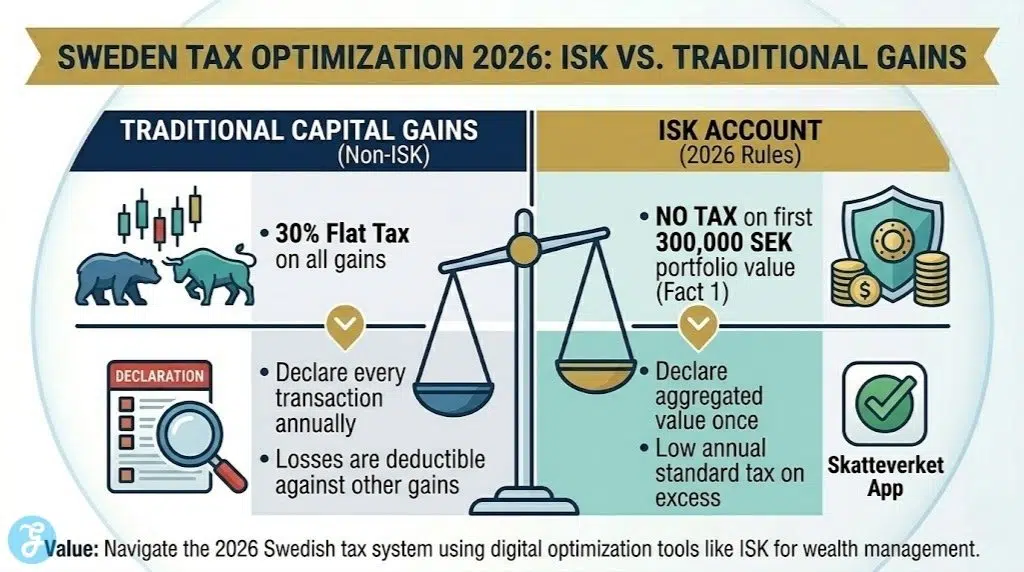
1. The ISK “Tax-Free” Threshold has Doubled to 300,000 SEK
The Investment Savings Account (ISK) remains the most powerful wealth-building tool in Sweden. For the 2026 income year, the government has officially increased the tax-free savings threshold.
-
Best for: Retail investors and families looking to grow a nest egg without capital gains complications.
-
Why We Chose It: This is a major 2026 shift that effectively turns Sweden into a tax haven for the first 300,000 SEK of your portfolio.
-
Things to consider: The tax is calculated as a lump sum on the total value; for any amount exceeding the 300,000 SEK threshold, you are still taxed at the standard (though low) ISK rate.
This reform is a direct attempt to boost household purchasing power in a recovering economy.
2. The 3:12 “Small Business” Reform is Now Unified
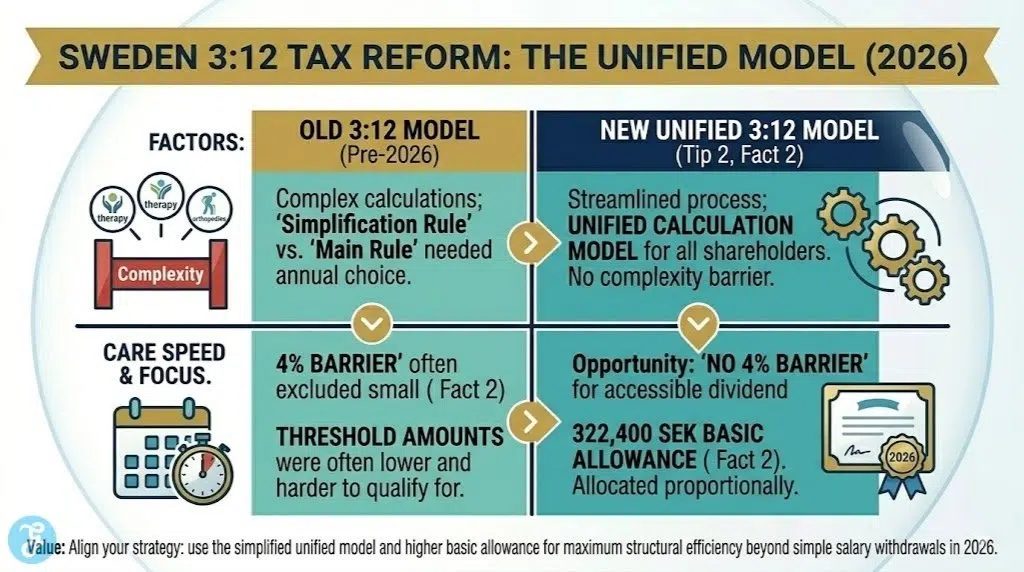
As of January 1, 2026, the complex “simplification rule” and “main rule” for closely held companies have been replaced by a unified calculation model.
-
Best for: Entrepreneurs and consultants who own their own Aktiebolag (AB).
-
Why We Chose It: The new model introduces a significantly higher basic allowance (threshold amount) of 322,400 SEK.
-
Things to consider: While simpler, you can only use a single threshold amount even if you own shares in multiple companies, allocated proportionally.
The 2026 rules remove the old “4% barrier,” allowing more shareholders to benefit from the lower 20% dividend tax rate.
3. The “Jobbpremie” (Job Bonus) is a 3,750 SEK Monthly Incentive
To combat social exclusion, the 2026 budget introduces a brand-new, tax-free job bonus for specific groups transitioning into the workforce.
-
Best for: Individuals re-entering the workforce after long-term unemployment or sickness.
-
Why We Chose It: It is a rare example of a “reverse tax,” where the government adds money directly to your pocket to encourage labor participation.
-
Things to consider: The bonus is capped at 3,750 SEK per month and is strictly linked to active employment income thresholds.
This incentive highlights Sweden’s 2026 “work-first” philosophy, prioritizing active income over passive benefits.
4. Expert Tax Relief Now Extends to 7 Years
For foreign specialists recruited to Sweden, the “Expert Tax” (Forskarskattenämnden) has been significantly improved.
-
Best for: High-earning international researchers, developers, and executives.
-
Why We Chose It: The 25% tax-free exemption previously lasted 5 years; for those arriving in 2026, it is now guaranteed for a full 7 years.
-
Things to consider: To qualify automatically based on salary, your monthly remuneration must exceed 88,801 SEK for the 2026 income year.
This extension makes Sweden one of the most competitive markets in Europe for high-level global talent.
5. ROT/RUT Deductions Have a New 75,000 SEK Combined Cap
The ROT (renovation) and RUT (domestic services) deductions allow Swedes to deduct a portion of labor costs directly from their invoices.
-
Best for: Homeowners and busy professionals who hire help for cleaning, gardening, or repairs.
-
Why We Chose It: While the ROT deduction has returned to 30% for 2026, the combined annual cap for an individual is a substantial 75,000 SEK.
-
Things to consider: The ROT portion specifically cannot exceed 50,000 SEK per year; the remaining 25,000 SEK can be used for RUT services like cleaning or laundry.
These deductions are applied at the source, meaning you only ever pay the net price to the service provider.
6. VAT on Food is Temporarily Slashed to 6%
In a move to lower the cost of living, the Swedish Parliament has proposed a temporary reduction in food VAT starting April 1, 2026.
-
Best for: Every household in Sweden managing rising grocery costs.
-
Why We Chose It: This is a rare broad-market tax cut that targets essential consumption rather than income.
-
Things to consider: The 6% rate is set to remain in effect until December 31, 2027, providing a two-year relief window.
This temporary measure is a cornerstone of the 2026 “Putting more money in people’s pockets” strategy.
7. Commuting Deductions Start at 15,000 SEK
If you travel a significant distance to work, you can deduct a portion of those costs from your taxable income.
-
Best for: Employees living in satellite towns or those with long daily commutes.
-
Why We Chose It: The threshold for 2026 has been raised to 15,000 SEK, meaning only costs exceeding this amount are deductible.
-
Things to consider: For car travel, the 2026 rate is 25 SEK per 10 km (or 9.50 SEK if using a company-provided EV).
Understanding these thresholds is vital for suburban dwellers who often underestimate their potential tax return.
8. SINK Tax for Non-Residents is Dropping to 22.5%
The Special Income Tax for Non-Residents (SINK) is being phased down to attract more short-term labor and cross-border commuters.
-
Best for: Digital nomads or contractors working in Sweden for less than six months.
-
Why We Chose It: The rate drops from 25% to 22.5% in 2026, with a further scheduled drop to 20% in 2027.
-
Things to consider: SINK is a flat tax with no deductions; sometimes opting for “Ordinary Taxation” instead can result in a lower bill if you have high deductible expenses.
The SINK reduction reflects a broader regional trend to compete with the lower-tax environments of neighboring Denmark and Norway.
9. Corporate Tax is Now a Flat 20%
Sweden has officially reduced its corporate income tax rate to 20% effective January 1, 2026.
-
Best for: International businesses looking for a Nordic base and local Aktiebolag owners.
-
Why We Chose It: This move puts Sweden below the European average, signaling that it is “open for business” despite its high personal tax reputation.
-
Things to consider: This 20% rate applies to the company’s profit before you decide how much to withdraw as salary or dividends.
Lower corporate taxes allow for greater reinvestment in R&D and employee growth.
10. Workplace EV Charging is Permanently Tax-Free
The temporary exemption for the benefit of charging an electric vehicle at work has been made permanent in 2026.
-
Best for: Employees with rechargeable vehicles provided by their employer or personal EVs charged on-site.
-
Why We Chose It: It removes a complex “fringe benefit” tax calculation that previously discouraged green commuting.
-
Things to consider: This exemption only applies to the charging cost; the vehicle itself may still incur a “Benefit-in-Kind” (BIK) tax.
This permanent change simplifies the transition to a fossil-free vehicle fleet for both employers and employees.
11. Interest Deductions are Now Limited to “Secured” Loans
A significant structural change for 2026 is the restriction of interest deductions on personal loans.
-
Best for: Individuals with significant mortgage or secured vehicle debt.
-
Why We Chose It: Previously, you could deduct 30% of interest on almost any loan; now, only loans with collateral (like a house) qualify.
-
Things to consider: If you have high-interest unsecured credit card debt or “payday” loans, you can no longer use tax deductions to soften the blow.
This shift encourages responsible borrowing and targets the deduction toward primary residence homeowners.
12. Dance Band Events Now Benefit from 6% VAT
In a quirk of cultural tax law, “dance band” events have been moved from the 25% VAT bracket to the lower 6% “cultural” bracket.
-
Best for: Cultural event organizers and the millions of Swedes who participate in social dancing.
-
Why We Chose It: It rights a long-standing “tax injustice” where concerts had 6% VAT but dance events (where music is the focus) had 25%.
-
Things to consider: This change takes effect on July 1, 2026, aiming to revitalize the local entertainment sector.
This niche reform is a classic example of how Sweden uses tax brackets to support specific cultural traditions.
13. Deductions for Donations from Companies are Back
For the first time in years, legal entities (companies) can receive a tax deduction for monetary donations to non-profit organizations.
-
Best for: Businesses with a strong CSR (Corporate Social Responsibility) focus.
-
Why We Chose It: It allows companies to deduct donations of up to 800,000 SEK per year to approved recipients in social assistance or research.
-
Things to consider: The donation must be at least 2,000 SEK at one time to qualify for the deduction.
This brings Sweden into alignment with many other Western nations that incentivize corporate philanthropy.
Strategic Analysis
The 2026 Swedish tax landscape is designed to reward “active participation” and “green choices.” The table below highlights how specific archetypes can optimize their 2026 filings.
| Archetype | Primary 2026 Benefit | Key Threshold to Monitor |
| The Entrepreneur | 3:12 Unified Reform | 322,400 SEK Basic Allowance |
| The Investor | Expanded ISK Limit | 300,000 SEK Tax-Free Zone |
| The Global Expert | 7-Year Relief Window | 88,801 SEK/Month Salary |
| The Commuter | Permanent EV Exemption | 15,000 SEK Deduction Floor |
Our Top 3 Picks And Why?
-
The ISK Threshold Increase: This is our top pick because it directly benefits the largest number of people. Turning the first 300,000 SEK of savings into a tax-free zone is a massive win for the middle class.
-
The 3:12 Unified Model: We chose this because it removes years of administrative “headache” for small business owners. Simplifying the dividend calculation is the most significant pro-business move in a decade.
-
The 7-Year Expert Tax Extension: This is a critical pick for Sweden’s future. Extending the relief period makes Sweden a vastly more attractive destination for the high-level engineers and researchers needed to power the green transition.
Preparation Checklist
-
[ ] Log into the Skatteverket e-service and ensure your ISK accounts are correctly categorized to utilize the 300,000 SEK threshold.
-
[ ] If you are an AB owner, meet with your accountant to map out your dividend strategy under the new 2026 3:12 basic allowance.
-
[ ] Audit your 2026 loans; prioritize paying off unsecured debt first, as the interest is no longer deductible.
-
[ ] Keep digital receipts for all RUT services (cleaning, laundry) to ensure you don’t exceed the 75,000 SEK combined cap.
-
[ ] For high-earners arriving after March 2026, confirm with your HR department that your “Expert Tax” application covers the full 7-year period.
-
[ ] If commuting, start a log of your mileage—the 15,000 SEK floor is high, so every kilometer counts.
The New Era of Swedish Fiscal Empowerment
Navigating the Sweden tax system 2026 guide reveals a country that is slowly moving away from the “one-size-fits-all” high-tax model of the past. By introducing targeted reliefs for investors, entrepreneurs, and green commuters, the Swedish government is attempting to balance its legendary social safety net with modern economic incentives. The 2026 reforms prove that “high tax” does not have to mean “low efficiency.” For those who know which forms to file and which thresholds to watch, Sweden in 2026 offers a surprisingly robust environment for building and protecting personal wealth.
FAQs
-
Is the 300,000 SEK ISK limit per person or per account? It is per person. You can have multiple ISK accounts, but the tax-free benefit is applied to your total aggregated holdings.
-
Does the ROT deduction apply to materials? No, ROT and RUT deductions apply strictly to the labor cost of the service, not the materials or travel expenses.
-
Can I apply for Expert Tax myself? Yes, both the employer and the employee can apply, but it must reach the Taxation of Research Workers Board within three months of starting work.