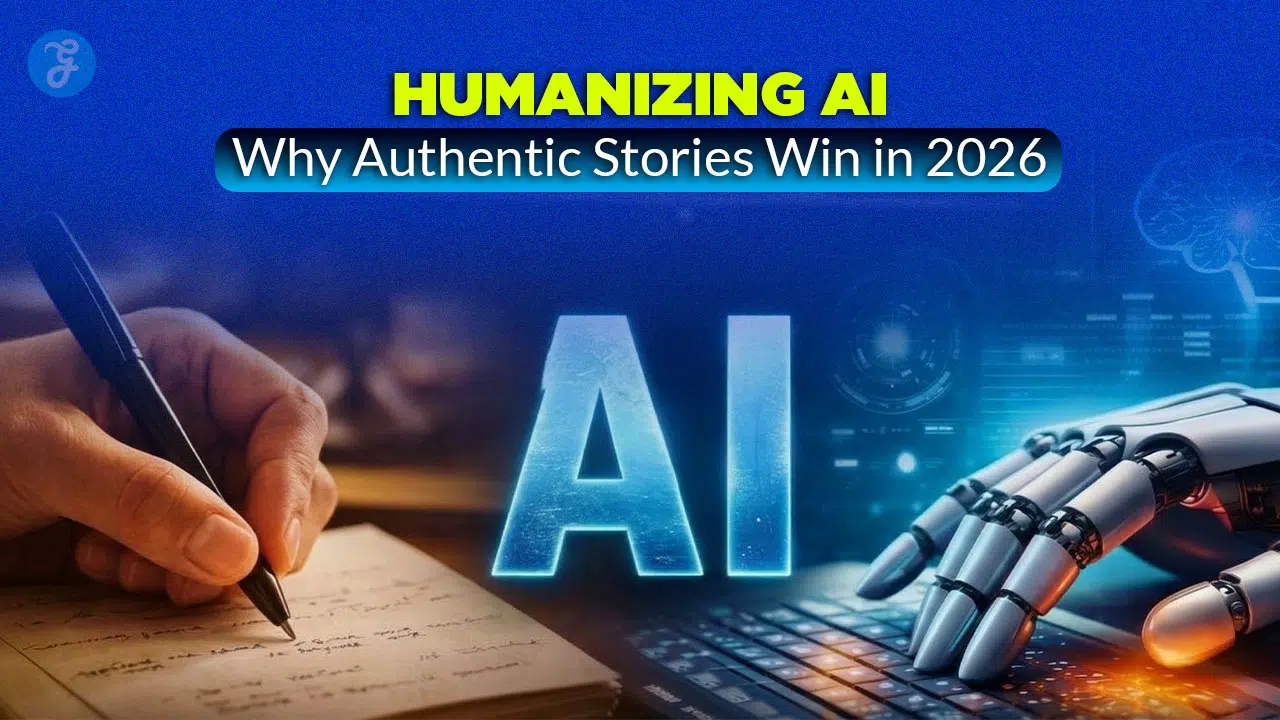
We have officially automated the soul out of the internet. By handing our brand voices over to generative AI, we’ve built a digital echo chamber where everything is perfectly optimised and entirely ignored. If you want to survive 2026, empathy is no longer just a soft skill; it is your only technical advantage.
The turning point did not happen quietly. When the major search engines rolled out their “Organic Authenticity” core updates earlier this spring, the digital marketing world watched in horror as millions of synthetic, AI-generated pages were de-indexed overnight. We spent the last three years treating our audiences like data points to be manipulated by predictive text models. We chased algorithmic supremacy, sacrificing our unique perspectives at the altar of search visibility. Now, the algorithms have evolved, and they are hunting for the one thing a server farm cannot generate: genuine human conviction.
The Human Impact of the Great Flattening
We arrived at this digital wasteland through a series of cold, logical steps that ultimately led to a creative dead end. When AI-driven content generation became the baseline industry standard in 2024, every brand, from multinational banks to local bakeries, began sounding exactly the same. We entered a period I call “The Great Flattening.” In this environment, blog posts, social captions, and email campaigns became indistinguishable blocks of text. We built a highly visible internet that is completely forgettable.
This relentless flood of synthetic content has induced severe automation fatigue among the general public. Consumers have developed a finely tuned sixth sense for prompt-engineered templates. When a reader clicks a link and senses the hollow rhythm of a machine, they bounce immediately. They are no longer looking for an aggregation of facts; they are desperately searching for a lived experience. They want to know that a real person, with actual skin in the game, sits behind the screen.
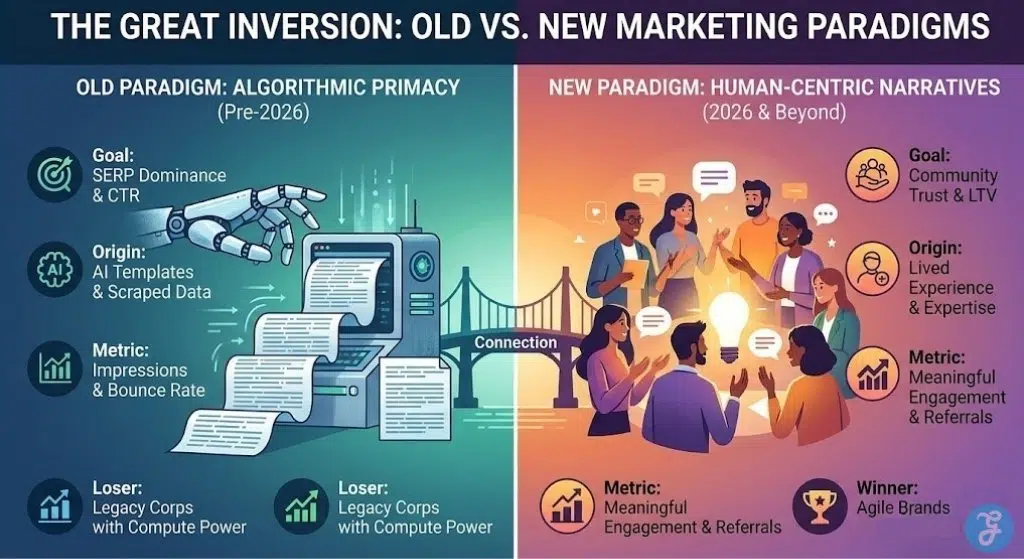
This profound shift in consumer behaviour necessitates a hard look at who is actually succeeding in this new environment. The old rules of engagement have been completely inverted. The following data outlines the stark divide between those clinging to outdated automation and those pioneering a new way forward.
| The Status Quo: Algorithmic Primacy | The 2026 Reality: Human-Centric Narratives |
| Primary Objective: SERP dominance, keyword stuffing, and high initial click-through rates. | Primary Objective: Deep community trust, brand advocacy, and long-term customer value. |
| Content Origin: Predictive text models, scraped competitor data, and prompt-engineered templates. | Content Origin: First-person lived experience, subject matter expertise, and expert intuition. |
| Core Success Metric: Raw impressions, bounce rates, and immediate session duration. | Core Success Metric: “Meaningful Engagement” thresholds and organic peer-to-peer referral loops. |
| The Losers: Large legacy corporations relying entirely on massive compute power to flood channels. | The Winners: Agile brands with authentic founders, clear missions, and a transparent operational ethos. |
Recognising this divide is the first step, but we must also address the severe financial penalties waiting for brands that refuse to adapt.
The Economic Cost of Algorithmic Obedience
The financial bleeding has already started for companies that continue to push generic, machine-written drivel. The most glaring symptom of this disease is the skyrocketing Customer Acquisition Cost (CAC). In a market where nobody clicks on anything that feels like spam, buying attention has become astronomically expensive.
When you strip the human narrative out of your marketing, you are left competing solely on price and convenience. You commoditise your own brand. If your content cannot build an emotional bridge to the consumer, your paid ads must work ten times harder just to secure a single conversion. We are no longer competing for mere visibility; we are fighting a brutal war for the endorsement of the individual.
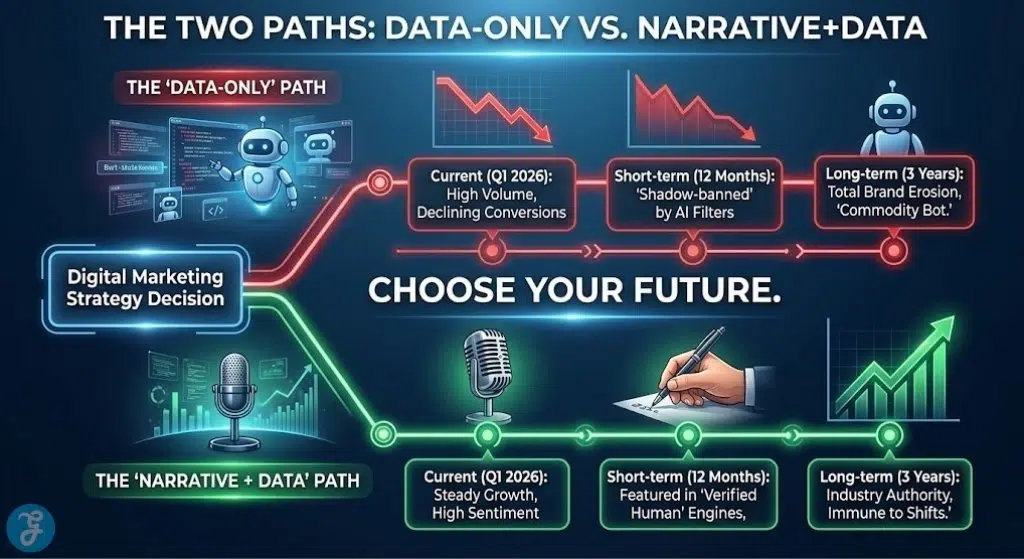
To visualise the financial trajectory of this misstep, consider the compounding losses over the next few years if you stay the course versus adopting a human-centric approach.
| Timeframe | The “Data-Only” Path | The “Narrative + Data” Path |
| Current (Q1 2026) | High initial publication volume masking rapidly declining conversion rates and poor lead quality. | Steady, deliberate audience growth supported by exceptionally high community sentiment and trust. |
| Short-term (12 Months) | Content increasingly “shadow-banned” by new AI-detection filters; plummeting organic traffic. | Frequently featured in “Verified Human” discovery engines; strong inbound marketing momentum. |
| Long-term (3 Years) | Total brand erosion; the company is viewed as a “commodity bot” with zero customer loyalty. | Cemented industry authority; a loyal community base that is entirely immune to sudden algorithmic shifts. |
Despite these glaring economic warnings, many boardrooms still fiercely defend their automated strategies. It is time we confront their primary justification.
The Counter-Punch: Why “Efficiency First” is a Terminal Disease
The strongest argument echoing in the halls of corporate marketing departments right now is the siren song of total efficiency. The logic dictates: “Why pay a senior copywriter or a creative director a premium salary when an advanced model can draft a comprehensive campaign in three seconds?” It sounds like flawless fiduciary responsibility.
Here is why that argument completely collapses under the weight of 2026 market data. Efficiency is only profitable if the end product holds value. Generating ten thousand blog posts an hour is a net negative if those posts actively degrade your brand equity and trigger spam filters. The “efficiency first” advocates entirely ignore the economic cost of boredom. Current analytics show that brands relying exclusively on generative output have seen their brand recall drop by 47% over the last two quarters. You are saving pennies on content production while burning millions in lost market share and severed consumer trust. The machine can write the words, but it cannot care about the outcome. And if you do not care, your customer certainly will not.
This lack of care extends beyond simple profit and loss; it touches upon global shifts in how information is governed.
The Geopolitical Stakes of Data Pollution
We must also zoom out and recognise that human-centric digital marketing is becoming a matter of international compliance and data sovereignty. Different regions are aggressively legislating how digital identities and automated content intersect.
The internet is fracturing along lines of trust. In markets that prioritise the human element and mandate transparency, consumer confidence remains stable. In markets that allow unchecked, unlabelled synthetic media to run rampant, institutional trust is cratering. Brands operating globally must navigate these disparate regulatory environments, meaning a human-first approach is not just good marketing—it is global legal insulation.
Let us look at how different entities are managing this exact crisis across the globe.
| Entity/Region | Primary Strategy Approach | 2026 Consumer Trust Rating |
| EU Tech Startups | Strict adherence to “Human-in-the-loop” transparency mandates; clear labelling of all AI assistance. | High (Viewed as leaders in ethical data practices and digital trust). |
| US Legacy Retail | Heavy, unregulated reliance on GenAI for product descriptions and customer service chatbots. | Low (Experiencing rapidly declining brand loyalty and high churn rates). |
| Direct-to-Consumer (DTC) | Founder-led, “unfiltered” video storytelling and raw, behind-the-scenes documentation. | Very High (Enjoying the highest conversion rates and community advocacy). |
The numbers supporting this shift away from automation are stark and undeniable. To put the current landscape into perspective, we must look at the hard data driving consumer behaviour right now.
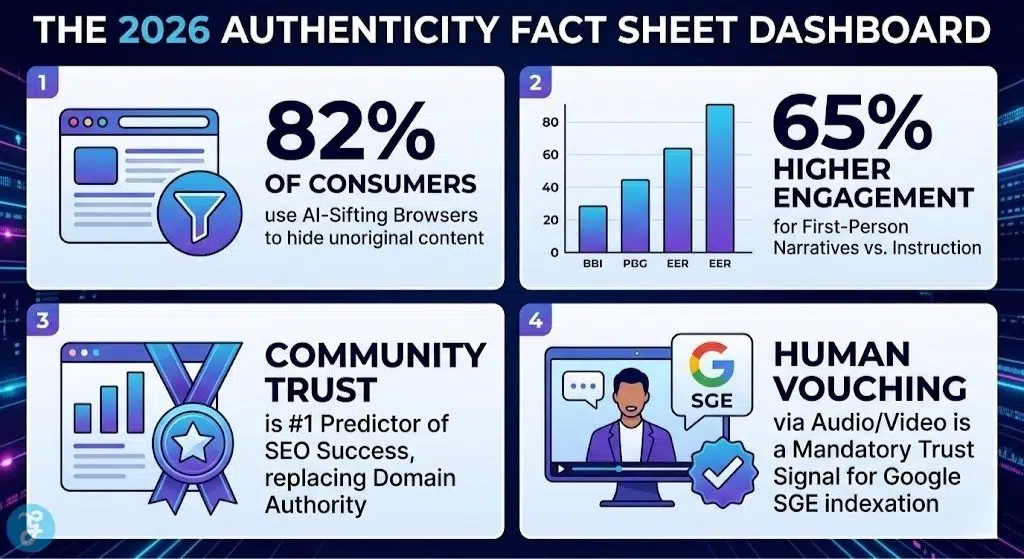
The 2026 Authenticity Fact Sheet
• 82% of consumers actively utilise “AI-Sifting” browser extensions that automatically hide or flag content registering a low human originality score.
• First-person narratives and opinion-led pieces currently see a 65% higher organic engagement rate than third-person, instructional summary content.
• Verified Community Trust has officially replaced technical “Domain Authority” as the absolute highest predictor of long-term search engine ranking success.
• Human Vouching—where a real, verifiable person speaks directly to the camera in embedded media—is now a mandatory trust signal required for indexation in Google’s Search Generative Experience (SGE).
Knowing the data is one thing; executing a recovery plan is another. Here is how we drag our brands back to reality.
The Practical Solution: A Roadmap for Humanising the Machine
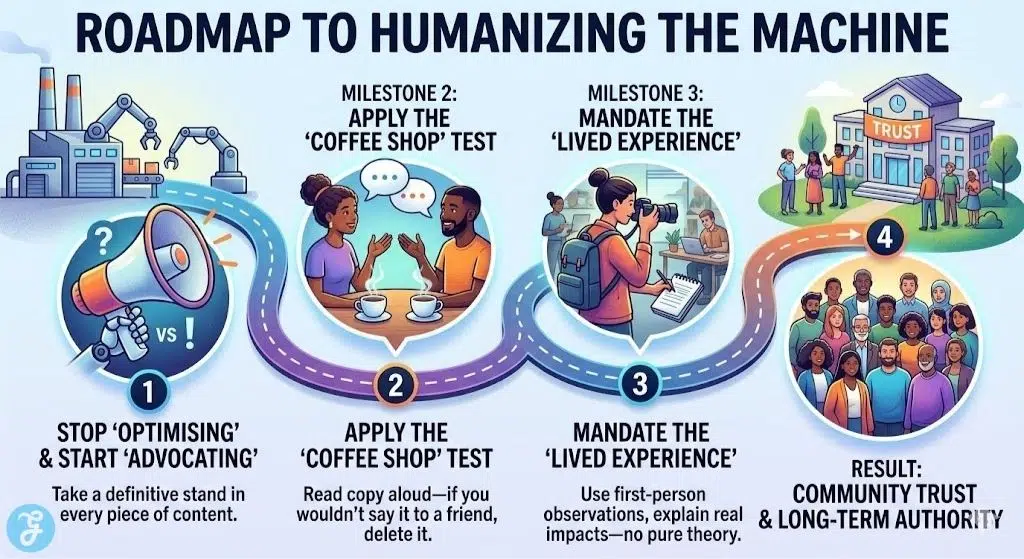
We do not need to smash the servers or abandon our analytics platforms. We need to put data back in its rightful place: as the skeleton of our strategy, not the skin. To reclaim your narrative and build actual community trust, you must implement the following structural changes immediately.
First, stop optimising and start advocating. Every piece of content your brand publishes from this day forward must take a definitive stand. If your latest industry report does not contain an opinion that a reasonable person could disagree with, it is a waste of server space. Second, subject all outgoing copy to the “Coffee Shop Test.” Read your newsletters and landing pages aloud. If you would not speak those words to a trusted friend over a cup of coffee, delete them. Words like “utilise,” “synergise,” and “leverage” are the dialect of machines, not humans. Finally, mandate the lived experience. Forbid your teams from writing purely theoretical advice. Do not just state that a market trend is occurring; explain exactly how that trend physically impacted your team, your clients, or your revenue last week.
As we look toward the immediate future, the divide between authentic and synthetic will only widen.
The Horizon Ahead: What Happens When the Code Breaks
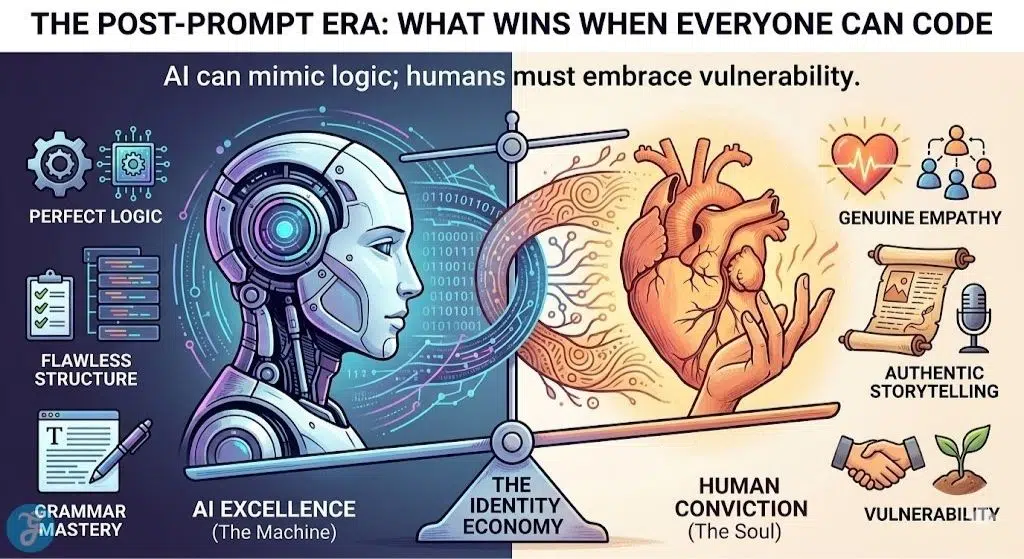
Over the next 12 to 18 months, the digital landscape will fully transition into the “Identity Economy.” As artificial intelligence inevitably becomes flawless at mimicking logic, structure, and grammar, it will remain fundamentally incapable of mimicking vulnerability. The brands that survive this transition will be the ones courageous enough to show their cracks. They will highlight their mistakes, document their painful pivots, and showcase the messy, human reality that an algorithm would automatically filter out.
The era of hiding behind a perfect, corporate veneer is over. The question you must ask your executive team tomorrow morning is this: Are we building an encyclopaedia for web crawlers, or are we building a community for human beings?