

Have you ever wanted your website to show up for people in different countries, but the wrong language keeps popping up? Maybe visitors from France land on your English page, or users in Mexico see content meant for Spain. This mix-up can send users right back to Google, and you lose out. That is why we are exploring International SEO: Hreflang Tags Demystified. Here is a simple fix I love: Hreflang Tags. They tell search engines which page matches each visitor’s language and region. If you set them correctly, Google knows what page of your site should show in every country.
This blog breaks down how Hreflang Tags work in international SEO. I will show you simple steps you can use today. You will learn why they matter, common mistakes to avoid, and easy ways to make sense of it all.
So, grab a cup of coffee, and let’s go through it together. I will show you everything you need to know to get more clicks from across the globe!
International SEO: Hreflang Tags Demystified
Hreflang tags act like signposts for search engines. They point out the exact language and region of a page. They help your site speak to people in their own words, wherever they live.
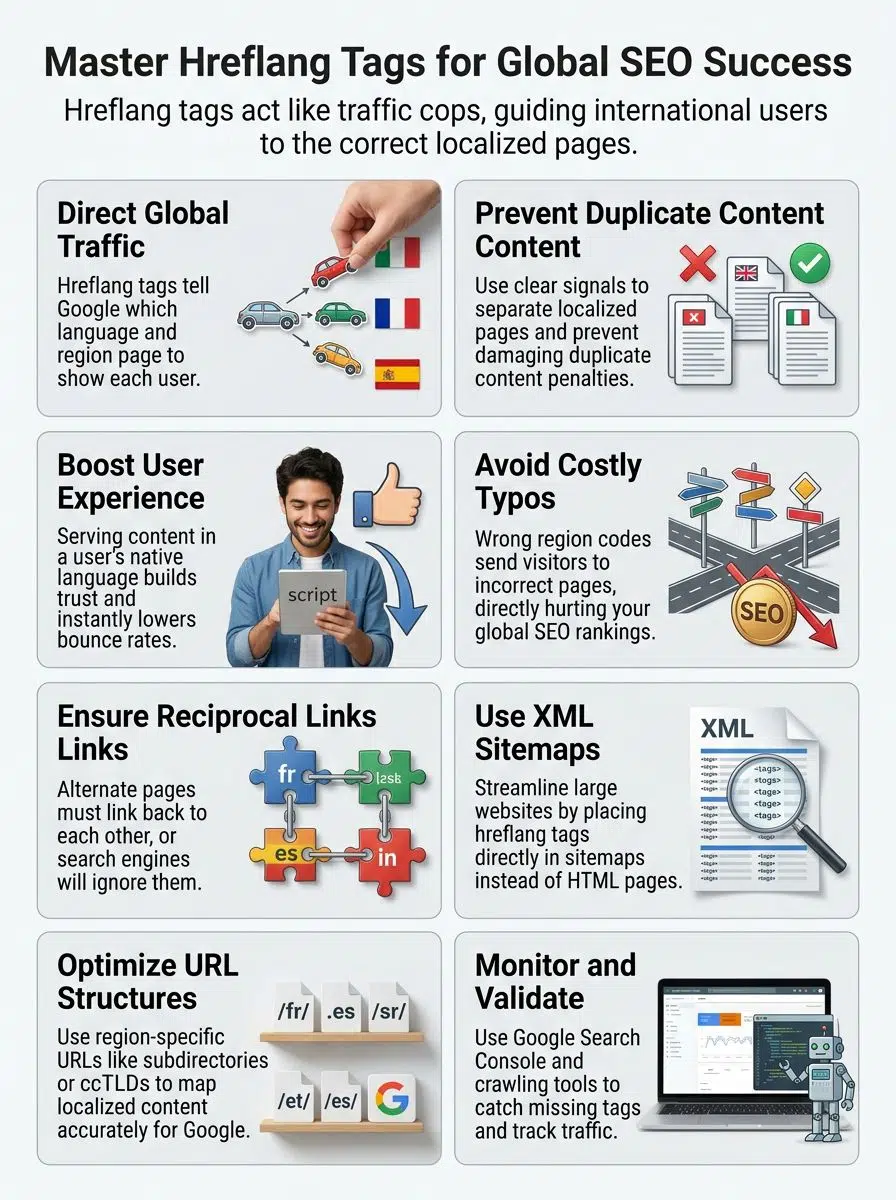
Hreflang tags act like friendly signposts for search engines. They tell Google which language and region each page is meant for. Think of them as traffic cops steering users to the most suitable content based on what they speak or where they live.
If a website serves both English speakers in the US and Spanish speakers in Spain, hreflang attributes help search engines show the right version. Websites use these small bits of HTML markup to support multilingual SEO strategies, avoid mix-ups, and meet search engine guidelines.
John Mueller, a Search Advocate at Google, often highlights that setting these tags correctly is one of the most complex parts of technical SEO. In fact, a 2025 study by Ahrefs found that 67% of websites attempting to use them actually contain errors. This little tag saves a lot of headaches with duplicate pages by telling Google which audience should see what content.
Speak your visitor’s language before you speak their mind; that’s good international SEO.
Importance in international SEO
After learning the definition and purpose of hreflang tags, it is clear how vital they are for international SEO. Search engines like Google use these tags to show the right language or regional page to each visitor. For example, a user in France searching on Google will see your French content if you use hreflang attributes correctly.
Pages aimed at multiple countries without proper language targeting can confuse search engines. This sometimes leads to duplicate content issues, which may hurt website rankings. Brands using good localization strategies and HTML markup boost their site’s SERP visibility across borders.
Here is why getting this right is so powerful for your website:
- Traffic Increases: A 2025 industry report from SEOClarity found that proper implementation can result in a 20% to 300% lift in organic traffic for targeted regions.
- Brand Protection: Major brands like Nike rely on these tags to keep their US English store separate from their UK English store.
- Clear Navigation: Think of it as handing out maps so all visitors end up at the right spot on your multilingual websites.
Small changes like using correct hreflang values drive big results in global SEO optimization and user experience.
How Do Hreflang Tags Work?
Hreflang tags act like road signs for search engines, pointing them to the right language page. They help your website show up in front of people who speak different languages or live in other places.
Language and regional targeting
Search engines use hreflang attributes to serve the right webpage language and region to each user. For example, a French speaker in Canada should get your French-Canadian page, not the one from France.
Small code snippets tell Google which version matches a user’s settings or location. The difference between en-US and en-gb may seem tiny to us, but it matters for search engine optimization. Regional targeting helps websites speak directly to people in different countries.
English pages made for Americans look and sound different than those written for Australians or Brits, even if both use English. To do this right, you must use specific formatting codes. Always use the ISO 639-1 format for your language code and the ISO 3166-1 Alpha 2 format for your country code.
A frequent mistake webmasters make in the US is using “en-UK” instead of the officially required “en-GB” for British visitors. Hreflang tags guide search engines so users land on content meant just for them. This makes visiting your website feel like coming home instead of getting lost at sea.
Indicating alternate versions of a webpage
After setting up language and regional targeting, it is time to show search engines which web pages match each version. Hreflang attributes act like little signposts in your HTML markup.
These tags say, “Hey Google, here is the Spanish page for Mexico,” or “This one suits French speakers in Canada.” For example, using helps global SEO strategies by pointing users to their right fit.
Google can pick from hundreds of alternate pages if you tell it where they are. This avoids confusion over duplicate content and keeps each region happy with local results. It is a simple feature that plays a big part in localization strategies, making sure every visitor gets what they need without extra clicks or guesswork.
You should also use an “x-default” tag. This acts as a fallback page for anyone whose language or region does not match your specific codes.
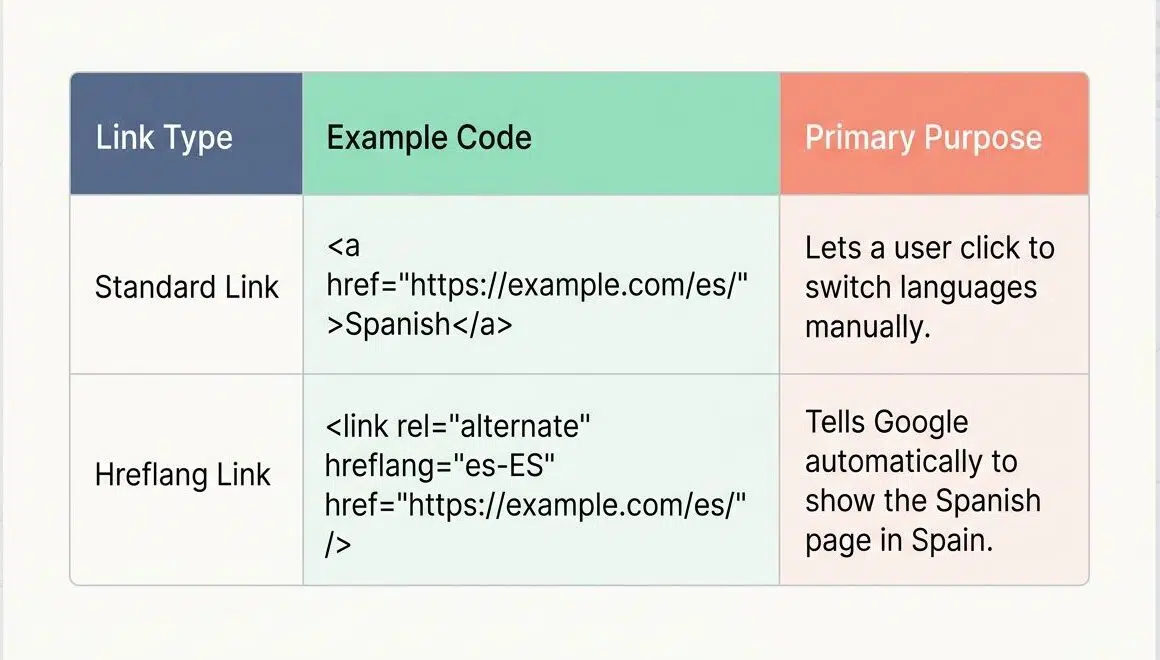
Here is a quick look at how a standard link compares to an alternate hreflang link:
| Link Type | Example Code | Primary Purpose |
|---|---|---|
| Standard Link | Spanish |
Let’s a user click to switch languages manually. |
| Hreflang Link | |
Tells Google automatically to show the Spanish page in Spain. |
A user in Berlin lands on a German page instead of an English one because of correct hreflang signals.
Why Are Hreflang Tags Essential for Global SEO?
Hreflang tags help your site speak the right language to each visitor, no matter where they are. They give search engines clear signals, helping you reach new places without tripping over old problems.
Avoiding duplicate content issues
Duplicate content can trip up your global SEO strategies fast. If the same text appears in many languages or on region-specific pages, search engines get confused. Sometimes, Google may treat them as one page and show the wrong version to users.
Use hreflang attributes to tell Google which language and country match each page. Adding proper hreflang tags helps keep each localized page separate in search results. This prevents problems with content duplication across different versions of your multilingual website.
To keep your site safe from duplicate content penalties, follow these rules:
- Do Not Cross Canonical Boundaries: A fatal error is pointing a canonical tag from your Spanish page to your English page. Each language version should always canonicalize to itself.
- Use Google Search Console: Monitor the International Targeting report inside Google Search Console to catch indexing errors early.
- Give Clear Signals: With these tags, you give clear signals for regional targeting and language localization.
This keeps your visibility high right where you want it. You will stay right in front of the correct audience in every SERP Search Engine Results Page!
Improving user experience for different regions
People feel more at home online when they read in their own language. Hreflang attributes help people see site content written just for them. A user in Paris sees French, while someone in Mexico finds Spanish.
Local phrases and clear wording boost comfort and trust. This type of localization makes visitors stick around longer. A 2026 report from Forbes Advisor notes that the average bounce rate for organic search is 46.9%. Serving the correct local page is the best way to lower that number for international visitors.
Localized websites can increase conversion rates by up to 300% when users feel at home.
On mobile phones or computers, seeing familiar words builds confidence fast. For example, a US buyer needs to see prices in USD, while a buyer in London needs to see GBP. Search engines use hreflang tags to pull up correct versions for each region, making sure the right person gets the right page.
These small details can lower bounce rates, raise engagement, and increase sales across borders. In fact, a 2026 study by SomyaTrans shows that highly localized websites can increase conversion rates dramatically.
Boosting search engine visibility in target markets
Making a website friendly for users in their own language helps keep them on the page. Search engines also notice these changes, thanks to hreflang attributes. Using proper SEO optimization and regional targeting, Google can show your site to people searching in different countries or languages.
For example, adding hreflang tags lets Google serve your French content to users in France and your Spanish page to those in Mexico. SERP visibility rises as search engines find the right localized pages. This keeps each webpage shining bright in its target country’s results instead of getting lost or mixed up with other versions.
Brands like Adidas use this tactic, so shoppers see local deals first, cutting down confusion. This is also important for new AI search tools. Data from Semrush in late 2025 shows AI Overviews trigger for around 15% to 25% of queries. Proper HTML markup helps AI tools like Gemini pick the exact local content to summarize for users.
With a correct keyword strategy, you help search engines match content with real user needs from Tokyo to Toronto.
Common Challenges When Using Hreflang Tags
Mixing up hreflang tags can send the wrong signal, leaving search engines scratching their heads. On top of that, keeping track of these tags gets trickier as sites grow and pages multiply like rabbits.
Misconfigured hreflang tags can cause big headaches for multilingual websites. One small typo or wrong language code, and search engines might show your page to the wrong audience.
A mix-up like “en-US” used instead of “en-GB” sends British visitors to American content. Search bots may then ignore your hreflang attributes altogether. Double trouble hits if you forget reciprocal links, use broken URLs, or skip adding hreflang tags on all versions of a site. For example, missing a tag on your Spanish page could confuse Google’s index and hurt SEO optimization in that market.
Here are the most common ways things go wrong:
- Broken Links: 2025 data from Semrush shows that broken links returning a 404 error inside hreflang tags are a major cause of ignored signals.
- Redirect Loops: Site owners sometimes slip up by using HTTP links while their main site runs on HTTPS. Always ensure your tags point to a live, 200-status URL.
- Simple Typos: Every simple mistake chips away at regional targeting success and lowers SERP visibility for global audiences.
Handling non-reciprocal hreflang links
Non-reciprocal hreflang links can throw a wrench into your SEO optimization plans. If you link from Page A to an alternate version on Page B using hreflang attributes, but Page B fails to link back in return, search engines may ignore both tags.
This glitch leaves users at risk of landing on the wrong regional content and tanks language targeting efforts. This is widely known as the “Missing Return Tag” error in the SEO community.
Google Search Central recommends full reciprocity for all alternate URLs. In practice, each language or region page should list every other variant with matching hreflang values and reciprocal links. You can use the Screaming Frog SEO Spider tool to crawl your site specifically for missing return links before you publish.
Missing this step is like leaving shoes without laces. Things just fall apart and stumble your site’s SERP visibility across multilingual websites. Using proper HTML markup helps combat these gaps while boosting international SEO results for website localization and global audiences.
Managing hreflang for large websites
Handling hreflang on large multilingual websites is no stroll in the park. Pages multiply fast, and each must have the correct language targeting for every region. Mistakes can pile up like dirty laundry, and one small slip could send visitors from Mexico to a page meant for Spain.
Using XML sitemaps with proper hreflang attributes helps keep things tidy and organized, even as your site grows past 10,000 pages. Putting these tags in your HTML header can actually slow down your page load speed if you have dozens of languages.
Many brands use automated tools or custom scripts to update their HTML markup. Manual work gets slow and messy at scale, so automation is key here. Spot checks catch missing tags before search engines notice anything off-key with your international SEO optimization efforts.
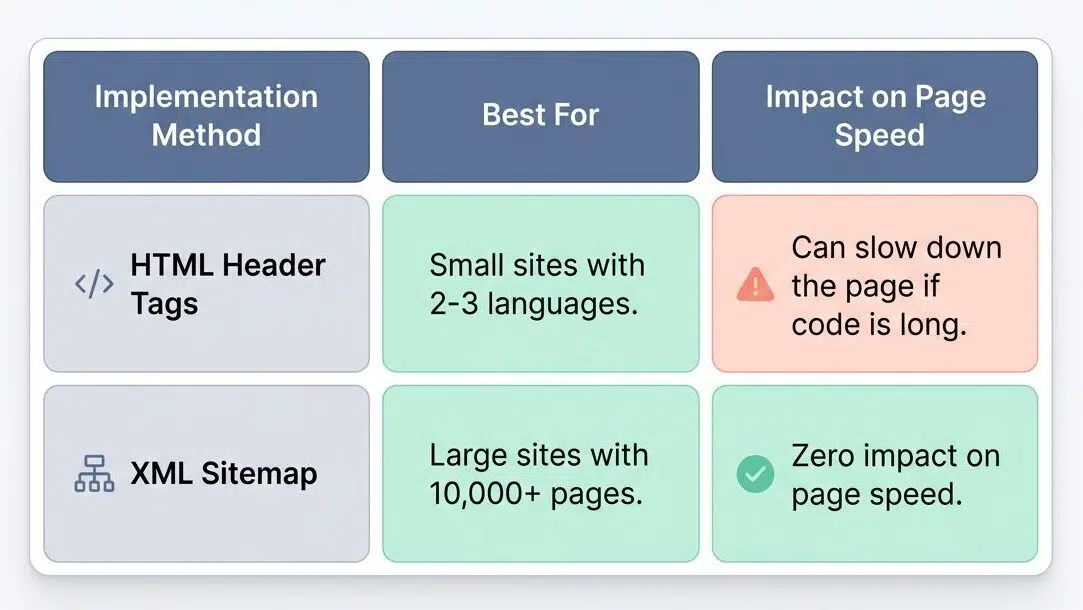
Here is a quick look at why sitemaps win for large sites:
| Implementation Method | Best For | Impact on Page Speed |
|---|---|---|
| HTML Header Tags | Small sites with 2-3 languages. | Can slow down the page if the code is long. |
| XML Sitemap | Large sites with 10,000+ pages. | Zero impact on page speed. |
Next up comes the importance of getting hreflang syntax right across each page version for top-notch search engine visibility in every market you target.
Best Practices for Implementing Hreflang Tags
Using hreflang tags the right way can save you from massive headaches. Stick around if you want fewer SEO surprises and happier site visitors.
Use the correct hreflang syntax
Hreflang syntax is like a GPS for your website. It tells Google, “Hey, this page is for English speakers in Canada,” or “Hola, esta página es para España.” Always use the correct format: .
Copying the wrong code leaves search engines confused, sends visitors to languages they do not speak, and can hurt SEO optimization. According to a 2025 study by Search Engine Land, about 8.9% of websites use completely invalid language codes.
Spot mistakes quickly by following these syntax rules:
- Check Your Codes: ISO 639-1 gives the right two-letter language codes. ISO 3166-1 Alpha 2 provides region codes. For example, “en-gb” stands for English in Great Britain, while “fr-fr” means French in France.
- Watch Your Punctuation: Never use underscores in your tags. A tag written as “en_US” is invalid; it must always use a hyphen like “en-US”.
- Keep It Simple: This simple formula helps keep multilingual websites clear and easy to navigate for everyone worldwide.
Implement hreflang in XML sitemaps
Once you set up the right hreflang syntax, XML sitemaps can help make things easier for search engines. Instead of adding hreflang tags to each webpage’s HTML, place them in your sitemap file.
This is a smart choice for multilingual websites with tons of pages. Each URL entry in your XML sitemap should list all alternate language or region versions using .
Keep in mind that standard XML sitemaps have a limit of 50MB or 50,000 URLs. If your international site is larger than this, you will need to split your sitemaps into multiple files. You can use popular WordPress plugins like Yoast SEO or Rank Math to automate this XML sitemap generation.
Final Thought
Mastering International SEO: Hreflang Tags Demystified might feel a bit technical at first, but the payoff is huge. They are your best tool for making sure your site speaks directly to your global audience. By pointing Google to the right language and region, you avoid duplicate content and give users exactly what they are looking for.
Start small, double-check your syntax, and use sitemaps to keep things organized as you grow. If you take the time to set up this HTML markup correctly, you will see a real difference in your SERP visibility. It is all about making your visitors feel at home, no matter where they live!






















