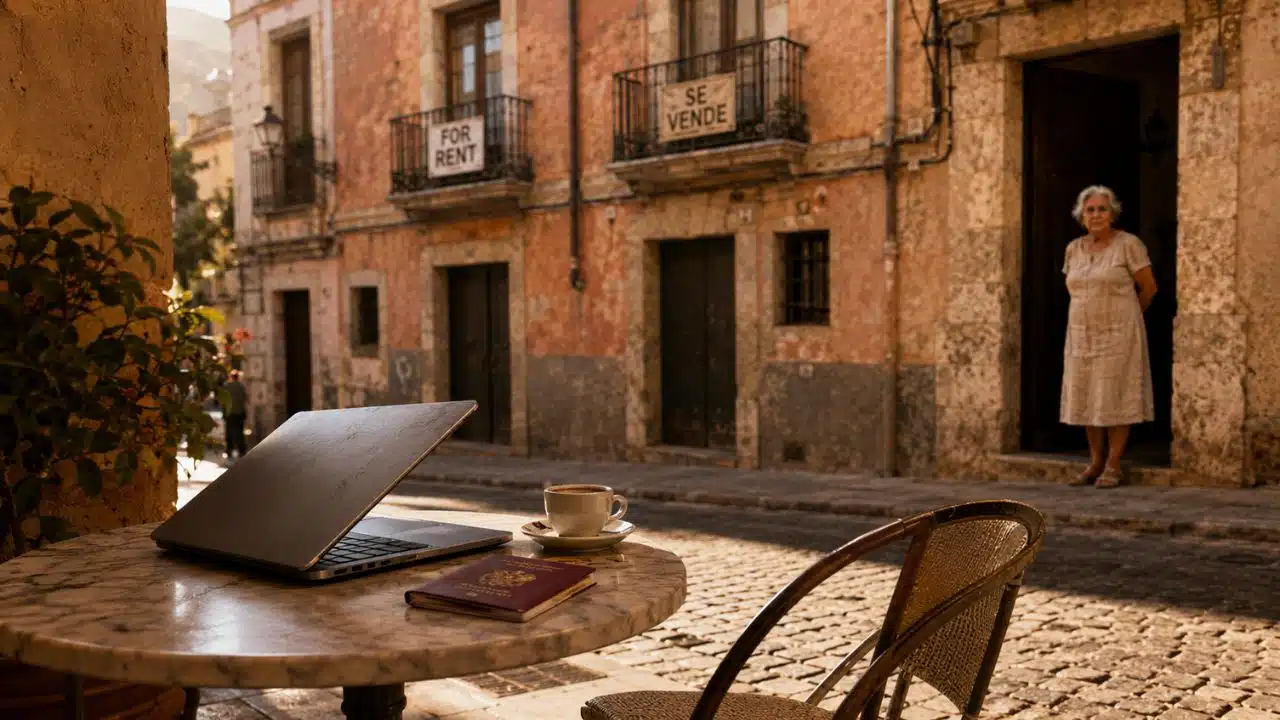
Lisbon priced out its locals. Bali changed its visa rules. Mexico City is rewriting tax law. The honeymoon is over. The nomad era was a free-rider problem with great Instagram. The corrections coming are healthy, not hostile.
I have spent the last five years watching the digital nomad era rise from a coffee-shop ritual into a small geopolitical force. I’ve sat in cafés in Tbilisi where every laptop was a foreign laptop. I’ve stood in line at immigration counters in Bali behind people who had been “on holiday” for nineteen months. I’ve talked to landlords in the Roma district of Mexico City who quietly stopped renting to locals because the foreigner with the dollar income would pay six months up front, in cash, and ask no questions about the building.
Now the correction is here, and I want to make a small, unfashionable case: this is good news.
Not because nomads are villains — most are not. Not because remote work is bad — it isn’t, and it has reshaped my own life in ways I am grateful for. But because the version of digital nomadism we built between 2020 and 2025 was a free-rider problem with great Instagram, and the rebalancing now underway is exactly what a healthy system should do.
The Boom We Just Lived Through
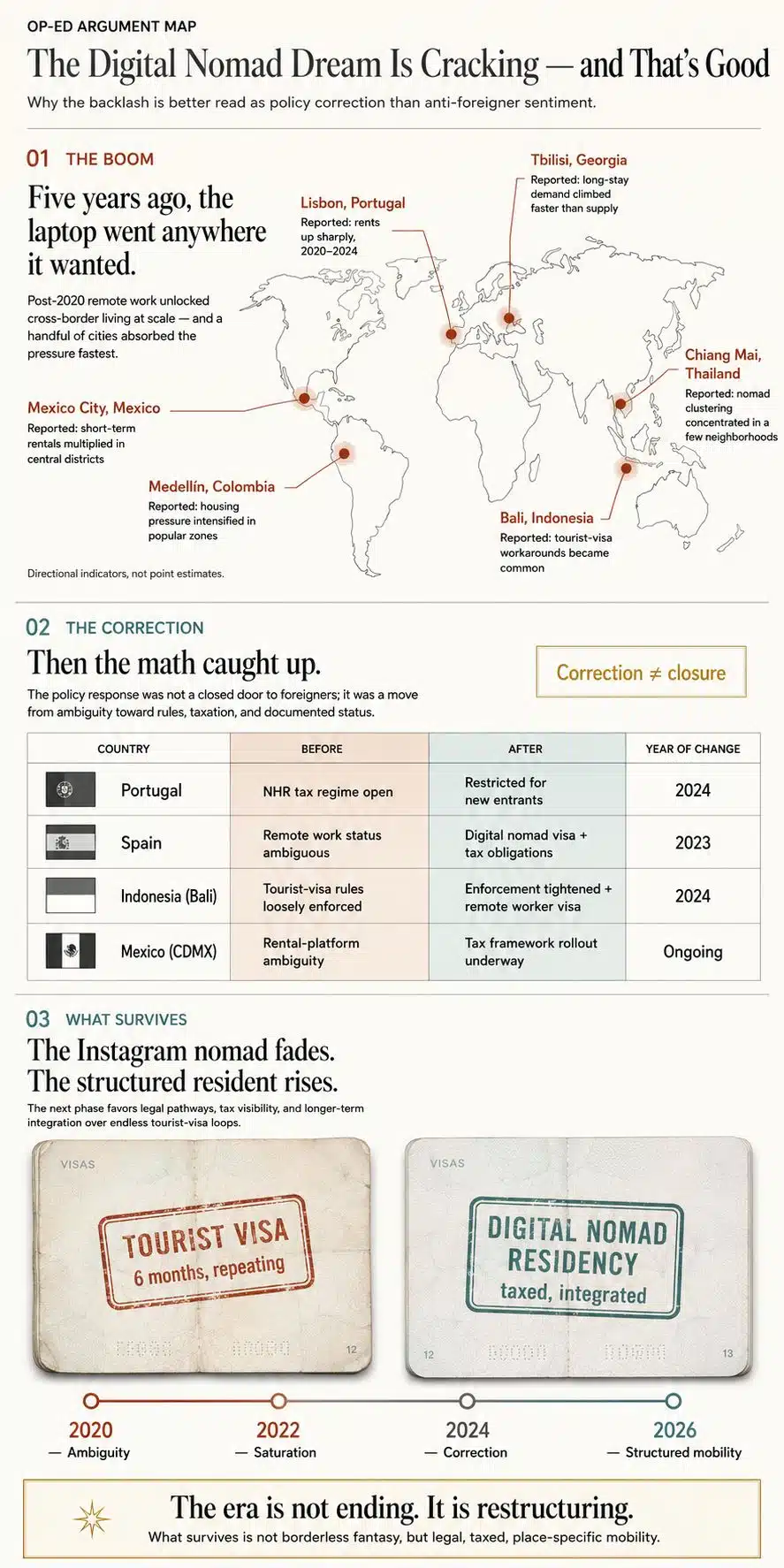
The pandemic did to remote work what war does to medicine: it compressed a decade of change into eighteen months. By mid-2021, a class of professionals that had previously been tethered to office leases discovered they could work from anywhere with a router. By 2022, “anywhere” had become a small handful of cities—Lisbon, Mexico City, Medellín, Tbilisi, Chiang Mai, Bali, and Cape Town—and a culture had grown up around the migration.
I am part of this culture. I have lived in five countries on three continents in the last six years. I have benefited, professionally and personally, from the same arbitrage I’m about to criticize. I want to be honest about that before I go further. The piece you are reading is not from above the system. It is from inside it.
The arbitrage looked, for a while, like genius. A salary indexed to one of the world’s richest economies, applied to a cost base indexed to one of the world’s middle-income economies. Subtract the difference. Pocket it. Post about it. The math was real. So was the lifestyle. So was, eventually, the damage.
Why the Cities Pushed Back
A digital nomad arriving in Lisbon in 2021 found rents that were, by their hometown standard, unbelievably cheap. A Lisbon native arriving at the same apartment in 2023 found rents that were, by their hometown standard, no longer affordable. Both of those statements were true at once, and the gap between them is the entire story.
Housing markets are not elastic in the timeframes nomads operate in. A neighborhood cannot grow itself a thousand new apartments because a thousand new laptops arrived. What it can do — what it did, in city after city — is reprice. The locals who could absorb the reprice stayed. The ones who couldn’t moved out, sometimes to neighborhoods they had never wanted to live in, sometimes out of the city entirely.
Then came the tax question. Portugal ended its Non-Habitual Resident regime, the tax shelter that had drawn so much of the early wave, in 2024—not because it disliked the nomads, but because the math no longer worked for the country. Spain’s digital nomad visa came with tax obligations attached from the start. Indonesia tightened enforcement on tourists who were quietly working on tourist visas, which is to say, on most of them. Mexico City began the slow legal work of tying short-term rentals into a tax framework that recognized what they were actually doing.
In every case, the policy logic was the same. A city is not a backdrop. It is a system that runs on tax revenue, housing supply, and social cohesion. When a new population uses the system without contributing to it, the system erodes. The corrections happening now are not hostile to nomads. They are the math catching up.
The Honest Argument
Most digital nomads I know are kind, curious, well-intentioned people. Many of them learn the language, support local businesses, and build real relationships. The problem was never any individual nomad. The problem was the structure—and the structure rewarded behaviors most nomads, most of the time, did not have to think about.
You did not have to think about the fact that your $1,400 rent represented six months of local median income. You did not have to think about the fact that the school down the street was funded by property taxes you weren’t paying. You did not have to think about the fact that the café you worked in every day had stopped serving the community that had built it.
You didn’t have to think about it because the system did not require you to. That is the definition of a free-rider problem: not malice, but the absence of any mechanism that would have made the costs visible.
Cities are now building those mechanisms. Visa frameworks with real tax thresholds. Short-term rental caps. Residency tracks that distinguish between someone passing through and someone investing. None of this is anti-foreigner. All of it is anti-extraction.
Why this is Healthy
Markets correct. They always correct. The question is whether the correction is orderly or chaotic and whether the system that emerges on the other side is more sustainable than the one that broke.
What is happening to digital nomadism right now is the orderly version. Governments are writing rules instead of erecting walls. Visa programs are being added, not removed — they are simply being attached to obligations. The number of countries offering legitimate digital nomad visas has more than tripled in three years. The friction is real, but the door is wider than it has ever been.
This is not the end of mobile work. This is the beginning of mobile work that is legible to the places it lands in.
What Survives, What Doesn’t
The version of nomadism that was always going to die is the version built on regulatory ambiguity. Six-month tourist visa stays. Income earned in one tax jurisdiction and consumed in another, with neither informed. Apartments rented through platforms the city never licensed. That model was not a movement. It was an exploit, and exploits get patched.
What survives — what is, in fact, getting stronger — is the version of mobile work that is structured. People who pick a country, get a real visa, pay real tax, learn the language, and stay long enough to be more than tourists. Cities, in turn, are competing for these residents with the seriousness they used to reserve for foreign investment. Estonia did it first. Portugal is rebuilding its program around it. Argentina, Greece, Brazil, Kenya, and a growing number of Caribbean nations are following.
The Instagram nomad — the one whose value proposition was a beach view and a tax loophole — is fading. The structured remote resident is rising. One of these is a person. The other was always a marketing campaign.
What to Do
If you’re a nomad, pick a country, not a circuit. The era of three-month rotations through six cities is ending, and the version of mobile work being built around longer stays, real visas, and real obligations is healthier for everyone, including you. Pay the tax. Learn the language. Treat the city as something other than a backdrop. Your well-being, ironically, will improve when you stop optimizing for arbitrage.
If you’re a city—build the rails before the next wave arrives. The countries that win this decade will be the ones that give serious remote workers a serious legal status, with serious obligations. Don’t ban. Structure. The economic upside of getting this right is enormous, and you have working models in three continents to copy from.
If you’re a remote worker who never left home, none of this requires leaving home. The mobile work era’s most underappreciated effect was on the cities people stayed in. Reinvest there. The most interesting story of the next five years is not where remote workers are going. It is what happens when they decide to stop going anywhere.
The Verdict
The digital nomad dream, in the form most of us first encountered it, was always going to be temporary. It was the early, unregulated phase of a much larger transition—the unbundling of work from place—and early phases of large transitions are always a little chaotic, a little extractive, and a little embarrassing when you look back at them.
What’s coming next is less photogenic but more durable. Visas that work. Tax frameworks that are honest. Cities that get to keep their character because the people moving in are paying for the privilege of joining it. The honeymoon is over. The marriage that follows can be a better one — but only if both sides agree to share the bills.
The free ride is ending. The actual journey is just starting.