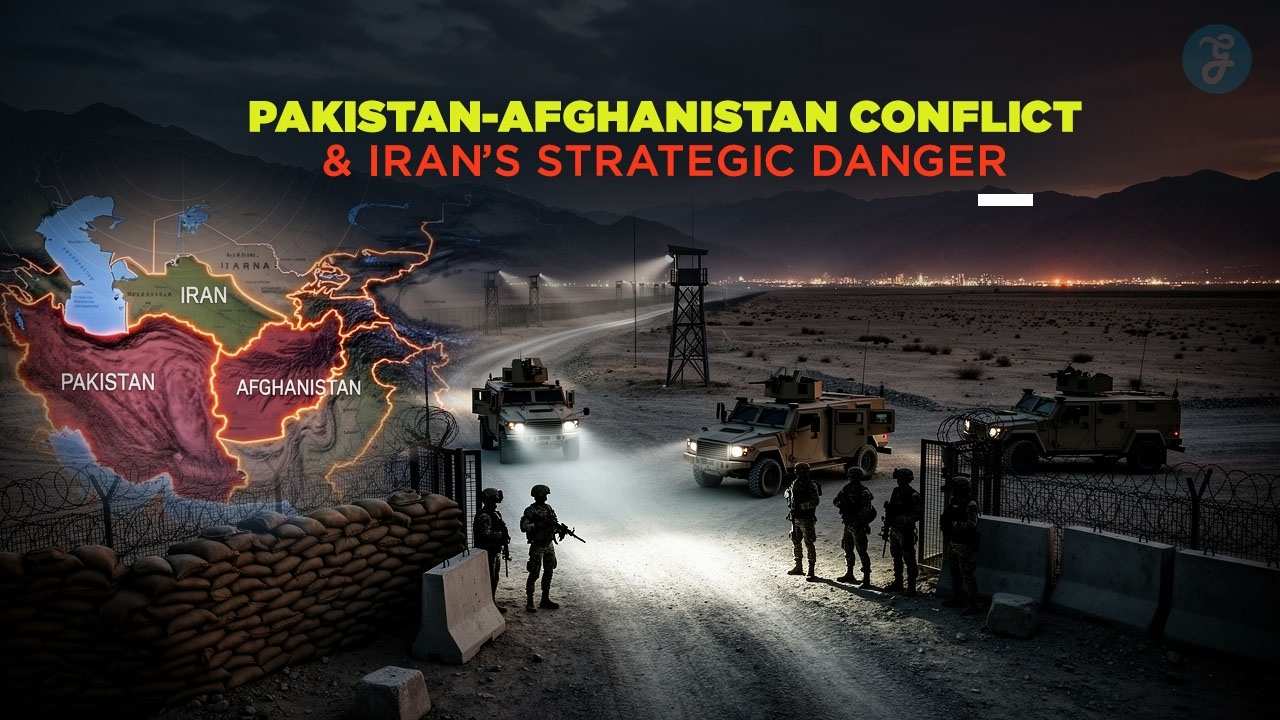
The Pakistan Afghanistan war 2026 impact on Iran is rapidly emerging as the most critical and underreported geopolitical crisis of the decade. As the international community remains transfixed by the escalating conflict in the Middle East involving the United States and Israel, a catastrophic secondary front has detonated on Tehran’s eastern flank. In late February 2026, the geopolitical landscape fractured when Pakistan officially declared a state of “open war” against the Afghan Taliban. Following unprecedented cross-border offensives by Afghan forces that reportedly killed dozens of Pakistani soldiers, Islamabad launched Operation Ghazab Lil-Haqq.
This massive military response involved widespread airstrikes targeting 46 locations across Afghanistan, including direct hits on Kabul, Kandahar, Paktia, and Nangarhar. This sudden shift from proxy friction to state-on-state warfare places the Iranian regime in an impossible geopolitical vise. While the western theater tests Iran’s proxy capabilities, the eastern theater directly threatens its core territorial integrity.
This conflict is the ultimate wildcard, threatening to fracture internal security, stretch military bandwidth beyond its breaking point, and trigger an unmanageable economic and demographic collapse.
The Anatomy of an Open War
To understand the peril Iran faces, we must first dissect how the Pakistan and Afghanistan relationship collapsed so completely. For decades, Pakistan viewed the Afghan Taliban as an essential tool for “strategic depth” against regional rivals. That paradigm is now permanently dead.
The Durand Line Dilemma
The root of the immediate territorial conflict is the Durand Line. This 2600-kilometer colonial-era border has never been recognized by any Afghan government, including the Taliban. The refusal to accept this boundary creates a permanent state of friction regarding border outposts, trade routes, and tribal movements.
The TTP Factor
The catalyst for the 2026 war is the Tehrik-i-Taliban Pakistan (TTP). Following the US withdrawal in 2021, TTP militants found safe haven in Afghanistan. Pakistan accuses the Afghan Taliban of sheltering these fighters, who have steadily escalated attacks against the Pakistani state.
Operation Ghazab Lil-Haqq
The February 2026 escalation marks a historical turning point. Pakistan’s decision to launch widespread airstrikes and declare open war indicates that diplomatic patience has evaporated. By striking the Taliban’s political capital in Kabul and its spiritual heartland in Kandahar, Pakistan has guaranteed a protracted, bloody conflict that will inevitably spill across regional borders.
Key Conflict Statistics [February 2026]
The sheer scale of the initial clashes highlights the severity of the crisis.
| Metric | Pakistan Claims | Afghanistan Claims |
| Military Objectives Targeted | 46 Afghan locations struck | 19 Pakistani outposts captured |
| Reported Casualties | 415 Afghan forces killed | 55 Pakistani soldiers killed |
| Civilian Impact | Denies targeting civilians | Reports 19 civilians killed |
| Operational Status | Open war declared | Vows a calculated retaliation |
The Two-Front Nightmare
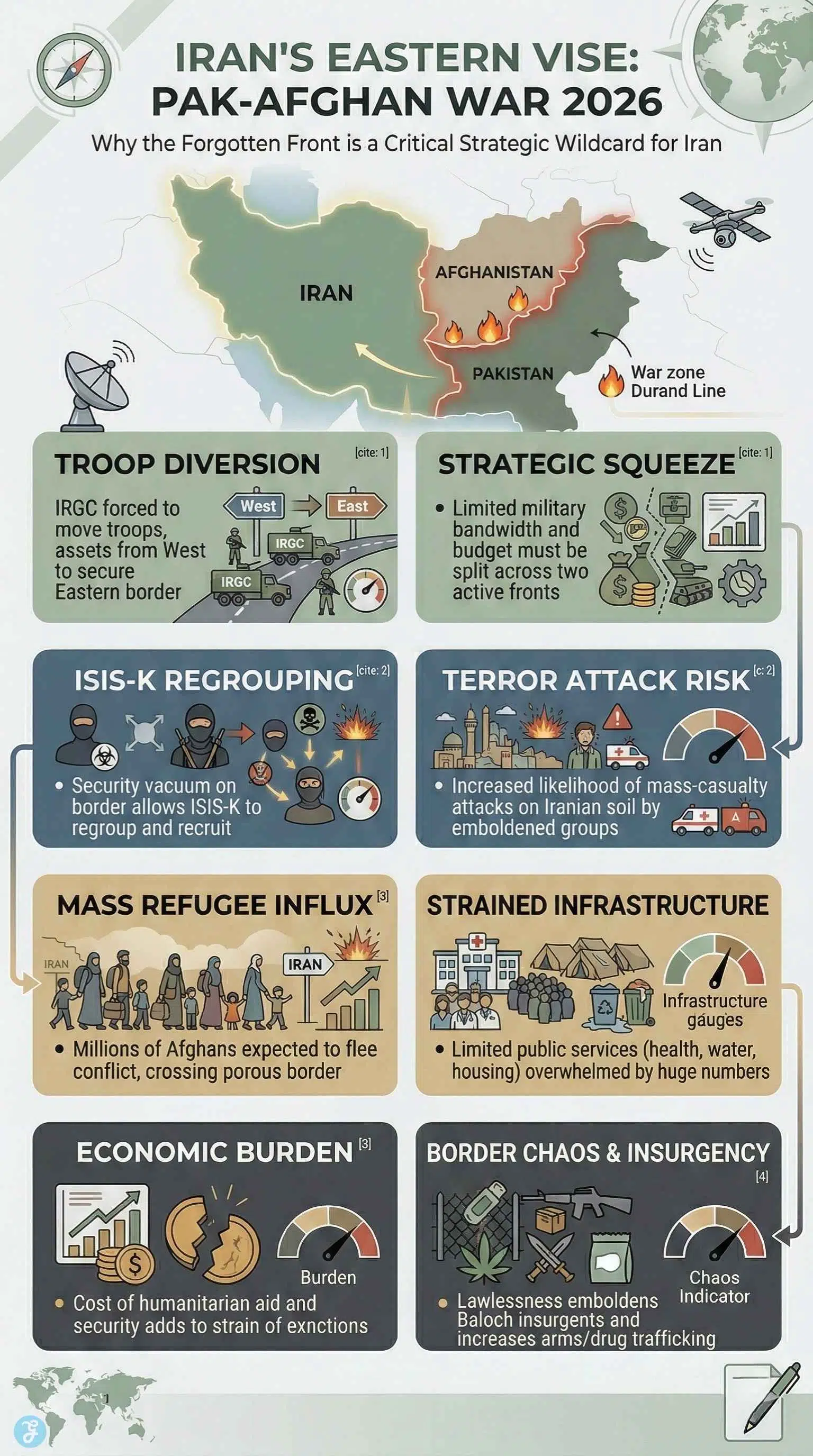
Iran currently faces a logistical and military nightmare. The nation shares a highly porous 900-kilometer border with Pakistan and Afghanistan. Securing this expanse requires massive troop deployments, advanced surveillance infrastructure, and constant air patrols.
Stretching the IRGC Thin
The Islamic Revolutionary Guard Corps (IRGC) is already stretched to its operational limits. The organization is deeply entrenched in managing the “Axis of Resistance” and bracing for direct military confrontations on its western borders. The eruption of a major war to the east forces Iranian military planners to make impossible choices.
The Squeeze on Resources
Iran simply cannot afford to militarize its eastern border without critically weakening its western defensive posture. Every battalion, drone squadron, and intelligence asset diverted to the Sistan-Baluchestan border represents a vulnerability in the Middle East. The Pakistan Afghanistan war 2026 impact on Iran, which is a crisis of resource allocation.
The Resurgence of Transnational Terror
The chaos of the Pakistan and Afghanistan war provides a massive strategic windfall for transnational terror groups. The most immediate and lethal threat to Iran in this category is the Islamic State Khorasan Province (ISIS-K).
The Operational Vacuum
Both the Afghan Taliban and the Pakistani military are currently dedicating their primary resources to fighting each other. Border security protocols have collapsed. Intelligence networks are completely focused on state-level military threats. This operational vacuum gives ISIS-K the exact breathing room it needs to regroup, recruit, and execute complex operations.
The Ideological Threat to Tehran
ISIS-K views Shia-majority Iran as a primary ideological enemy. The group does not limit its ambitions to Afghanistan and Pakistan. It actively seeks to destabilize the Iranian state and slaughter its citizens.
Historical Precedent and Future Risks
The devastating Kerman bombings serve as a grim reminder of ISIS-K’s capabilities. A destabilized eastern border drastically increases the probability of weapons, explosives, and radicalized operatives flowing undetected into Iranian territory. For Iran, the ongoing war next door is a ticking time bomb for domestic terrorism.
Threat Matrix for Iran:
- ISIS-K: High Probability of infiltration, targets civilian centers.
- Al-Qaeda: Medium Probability of exploitation, utilizes chaotic supply lines.
- TTP: Low Direct Threat to Iran, but drives the regional instability.
The Narco-Terror Nexus and Border Crime
The collapse of border authority also revitalizes the Afghan narco-economy. While the Taliban previously claimed to ban opium cultivation, the economic desperation of a multi-front war forces a rapid reversal of that policy. Opium and methamphetamine production remain the most reliable ways to fund an insurgency or a wartime state.
Iran already suffers from one of the highest rates of opiate addiction in the world. A chaotic border allows heavily armed smuggling cartels to push massive quantities of narcotics into Iranian territory. These cartels frequently engage in deadly shootouts with Iranian border guards. The profits from this drug trade directly fund the very Sunni extremist groups, like ISIS-K and the TTP, that seek to destroy the Iranian state.
Emboldening Separatism
The tri-border region connecting Iran, Pakistan, and Afghanistan is historically restive. The current war acts as an accelerant for long-standing ethno-nationalist grievances, specifically regarding the Baloch population.
The Cross-Border Insurgency
Baloch separatist groups, such as the Balochistan Liberation Army (BLA), operate seamlessly across these borders. These factions have waged a decades-long insurgency against both Islamabad and Tehran, seeking greater autonomy or total independence.
A Permissive Environment for Chaos
The breakdown of the Pakistani military’s border control apparatus allows separatist groups to move with unprecedented freedom. Arms smuggling networks, previously suppressed by joint border patrols, are now operating without restriction. This influx of high-grade weaponry directly threatens Iranian security forces stationed in the southeast.
The Threat to Sistan-Baluchestan
Iran’s Sistan-Baluchestan province is already a flashpoint for anti-government sentiment and intermittent violence. The influx of weapons and emboldened militants from Pakistan could easily ignite a full-scale insurgency inside Iran. The Iranian government is acutely aware that internal uprisings, fueled by external chaos, pose a severe threat to regime survival.
The Weaponization of Water: The Helmand River Crisis
While bullets and bombs dominate the headlines, a quieter but equally lethal threat flows across the Afghan border. The Helmand River is the lifeblood of eastern Iran. It provides essential drinking water and agricultural sustenance for the parched Sistan-Baluchestan province.
A History of Thirst
Tehran and Kabul have fought bitterly over water rights for decades. A 1973 treaty theoretically guarantees Iran a specific share of the Helmand River water. The Taliban has repeatedly violated this agreement by constructing dams and redirecting water flows to serve their own agricultural needs. This has transformed massive Iranian wetlands into dust bowls and triggered intense local protests against the Iranian government.
Water as a Weapon of War
In a state of open conflict with Pakistan, the Afghan Taliban will prioritize their own survival and resource hoarding above all else. Any pretense of honoring water treaties with Iran will vanish. The Taliban can easily weaponize the Helmand River, cutting off water flows entirely to punish regional neighbors or hoard resources for their own wartime agriculture.
The Domestic Fallout for Tehran
A sudden and complete cutoff of the Helmand River would devastate Iranian agriculture in the east. It would accelerate internal migration, forcing hundreds of thousands of impoverished farmers to abandon their land and move toward already overcrowded Iranian cities. This environmental weaponization creates a domestic crisis that the IRGC cannot solve with military force.
The Impending Demographic and Economic Shock
Beyond the kinetic military threats, the Pakistan Afghanistan war 2026 impact on Iran carrying demographic and economic consequences. The humanitarian fallout will inevitably spill over Iran’s borders.
The Refugee Tsunami
Afghanistan is already experiencing a catastrophic humanitarian crisis. Over 17 million Afghans face severe food insecurity. The initiation of relentless airstrikes, artillery barrages, and the destruction of infrastructure will force millions to flee. With Pakistan actively bombing Afghan territory and closing its own borders, the primary escape route for desperate refugees is west into Iran.
Iran’s Economic Breaking Point
The Iranian economy is incredibly fragile. Years of severe international sanctions, inflation, and currency devaluation have hollowed out the state’s financial reserves. Iran currently hosts millions of Afghan refugees from previous conflicts. The state infrastructure simply cannot absorb a new influx of millions of displaced persons. The financial burden of providing food, shelter, and medical care would mandate sweeping cuts to domestic programs, potentially sparking widespread civil unrest among the Iranian populace.
Paralyzing Regional Trade
The conflict completely paralyzes vital regional connectivity projects. Trade routes linking Central Asia to Iran’s crucial Chabahar port are now effectively war zones. The loss of transit fees, cross-border commerce, and foreign investment in these logistical hubs will deal a severe blow to Iran’s attempts to build a sanctions-proof economy.
The Death of Energy Diplomacy: The Pipeline Mirage
For years, Iran has banked on the completion of the Iran-Pakistan gas pipeline. Dubbed the “Peace Pipeline,” this multi-billion-dollar infrastructure project was designed to supply energy-starved Pakistan with Iranian natural gas. It represented a vital financial lifeline for Iran’s heavily sanctioned energy sector.
The outbreak of the Pakistan Afghanistan war in 2026 permanently killed this project. Pakistan is now diverting all available state funds toward its military campaign. Foreign investors will refuse to finance pipeline construction in an active war zone. Furthermore, the pipeline route runs directly through the volatile Sistan-Baluchestan and Balochistan regions, making it a prime target for separatist sabotage. The loss of this anticipated energy revenue is a catastrophic blow to Iran’s long-term economic planning.
The Broader Chessboard
The Pakistan and Afghanistan war does not exist in a vacuum. External global powers are actively analyzing how this conflict shifts the balance of power in Asia and the Middle East.
Exploiting the Distraction
For the United States and Israel, the eastern conflict is a massive strategic advantage. The war effectively pins Tehran down, draining its resources and forcing it into a defensive posture without the West firing a single shot. A distracted Iran is less capable of coordinating complex proxy attacks in the Levant or the Red Sea.
China’s Dilemma
Beijing views the war with deep alarm. The China-Pakistan Economic Corridor (CPEC) is a crown jewel of the Belt and Road Initiative. A destabilized Pakistan and an Afghanistan engulfed in war directly threaten billions of dollars in Chinese infrastructure investments. China may be forced into an uncomfortable role as a regional mediator to protect its economic interests.
India’s Shadow
New Delhi watches the conflict closely. The Afghan Taliban has recently cultivated warming diplomatic ties with India. Pakistan perceives this relationship as a deliberate strategy of encirclement. This paranoia fuels Pakistan’s aggressive military posture, further complicating any potential diplomatic off-ramps.
Wrapping Up: Iran’s Narrowing Options
The Iranian Foreign Ministry has engaged in frantic diplomacy, pleading for an immediate dialogue and a cessation of hostilities between Islamabad and Kabul. However, these pleas are falling on deaf ears.
The harsh reality is that military force alone cannot secure Iran’s borders. Durability requires regional cooperation, stable neighbors, and robust economic integration. None of these elements currently exists on Iran’s eastern flank. The Pakistan Afghanistan war 2026 impact on Iran that exposes a fundamental vulnerability in Tehran’s grand strategy.
While the nation has spent decades building a forward-defense network in the Mediterranean and the Persian Gulf, it has neglected the deep structural rot on its own borders. The true existential threat to the Iranian state may not arrive via stealth bombers from the West, but through the chaotic, forgotten mountains of the East.