Have you ever found yourself screaming at the TV while watching Alice in Borderland because a character made a terrible choice? I think we have all been there. Watching players navigate the deadly streets of an abandoned Shibuya is stressful. It makes you wonder if the “smartest” characters are actually the ones who deserve to survive.
Here is a fascinating detail most fans miss. While Arisu is the protagonist, the show and the original manga by Haro Aso treat “intelligence” very differently. It is not just about IQ. It is about adaptability.
I am going to break down exactly how these characters think. We will look at who has the book smarts, who has the street smarts, who really earned their visa extension, and who is just lucky. Grab a snack, and let’s figure out Alice In Borderland Characters Ranked By Intelligence.
The Framework: Understanding Intelligence by “Suits”
Before we rank the characters, we have to understand the arena. In the Borderland, intelligence isn’t one-size-fits-all. The card suits dictate the type of intelligence required to survive.
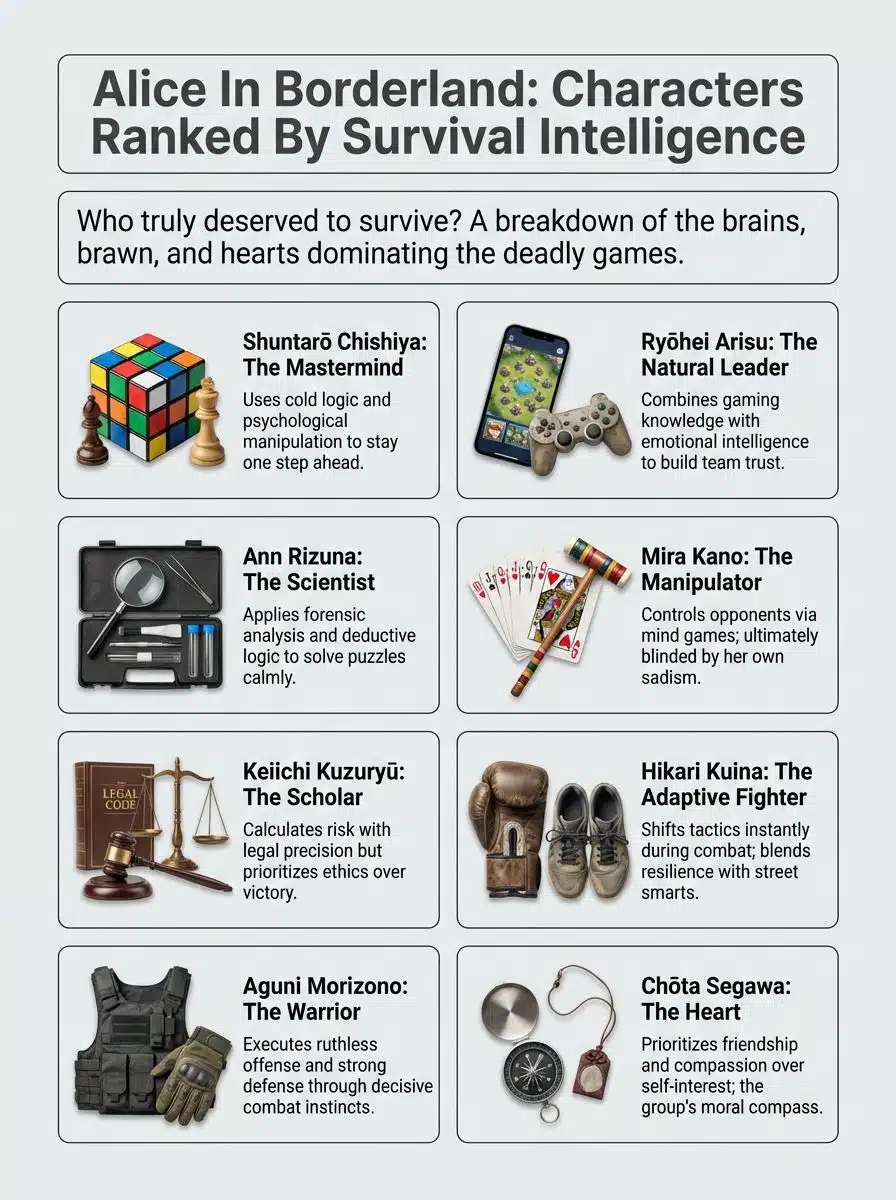
- Diamonds (Intelligence): Pure logic, math, and probability.
- Hearts (Psychology): Emotional manipulation, empathy, and betrayal.
- Clubs (Teamwork): Social intelligence, leadership, and cooperation.
- Spades (Physical): Kinetic intelligence, spatial awareness, and combat tactics.
In the Borderland, being a genius at math might help you in a Diamonds game, but it could get you killed in a Hearts game. Intelligence here is a mix of skills that keeps you breathing for one more day.
Criteria for Ranking Intelligence
I evaluate these characters based on four specific types of survival intelligence. You can see how they differ below.
| Intelligence Type | Why It Matters | Best Example |
| Logical Reasoning (IQ) | Solving complex puzzles, math problems, and deduction under strict time limits. | Ann Rizuna |
| Game Theory (Strategy) | Predicting opponent moves and manipulating outcomes to ensure a win. | Shuntarō Chishiya |
| Emotional Intelligence (EQ) | Reading people, building trust, and spotting lies or betrayal. | Ryōhei Arisu |
| Kinetic Intelligence | Using the physical environment and combat skills to survive physical threats. | Hikari Kuina |
Problem-solving abilities: This is the raw ability to crack a code. Ann Rizuna is a prime example here. Her background as a forensic scientist allows her to treat games like crime scenes. She gathers data before she acts.
Strategic thinking: This goes beyond solving a puzzle. It involves manipulating the players. Chishiya treats people like chess pieces. He does not just play the game; he plays the opponents.
Emotional intelligence: In Hearts games, logic often fails. This is where Arisu shines. He survives because he understands human pain. He can predict what a desperate person will do because he feels that desperation himself.
Adaptability under pressure: Plans fall apart. The best players shift gears instantly. Kuina might start a fight with fists, but she is smart enough to run or use a weapon if the odds change. Survival favors the flexible.
Shuntarō Chishiya: The Sociopathic Strategist
Shuntarō Chishiya is often cited by fans as the smartest character in the series. His intelligence is cold, calculated, and terrifyingly efficient. In the show, he is a medical student, which explains his detached clinical view of life and death.

“To gain something, you must lose something.”
Why does he dominates Diamonds games
Chishiya excels in games that require Game Theory, specifically the concept of “Nash Equilibrium.” This is where you make the best decision based on what you think your opponents will do. His victory in the “King of Diamonds” game is a textbook application of the Keynesian Beauty Contest economic theory. He knew he had to guess a number based on what everyone else would guess, not just random chance.
Insider Tip: In the manga, Chishiya also plays the Jack of Diamonds game, which is Mahjong. The show cut this, but it further proves his ability to calculate odds and read “tells” on a professional level.
He rarely panics. While others scream, he observes. This lack of emotional response is his superpower in a world designed to break you psychologically. He is obviously the smartest. His strategy in the Jack of Hearts game was unmatched. He constantly gambles with his life, yet he never seems to lose.
[Read my full analysis on Chishiya’s survival strategy here]
Ann Rizuna: The Logical Thinker
Ann Rizuna brings the scientific method to a death game. She worked for the Tokyo Metropolitan Police Department as a forensic scientist. This background means she trusts evidence over emotion.

Her finest moment
During the “Witch Hunt” (10 of Hearts) game, Ann did not run around aimlessly. She examined the body. She looked for fingerprints on the knife. She analyzed the blood spatter.
- Observation: She noticed the specific angle of the stab wound.
- Deduction: She realized the victim held the knife herself.
- Action: She moved to prove it with hard evidence.
In the manga, Ann participates in the Queen of Diamonds game, which is a target shooting game involving logic and geometry. The show changed her path to include more physical action, but her core strength remains her deductive reasoning. She solves survival like a math equation and death games like they are crime scenes, yet she rarely gets the credit she deserves.
[Read my analysis of why Ann is the show’s most underrated character here]
Keiichi Kuzuryū: The Calculated Strategist
Keiichi Kuzuryū is the King of Diamonds for a reason. Before the Borderland, he was a lawyer specializing in international corporate law. He spent his life negotiating the value of human lives in settlements.
The philosophy of his game
His game, the “Beauty Contest,” is pure mathematics and philosophy. He forces players to determine the value of their own lives relative to others. His intelligence is high, but it is burdened by his obsession with fairness.
A fatal flaw?
Kuzuryū is smart enough to win, but he chooses not to. He realizes that deciding who lives and dies is an impossible moral burden. His sacrifice was not a lack of intelligence; it was a final act of legal rebellion against the system. He proved that even in a game of pure logic, human values can override the math.
Mira Kano: The Manipulative Genius
Mira Kano is the Queen of Hearts. Her intelligence is not about math; it is about psychiatry and neurology. She understands the human brain’s breaking points better than anyone else.
Weaponizing empathy
Mira does not use guns. She uses words. In the final game, she nearly defeats Arisu and Usagi just by talking over a game of croquet. She induces hallucinations and despair by tapping into their deepest traumas.
The “Placebo” tactic
She convinces players that their struggle is meaningless. This is a psychological trick often called “gaslighting” but weaponized to a lethal degree. Her weakness is her own curiosity. She finds Arisu so interesting that she delays her kill, giving him a chance to snap out of it. Her boredom is her only vulnerability. She doesn’t need weapons; she destroys you with words and hallucinations.
[Learn the secret why Mira’s psychological games are harder than physical ones]
Ryōhei Arisu: The Natural Leader
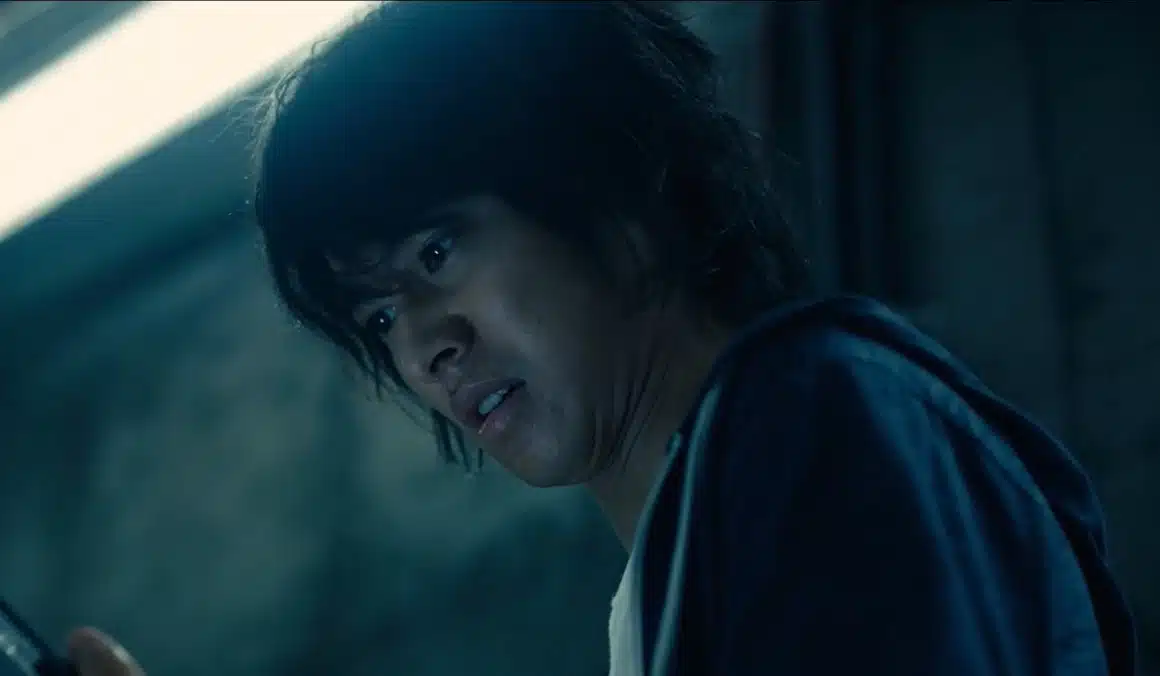
Arisu is not a doctor or a lawyer. He is a gamer. In the real world, this was seen as a waste of time. In Borderland, it is a critical survival skill. He possesses what psychologists call “fluid intelligence.”
Why gamers survive
Arisu instinctively understands “game mechanics.” He looks for:
- Hidden rules the Game Master did not explain.
- Glitches or loopholes in the system.
- The developer’s intent (the psychology of the person who made the game).
Comparison: Arisu vs. The Pros
| Attribute | Chishiya (The Pro) | Arisu (The Gamer) |
| Approach | Calculates the odds mathematically. | Feels the “flow” of the game emotionally. |
| Teamwork | Uses people as tools. | Uses trust to build alliances. |
| Winning Move | Logic and Nash Equilibrium. | Lateral thinking and empathy. |
In the “Hide and Seek” (7 of Hearts) game, Arisu realized the cruel twist before anyone else. His high Emotional Intelligence allowed him to understand that the game was designed to tear them apart, not to be won by skill. A similar thing happened at the ten of hearts game, which wasn’t really about finding a killer; it was about breaking the group apart.
[Read my in-depth evaluation of why the Witch Hunt was the ultimate test of trust here]
Enji Matsushita: The Deceptive Dealer
Enji Matsushita is the hidden villain in the “Jack of Hearts” game (Solitary Confinement). In the show, he poses as a helpless, trusting player. In reality, he is a citizen of the Borderland.
The Cheat Code
Enji’s game relies on paranoia. He manipulates the group dynamics to make them kill each other.
“Trust is the most dangerous thing in this prison.”
Insider Tip: In the manga, Enji cheats using a prosthetic eye that reflects the symbol on his collar. In the show, this was changed to him using hypnosis and a partner. Both versions show a character who relies on unfair advantages rather than pure skill. He loses because he underestimates the deductive duo of Yaba and Banda.
Suguru Niragi: The Tactical Agent of Chaos
If Chishiya is “Ice,” Niragi is “Fire.” It is easy to dismiss him as a psychopath with a gun, but that underestimates his intellect. In the real world, Niragi was a game engineer (often implied to be in IT/development), meaning he understands systems just as well as Arisu does.
“Scorched Earth” Strategy
Niragi’s intelligence is driven by hate. He realized early on that in a lawless world, the person willing to commit the most violence often rules.
-
Tactical Aggression: He doesn’t just shoot; he suppresses. During the “Witch Hunt,” he nearly took control of the entire beach by creating a bottleneck scenario. He knows how to herd people like sheep.
-
Technical Skill: He modified weapons and understood the beach’s infrastructure. He isn’t a mindless brute; he is a tech-savvy nihilist who chooses violence.
The Fatal Flaw
His intelligence is high, but his EQ is nonexistent. He believes survival is about dominating others, whereas Arisu believes it is about co-existing. Niragi’s downfall is his inability to trust; he creates enemies faster than he can kill them. He survives purely on spite, which is a powerful fuel, but it burns out eventually.
His rivalry with Chishiya was clearly visible, but he used to be frustated why he couldn’t decode Chishiya’s strategy. While Chishiya uses logic, Niragi uses pure chaos to disrupt the game.
[Read my breakdown of why logic always beats chaos in Niragi vs. Chishiya]
Ginji Kyūma: The Analytical King of Clubs
Ginji Kyūma leads the “Osmosis” game. He is a musician and a nudist, which might make you underestimate him. Do not be fooled. His philosophy of “nudism” is a metaphor for hiding nothing. He believes in total transparency.
Leadership through trust
Kyūma’s intelligence is social. He creates a team that operates as a single organism. In the Clubs suit (Teamwork), this is the ultimate weapon. While Arisu’s team was chaotic and arguing, Kyūma’s team moved in perfect sync. He accepts his death with grace because he understands that his team played their best.
Akane Heiya: The Survival Expert
Akane Heiya has “kinetic intelligence.” While Chishiya is doing math, Akane is surviving an explosion. She lost her leg in the “Seven of Spades” game (Boiling Death) and still managed to survive.
Adaptability in combat
She learned archery in high school, a skill that saved her life against the King of Spades. But her real smarts come from her refusal to die. She navigates the physical ruins of Tokyo better than almost anyone. She proves that you do not need a high IQ to be smart. You need grit.
Aguni Morizono: The Tactical Warrior
Aguni is the hammer to Hatter’s nail. As a former member of the Japan Self-Defense Forces (JSDF), his intelligence is tactical and military-grade. He understands chains of command, perimeters, and threat assessment.
Defense and Offense
Aguni does not solve riddles; he neutralizes threats. In the fight against the King of Spades, Aguni was the only one who could think tactically about flanking and suppression fire. He kept the others alive by drawing fire, a calculated risk he knew he could survive longer than they could.
Hikari Kuina: The Resilient Fighter
Hikari Kuina is more than just a martial artist. She is observant. Before her transition, her father forced her to train in traditional karate, giving her discipline and spatial awareness.

Tactical fighting
In her fight against the “Last Boss,” she did not just punch. She used the environment. She realized she could not overpower him, so she outmaneuvered him. She uses her history and her pain as fuel. Her bond with Chishiya is interesting. She is the muscle to his brain, but she is smart enough to know when he is manipulating her. It proves that being the strongest fighter doesn’t guarantee you a visa extension in this world.
[Read why pure strength isn’t enough for Kuina and Aguni here]
Takeru Danma [Hatter]: The Visionary Leader
The Hatter, or Takeru Danma, had “Charismatic Intelligence.” He built “The Beach” cult from nothing. He realized early on that people need hope more than they need food.
The “Cult Leader” playbook
He invented the lie that collecting all the cards would let one person leave. This was a stroke of genius. It turned a chaotic free-for-all into an organized society. He effectively gamified their survival.
- Goal: Control the masses.
- Method: Create a shared myth (The Beach).
- Result: Hundreds of players working for him.
Saori Shibuki: The Resourceful Survivor
Saori Shibuki is often disliked by fans, but she was a survivor. She was the first person to explain the visa system to Arisu. She used her sexuality and manipulation as tools because she lacked physical strength.

The “Corporate” mindset
In her real life, she moved up the corporate ladder by using others. She applied this same logic to the Borderland. It is ruthless, but it is a form of intelligence. She assessed that Arisu’s friends were weak and tried to isolate the strongest member (Arisu) for herself. She played a selfish game early on, and it backfired immediately.
[Read my analysis of why nobody liked Shibuki and the flaw in her strategy here]
Daikichi Karube: The Loyal Protector
Karube had “Street Smarts.” He worked in a bar and was constantly in fights. This gave him a quick intuition about danger. He often spotted physical threats before Arisu did.
Why he died
Karube was smart enough to realize the nature of the “7 of Hearts” game instantly. He knew that for Arisu to live, he had to die. His death was a conscious choice, not a failure of intelligence. He weighed the value of his life against his best friend’s potential and made the trade.
Chōta Segawa: The Kind-Hearted Ally
Chōta is the tragic figure. He was an IT engineer, so he had technical skills, but he was held back by deep religious guilt and a lack of self-confidence. His leg injury in the first game severely limited his tactical options.
His intelligence was limited by his fear. He panicked easily, which clouds judgment. However, in his final moments, he found clarity. Like Karube, he chose self-sacrifice, proving he understood the game’s cruel rules perfectly in the end. It felt like they died too soon, but their sacrifice was essential for Arisu’s growth.
[Read my full take on justice for Karube and Chota here]
Yuzuha Usagi: The Wilderness Expert
Usagi is often reduced to “the love interest” or “the athlete,” which is a massive disservice to her character. She possesses a specific type of intelligence that city-slickers like Arisu lack entirely: Primitive Survival Intelligence.

Urban vs. Wild Survival
While Arisu is trying to “hack” the game’s software, Usagi is surviving the hardware (the world).
- Resource Management: In the early episodes/chapters, while others are starving or eating expired convenience store trash, Usagi is hunting rabbits and foraging. She understands that the games aren’t the only thing that kills you; dehydration and starvation do too.
- Stealth and Spatial Awareness: Her climbing ability isn’t just parkour; it’s tactical positioning. In the “Tag” game, she instinctively found vertical blind spots that the gunmen couldn’t check.
- Mental Fortitude: As the daughter of a disgraced mountaineer, she was trained to survive in isolation. When the “King of Spades” turned the city into a war zone, Usagi was the most comfortable because she treats the ruins like a mountain range, dangerous, but navigable. Some say she survived because of plot armor, but her wilderness skills tell a different story.
[Read my analysis on Usagi’s survival skills vs. plot armor]
Kōdai Tatta: The “Everyman” Who Became a Hero
Tatta is often overlooked because he wasn’t a genius like Chishiya or a fighter like Aguni. He was a regular guy, a bit goofy, a bit clumsy, and seemingly “useless” in high-stakes games. But that is exactly why he deserved to live. He represented the average person trying to do their best.
Why did he deserve to live
Tatta possessed “Humility Intelligence.” He knew he wasn’t the main character. He knew he couldn’t lead. Instead of letting ego get in the way (like Niragi), he fully committed to supporting those who could lead. He found his purpose in service to the team.
Why did he have to die
Tatta’s death in the King of Clubs game is arguably the most brutal “gut punch” of the series. To keep the team’s points secure against the King, Tatta smashed his own hand with a hammer to remove his bracelet. He didn’t die because he was weak; he died because he was desperate to prove he wasn’t a burden. He sacrificed his body to ensure Arisu’s plan worked. His death forced Arisu to realize that his “genius” plans often had a human cost, a lesson that changed how Arisu played every game afterward.
[Read how Tatta proves loyalty is a type of intelligence here]
The Balance Between Intelligence and Morality
The show asks a big question: Is it smart to be good? Chishiya survives by being selfish. Arisu survives by being good. Who is right?
The “Prisoner’s Dilemma”
This is a famous game theory problem. If everyone cooperates, everyone does okay. If one person betrays, they win big, and others lose. Chishiya always chooses betrayal. Arisu always chooses cooperation.
In the long run, Arisu’s strategy proved superior. By cooperating, he built a team (Usagi, Kuina, Ann) that saved him when he could not save himself. Chishiya, operating alone, eventually had to rely on luck and the mercy of others. Intelligence without morality leaves you isolated.
How Intelligence Affected Survival in Alice In Borderland
If we look at the survivors, a pattern emerges. Pure IQ was not enough.
Decisions in life-or-death games
The players who hesitated died. Arisu often hesitated, but his friends covered for him. Chishiya never hesitated. The winners were those who could make a decision in a split second, whether it was to run, fight, or lie.
Collaboration versus individuality
Solo players like the “Jack of Hearts” participants died or went insane. Team players like Arisu’s group survived. The data suggests that Social Intelligence (EQ) has a higher survival rate than pure Logical Intelligence (IQ) in the Borderland.
Alice In Borderland Characters Ranked By Intelligence Who Deserved to Survive
Survival in the Borderland isn’t a participation trophy. It is earned. But “deserving” is subjective. Does the ruthless tactician deserve it more than the kind-hearted leader? I have broken this down by the three distinct pillars of survival: Tactical, Moral, and Evolutionary.
1. The Tactical Victor: Shuntarō Chishiya
If the Borderland is strictly a game of logic, Chishiya is the only undisputed winner.
- The Argument: He never relied on luck. He never relied on the “power of friendship.” He treated every engagement like a transaction. In a Darwinian sense, he is the fittest.
- Did he deserve it: Yes. He mastered the rules of the world he was placed in. He beat the administrators (the Citizens) at their own game without ever breaking a sweat. If survival is a skill, he is the grandmaster.
2. The Evolutionary Victor: Ryōhei Arisu
Arisu started as the weakest link. He was unemployed, lazy, and lacked direction. His survival is the most “earned” because he had to change the most to get it.
- The Argument: Chishiya was the same person at the beginning and the end. Arisu evolved. He learned to kill, he learned to lead, and he learned to forgive.
- Did he deserve it: Yes. The Borderland seems designed to test the human spirit’s ability to grow. Arisu passed the test that the Citizens failed: he refused to lose his humanity while gaining the skills to survive.
3. The Resilience Victor: Hikari Kuina
Kuina fought two wars: one against the game, and one against her past.
- The Argument: Many characters had tragic backstories, but Kuina used hers as fuel. She didn’t survive despite her trauma; she survived because of it. Her ability to endure physical pain (from her father) and social rejection made her unshakeable.
- Did she deserve it: Absolutely. She represents the sheer will to live. While Chishiya fought with his brain and Arisu with his heart, Kuina fought with her gut. She refused to die today because she fought too hard to be herself yesterday.
The “Necessary” Sacrifices: Why the Best of Died
In survival scenarios, we assume the weak die first. Alice in Borderland flips this script. Sometimes, the strongest and the kindest die because their attributes, loyalty, love, and bravery are liabilities in a world built on betrayal.
Two deaths stand out not because they were shocking, but because they were heartbreakingly unfair. These men deserved to live, and their absence left a void that the survivors struggled to fill.
Daikichi Karube: The Warrior Who Chose Peace
If the Borderland were a standard physical battle royale, Karube would have made it to the finale. He was arguably better equipped for this world than Arisu ever was.

Why did he deserve to live
Karube possessed “Street Intelligence.” Working in a bar, he understood conflict, de-escalation, and physical defense. He had the “Spades” aptitude naturally. More importantly, he had the mental fortitude to accept the new reality immediately. While Arisu was panic-stricken, Karube was already strategizing. He was the protector, the big brother, and the muscle.
Why did he have to die
Karube’s death in the 7 of Hearts wasn’t a failure of skill; it was a triumph of love. He realized a hard truth: he was strong enough to survive the games, but he wasn’t smart enough to beat the system. He saw that Arisu had the lateral thinking required to unravel the mystery of the Borderlands. Karube didn’t lose. He surrendered. He weighed his life against his best friend’s potential and decided Arisu was the better bet for the future. It remains the series’s most selfless act.
Keiichi Kuzuryū (King of Diamonds): The Intellectual Suicide
Kuzuryū is the ultimate “what if.” Based on raw intellect, he was arguably the smartest person in the entire series—smart enough to design the games that baffled Chishiya.
The Missed Opportunity
In his final game against Chishiya, he had the math to win. He knew the numbers. But he realized that winning meant validating a system he no longer believed in. He deserved to survive based on intellect, but he chose not to. He chose to die to uphold his newfound belief that the value of a life cannot be decided by a majority vote.
The Dark Horses: Unsung Geniuses of the Borderland
While the main cast gets the screen time, some of the most terrifying displays of intelligence happen in the side stories. These characters didn’t just survive; they thrived in environments that broke everyone else.
Yaba and Banda: The Predators in Suits
In the “Jack of Hearts” (Solitary Confinement) game, Oki Yaba and Sunato Banda proved that you don’t need to be a main character to be a genius. You just need to be a psychopath.
- Oki Yaba: A high-ranking corporate conman who understands that power is a currency.
- Sunato Banda: A serial killer who understands the anatomy of fear.
Why are they the series’ true terrifying intellects
Most players in the Jack of Hearts game relied on trust. Yaba and Banda relied on dominance. They identified the “Jack” (Enji Matsushita) not by guessing, but by systematically eliminating every other variable. In the Jack of Hearts, Chishiya also recognized Jack, but he acts coldly; is he actually a psychopath like Banda?
[Read who the true sociopath is in my Chishiya vs. Banda comparison here]
The “Torture” Strategy
When they realized Enji was a citizen, they didn’t just kill him. They kept him alive. They tortured him to extract information about the nature of the Borderland. This wasn’t cruelty; it was data mining.
The IQ Flex
They realized that killing the boss ends the game, but breaking the boss yields answers. They were the only players who viewed the Borderland not as a tragedy, but as a playground suited to their lack of empathy. They eventually chose to stay as Citizens, proving they had “conquered” the world mentally.
The “Citizen” Paradox: Why The Bosses Lost
We spend so much time analyzing the players that we often forget the opponents. The “Citizens” (Face Card bosses) were technically superior. They had home-field advantage, unlimited resources, and knew the rules. So, why did they lose? Their intelligence was their downfall.
The Trap of Perfection
The Citizens represented “stagnant” intelligence. They had survived so long that they stopped evolving.
- The King of Diamonds (Kuzuryū): He was paralyzed by his own philosophy. He valued “fairness” over his own life, proving that rigid logic is brittle.
- The King of Clubs (Kyūma): He treated the death game like a fair sport. He forgot that Arisu wasn’t playing for honor; he was playing for survival. Kyūma lost because he underestimated the desperation of the living.
- The Queen of Hearts (Mira): Her fatal flaw was boredom. She was so intelligent that she found life predictable. She let Arisu live simply because he was “interesting.”
The Lesson: The moment you stop fearing death, you lose the survival instinct. The players won not because they were smarter, but because they were terrified. Fear is a sharper tool than confidence.
Manga vs. Netflix: The “Lost” IQ Moments
If you have only watched the show, you are missing about 30% of the character’s intelligence. The Netflix adaptation is fantastic, but it simplified several games to make them more cinematic. Here is what the manga reveals about their true brainpower.
- Chishiya’s Mahjong Mastery: In the show, Chishiya wins purely by observing behavior. In the manga, he plays the Jack of Diamonds (Mahjong). This scene is critical because it shows his ability to calculate probability in real-time while engaging in psychological warfare. It is arguably his smartest moment in the entire series.
- Arisu’s “Bus” Deduction: Early in the manga, there is a “distance” riddle involving a bus and a run for water. Arisu solves it using physics and geometry, proving early on that he isn’t just a gamer with “feelings”, he is genuinely good at math.
- The “Poison” Game: There is a side story involving poison gas that tests Ann’s chemical knowledge far more than the show does. It cements her status not just as a detective, but as a literal scientist.
Why this matters: The show makes them look like action heroes. The manga makes them look like geniuses.
Lessons About Intelligence From the Series
Alice in Borderland Characters Ranked by Intelligence teaches us that there is no single way to be smart. You need the logic of a scientist, the heart of a humanist, and the grit of a soldier.
- Lesson 1: Observe before you act (Chishiya).
- Lesson 2: Build a team you can trust (Arisu).
- Lesson 3: Panic is the real enemy.
The Card That Wasn’t Played
However, as the survivors wake up and the dust settles, one final mystery remains. We saw the King of Spades, the Queen of Hearts, and every card in between. But in a standard deck, there is always one extra card, the wildcard that defies all rules.

It appears silently at the very end. It has no game, no rules, and no clear face. It is just a card, fluttering on a table in the real world. Is it a final boss? A gatekeeper? or something far more terrifying?
[Read my explanation of the Joker ending without spoilers here]
A Final Hint: Don’t think of the Joker as a “villain” to be defeated. In mythology, the Joker is often the Fool, the entity that exists between the beginning and the end. If the Borderland is a waiting room for death, ask yourself: Who is the ferryman taking them back to life?
Wrapping Up: The Final Test of Intelligence
Alice in Borderland ultimately teaches us that survival isn’t just about high IQ scores or combat drills. If it were, Chishiya or Aguni would have been the sole survivors. Instead, the Borderland acted as a filter, removing those who gave up on life and keeping those who found a reason to live.
Arisu didn’t survive because he was the “smartest” in the traditional sense. He survived because he mastered the most difficult skill of all: Balance. He used Chishiya’s logic, Kuina’s grit, and his own empathy to forge a path where others saw dead ends.