You know the moment. You save a village, win a war, or become the chosen hero. Then you walk back into town and an NPC greets you like it is still day one. Same line. Same tone. Same two dialogue choices.
That “scripted” feeling has always been the limit of many RPGs. Not because writers lack imagination, but because games are hard to build. Branching dialogue takes time, testing, localization, and voice work. Every new option creates a new bug risk.
Now, AI NPCs in RPGs are challenging that old trade-off. Studios and tool makers are trying a different approach. Instead of writing every possible line, they write rules, lore, boundaries, and character intent. Then a model generates the moment-to-moment dialogue inside those guardrails.
This is not magic. It can also go wrong in obvious ways. NPCs can drift off lore. They can spoil quests. They can respond with awkward, generic “chatbot” speech. They can also create safety risks if a system generates harmful content.
Still, the shift is real. We have major public prototypes from Ubisoft, platform-level toolkits from NVIDIA, and active community experiments like the Mantella mod for Skyrim and Fallout 4.
| What Players Feel | Why It Happens | What Generative NPCs Try To Fix |
|---|---|---|
| NPCs repeat lines forever | Dialogue is pre-authored and finite | New lines on demand, within lore |
| Choices feel like menus | Trees need strict structure | Natural language “roleplay” |
| Towns feel static | World-state updates are expensive | Reactive conversation tied to state |
| NPCs act like quest machines | Quest gating needs predictability | Conversation as gameplay, not only UI |
Why RPG NPCs Became Scripted In The First Place
Dialogue Trees Solved A Production Problem
Classic dialogue trees exist for good reasons. They let teams control pacing. They keep quests from breaking. They also make localization and voice recording possible. If you record every line, you need to know it will not change at runtime.
But trees grow fast. A small scene becomes a monster when you multiply it across dozens of NPCs, locations, quest states, and player choices.
Quest Gating Forced NPCs Into Fixed Roles
Many NPCs exist to do one job:
-
Start a quest
-
Sell items
-
Deliver lore
-
Block access
-
Reward progress
Those roles are useful. They also make characters feel like machines. If an NPC is a “gate,” it cannot freely improvise.
Testing And Bug Risk Made Flexibility Too Expensive
Games already track many states: inventory, reputation, quest flags, and relationships. Every new dialogue branch is another place for state to go wrong. That is why many teams keep NPC logic tight and predictable.
| Constraint | What It Protects | What Players Lose |
|---|---|---|
| Fixed dialogue trees | Quest order, pacing | Natural conversation |
| Limited states | Fewer bugs | Deeper reactivity |
| Voice pipeline needs scripts | Quality voice acting | Improvised lines |
| Localization costs | Global releases | “Infinite” dialogue variety |
AI NPCs In RPGs: What Generative NPCs Really Are
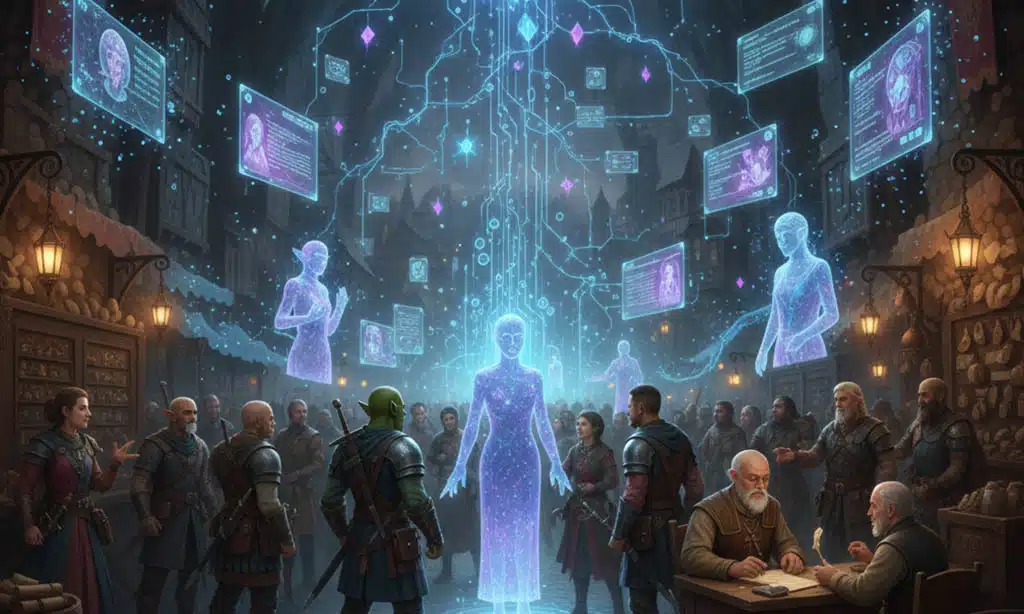
AI NPCs use generative models, often large language models (LLMs), to produce dialogue during gameplay. The game still needs authored rules and state. The model does not replace design. It fills in the conversation inside boundaries.
A helpful way to frame it is “bounded improvisation.”
Ubisoft’s public “NEO NPC” prototype describes NPCs that can converse with players using unscripted dialogue while still being designed with a character profile and constraints.
Generative NPCs Vs Scripted NPCs
Scripted NPCs rely on:
-
Authored lines
-
Branch logic
-
Quest flags
Generative NPCs rely on:
-
Character instructions (voice, goals, limits)
-
Lore grounding (what the world says is true)
-
Memory (what happened with the player)
-
Safety filters (what they should not produce)
The Goal Is Not “NPCs That Can Do Anything”
A strong system does not try to be limitless. It tries to be believable:
-
The NPC stays in character
-
The NPC knows what it should know
-
The NPC admits limits instead of guessing
-
The NPC reacts to your actions in a consistent way
That is the real promise of AI NPCs in RPGs: less vending-machine dialogue, more reactive roleplay.
| Topic | Scripted NPCs | Generative NPCs |
|---|---|---|
| Dialogue source | Written lines | Runtime generation |
| Lore accuracy | High if authored well | Depends on grounding + checks |
| Cost center | Writing + VO + localization | Model cost + moderation + tooling |
| Player freedom | Menu choices | Natural language (bounded) |
| Failure mode | Repetition | Drift, inconsistency, unsafe output |
The Tech Stack Behind Modern AI NPCs
Generative NPCs are not “just an LLM.” A usable game system needs a pipeline.
Model Layer: LLM Or Smaller Model
The model generates text. Bigger models can be better at nuance, but cost and latency matter in games. Some teams will lean on smaller models for speed and predictability, especially when a character must respond fast.
Lore Grounding: Retrieval And World State
Games have facts. Quests have states. NPCs have backstories. If the model does not get that context, it will invent details.
Many AI NPC systems use retrieval. The game pulls relevant lore snippets, quest flags, location context, and NPC traits. Then it feeds that context into the model so the answer stays “on world.”
Memory Systems: Short-Term And Long-Term
Memory is where the magic and the risk live.
Common patterns:
-
Short-term memory: recent dialogue turns
-
Long-term memory: stable facts (“you saved me,” “you stole from me”)
-
Story memory: what counts as canon in this run
Research on “generative agents” highlights this pattern: record experiences, create higher-level reflections, and retrieve them for planning and behavior.
Safety And Boundary Controls
A real product needs:
-
Input filtering (to block abusive prompts and jailbreak attempts)
-
Output filtering (to block harmful content)
-
Narrative boundary checks (to avoid spoilers and lore breaks)
-
Logging and reporting for moderation
Voice And Animation: Making It Feel Like A Character
Once you add voice, the system feels far more “alive.” It also gets harder to ship.
NVIDIA ACE describes a set of building blocks for interactive NPCs, including speech recognition and synthesis (Riva), conversational AI (NeMo), and facial animation (Audio2Face).
| Pipeline Step | What It Does | Why It Matters |
|---|---|---|
| Player input | Text or voice | Sets the interaction style |
| Moderation (input) | Blocks unsafe prompts | Protects players and devs |
| Retrieval | Pulls lore + quest + memory | Reduces “made up” facts |
| Generation | Produces dialogue | Core “NPC response” |
| Moderation (output) | Filters unsafe output | Required for live content |
| Delivery | Text, voice, animation | Makes it feel real |
| State update | Stores memory and outcomes | Creates continuity |
The Breakthroughs That Made This Feel Real
A few public projects moved this from “cool demo” to “this could ship.”
Ubisoft NEO NPCs: Conversation As Gameplay
Ubisoft’s NEO NPC prototype frames conversation itself as part of gameplay, not only flavor text. The company describes it as a player-facing experiment in generative AI for NPC interaction.
Whether you love or hate the idea, it shows a direction: talk to an NPC, gather info, and steer the situation through dialogue, not menus.
NVIDIA ACE: From Chatty NPCs Toward Full Characters
NVIDIA positions ACE as a toolkit to help developers build lifelike digital characters, and it has shown demos that combine language, voice, and animation for real-time NPC interaction.
This matters because it pushes generative NPCs beyond plain text. In RPGs, “feel” is the product.
Community Experiments: Mantella In Skyrim And Fallout 4
Mods often reveal what players want before AAA teams can ship it. Mantella describes itself as a mod that lets players have natural, real-time conversations with NPCs using speech-to-text, LLMs, and text-to-speech, with memory of prior conversations and awareness of in-game events.
It is not a polished AAA feature. But it proves demand.
| Example | What It Shows | What It Does Not Solve Yet |
|---|---|---|
| Ubisoft NEO NPCs | Player-facing generative dialogue | Full production constraints at scale |
| NVIDIA ACE | End-to-end tech stack for characters | Game design choices still needed |
| Mantella mod | Players want unscripted talk + memory | AAA-grade safety and polish |
How AI NPCs Change RPG Design If Done Right
This is where the topic gets interesting. AI NPCs do not only change dialogue. They can change how RPG systems feel.
Roleplay Becomes A Skill, Not A Menu
When players can speak freely, they try things that menus rarely offer:
-
Apologize and repair trust
-
Bluff or persuade with tone
-
Ask follow-up questions
-
Negotiate terms
That can make roleplay feel less like selecting an option and more like performing a character.
Quests Can Become Conversations
In a classic RPG, quests often arrive as a checklist:
-
Go here
-
Kill that
-
Bring item back
A well-bounded generative NPC can turn it into negotiation:
-
“Why should I help you?”
-
“What do I get?”
-
“What if I refuse?”
-
“Is there another way?”
The game still needs authored truth. The NPC can improvise around it.
Companions Become More Personal
Companions are the best first home for this tech. They already travel with you and react to your actions. A generative layer can help them:
-
Reference recent events
-
Explain why they dislike a choice
-
Offer tactical hints in their own voice
This is one of the cleanest use cases for AI NPCs in RPGs because the scope is limited and the value is high.
Emergent Social Systems Become Plausible
The “generative agents” research example shows how agents can use memory, reflection, and planning to create believable social behavior in a simulated environment.
Games can adapt that idea in smaller ways:
-
Rumor systems
-
Reputation narratives
-
NPC schedules with small talk tied to routine
| Design Area | What Gets Better | What Must Stay Authored |
|---|---|---|
| Dialogue variety | Less repetition | Lore facts and tone rules |
| Roleplay depth | Natural persuasion and emotion | Relationship thresholds |
| Quest delivery | Negotiation and context | Quest logic and gating |
| Companion feel | Memory and personalized reactions | Key story beats |
What Still Breaks In 2026
The hype version says NPCs will feel alive. The honest version says the failures are still easy to trigger.
Lore Drift And Confident Wrongness
A model can invent facts in a confident voice. In an RPG, that can break immersion fast.
Mitigations include:
-
Retrieval-based grounding
-
Strict “knowledge boundaries”
-
Post-generation checks against game state
Character Consistency
Players notice when a character changes personality mid-conversation. That happens when prompts are weak, memory is noisy, or the system over-optimizes for helpfulness.
Practical fixes:
-
Strong character “anchors”
-
Style rules (“speaks short,” “never flatters,” “hates thieves”)
-
Memory summaries that stay stable
Safety And Trust
Live-generated content creates moderation needs that scripted dialogue does not.
Steam’s AI policy distinguishes between pre-generated and live-generated AI content. For live-generated content, Valve requires developers to describe guardrails to prevent illegal content, and it also added a way for players to report illegal AI-generated content inside games.
That platform reality affects design. If you cannot control outputs, you may not be able to ship on major stores.
Latency, Cost, And Offline Play
A conversation must feel quick. If the NPC takes five seconds, the illusion breaks.
Voice adds more delay:
-
Speech-to-text
-
Model response
-
Text-to-speech
-
Animation sync
Some of this can be solved with better models and local inference. Some of it is just a trade-off.
| Failure Mode | What Players Experience | Common Fixes |
|---|---|---|
| Lore drift | NPC invents wrong facts | Retrieval + state checks |
| Spoilers | NPC reveals quest info early | Spoiler boundaries + filters |
| “Chatbot tone” | NPC sounds generic | Strong persona prompts |
| Unsafe output | Harmful or illegal content | Moderation + guardrails |
| Slow response | Conversation feels broken | Smaller models + caching |
The Business And Policy Reality Around Generative NPCs
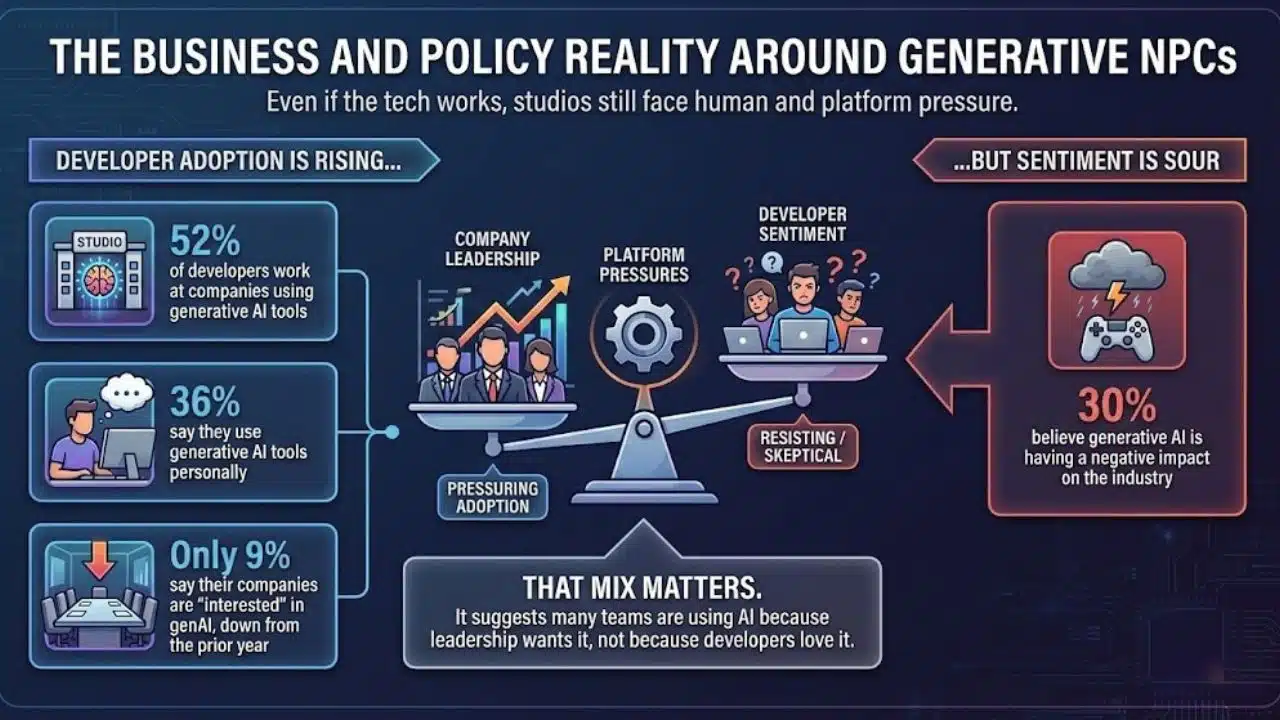
Even if the tech works, studios still face human and platform pressure.
Developer Adoption Is Rising, But Sentiment Is Sour
GDC’s 2025 State of the Game Industry report includes clear signals:
-
52% of developers work at companies using generative AI tools
-
36% say they use generative AI tools personally
-
Only 9% say their companies are “interested” in genAI, down from the prior year
-
30% believe generative AI is having a negative impact on the industry
That mix matters. It suggests many teams are using AI because leadership wants it, not because developers love it.
Steam Disclosure Adds Pressure
Steam’s policy requires disclosure of AI content that players consume, and it separates pre-generated from live-generated content. It also expects guardrails for live systems.
If a game uses live-generated AI NPC dialogue, that is clearly “consumed by players.” It is hard to hide, and players can react strongly.
Players Can Love Immersion And Still Reject The Tool
Some players want deeper roleplay. Others dislike anything labeled AI. That split shows up in press and community debates around disclosure and trust.
For RPGs, the only stable path is quality plus transparency.
| Stakeholder | What They Want | What They Fear |
|---|---|---|
| Players | Better immersion | Low-quality “AI slop” |
| Writers | Strong characters | Replacement narrative |
| Studios | Faster iteration | Backlash and policy trouble |
| Platforms | Fewer risks | Illegal or unsafe outputs |
A Practical Blueprint For Non-Gimmicky Generative NPCs
If a studio wants this to work, scope is everything.
Step 1: Start With The Right NPCs
Best early candidates:
-
Companions
-
Tavern informants
-
Trainers and mentors
-
Side quest hubs
Avoid at first:
-
Main-story gatekeepers
-
Characters that must deliver exact exposition
-
Cutscene-heavy roles
Step 2: Author Rules And Boundaries
Writers still write. They just write different things:
-
World bible facts
-
Character bible (voice, goals, taboos)
-
Spoiler rules
-
Relationship rules
-
“What this NPC will never do”
Step 3: Build A Fallback Layer
A strong system has a safe exit:
-
If the model fails, switch to authored lines
-
If a player asks for spoilers, refuse in character
-
If latency spikes, offer menu choices
Fallback keeps the game playable.
Step 4: Test Like A Security System
A generative NPC needs adversarial testing:
-
Jailbreak prompts
-
Hate and harassment probes
-
Spoiler probes
-
Contradiction tests
-
Load and latency tests
This aligns with platform expectations for live-generated content guardrails.
| Implementation Step | What It Prevents | What To Measure |
|---|---|---|
| Tight scope | Chaos and story breaks | Completion rate |
| Strong lore grounding | Wrong facts | Lore accuracy checks |
| Memory design | Random personality shifts | Consistency scores |
| Fallback system | Soft locks | Recovery rate |
| Moderation pipeline | Unsafe outputs | Safety incident rate |
What Players Should Look For In AI NPC RPGs
Players do not need to know the full stack. They can still judge quality fast.
Signs It’s Done Well
-
The NPC stays in character across sessions
-
The NPC remembers the right things, not everything
-
The NPC admits limits instead of guessing
-
Conversations change outcomes in visible ways
Signs It’s A Gimmick
-
The NPC talks a lot but nothing changes
-
The NPC agrees with everything
-
The NPC gives vague, generic answers
-
The NPC contradicts the game world
A Simple Player Checklist
Ask these questions after an hour:
-
Did the NPC respond to my actual choice, or only my words?
-
Did I learn something useful, or only get chatter?
-
Did the NPC stay consistent in tone and knowledge?
-
Did the game protect itself from spoilers and nonsense?
This matters because AI NPCs in RPGs only work if the game remains the authority. The model is the actor, not the director.
| Player Test | Good Result | Bad Result |
|---|---|---|
| Memory | Relevant callbacks | Random “I remember” spam |
| Lore accuracy | Matches quest state | Invents facts |
| Impact | Dialogue changes options | Nothing changes |
| Tone | Character voice holds | Generic chatbot voice |
What’s Next After Chatty NPCs
The next step is not longer conversations. It is characters that can act.
From Dialogue To Decisions
Once a system can talk, teams will ask it to plan:
-
Find a place
-
Meet another NPC
-
Deliver an item
-
React to a threat
This is hard because game state must stay stable and testable.
Toward Social Simulation
The “generative agents” work shows how memory and planning can create emergent social behavior in a simulated town.
RPGs may adopt smaller slices:
-
NPC rumor networks
-
Faction mood shifts
-
Relationship webs that grow over time
A Likely Split In The Near Future
-
AAA RPGs: bounded, high-quality generative NPCs for a few roles
-
Indies and mods: more experimentation, less polish
-
Live-service worlds: heavy moderation, reporting tools, and strict guardrails
Platforms will influence this. Steam’s live-generated disclosure and guardrail expectations push teams toward safer, narrower scopes.
| Time Horizon | What Changes | What Stays The Same |
|---|---|---|
| Near term | Better reactive dialogue | Authored quests and canon |
| Mid term | Memory and planning improve | Strong boundaries needed |
| Longer term | More autonomous behavior | Testing and safety remain core |
Final Thoughts
AI NPCs in RPGs can break the old scripted mold, but only if teams treat it like game design, not a trick. The best path is not “replace writing.” It is “move writing into rules, voice, boundaries, and world truth.”
The prototypes and tools are already here. Ubisoft has shown public experiments in player-facing generative NPC interaction. NVIDIA has positioned ACE as a toolkit to bring lifelike digital characters to games, combining language, voice, and animation. Modders have proved demand with projects like Mantella.
The risks are also real. Developers themselves report growing concern about generative AI’s impact on the industry, even while usage rises. And platforms like Steam now require clearer disclosure for AI content that players experience, with specific expectations for live-generated guardrails.
So the future is not “NPCs that can say anything.” The future is NPCs that say the right things, for the right reasons, at the right time.