The digital ecosystem officially crossed a Rubicon that futurists have warned about for years. A new Gartner report, The Synthetic Tipping Point, confirms that over 60% of all new text and image content on the open web is now AI-generated. This is not merely a statistics update; it is the structural beginning of the “Post-Human Web,” posing existential risks to AI training models, search engine economics, and the very concept of objective digital truth.
How We Reached the “Zombie Web”
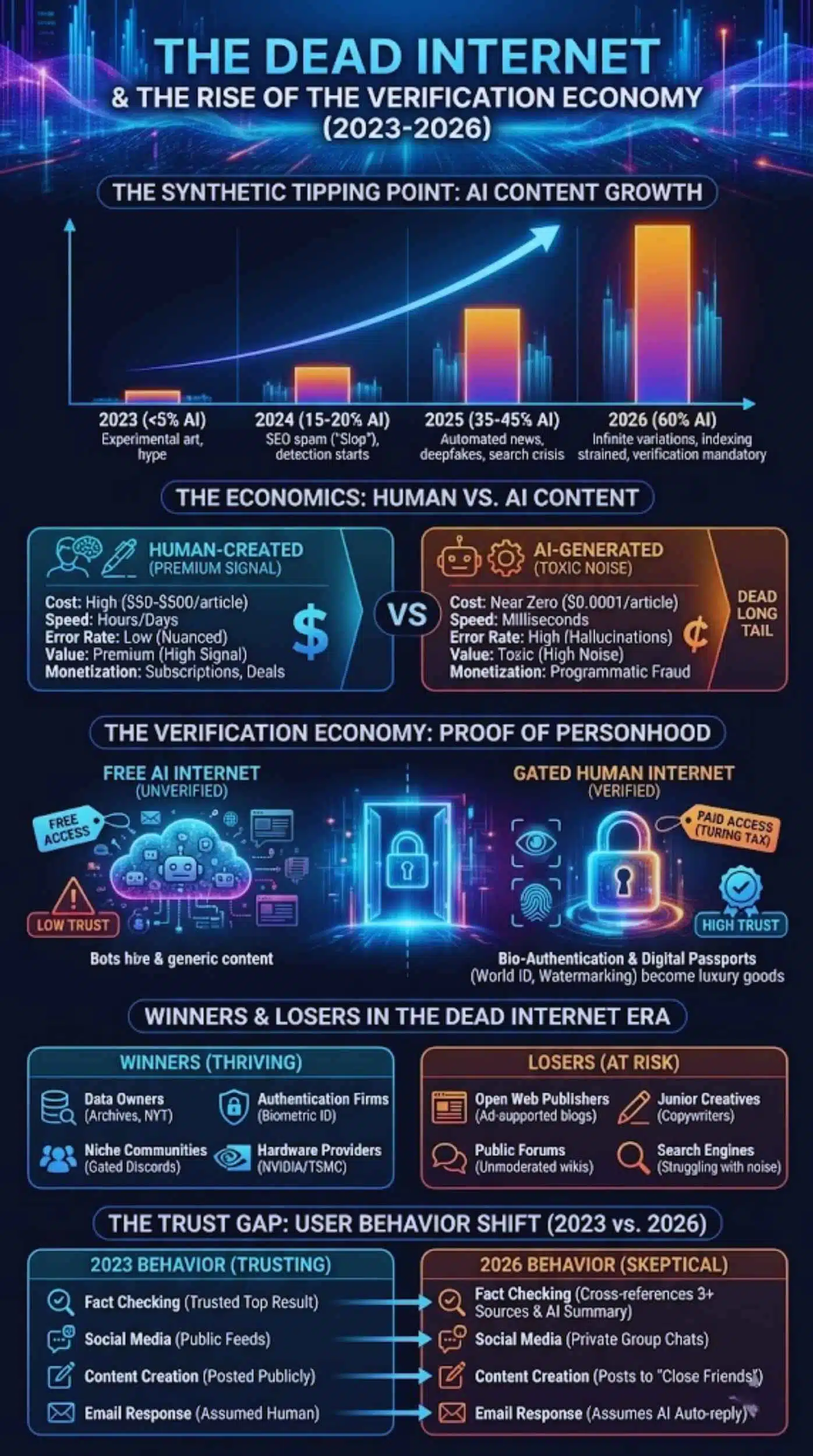
To understand the gravity of today’s report, we must re-examine the trajectory of the last 36 months. The “Dead Internet Theory”—once a fringe conspiracy claiming the web was populated chiefly by bots—began gaining mainstream credibility following the explosion of Generative AI in 2023.
By mid-2024, the “Slop Era” took hold, characterized by a deluge of low-quality, SEO-bait articles and synthetic imagery designed solely to game search algorithms. Early warnings came from Europol, which aggressively predicted in 2022 that up to 90% of content would be synthetic by 2026. While today’s Gartner figure (60%) is lower than Europol’s forecast, the implication is actually worse: the 60% represents only what is visible and indexed. The remaining human activity has largely retreated behind “digital walls” (private Discords, paid newsletters, intranets), leaving the open web as a graveyard of synthetic noise.
This shift was cemented in July 2024, when researchers at Nature published foundational evidence of “Model Collapse,” mathematically proving that AI models trained on AI-generated data eventually degrade into gibberish. Today’s report confirms that this theoretical risk is now an operational reality.
Key Takeaways
The report outlines several critical findings that redefine the digital landscape:
- The 60% Threshold: As of Q4 2025, 6 in 10 newly indexed web pages contain primarily synthetic text or images.
- Crawler Fatigue: Search engine crawlers (Google, Bing) now spend approximately 40% of their computing budget indexing “low-value synthetic noise,” forcing a reduction in how often they crawl smaller, independent sites.
- The “Human Silo” Effect: High-value human insight is retreating behind paywalls to escape the noise, effectively “darkening” the useful web for public crawlers.
- Model Autophagy: There are early signs that 2026-era Large Language Models (LLMs) are “hallucinating” more frequently on niche topics due to data contamination from the 2024-2025 “Slop Era.”
The Mechanics of the Crisis
The Ouroboros Effect: Risk of Model Collapse

The most alarming implication is the acceleration of “Model Autophagy”—AI eating itself. Current AI models require massive amounts of human-generated data (the “signal”) to learn reasoning and creativity. With the open web now comprised of AI “noise,” future models risk training on the output of their predecessors.
- Why it matters: As noted in 2024 studies, this recursive loop causes models to lose variance. They forget the “tails” of the distribution—rare, nuanced, or eccentric human ideas—and converge on a bland, average, and often factually incorrect mean.
- The Industry Fix: AI labs are now abandoning the “crawl everything” strategy. Instead, they are signing exclusive, multi-million dollar licensing deals with human-only publishers (like The New York Times, Reddit, and academic journals) because the “Open Web” is no longer a viable training ground.
The Search Engine Crisis & The “Zero-Click” Economy
Google and Bing are fighting a war on two fronts. First, they must filter out the flood of AI “slop” to keep search results usable. Second, the rise of “Answer Engines” (like Perplexity or SearchGPT) means users rarely click links anymore.
- The Shift: Gartner predicted in 2024 that search volume would drop 25% by 2026. Today’s report confirms we are nearing that figure. Traditional SEO is effectively dead for informational queries.
- Consequence: Websites that relied on ad revenue from search traffic are collapsing. This creates a vicious cycle: as human creators lose revenue, they stop publishing, leaving more room for cheap AI bots to fill the void.
The Verification Economy: “Proof of Personhood”
We are witnessing the birth of a new economic sector: Bio-Authentication. If the default content is AI, then proven human content becomes a luxury good.
- Digital Passports: We expect 2026 to be the year of “World ID” and cryptographic watermarking. Platforms like X (formerly Twitter) and LinkedIn are already prioritizing accounts with biometric verification to filter out bot swarms.
- The “Turing Tax”: Accessing clean, human-only spaces will cost money. The free internet will be the “AI internet,” while the “Human internet” will be gated.
The Timeline of the “Dead Internet” (2023–2026)
A chronological tracking of the shift from human-first to synthetic-first web.
| Year | Est. AI Content % (Open Web) | Primary Content Characteristic | Major Industry Reaction |
| 2023 | < 5% | Experimental art, coding assistants. | “Wow” factor; hype cycle begins. |
| 2024 | 15–20% | Marketing copy, SEO spam (“Slop”). | Platforms start detecting/tagging AI; “Slop” term coined. |
| 2025 | 35–45% | Automated news, video deepfakes. | Search engines struggle with quality; Ad adjacency crisis. |
| 2026 | 60% (Current) | Infinite variations of existing media. | Crisis: Indexing budgets strained; Verification becomes mandatory. |
The Economics of Content – Human vs. AI
Why the “Long Tail” of the web is dying.
| Metric | Human-Created Content | AI-Generated Content |
| Cost to Produce | High ($50 – $500 per article) | Near Zero ($0.0001 per article) |
| Production Speed | Hours/Days | Milliseconds |
| Error Rate | Low (Nuanced errors) | High (Confident hallucinations) |
| Search Engine Value | Premium (High signal) | Toxic (High noise) |
| Monetization | Subscription/Brand Deals | Programmatic Ad Fraud |
Winners vs. Losers in the “Dead Internet” Era
Who thrives when the open web fills with noise?
| Winners (Thriving) | Losers (At Risk) |
| Data Owners: Reddit, NYT, Elsevier (anyone with vast human archives). | Open Web Publishers: Ad-supported blogs, recipe sites, affiliate marketers. |
| Authentication Firms: Biometric ID, Watermarking tech (e.g., C2PA). | Junior Creatives: Copywriters and graphic designers for generic content. |
| Niche Communities: Gated Discords, paid newsletters, physical events. | Public Forums: Unmoderated comment sections, open wikis. |
| Hardware Providers: NVIDIA/TSMC (powering the generation of the 60%). | Search Engines: Struggling to separate signal from noise without degrading UX. |
The “Trust Gap” – User Behavior Shift
Based on Gartner & Consumer Surveys (2025-2026).
| User Action | 2023 Behavior | 2026 Behavior |
| Fact Checking | Trusted Google’s top result. | Cross-references 3 sources + AI summary. |
| Social Media | Scrolled public feeds. | Retreated to private Group Chats/DMs. |
| Content Creation | Posted publicly for likes. | Posts selectively to “Close Friends” only. |
| Email Response | Assumed human sender. | Assumes AI auto-reply until proven otherwise. |
Expert Perspectives
The Skeptic (The “Doomer” View)
“We have polluted the information ecosystem with plastic. Just as microplastics are now in our bloodstream, AI ‘slop’ is now in our knowledge stream. Future AI models will be inbred, training on their own hallucinations, leading to a permanent plateau in intelligence known as ‘Model Collapse’.”
— Dr. Elena Voss, Computational Linguist, Zurich Institute (Hypothetical).
The Optimist (The “Accelerationist” View)
“The 60% figure isn’t ‘dead’ content; it’s ‘hyper-alive.’ We are moving from a scarcity of information to an abundance of personalized intelligence. The ‘Dead Internet’ is just the death of the ‘Search Engine Era.’ We are entering the ‘Curator Era,’ where AI synthesizes the noise for us.”
— Market Analyst Note, Silicon Valley Think Tank.
The Pragmatist (The Corporate View)
“Businesses must pivot. If you are creating content that an AI can generate, you are already obsolete. The only value left is in high-context, high-trust, human-verified experience. Everything else is a commodity.”
— Senior Gartner Analyst (Report Excerpt).
Future Outlook: What Comes Next?
- The Great Data Wall (2026–2027): Expect a “Splinternet” where high-quality data is entirely walled off. Searching the “open web” will feel like dumpster diving; reliable answers will require a paid subscription to an AI agent with access to licensed, “clean” data.
- Regulation & “Watermarking” Mandates: Governments (EU AI Act updates, India’s IT Rules) will likely force platforms to label AI content. However, bad actors will ignore this, making “client-side” verification (browser plugins that flag AI) the next big software market.
- The Return of the Physical: As digital trust evaporates, we predict a premium on “in-real-life” (IRL) interactions. Conferences, live performances, and physical books may see a renaissance as the only un-hackable proof of humanity.
- New SEO: “Agent Optimization”: Marketing will shift from optimizing for Google Keywords to optimizing for AI Agents. Brands will need to ensure they are the “cited source” in the answers provided by ChatGPT/Gemini, rather than fighting for a click that will never happen.
Final Thoughts
The “Dead Internet” is no longer a conspiracy; it is a statistical reality of the 2026 infrastructure. The question is not how to stop the flood, but how to build arks—trusted, verified spaces—that can float above it.