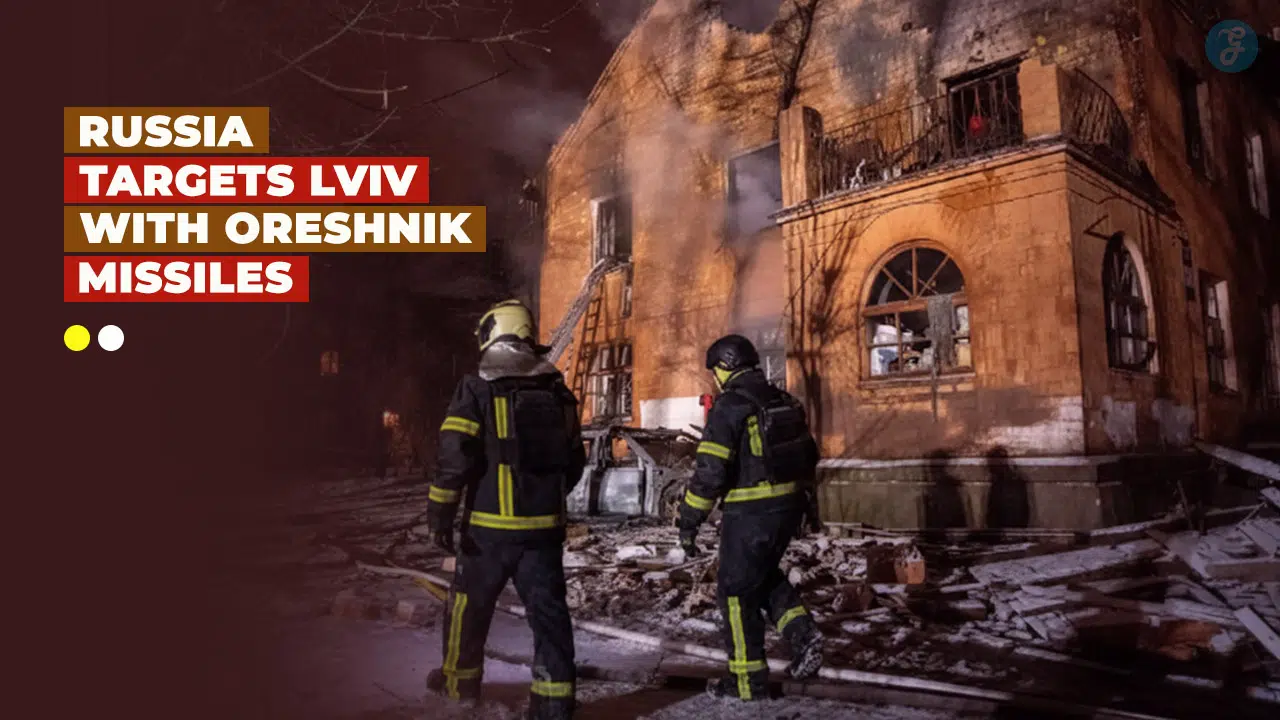
Russia’s January 9 strike on Lviv using the Oreshnik intermediate-range ballistic missile (IRBM) marks a calculated escalation.1 By targeting Western Ukraine’s logistics heart with a weapon nearly impossible to intercept, Moscow is signaling that no “safe harbor” remains for NATO aid or energy infrastructure, regardless of distance from the front.
The Road to Lviv: From Warning to Action
The trajectory to this moment began in November 2024, when Russia first unveiled the “Oreshnik” (Hazelnut) missile in a strike on Dnipro.2 At the time, analysts debated whether the weapon—a conventionally armed IRBM derived from RS-26 Rubezh technology—was a one-off experimental warning or a new standard in Moscow’s arsenal. For nearly 14 months, the weapon remained largely absent from the theater, leading many to dismiss it as a “wonder weapon” prototype with limited stock.
That complacency ended last week. The strike on Lviv, specifically targeting critical infrastructure near the Polish border (suspected to be energy storage and logistics transfer points), fundamentally alters the risk calculus.3 Unlike the Dnipro strike, which hit an industrial city relatively close to the front, the Lviv attack pierces the “strategic depth” of Ukraine, directly threatening the primary artery for Western military assistance and the safety of European energy security.
Strategic Signaling: The Kinetic Message
The use of the Oreshnik against Lviv is less about the physical damage caused and more about the message sent to Kyiv and Washington.
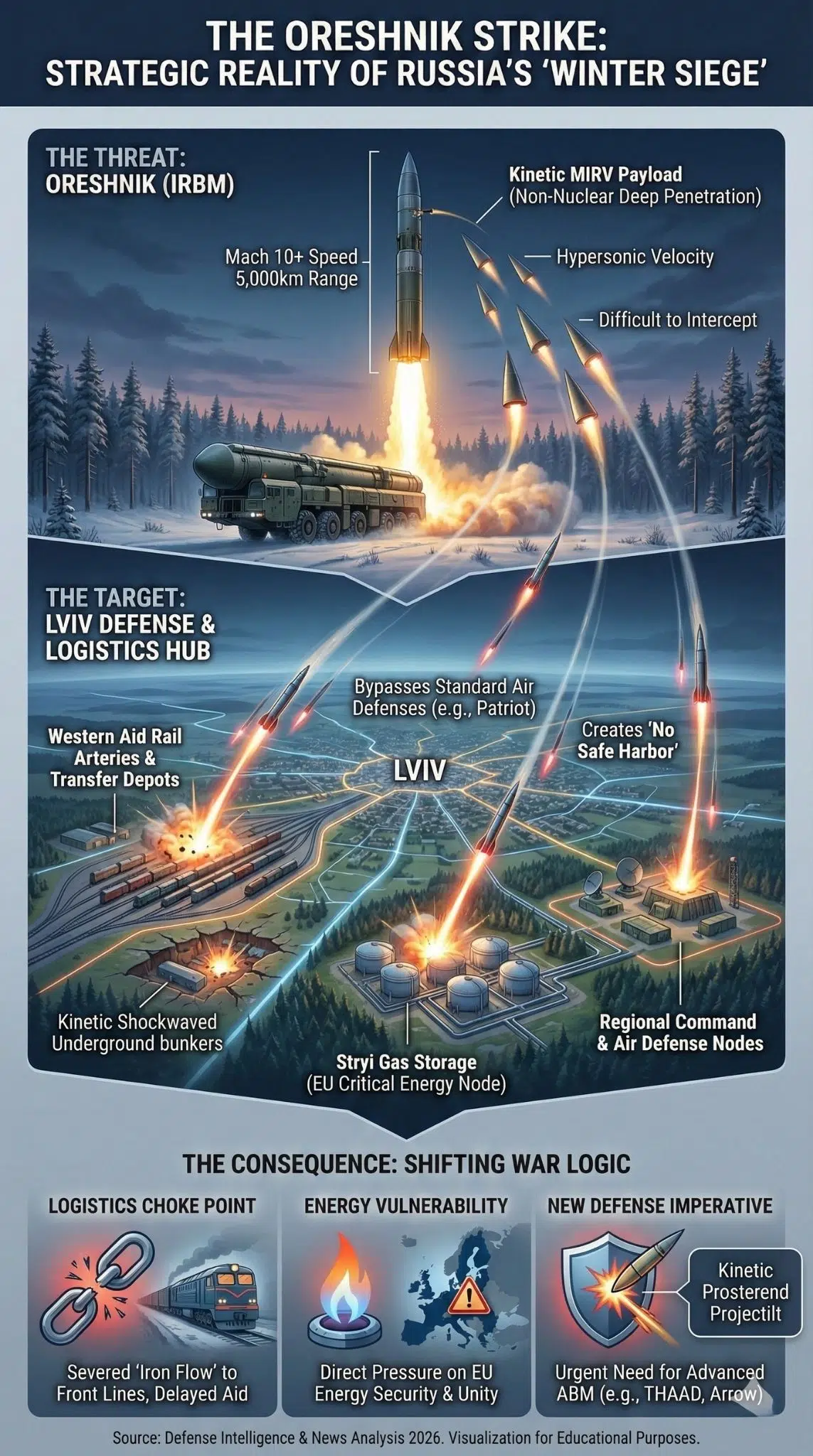
- Psychological Warfare: The missile reportedly carried a kinetic (inert) payload or a non-nuclear conventional warhead.4 The sheer velocity (Mach 10+) creates a kinetic impact comparable to a meteorite, capable of penetrating deep underground bunkers without high explosives.5 This demonstrates that Russia can destroy fortified command centers or gas storage facilities without crossing the nuclear threshold.6
- The “Unstoppable” Narrative: By using a weapon with Multiple Independently-targetable Reentry Vehicles (MIRVs), Russia is forcing Ukraine to confront a threat its current air defenses (including Patriot PAC-3s) struggle to counter reliably.7 It creates a sense of vulnerability in Lviv, a city that has functioned as a relative sanctuary and diplomatic hub.
The “Oreshnik” Factor: Tech Hype vs. Reality
While Russian propaganda frames the Oreshnik as a revolutionary hypersonic breakthrough, technical analysis suggests a more nuanced reality.8 It is likely a repackaging of Cold War-era ICBM technology stripped of nuclear payloads to serve a conventional role.
- Cost-Benefit Disparity: Launching an IRBM is prohibitively expensive for conventional warfare. A single launch can cost tens of millions of dollars. Using such a high-value asset against infrastructure suggests the target was high-priority, or the political value of the strike outweighed the military cost.
- The Supply Question: Intelligence reports indicate Russia’s stockpile of these airframes is limited. This suggests the “Winter Siege” on Lviv may not be a sustained bombardment campaign but rather a series of punctuated, high-visibility strikes designed to erode morale and force Ukraine to the negotiating table under unfavorable terms.
Lviv’s Vulnerability: The Logistics Choke Point
Lviv is the throat through which Ukraine breathes. As the primary entry point for NATO supplies and the hub for refugees and diplomatic missions, its security is paramount.9
- The Energy Dimension: The strike reportedly targeted infrastructure linked to the Stryi gas storage facility—the largest in Europe.10 This facility is crucial not just for Ukraine, but for the EU’s energy resilience. Targeting it places direct pressure on European capitals to push for a ceasefire or risk energy instability.
- Logistical Bottlenecks: By demonstrating the ability to strike railheads and transfer depots in Lviv with precision, Russia is threatening to sever the “Iron Flow” of munitions reaching the Donbas front lines.
Diplomatic and Political Fallout
The timing—occurring shortly after U.S. diplomatic overtures and amidst a harsh winter—is not coincidental.
- Testing Western Resolve: The strike challenges the incoming or current U.S. administration’s (referencing the 2026 timeline) stance on escalation. It effectively asks: “Will you provide Ukraine with THAAD or Aegis Ashore systems to counter this, or will you back down?”
- Internal Pressure on Zelensky: With the front lines grinding slowly and energy deficits mounting, strikes on Lviv bring the war home to the most pro-Western, nationalist stronghold of Ukraine, potentially straining internal political unity.
Comparative Analysis: The Weapon Systems
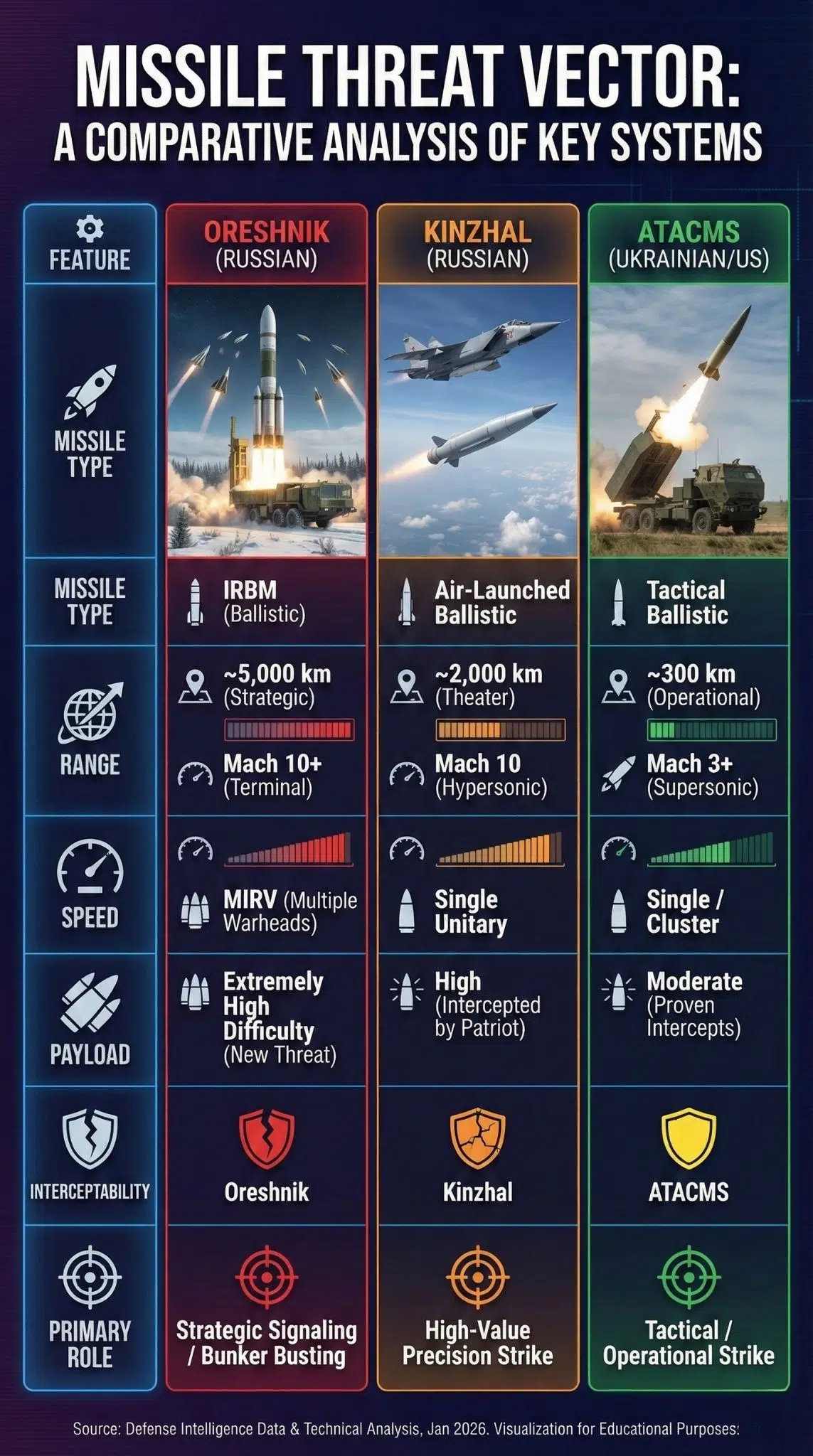
To understand the shift in threat level, we must compare the Oreshnik to other key missile systems used in the conflict.
| Feature | Oreshnik (Russian) | Kinzhal (Russian) | ATACMS (Ukrainian/US) |
| Type | IRBM (Ballistic) | Air-Launched Ballistic | Tactical Ballistic |
| Range | ~5,000 km | ~2,000 km | ~300 km |
| Speed | Mach 10+ (Terminal) | Mach 10 | Mach 3+ |
| Payload | MIRV (Multiple Warheads) | Single Unitary | Single / Cluster |
| Interceptability | Extremely High Difficulty | High (Intercepted by Patriot) | Moderate |
| Primary Role | Strategic Signaling / Bunker Busting | High-Value Precision Strike | Tactical / Operational Strike |
Strategic Impact: Lviv’s Role
| Aspect | Lviv Before 2025 | Lviv in Jan 2026 (Post-Strike) |
| Security Status | Relative “Safe Zone” / Rearguard | Frontline Vulnerability |
| Primary Function | Humanitarian & Diplomatic Hub | Contested Logistics Choke Point |
| Air Defense | Standard Layered Defense | High-Priority Gap (Needs THAAD/Arrow) |
| Energy Role | Stable Transit Node | Threatened Storage Criticality |
Expert Perspectives
“The Oreshnik strike is a textbook example of ‘escalate to de-escalate’ within the conventional sphere. Russia is using strategic-grade delivery systems to deliver tactical effects, signaling that they have climbed a rung on the escalation ladder that Ukraine cannot match without direct Western intervention.” — Dr. Elena K., Senior Fellow at the Institute for Modern War Studies.
“Technically, the Oreshnik is not new physics. It’s old Soviet rocketry with a new mission. However, the physics of a kinetic reentry vehicle hitting Lviv at Mach 10 are undeniable.11 It essentially turns a telephone pole made of tungsten into a bunker buster.” — Markus T., Defense Systems Analyst.
Future Outlook: What Comes Next?
- Air Defense Re-shuffling: Ukraine will likely demand upgraded anti-ballistic missile (ABM) systems capable of exo-atmospheric interception (like THAAD). This will spark a new debate in Washington and Brussels.
- Targeting of Gas Storage: If Russia continues to target the Stryi gas infrastructure, European gas prices could see a volatility spike, testing EU unity regarding sanctions and aid.
- Asymmetric Response: Expect Ukraine to intensify long-range drone strikes against Russian missile production facilities (like Kapustin Yar) in an attempt to hit the Oreshnik at its source.
- Diplomatic Freeze: Any “peace plans” circulating in early 2026 will likely be frozen as Kyiv refuses to negotiate under the gun of a new strategic threat, and Moscow feels emboldened.
Final Words
The Oreshnik strike on Lviv is more than a military attack; it is a geopolitical statement. It erases the concept of a “safe rear” in Ukraine and challenges the West to either upgrade Ukraine’s defensive shield significantly or accept that Russia can hold all of Europe’s eastern flank hostage to hypersonic coercion.