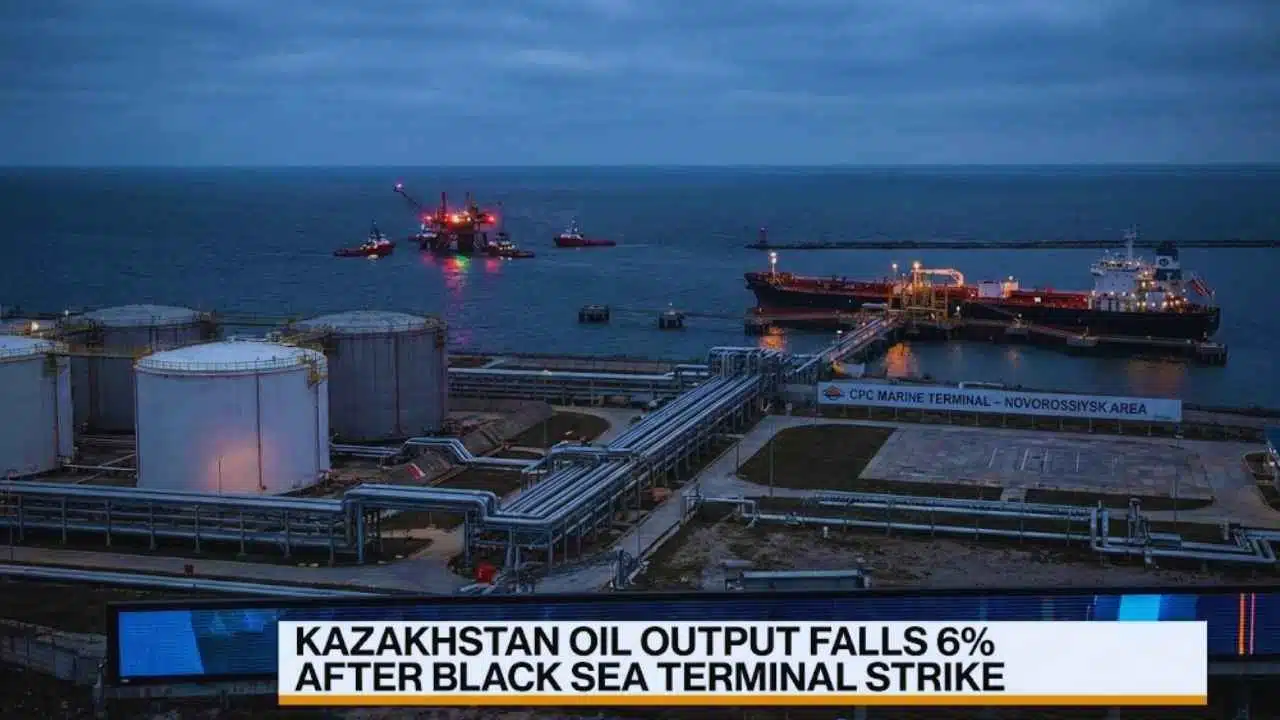
Kazakhstan oil output slipped about 6% in December after a Ukrainian naval-drone strike damaged a vital Black Sea loading point used to ship most of the country’s crude, forcing emergency reroutes and raising risks to revenue and production targets.
What Happened And Why It Matters
Kazakhstan is one of the world’s biggest oil producers, and most of its crude reaches global markets through the Caspian Pipeline Consortium (CPC) route to Russia’s Black Sea coast near Novorossiysk.
On November 29, an unmanned surface (naval) drone attack severely damaged Single Point Mooring No. 2 (SPM-2) at the CPC marine terminal. The incident reduced the terminal’s loading capacity because:
- SPM-2 was knocked out and later described as not feasible to operate further in its damaged condition.
- SPM-3 was already offline for maintenance.
- Only SPM-1 remained in service, effectively cutting loading capacity roughly in half for a period.
With fewer tankers able to load, crude backed up in the system. Kazakhstan had to slow production and rapidly shift some flows to costlier, more complex export routes—moves that still cannot fully replace CPC volumes.
Kazakhstan’s December Output: The Key Numbers
Industry data for December 1–28 shows Kazakhstan’s oil and gas condensate output fell to about 1.93 million barrels per day, down from November averages. The biggest hit was at Tengiz, the country’s largest oilfield (operated by Chevron), where output fell by roughly 10% over the same period.
Table: Production And Export Impact (December vs. November)
| Metric | November Baseline | December (Approx.) | Change |
|---|---|---|---|
| Kazakhstan oil + condensate output | Higher than Dec | ~1.93 million bpd | ~6% down |
| Tengiz output | Higher than Dec | ~719,800 bpd | ~10% down |
| CPC Blend exports via Novorossiysk | Higher than Dec | ~1.082 million bpd | Down sharply (near 14-month low) |
Note: Figures reflect industry/official routing and loading updates reported in late December, covering Dec. 1–28 performance and CPC Blend loadings.
The Export Terminal Bottleneck
The CPC marine terminal typically relies on multiple offshore mooring points to load large tankers. After the November 29 strike, port authorities halted loading and moved ships out of the area. With only one mooring point operating, CPC had to revise loading plans downward.
Bad weather in the Black Sea also slowed diving and repair work at points in December, prolonging the bottleneck. Even when partial operations resumed, reduced loading capacity kept exports below normal.
This matters because CPC is the main “pressure valve” for Kazakhstan’s upstream production. When exports slow, storage fills up and producers must cut output or face operational constraints.
Diplomatic Fallout: Kazakhstan Protests Ukraine
Kazakhstan’s Foreign Ministry issued a formal protest, calling the incident the third attack this year on what it described as a civilian facility protected under international law. The government also warned that such incidents threaten freedom of navigation and broader international norms.
For Kazakhstan, the sensitivity is obvious: the country is not a direct party to the conflict, but its economy is heavily tied to uninterrupted oil exports.
Rerouting Oil: What Kazakhstan Is Doing Instead
Kazakhstan’s pipeline operator and government moved quickly to reroute volumes—mainly through three channels:
- Baku–Tbilisi–Ceyhan (BTC) corridor (via the Caspian/port chain): Additional shipments were scheduled through Aktau and onward toward the BTC system—an option that bypasses Russia but involves extra logistics and maritime steps.
- Atyrau–Samara route (northbound): Kazakhstan increased flows via Atyrau–Samara into Russia’s pipeline network. Some of these volumes can ultimately move toward European destinations depending on routing and contracts.
- Direct shipments to China (including a new Kashagan-to-China move): Kazakhstan arranged a first-time shipment of Kashagan crude toward China via existing infrastructure, including the Atasu–Alashankou pipeline link.
Emergency Diversions Announced For December
| Route / Destination | Incremental Volume Mentioned For December | Notes |
|---|---|---|
| Port of Aktau → BTC corridor | +58,000 tons | More steps/logistics, but bypasses the CPC bottleneck |
| Atyrau–Samara | +232,000 tons | Uses Russia’s system; may face higher costs/constraints |
| China (incl. Kashagan-linked volumes) | +72,000 tons | Includes first-time Kashagan volumes toward China |
These diversions help—but they do not fully replace CPC capacity. They also tend to be more expensive per barrel and require careful scheduling across multiple operators and transit points.
The Tengiz Expansion: Big Plans Meet A Tight Exit
The timing is especially difficult because Tengiz has been in a major ramp-up phase after a multibillion-dollar expansion designed to lift production significantly.
When export infrastructure tightens, producers can’t always sustain higher output, even if the field itself can produce more. In practice, a constrained export route can:
- force temporary production reductions,
- delay achieving targeted output plateaus, and
- compress government revenues and company cash flows.
For global markets, any sustained disruption on a route linked to about 1% of global crude supply can add to supply anxiety—especially when the disruption coincides with other geopolitical risks.
Who Owns CPC And Why That Complicates The Picture
CPC is jointly owned by a mix of state and international shareholders, including Russian and Kazakh state-linked entities and large oil companies. That structure matters because:
- Operational decisions must balance multiple stakeholders.
- Repair timelines and regulatory approvals can be politically sensitive.
- The route is strategically important for both Kazakhstan’s economy and international producers exporting Kazakh crude.
What Happens Next
Several near-term factors will shape Kazakhstan’s oil outlook:
- Repair progress and weather windows at the Black Sea terminal.
- Availability of alternative capacity (BTC chain, Atyrau–Samara, China-bound lines).
- Production management at major fields such as Tengiz and Kashagan to avoid storage constraints.Geopolitical risk, including whether strikes on energy-related infrastructure continue or expand.
If CPC returns closer to normal loading rates, Kazakhstan could stabilize output. If constraints persist, Kazakhstan may face continued production management—and potentially higher unit transport costs that erode net export revenue.
Kazakhstan’s December production drop shows how quickly a single infrastructure hit can ripple through a major exporter’s entire oil system. With CPC handling most of Kazakhstan’s crude exports, reduced loading capacity translated into lower output, emergency reroutes, and renewed questions about how resilient the country’s export options really are. The next key watchpoint is whether CPC loading capacity normalizes—and how quickly Kazakhstan can restore stable export flows without sacrificing field performance.