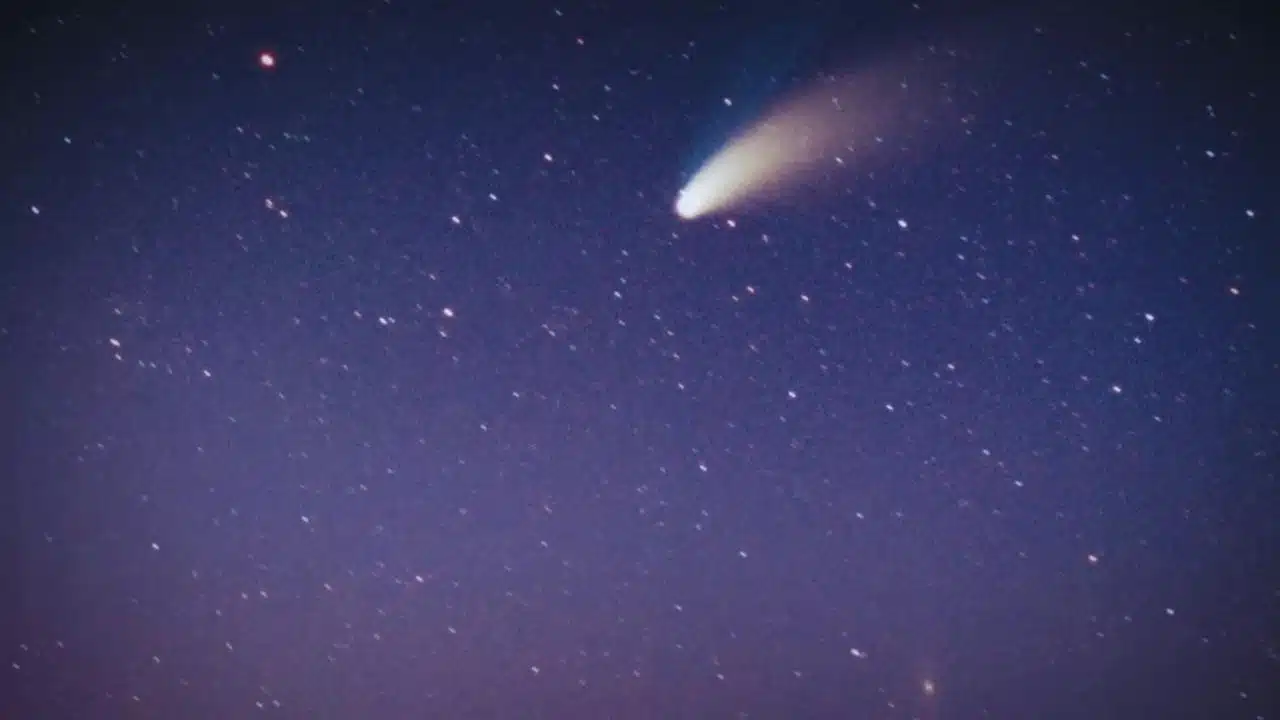
A new Dec. 26, 2025 image shows interstellar comet 3I/ATLAS staying oddly compact and lopsided after perihelion, as astronomers track its March 2026 flyby of Jupiter for clues to its strange activity.
What’s happening with 3I/ATLAS — and why scientists care
Comet 3I/ATLAS is only the third confirmed interstellar object ever found passing through our solar system, meaning it arrived from beyond the Sun’s gravitational family and will not return. NASA classifies it as interstellar because its trajectory is hyperbolic—an open, unbound path that traces back to outside the solar system.
The latest ground-based imaging from Dec. 26, 2025 (as described by observers) suggests something that doesn’t neatly match “textbook” expectations: after its closest approach to the Sun, the comet is still showing a tight, pin-like central condensation with an asymmetric, off-balance coma rather than gradually relaxing into a more diffuse, symmetric appearance typical of many comets as they cool.
That persistence matters because the months after perihelion can reveal whether a comet’s shape and activity are driven mostly by:
- ordinary but strongly directional jets from discrete vents,
- unusual dust grain size/behavior (how dust scatters light and responds to sunlight),
- a changing rotation state that re-aims active regions,
- or less common chemistry that activates at unexpected distances.
Fast, far, and fleeting: where the comet has been
NASA says 3I/ATLAS posed no threat and stayed far away even at its closest Earth approach: about 1.8 AU (~170 million miles / 270 million km) on Dec. 19, 2025.
It also never came particularly close to the Sun compared with many bright naked-eye comets. NASA lists its perihelion distance as around 1.4 AU (just inside Mars’ orbit region) with closest solar approach around Oct. 30, 2025.
Key timeline (so far)
| Date (2025–2026) | Milestone | What we learned |
| July 1, 2025 | Discovery reported by ATLAS in Chile | Confirmed as interstellar via hyperbolic orbit |
| Aug. 2025 | Ground campaigns detect structured inner-coma features | Jet morphology used to infer rotation |
| Oct. 30, 2025 (approx.) | Perihelion | Activity expected to peak then ease |
| Dec. 19, 2025 | Closest approach to Earth (~1.8 AU) | Best geometry for follow-up from Earth |
| Mar. 16, 2026 | Jupiter flyby (~0.358 AU) | Gravity/tidal environment may expose new behavior |
The “wobbling jets” mystery: a rotating engine in the coma
One of the most concrete “oddities” tied to 3I/ATLAS is a set of jet-like structures in its inner coma that appear to shift position angle periodically, a pattern consistent with an active source rotating in and out of view.
A detailed observing campaign using the Two-meter Twin Telescope (TTT) at Spain’s Teide Observatory reported a faint jet detected on seven nights in August 2025, with position-angle measurements showing a periodic modulation consistent with a precessing jet. The paper notes this periodicity can imply a nucleus rotation period of roughly 15.5 hours (if the geometry matches a single dominant source near a pole).
The Instituto de Astrofísica de Canarias (IAC) also highlighted the same finding publicly, describing it as a first: periodic modulation of a jet detected in an interstellar comet, used to constrain rotation.
Why this matters now: if the comet’s activity is being driven by a small number of powerful vents, even modest changes in rotation or outgassing strength can keep the coma asymmetric long after perihelion—matching what observers describe in late-December images.
Spacecraft observations filled the “solar blind spot”
After late September and into October, 3I/ATLAS moved into a geometry where it became hard to observe from Earth as it approached the Sun’s glare. NASA notes that it would pass too close to the Sun for ground observers and then reappear by early December.
That’s where spacecraft helped. NASA lists a long roster of missions that tracked the comet at different times, including Hubble, Webb, Swift, Europa Clipper, Psyche, Lucy, Parker Solar Probe, PUNCH, and ESA/NASA’s SOHO, among others.
NASA also summarized how spacecraft like Psyche and Lucy captured coma/tail structure while en route to their own destinations, helping refine trajectory and characterize the coma.
Separately, a report describing Parker Solar Probe observations says the probe imaged 3I/ATLAS between Oct. 18 and Nov. 5, 2025, providing additional coverage during a key period near perihelion.
The nickel question: what was detected vs. how it’s being interpreted
A major driver of public debate has been spectroscopy showing nickel emission lines while iron lines were not detected in the same dataset—an unusual-looking combination at first glance.
A VLT spectroscopy paper reports:
- detection of numerous Ni I lines,
- Fe I undetected,
- and quantifies CN and nickel production rates from late August 2025 observations, while also discussing plausible low-energy release mechanisms (for example, nickel-bearing molecules or organometallic carriers) without requiring exotic explanations.
Harvard astrophysicist Avi Loeb has argued publicly that the nickel-heavy signature resembles industrial alloys; his own written commentary explicitly frames the nickel/iron imbalance as resembling “industrially produced nickel alloys.”
NASA’s position, however, remains that the overall evidence points strongly to a natural comet: NASA’s official overview presents 3I/ATLAS as an interstellar comet with a dust-and-gas coma, imaged repeatedly across missions, and emphasizes that the object behaves like a comet and poses no threat to Earth.
Jupiter encounter: the next big natural “stress test”
The next major waypoint is 3I/ATLAS’s close approach to Jupiter on March 16, 2026, projected at about 0.358 AU (~53.6 million km).
That’s not a near-miss in the everyday sense, but it’s close enough for Jupiter’s gravity to measurably shape the comet’s trajectory and potentially influence:
- the orientation and dynamics of dust structures,
- the evolution of any jets,
- and the stability of a compact nucleus if it is rotating rapidly.
Some researchers have even explored whether an existing spacecraft at Jupiter could adjust its trajectory to get closer to the comet during this window, underscoring how valuable the encounter geometry is.
Why 3I/ATLAS is a big deal even if it’s “just a comet”
Interstellar objects are time capsules. They are pieces of other planetary systems delivered to us on a one-time, high-speed pass. NASA notes Hubble observations have helped constrain the nucleus size (upper limits and uncertainty remain), and multi-mission coverage has provided an unusually rich dataset for such a fleeting visitor.
And there’s a practical lesson: even with today’s telescopes and spacecraft, the warning time is short. ESA’s Comet Interceptor mission—planned for launch in 2029—is designed to wait at the Sun–Earth L2 point for a fresh target, including the possibility of an interstellar visitor, so a future “3I-like” object could be met with a purpose-built flyby rather than improvised observing campaigns.
What to watch next
Over the next few months, researchers will be watching whether 3I/ATLAS’s asymmetry fades as it continues outward—or whether it stays stubbornly lopsided, which would strengthen the case for highly directional outgassing, unusual dust, or rotation-driven geometry effects.
The March 2026 Jupiter flyby is the next checkpoint. If the coma morphology changes sharply around that time, it could help separate “surface jet physics” from “dust and viewing geometry,” and it may also refine estimates of the nucleus rotation state suggested by the wobbling-jet observations.