

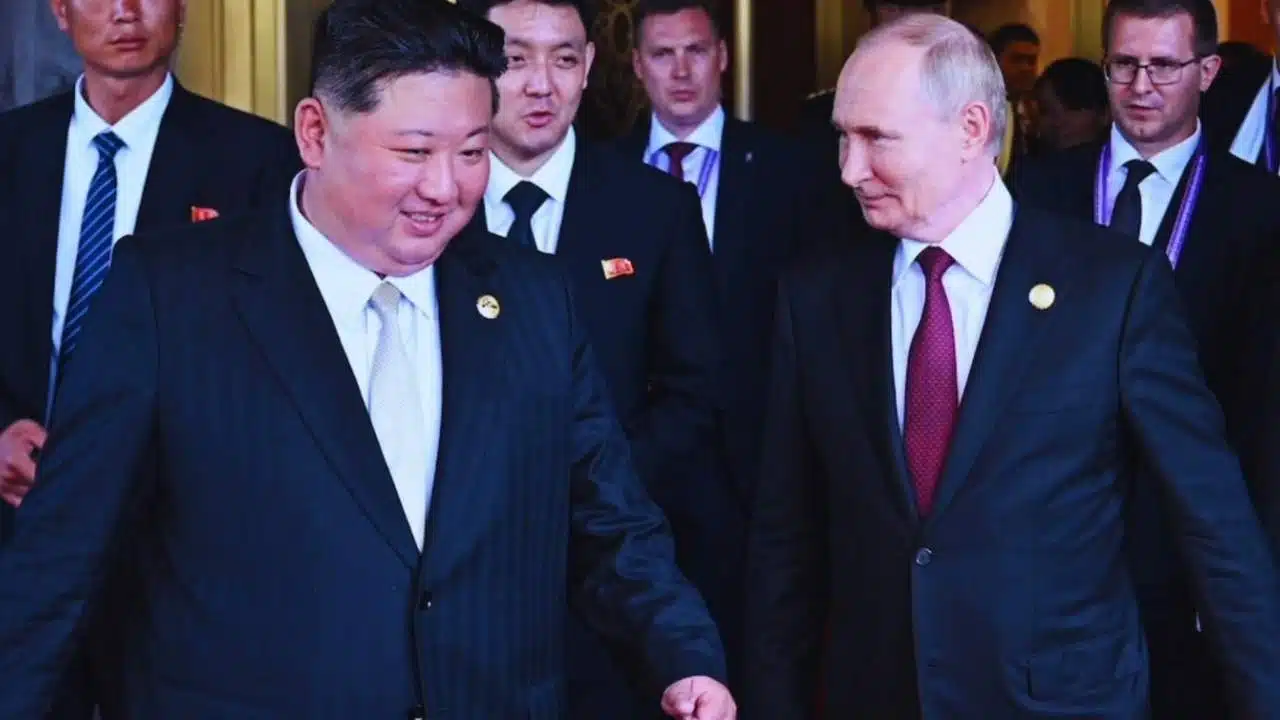
Kim Jong un sent New Year greetings to Vladimir Putin on Dec. 27, calling DPRK-Russia ties a “blood” alliance and pledging solidarity into 2026, as both sides spotlight growing military cooperation and their 2024 strategic treaty.
What Kim’s message to Putin revealed, and why the wording matters?
North Korean leader Kim Jong-un sent a New Year message to Russian President Vladimir Putin on Saturday, Dec. 27, offering “the warmest and sincerest greeting of best wishes” to Putin and to the Russian government and people for the start of 2026.
The key takeaway was not the greeting itself, but the language used to describe the relationship. The message portrayed the DPRK-Russia partnership as a bond shaped by sacrifice and conflict, describing it as an alliance “sharing blood, life and death in the same trench.” It also called the relationship a “precious common asset” to be carried forward “forever,” framing it as something beyond routine diplomacy.
That phrasing is significant because it pushes the relationship into a more openly military and existential narrative. It suggests Pyongyang wants the public—both at home and abroad—to see the partnership as tested under pressure and built for the long term.
Kim’s message also described 2025 as a year “filled with immortal events” in the history of bilateral ties. While the message did not list those events one by one, both governments have increasingly linked the relationship to wartime cooperation and joint strategic interests.
Public themes emphasized in the New Year exchange
| Theme | What was emphasized | Why it stands out |
| “Blood” alliance language | The relationship is described as sharing “blood, life and death” | Suggests ties are tied to battlefield-level sacrifice, not just diplomacy |
| Permanence | The alliance is framed as a “common asset” meant to last | Signals intention to keep cooperation regardless of outside criticism |
| 2025 as a turning point | The year is depicted as historically decisive for ties | Reinforces that recent cooperation is not temporary or symbolic |
Putin’s earlier greeting and the Kursk focus
The exchange came after North Korean state media said Kim received a greeting message from Putin on Dec. 18. That earlier communication described 2025 as having “special significance” for the relationship.
The Dec. 18 message drew attention because it highlighted North Korean involvement connected to Russia’s Kursk region. It praised the participation of North Korean soldiers in battles there and said that subsequent activities by an engineers’ unit in Russia reinforced the “invincible friendship” and “militant fraternity” between the two countries.
Kursk has become a recurring reference point in how both sides describe their relationship publicly. Instead of keeping military support vague, the messaging repeatedly points to concrete cooperation tied to territory Russia describes as strategically and politically sensitive.
Beyond broad references, Russian regional officials have made specific claims about engineering work. A public statement attributed to the Kursk region’s governor said combat engineers from a North Korean unit cleared mines across nearly 42,400 hectares and destroyed more than 1.5 million explosive devices. Those numbers were presented as evidence of practical support that directly affects reconstruction and civilian safety.
Separately, North Korean reporting around the engineers’ return has added another layer: it has described a welcoming ceremony in Pyongyang for returning engineering troops and acknowledged deaths among personnel involved in the mission. Even limited disclosures of casualties can carry political weight in a system that typically tightly manages wartime narratives.
In combination, these details help explain why Kim’s Dec. 27 message used unusually stark “blood” language. The public storyline now treats the relationship as operational, not theoretical.
The 2024 treaty and how it reshaped the relationship?
The New Year exchange is rooted in a formal framework established in 2024, when Kim and Putin met in Pyongyang and signed a new strategic partnership treaty.
Public reporting around the treaty has emphasized a mutual support component if either side faces armed aggression. In plain terms, the treaty is presented as committing the two countries to consult and assist each other if one enters a state of war due to external attack, referencing the UN Charter’s self-defense provisions.
This matters for two reasons.
First, it provides political cover. When leaders publicly praise military cooperation, the treaty offers a ready-made justification: cooperation is portrayed as aligned with a formal strategic agreement rather than a series of ad-hoc actions.
Second, it strengthens deterrence messaging. Even if the exact scope of support is debated internationally, the treaty allows both sides to signal that their coordination could expand during crises, not shrink.
The treaty also landed at a moment when both countries faced strong incentives to deepen cooperation. Russia has sought ways to sustain military production and logistics during a long war. North Korea has faced persistent economic constraints and international sanctions tied to its nuclear and missile programs. A closer partnership offers each side potential benefits—political backing, material support, and strategic leverage—even as it increases international scrutiny.
Timeline of key milestones shaping DPRK–Russia ties
| Date | Milestone | What changed |
| March 28, 2024 | UN Security Council fails to renew the DPRK sanctions Panel of Experts mandate after a Russian veto | Reduced the UN’s formal investigative capacity and increased pressure for alternative monitoring |
| June 19, 2024 | DPRK and Russia sign a comprehensive strategic partnership treaty in Pyongyang | Created a formal framework frequently cited in political messaging |
| October 2024 | Multilateral monitoring mechanism is launched by a group of states | Shifted monitoring efforts outside the UN Panel of Experts structure |
| May 29, 2025 | First multilateral monitoring report is released | Consolidated allegations about transfers, training, and deployment-related cooperation |
| Dec. 18 & Dec. 27, 2025 | Putin and Kim exchange New Year greetings referencing Kursk and “blood” alliance language | Signals willingness to publicly “own” the partnership narrative going into 2026 |
Sanctions scrutiny and the key claims being examined
The DPRK remains under extensive UN Security Council sanctions linked to its nuclear and ballistic missile programs. These measures restrict arms transfers, military cooperation, and a range of financial and trade activities. That backdrop is crucial because deeper DPRK-Russia cooperation is being viewed through the lens of compliance and enforcement.
After the UN Security Council failed in March 2024 to renew the mandate of the Panel of Experts that assisted the DPRK sanctions committee, a group of states created an alternative mechanism to monitor and report on alleged sanctions violations. In May 2025, that mechanism issued its first major report focused on alleged unlawful military cooperation between North Korea and Russia.
The report’s executive summary described a broad set of allegations, including transfers of arms and related materiel through multiple routes, training activities connected to troop deployments, and additional claims involving fuel and financial links. The report also described troop deployments beginning in late 2024 and said both governments confirmed North Korean military support in 2025.
Russia and North Korea have consistently rejected accusations of sanctions violations, while presenting their relationship as legitimate cooperation between sovereign states. But the international debate remains intense because the allegations involve weapons transfers, troop deployments, and potential exchanges of sensitive technology.
What monitoring efforts are alleging at a high level?
| Area under scrutiny | Core allegation (summary) | Why it matters |
| Weapons and materiel | Movement of munitions and weapons systems between the two countries | Directly conflicts with multiple UN restrictions on arms trade involving the DPRK |
| Training and deployment | Training of North Korean troops connected to Russia-linked operations | Raises escalation concerns and deepens operational interoperability |
| Fuel and finance | Claims involving petroleum supply limits and financial channels | Expands the issue beyond weapons into trade controls and enforcement |
| Technology risk | Concerns about sensitive military or dual-use technology exchanges | Could affect regional security calculations and proliferation concerns |
This scrutiny helps explain why the language in the New Year greetings matters. If the partnership were only symbolic, it would be less likely to trigger sustained multilateral monitoring and repeated sanctions-related claims. But when leaders describe ties as “militant fraternity” and “sharing blood,” it signals a relationship that other governments will treat as security-relevant, not merely diplomatic.
What to watch next as 2026 begins?
Kim’s Dec. 27 message sets a clear tone for the coming year: Pyongyang wants the world to understand that its relationship with Moscow is not a short-term alignment, and it is willing to describe it in stark, wartime terms.
What happens next will likely depend on three practical variables.
One is how openly both sides continue to describe military cooperation. Public messaging can be strategic: it can deter adversaries, strengthen domestic legitimacy, and shape negotiation leverage. But it also carries a cost—greater scrutiny and potential additional measures from countries focused on enforcement.
A second variable is whether additional operational details emerge about deployments, engineering missions, or logistical support. Specific figures and confirmed activities tend to drive international reactions more than broad political language.
The third is how the sanctions-monitoring landscape evolves after the weakening of the UN expert-panel system. Alternative monitoring reports are likely to continue, and governments may use them to shape policy responses, from diplomatic pressure to tighter enforcement actions.
For readers, the central point is straightforward: the DPRK-Russia relationship is being framed by both capitals as a strategic partnership forged under wartime conditions. The New Year exchange did not introduce a brand-new policy, but it raised the visibility of an alliance that is already reshaping security discussions across Northeast Asia and Europe.
























