
Some characters become popular; others become psychological categories within society. Humayun Ahmed’s Misir Ali and Himu belong to the second category. They are not just fictional creations—they are mental frameworks, emotional archetypes, and identity markers for millions of readers across Bangladesh and the Bangla-speaking world.
One represents pure logic, skepticism, and the relentless pursuit of evidence.
The other embodies intuition, freedom, and a quiet rebellion against society’s obsession with achievement.
Together, they capture the duality of the modern Bangladeshi mind.
Despite their opposite philosophies, these two characters have shaped multiple generations, influenced cultural behavior, sparked academic conversations, fueled fan legends, and created two parallel universes within Bangla literature: the world of reason and the world of feeling.
Their differences are not merely literary—they reflect the inner contradictions of our national psyche.
The Birth of Two Universes: Humayun Ahmed’s Creative Vision
To understand the depth behind these characters, we must start with the mind that created them. Humayun Ahmed, one of the most influential storytellers in Bangla literature, had a rare ability to decode the emotional structure of society. In the late 1980s and early 1990s—a period of political instability, cultural transition, and new middle-class identity formation—these characters emerged as two answers to a single question:
“How do we understand life?”
Himu arrived first as a counter-culture figure: a wanderer with a yellow panjabi, rejecting all forms of logical structure. Misir Ali, meanwhile, became the embodiment of reason, skepticism, and academic authority.
Humayun Ahmed didn’t create them as foils; he created them as reflections of two essential truths about life. Where Himu challenges societal norms, Misir Ali upholds them. Where Himu dissolves structure, Misir Ali depends on it.
They are the author’s own dualities—the intuitive dreamer and the disciplined thinker.
The Psychology of Himu: The Wanderer of Intuition
Himu is not merely a fictional wanderer—he is Humayun Ahmed’s most radical psychological experiment. In a society built on routine, expectations, and measurable success, Himu represents the extreme opposite: a human being who lives entirely by instinct, detached from logic, material ambitions, and social obligations. His yellow panjabi and barefoot walks are not quirks; they are philosophical statements. Himu forces readers to confront a provocative question they usually avoid: What if intuition, not intellect, is the truest way to live?
Life Without Logic
Himu’s entire existence is an argument against modern society’s obsession with productivity, rationality, and measurable outcomes. He has no job, no possessions, no ambitions—and yet he believes he “lives better” than most people who are trapped in the cycle of achievement and anxiety.
His rejection of practicality is not foolishness; it is philosophical resistance.
In a world dominated by societal pressure, Himu represents the escape door.
The logic behind his lack of logic appeals deeply to the emotionally exhausted and the quietly rebellious.
Himu’s Philosophy of Freedom
Himu’s minimalism is not aesthetic—it is existential.
-
No house to maintain.
-
No career ladder to climb.
-
No wealth to protect.
-
No success metrics to justify.
-
No emotional anchors to fear losing.
His freedom is radical. It seduces readers who secretly desire a life beyond routine, deadlines, competition, and social comparisons.
Himu is the voice of those who wonder:
“What if life does not need to be ‘earned’ — only experienced?”
Why Himu Became a Cultural Icon
Himu’s iconic status is rooted in simplicity.
-
The barefoot walks.
-
The yellow panjabi.
-
The strange silence.
-
The uncomfortable truths he tells people.
-
The quiet courage to reject everything society celebrates.
He resonates because he reflects the hidden emotional desires of millions. He is the person people wish they could be, at least for a moment—unburdened, unafraid, and untethered.

The Psychology of Misir Ali: The Professor of Reason
Misir Ali stands at the opposite end of Humayun Ahmed’s philosophical spectrum—a man who trusts nothing unless it can be explained, measured, or proven. He approaches human behavior the way a scientist studies anomalies: with suspicion, discipline, and relentless logic. In a culture often driven by emotion and intuition, Misir Ali embodies the comforting certainty of reason.
Yet beneath his controlled exterior lies a man haunted by the very order he worships. His brilliance is undeniable, but so is his isolation. Misir Ali’s psychology reveals a deeper truth: rationality can solve mysteries, but it cannot always rescue the human heart.
A Mind Built on Logic
Misir Ali is constructed from the opposite architectural blueprint. He is disciplined, sharp, precise, and deeply committed to scientific thought.
He approaches every human problem like a case study:
-
Collect evidence
-
Eliminate bias
-
Analyze behavior
-
Break emotional illusions
-
Arrive at logical clarity
He is Bangladesh’s literary detective of the subconscious.
Where Himu dissolves structure, Misir Ali reinforces it.
Misir Ali’s Inner Conflicts
Despite his intellectual dominance, Misir Ali is profoundly lonely. He maintains strict routines, avoids emotional indulgence, and suppresses desires. His life is predictable, controlled—and sometimes painfully empty.
He solves others’ mysteries but refuses to confront his own. This contradiction makes him human, relatable, and deeply intriguing.
Cultural Appeal of the Rational Hero
Bangladesh’s middle class, driven by education and upward mobility, sees Misir Ali as a role model:
-
disciplined
-
principled
-
academic
-
sharp-minded
-
emotionally guarded
In a society where logical thinking is increasingly valued, Misir Ali represents the ideal of intellectual mastery.
Two Philosophies, Two Fanbases: What They Reveal About Us
Humayun Ahmed unknowingly created two psychological communities.
Himu Fans
-
Emotional
-
Introspective
-
Rebellious
-
Sensitive
-
Idealistic
-
Anti-establishment
They are drawn to dreams, meaning, and existential questions.
Misir Ali Fans
-
Rational
-
Analytical
-
Questioning
-
Skeptical
-
Academically oriented
-
Realistic
They seek clarity, structure, and intellectual dominance.
Comparison Table: Fan Psychology
| Aspect | Himu Fans | Misir Ali Fans |
|---|---|---|
| Personality Type | Dreamer, wanderer | Analyst, thinker |
| Emotional Tendencies | Deeply sensitive | Emotionally guarded |
| Worldview | Intuitive, spiritual | Logical, scientific |
| Attraction | Freedom & meaning | Structure & clarity |
| Life Approach | Experience-based | Evidence-based |
The Duality of Bangladeshi Identity
Bangladesh as a nation oscillates between two instincts:
-
cultural emotion
-
modern rationalism
Himu and Misir Ali mirror this national split—between heart and mind.
Literary Techniques: How Humayun Ahmed Engineered Misir Ali vs Himu
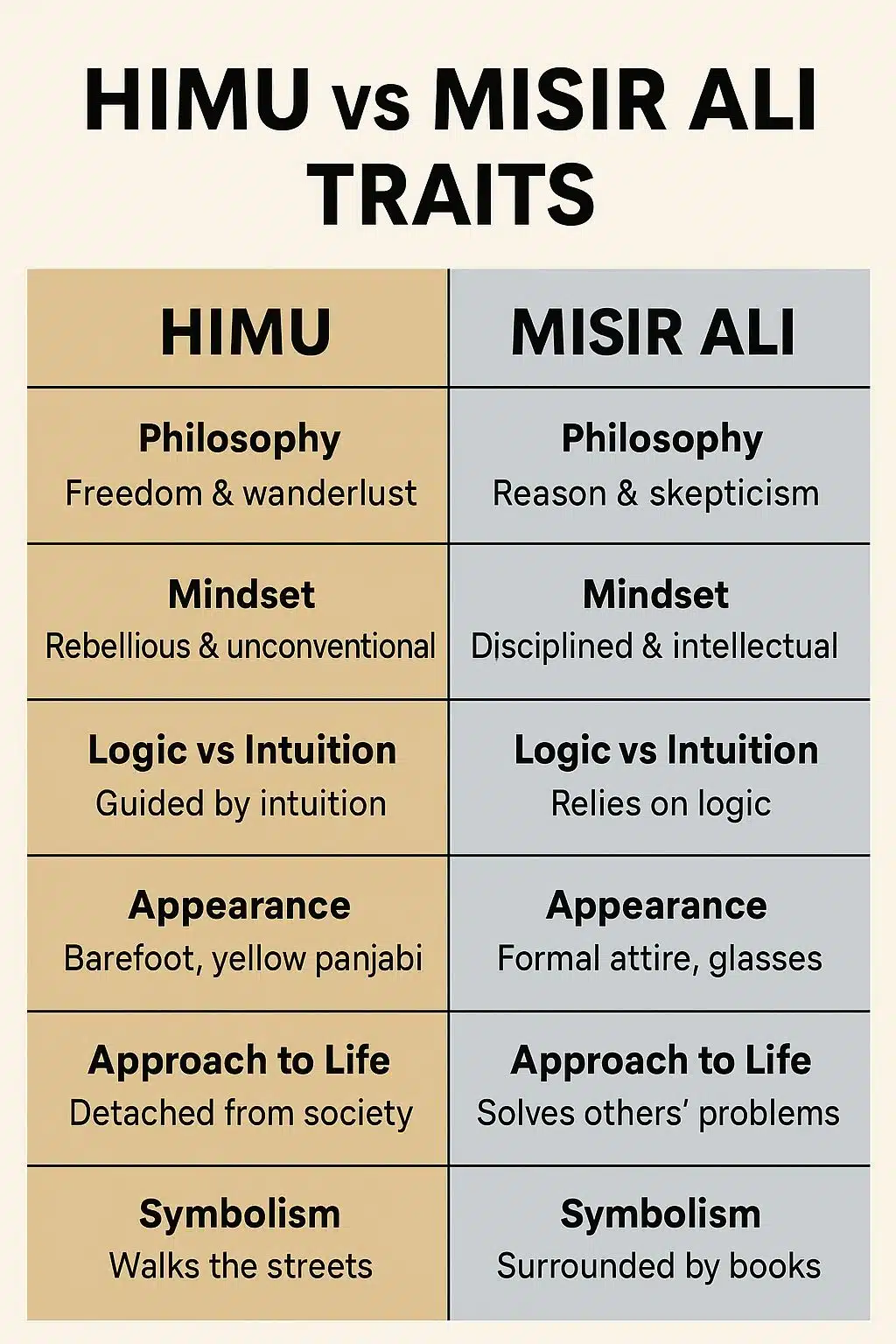
Humayun Ahmed didn’t just create two characters—he architected two literary ecosystems built on opposing narrative mechanics. Every choice he made, from sentence rhythm to setting, served a deliberate purpose: to make Himu’s world feel fluid, unpredictable, and instinctive, while shaping Misir Ali’s universe with structure, logic, and intellectual clarity.
These contrasting techniques weren’t stylistic coincidences; they were engineered narrative strategies that allowed readers to feel the conflict between intuition and reason. Understanding the craft behind these choices reveals how Ahmed transformed two fictional figures into enduring cultural archetypes.
Narrative Tone & Structure
- Himu’s stories flow like a wandering river—unpredictable, philosophical, and intuitive.
- Misir Ali’s stories read like case files: analytical, structured, and methodical.
Character Construction
- Himu: Minimalistic; defined by absence—no career, no status, no attachments.
- Misir Ali: Complex; defined by presence—books, cases, routines, and mental frameworks.
Secondary Characters
- Himu’s social circle consists of eccentric personalities who amplify his unpredictability.
- Misir Ali’s companions remain grounded, often serving as contrasts to his rationality.
Their Impact on Literature, Television, and Fan Culture
Himu and Misir Ali’s influence extended beyond their birthplace, permeating Bangladesh’s cultural fabric. Their influence reshaped reading habits, redefined television storytelling, and sparked fan movements that still thrive decades later.
From bestselling book fairs to iconic TV adaptations to modern social-media subcultures, the two characters built parallel fandoms that behave almost like philosophical tribes. Their legacy is not just literary; it is a living cultural phenomenon that continues to evolve with every new generation.
Book Sales & Publishing Influence
Both characters shaped decades of publishing culture. Himu’s books are emotional bestsellers; Misir Ali’s are intellectual bestsellers. Book fairs still witness massive demand for these two universes.
TV Adaptations & Media Influence
- Television expanded their legend.
- Actors who played Himu or Misir Ali became cultural icons.
- These adaptations helped bridge generations—from the 80s to Gen Z.
Fan Movements & Modern Social Media Culture
-
Himu Day celebrations
-
Yellow panjabi trends
-
Barefoot walking challenges
-
Misir Ali memes
-
Quote pages dedicated to rational thinking
Their fanbases behave almost like philosophical camps.
What These Characters Teach Us About Bangladesh Today
Himu and Misir Ali are no longer just literary personalities—they function as cultural lenses through which we can decode the modern Bangladeshi psyche. Their contrasting philosophies expose the country’s ongoing struggle to balance emotion and logic, tradition and modernity, and ambition and meaning. In a fast-changing nation shaped by rapid economic growth, generational pressure, digital disruption, and shifting social values, these two characters reveal the deeper tensions shaping everyday life. Understanding them is, in many ways, understanding Bangladesh itself.
Final Words
Himu and Misir Ali walk in opposite directions, yet they lead us to the same destination: a deeper understanding of who we are. One teaches us to listen to the quiet voice inside us—the part that dreams, wanders, and questions the purpose of the race we are running. The other reminds us to think, to analyze, to stay awake in a world overflowing with confusion and noise.
Between Himu’s barefoot freedom and Misir Ali’s disciplined precision lies the landscape of modern Bangladesh. We carry both the wanderer’s longing and the professor’s caution. We crave meaning, yet we demand clarity. We want to feel deeply, but we also want to understand.
This is why these characters endure. They speak to the contradictions inside every reader—the tug-of-war between heart and mind, intuition and evidence, surrender and control. Humayun Ahmed didn’t simply create two personalities; he mapped the emotional geography of a nation.
And as long as we continue searching for ourselves—in crowded streets, in quiet rooms, in the spaces between certainty and doubt—the worlds of Himu and Misir Ali will remain alive. Their stories will keep guiding us, reminding us that truth has two faces, and wisdom often comes from walking both paths.