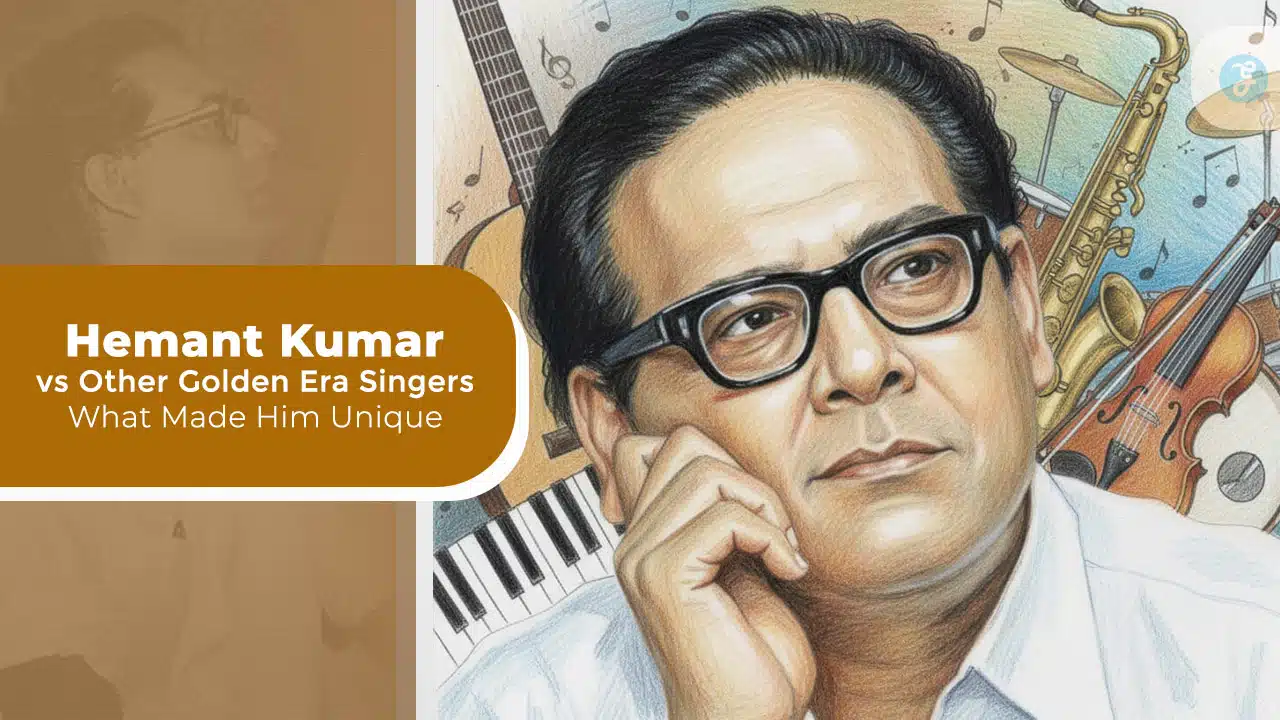
The Golden Era of Indian playback singing, roughly from the 1940s to the 1970s, gave us some of the most unforgettable voices in cinema. This period was blessed with stalwarts like Mohammed Rafi, Kishore Kumar, Mukesh, Talat Mahmood, and Hemant Kumar (Hemanta Mukhopadhyay). Each singer had a distinctive voice, style, and emotional appeal, creating a golden chapter in Indian film and music history.
But while Rafi was celebrated for his versatility, Kishore for his youthful energy, Mukesh for his soulful sadness, and Talat for his silky ghazals, Hemant Kumar carved out his own special space. His deep baritone, emotional restraint, and dual role as both singer and composer made him stand apart from his contemporaries.
This article explores Hemant Kumar vs. other golden era singers, analyzing what truly made him unique and why his legacy continues to shine even 36 years after his passing.
Hemant Kumar’s Voice: The Deep Baritone That Touched Souls
In an age when most playback singers leaned towards higher notes and soaring ranges, Hemant Kumar’s deep baritone voice became instantly recognizable. His singing was calm, composed, and full of gravity. Unlike Rafi’s brightness or Kishore’s playful dynamism, Hemant’s voice gave songs a serene dignity.
His tone carried a sense of maturity and warmth, often making his songs feel intimate, as if sung directly into the listener’s heart.
Emotional Depth
Hemant Kumar was often called the “Voice of the Soul,” because his singing evoked quiet reflection and tenderness rather than flamboyance. He had the rare ability to bring out emotions like longing, devotion, melancholy, and romance without overdramatizing them.
Songs like “Yeh Nayan Dare Dare” and “Na Tum Humein Jano” showcase how his minimalistic style created maximum emotional impact.
His Versatility in Music
Playback Singer Across Languages
Unlike some contemporaries who were confined mainly to Hindi cinema, Hemant Kumar was equally successful in Hindi and Bengali music. While Bollywood gave him fame, his Bengali repertoire—including modern songs and Rabindra Sangeet renditions—cemented his place as a cultural icon.
Master of Rabindra Sangeet
Hemant Kumar is regarded as one of the finest interpreters of Rabindranath Tagore’s songs. His renditions carried the correct mix of devotion and artistry, balancing classical depth with accessibility for the masses. To Bengalis, his Rabindra Sangeet versions are treasures that continue to be cherished.
As a Composer
What made Hemant truly unique compared to Rafi, Mukesh, or Talat was his success as a music director. He composed for both Hindi and Bengali films, delivering timeless melodies.
-
In Hindi cinema, his compositions like “Jaane Woh Kaise Log The” (Pyaasa) and “Na Tum Humein Jano” (Baat Ek Raat Ki) are still regarded as masterpieces.
-
In Bengali films, he worked on scores that blended Indian classical traditions with modern elements.
This dual identity as singer and composer gave him a broader artistic vision than most of his contemporaries.
Hemant Kumar vs Other Golden Era Singers
Hemant Kumar vs Mohammed Rafi
-
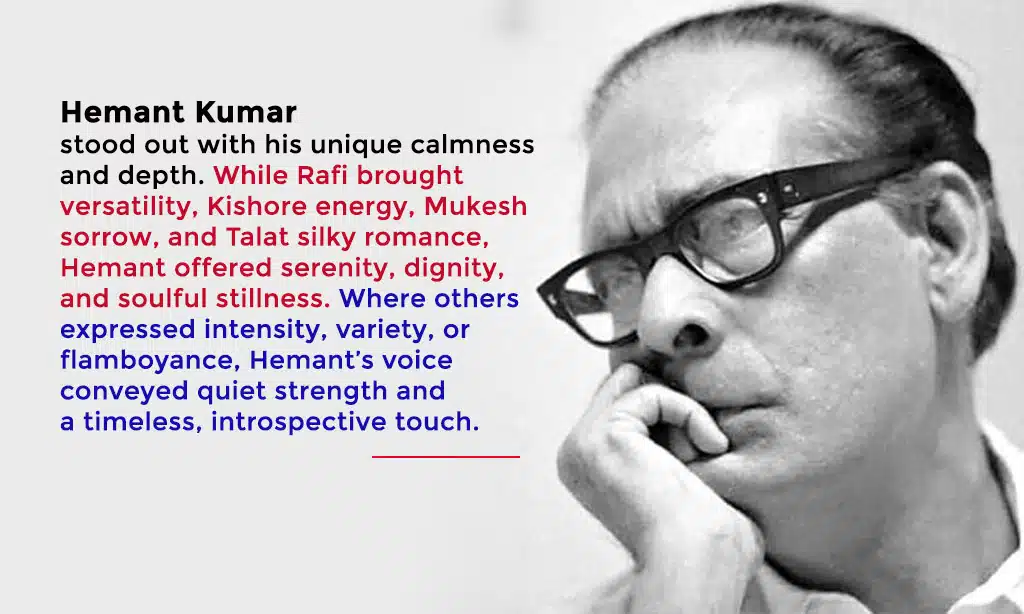
Rafi: Known as the most versatile singer of his time, Rafi could switch from bhajans to qawwalis to romantic numbers with unmatched ease. His voice carried energy and adaptability.
-
Hemant: In contrast, Hemant Kumar’s strength lay in soulful restraint. Where Rafi dazzled with range, Hemant touched the heart with stillness.
If Rafi was the voice of versatility, Hemant Kumar was the voice of serenity.
Hemant Kumar vs Kishore Kumar
-
Kishore: Bubbly, experimental, and energetic, Kishore Kumar brought youthful charm and comic timing to his songs. His style evolved strongly in the 1970s.
-
Hemant: He leaned toward classicism and emotional gravity. Unlike Kishore’s flamboyance, Hemant’s songs carried quiet dignity and depth.
Kishore made you tap your feet, and Hemant made you close your eyes and reflect.
Hemant Kumar vs Mukesh
-
Mukesh: Famous as the “voice of Raj Kapoor,” Mukesh specialized in tragic songs. His slightly nasal tone expressed pain and melancholy beautifully.
-
Hemant: While Hemant also sang sad songs, his baritone lent them strength and calm acceptance instead of outright sorrow.
Mukesh was the voice of lament, and Hemant was the voice of soulful endurance.
Hemant Kumar vs Talat Mahmood
-
Talat: Known for his silky, velvety voice, Talat was unmatched in ghazals. His tremolo-rich singing suited romantic despair.
-
Hemant: His voice was broader, deeper, and more commanding, offering a contrast to Talat’s delicate style.
Talat’s songs felt like whispers of love; Hemant’s felt like eternal echoes.
Signature Songs That Define His Uniqueness
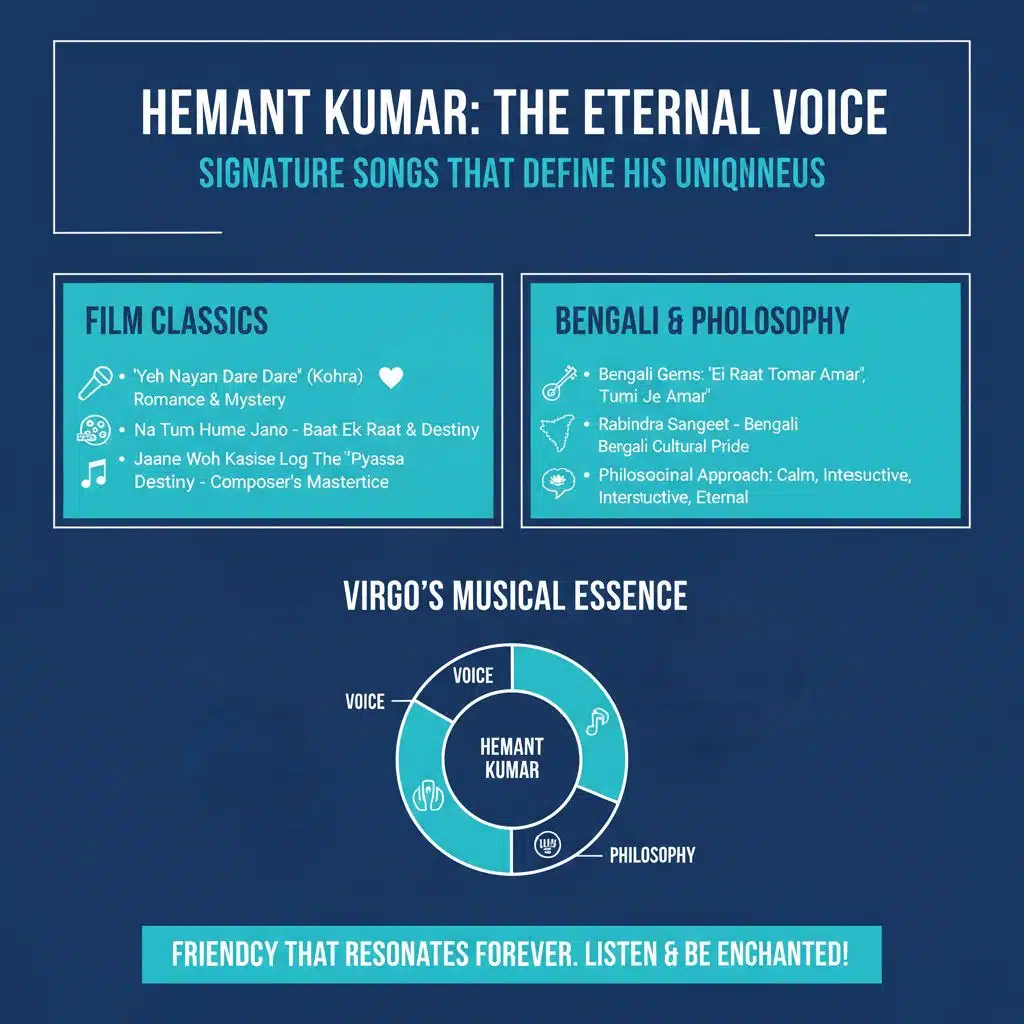
A few songs stand as perfect examples of why Hemant Kumar remains unforgettable:
-
“Yeh Nayan Dare Dare” (Kohra)—Romance wrapped in mystery.
-
“Na Tum Humein Jano” (Baat Ek Raat Ki)—A haunting melody of love and destiny.
-
“Jaane Woh Kaise Log The” (Pyaasa) – As a composer, he created one of Guru Dutt’s most memorable songs.
-
Bengali gems like “Ei Raat Tomar Amar,” “Tumi Je Amar,” and his Rabindra Sangeet renditions still define Bengali cultural pride.
These songs showcase not just his voice but also his philosophical approach to music—calm, introspective, and eternal.
Why Hemant Kumar’s Legacy Still Matters
Even decades after his passing, Hemant Kumar’s music continues to thrive on streaming platforms, radio, and live concerts. His uniqueness lies in three aspects:
-
Dual Talent: Unlike many singers, he was both a successful playback singer and a respected composer.
-
Cultural Bridge: He seamlessly connected Bengali and Hindi music, influencing both traditions deeply.
-
Timeless Appeal: His baritone remains unmatched, soothing listeners in an age of digital noise.
For younger generations, Hemant Kumar serves as a reminder that music is not just about entertainment but about creating timeless emotions.
Takeaways
When we discuss Hemant Kumar vs. other golden era singers, it’s not about competition—it’s about uniqueness. Rafi’s versatility, Kishore’s energy, Mukesh’s pathos, and Talat’s velvet all enriched Indian music. But Hemant Kumar gave us something different: a voice of quiet power, soulful simplicity, and timeless dignity.
His deep baritone and soulful compositions still make listeners pause, reflect, and feel. And that is why, even after 36 years, Hemant Kumar remains immortal—an artist who proved that true music never fades.