The International Criminal Court (ICC), headquartered in The Hague, Netherlands, announced that it had recently experienced a highly sophisticated and specifically targeted cyberattack. The incident occurred during the previous week and is being treated with utmost seriousness by the global tribunal, which deals with some of the world’s most complex and sensitive war crimes and crimes against humanity.
According to official statements from the court, while the attack was successfully contained, a full-scale impact analysis is underway. This review is intended to determine whether any sensitive data was compromised, what systems were affected, and how to reinforce digital defenses going forward.
Internal and External Security Measures Activated
Court administrators emphasized that swift and comprehensive measures have already been implemented to maintain operational continuity. This includes strengthening the court’s cybersecurity infrastructure, isolating compromised systems, and collaborating with external cybersecurity experts and intelligence agencies.
The ICC did not specify the methods used by the attackers or name any suspected perpetrators. The incident comes at a time when the court is dealing with politically charged investigations and facing mounting digital threats from both state and non-state actors.
ICC Investigations Involving Global Political Leaders
The ICC is currently handling several high-profile investigations involving powerful political figures and ongoing international conflicts:
-
Israel–Palestine Conflict: In late 2024, the court issued arrest warrants for Israeli Prime Minister Benjamin Netanyahu and former Defense Minister Yoav Gallant. The charges include alleged war crimes committed during Israel’s military operations in Gaza. These include accusations such as the deliberate use of starvation against civilians as a method of warfare. Israel has outright rejected the ICC’s jurisdiction and defended its actions as being consistent with international humanitarian law, pointing to measures taken to avoid civilian casualties and facilitate humanitarian aid.
-
Russia–Ukraine War: The ICC is actively investigating Russia’s actions in Ukraine. A high-profile arrest warrant remains in effect for Russian President Vladimir Putin. The court holds him personally accountable for the forced deportation of Ukrainian children, which is being treated as a war crime under the Rome Statute.
-
Philippines Drug War: Former Philippine President Rodrigo Duterte has been placed under ICC detention and may face trial over thousands of extrajudicial killings carried out under his controversial anti-drug campaign. The alleged crimes occurred between 2016 and 2022 and have drawn condemnation from international human rights organizations.
Political Fallout: Sanctions from the United States and Pushback from Israel
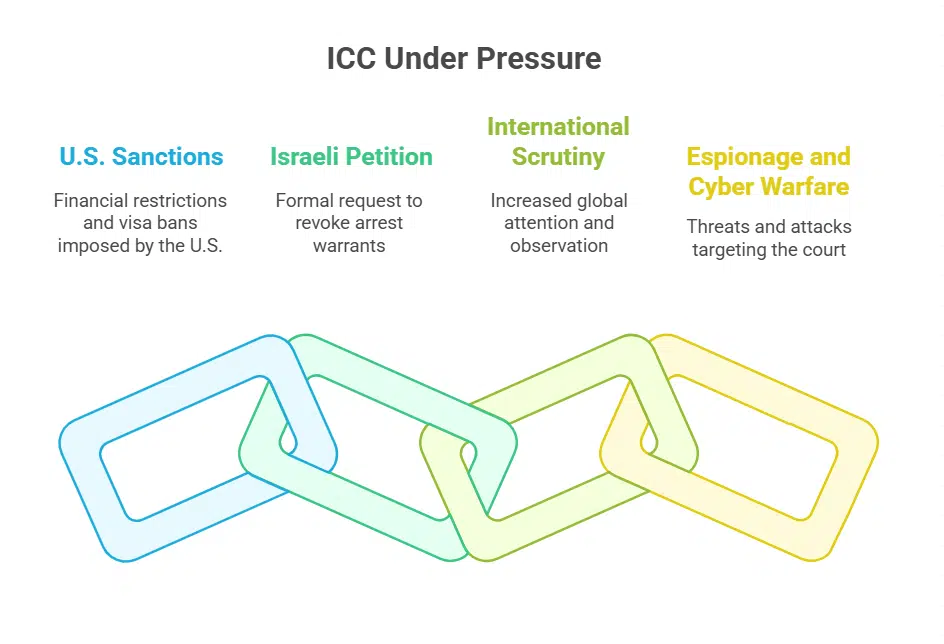
In recent months, the ICC’s work has led to rising tensions with both the United States and Israel. In February 2025, the U.S. government under President Donald Trump imposed sanctions on the ICC’s Chief Prosecutor, Karim Khan. The sanctions included financial restrictions and visa bans, signaling Washington’s strong opposition to the court’s proceedings that allegedly implicate U.S. personnel and allies.
In June 2025, the U.S. escalated its position by also sanctioning four ICC judges involved in the Gaza-related arrest warrants. Meanwhile, the Israeli government formally petitioned the court to revoke the arrest warrants for its top leaders, arguing that the ICC lacks legal authority over a sovereign state engaged in self-defense.
These political pressures have placed the court under enormous international scrutiny, making it an increasingly attractive target for espionage and cyber warfare.
Cyberattack Occurred During NATO Summit in The Hague
The timing of the cyberattack is particularly concerning, as it coincided with a major NATO leaders’ summit held in The Hague. The summit, which brought together representatives from 32 member states, was hosted at a conference venue located not far from the ICC headquarters.
Due to the summit’s importance and the presence of world leaders, the city was under tight security, both physically and digitally. Advanced cybersecurity protocols were in place throughout the area, raising questions about whether the attack on the ICC was an isolated incident or part of a broader attempt to infiltrate high-level institutions during the gathering.
The ICC has not commented on any potential link between the summit and the cyberattack, nor has it confirmed whether any confidential data—such as ongoing case files, witness identities, or prosecution strategies—was accessed by the attackers.
History of Cyberattacks and Espionage Attempts
This is not the first time that the ICC has faced digital intrusions or attempts to undermine its operations through espionage:
-
2023 Cyberattack: The court was previously targeted in a serious cyber incident in 2023. Although details were limited at the time, internal sources reported that the damage was significant enough to affect basic infrastructure. Even now, in mid-2025, some of the court’s technology systems, including wireless internet access within its headquarters, have not been fully restored to optimal function.
-
2022 Russian Espionage Attempt: In a separate incident in 2022, Dutch intelligence services exposed an undercover Russian agent who had applied for an internship at the ICC using a false identity. The agent was believed to be part of Russia’s military intelligence unit (GRU) and had assumed the identity of a Brazilian citizen. Dutch authorities swiftly expelled the individual and revealed the operation publicly, further highlighting the ICC’s vulnerability to foreign intelligence activities.
Implications for Global Justice and Cybersecurity
The recent cyberattack on the ICC underscores the growing risks faced by international legal institutions operating in a digital era. As the court continues to pursue cases involving war crimes, crimes against humanity, and genocide, it becomes an increasingly valuable target for those seeking to obstruct justice, influence legal outcomes, or extract politically sensitive information.
International cybersecurity experts warn that cyberattacks of this nature are likely to increase, particularly when international legal bodies investigate powerful state actors or controversial global events. The attack also raises ethical and legal concerns regarding the protection of whistleblowers, witnesses, and victims whose information may be stored within the court’s digital systems.
Although the ICC has assured the public that business operations remain stable and no major disruptions have occurred, it continues to face a challenging environment—one where digital security and legal impartiality must work hand in hand to uphold international law.