


In a sweeping effort to clean up the digital advertising landscape, Google has released its 2024 Ads Safety Report, revealing that it blocked a staggering 5.1 billion harmful ads, restricted 9.1 billion more, and suspended over 39 million advertiser accounts worldwide. The company credits much of its success to rapid advancements in artificial intelligence (AI), particularly models under its Gemini AI platform, which now serve as a frontline defense in combating fraudulent, misleading, and unsafe content online.
The scale of enforcement highlights the evolving nature of online threats, especially as scammers increasingly use AI-generated content, deepfakes, and impersonation techniques to deceive users and manipulate digital ad ecosystems.
AI-Powered Enforcement at the Core of Google’s Strategy
According to Alex Rodriguez, General Manager for Ads Safety at Google, 2024 was a breakthrough year in AI-driven ad protection. Speaking about the report, Rodriguez said:
“We rolled out more than 50 AI model upgrades in 2024, helping us act faster and smarter—stopping threats before users even saw them.”
These models were able to detect patterns of fraudulent behavior, such as fake businesses, stolen payment credentials, and networked scam operations. In most cases, malicious actors were identified and banned before they could run a single ad. This shift to preemptive enforcement marks a significant advancement over reactive policies of the past.
Policy Updates and 700,000 Impersonation Scams Taken Down
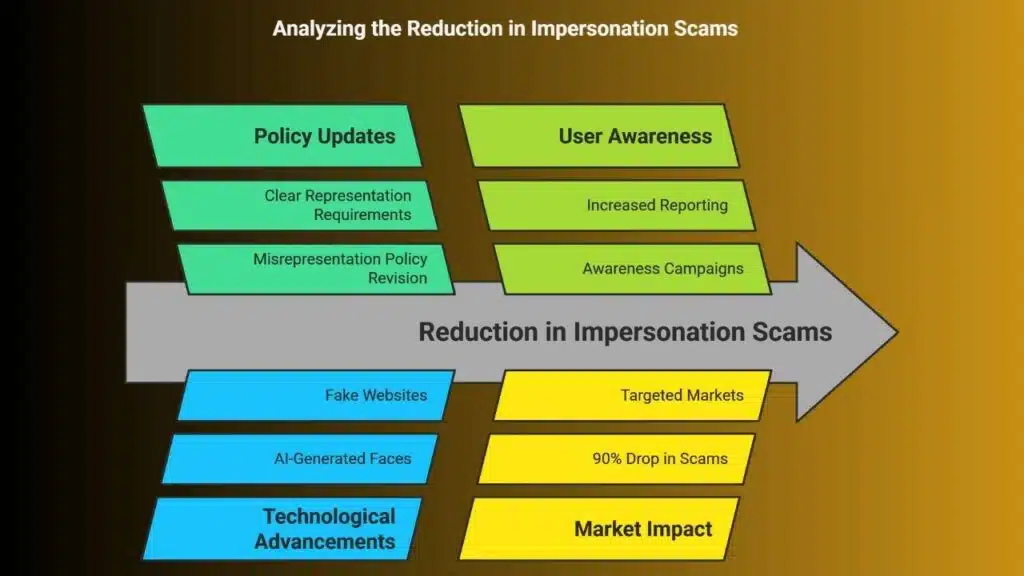
To match the evolving sophistication of online fraud, Google also updated several key advertising policies. Most notably, the Misrepresentation Policy was revised in March 2024 to directly address impersonation tactics and misleading business claims.
The results were dramatic:
- Over 700,000 advertiser accounts linked to impersonation scams were taken down.
- This led to a 90% drop in user-reported impersonation scams in affected markets.
Impersonation scams have targeted individuals, brands, and political entities alike. Many scammers used AI-generated faces, voiceovers, or even fake websites to impersonate public figures or businesses. Google’s policy update ensures advertisers must clearly and honestly represent who they are and what they’re promoting.
Tackling Global Election Misuse: Over 10 Million Political Ads Removed
2024 was a critical election year, with nearly half the global population eligible to vote. Recognizing the risks of political misinformation, Google adopted stricter enforcement rules around election-related ads.
Key actions included:
- Removing over 10.7 million political ads that failed to comply with transparency standards.
- Enforcing rules that require verified advertiser identity, disclosure of sponsors, and labeling of AI-altered content such as deepfakes, synthesized voices, or manipulated video.
In a world increasingly vulnerable to synthetic content, Google mandated that political ads must prominently disclose when they include AI-generated or manipulated media, ensuring voters are not misled by fabricated endorsements or events.
A Focus on Africa: Fighting Misleading Political Ads and Scam Networks
Google’s 2024 report also singled out Africa, particularly Nigeria, as a region where its enforcement had significant impact. The continent has experienced a rise in misleading political content, impersonation scams, and exploitative advertising practices—often targeting communities with limited access to digital literacy education.
In Nigeria, Google’s local team collaborated with election watchdogs and digital literacy advocates to ensure higher ad quality and reduced misinformation. More than 100 global and regional experts were tasked with reviewing sensitive content, resulting in a meaningful decline in deceptive political advertising across the region.
Massive Publisher Enforcement and Domain-Level Actions
Beyond advertisers, Google also took firm action against publishers and website owners who violated its ad policies.
- Ads were blocked or restricted on over 1.3 billion publisher pages.
- Enforcement actions were taken on more than 220,000 publisher websites at the domain level.
These measures help protect users from landing on pages hosting malware, misinformation, adult content, or harmful conspiracy theories disguised as legitimate media outlets.
Human Review Teams Still Play a Critical Role
Despite major advancements in AI detection, Google clarified that human reviewers remain essential, especially in complex or borderline cases.
These teams evaluate:
- Context-sensitive policy violations.
- Nuanced content such as satire, artistic expression, or political commentary.
- New fraud patterns that AI systems are still learning to identify.
By balancing AI scale with human judgment, Google is able to maintain enforcement accuracy while adapting to rapidly changing threats.
Collaborating with Global Authorities to Stay Ahead of Threats
Google isn’t working alone. In 2024, the tech giant continued to collaborate with:
- Global Anti-Scam Alliance
- Government regulators
- Industry watchdogs
- Digital literacy organizations
These partnerships allow Google to exchange threat intelligence, validate enforcement measures, and share best practices for ad safety across borders and platforms.
Google emphasized that the battle against bad ads is ongoing, and as threats evolve, so too will its enforcement strategy.
AI is Changing the Game in Online Safety
The scale of Google’s 2024 enforcement reveals how artificial intelligence is fundamentally reshaping digital trust and security. With 5.1 billion harmful ads blocked, 9.1 billion more restricted, and 39 million advertiser accounts suspended, the message is clear: malicious advertisers are being outpaced by AI innovation.
But the company also recognizes that this is only the beginning. As threats grow more complex, Google’s blend of AI precision and human oversight will be critical in maintaining a safer digital ecosystem—for advertisers, publishers, and users alike.
The Information is Collected from MSN and TechCrucnh.





















