Is Tokyo Ghoul season 2 and 3 connected? This question has puzzled many fans of the series due to the dramatic shift in storytelling, characters, and tone between the two seasons.
While they are connected, the link is indirect and complicated. Season 3, titled Tokyo Ghoul:re, introduces new characters and a fresh narrative while still maintaining ties to the events and characters of previous seasons. However, the transition between these seasons is not seamless, leaving viewers with a mix of intrigue and confusion.
Is Tokyo Ghoul Season 2 and 3 Connected?
The connection between Tokyo Ghoul season 2 and season 3 lies in their shared universe and overarching storyline, but the narrative approach creates a sense of disconnection.
Season 2 (Tokyo Ghoul √A) deviates significantly from the manga, presenting an alternate storyline that focuses on Kaneki Ken’s journey as he joins Aogiri Tree. On the other hand, season 3 (Tokyo Ghoul:re) adapts the sequel manga, introducing Haise Sasaki as a new protagonist while incorporating elements from earlier seasons.
The Controversial Shift from Season 2 to Season 3
The transition from Tokyo Ghoul season 2 to season 3 was met with mixed reactions from fans. While many were eager to continue following the story and characters they had grown to love, the shift in narrative direction and character development left some viewers feeling disoriented.
The second season of Tokyo Ghoul had already deviated significantly from the manga source material, and the third season took an even more dramatic turn.
Key Changes in Season 3
Tokyo Ghoul season 3, titled Tokyo Ghoul:re, introduced several major changes:
- It was based on the sequel manga series.
- The story followed a new protagonist named Haise Sasaki, who works for the Commission of Counter Ghoul (CCG).
- Sasaki is revealed to be a half-ghoul himself, with a mysterious connection to Ken Kaneki, the original protagonist.
- The season does not directly acknowledge or follow up on the events of season 2, creating a disconnect for many viewers.
Understanding the Timeline
To better grasp the connection between seasons 2 and 3, it’s essential to understand the timeline of events:
- Tokyo Ghoul Season 1: Introduces Ken Kaneki and the world of ghouls.
- Tokyo Ghoul Season 2 (√A): Deviates from the manga, following an alternate storyline.
- Two-year time skip
- Tokyo Ghoul:re (Season 3): Begins with new characters and a transformed world.
The two-year gap between seasons 2 and 3 is crucial, as it allows for significant changes in the characters and the world they inhabit. During this time, many of the familiar faces from previous seasons have undergone dramatic transformations.
For example, Hinami, who was last seen as a young girl in season 2, appears in season 3 as a representative for Aogiri, a ghoul organization. This transformation is explained as a result of the events that occurred during the time skip, including the destruction of Anteiku and the loss of loved ones.
The Soft Reboot Approach
Tokyo Ghoul:re can be considered a soft reboot of the series. It serves as both an adaptation of the sequel manga and a follow-up to the first season of the anime.
Interestingly, it largely ignores the events of Tokyo Ghoul √A (season 2), which had significantly departed from the manga’s storyline. This decision was likely made to bring the anime back in line with the source material, but it came at the cost of continuity for anime-only viewers.
Reasons for the Soft Reboot
- Align with manga: Bring the anime closer to the original story.
- Fresh start: Attract new viewers while retaining existing fans.
- Address criticism: Respond to negative feedback about season 2’s deviations.
Connecting the Dots: Key Plot Points
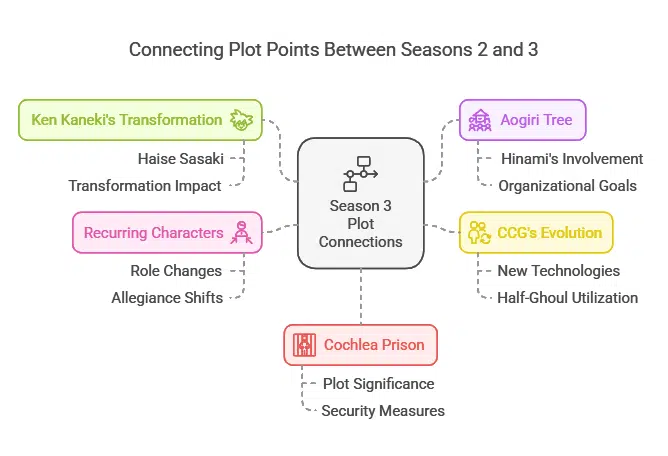
While the connection between seasons 2 and 3 may seem tenuous, there are several plot points and character arcs that bridge the gap:
- Ken Kaneki’s Transformation: The protagonist’s journey from human to half-ghoul continues, albeit in a new form as Haise Sasaki.
- Aogiri Tree: The ghoul organization remains a significant presence, with familiar characters like Hinami now involved.
- CCG’s Evolution: The human organization fighting ghouls has developed new strategies and technologies, including the use of half-ghouls like Sasaki.
- Recurring Characters: Despite the time skip, many characters from previous seasons reappear, often in new roles or with altered allegiances.
- Cochlea Prison: The maximum-security facility for ghouls, introduced in earlier seasons, plays a crucial role in season 3’s plot.
Statistical Insights
To better understand the impact and reception of Tokyo Ghoul’s various seasons, let’s look at some relevant statistics:
- Manga Sales:
- Original Tokyo Ghoul series: Over 12 million copies sold
- Tokyo Ghoul:re (2015): 3.7 million copies sold in Japan
- Tokyo Ghoul:re (2016): 4.3 million copies sold
- Tokyo Ghoul:re (2017): Over 5.3 million copies sold
- Tokyo Ghoul:re (2018): 3.2 million copies sold
- Total Franchise Sales:
- June 2017: Over 24 million copies in circulation
- January 2018: 34 million copies worldwide
- July 2018: 37 million copies in circulation
- March 2019: 44 million copies in circulation
- January 2021: Over 47 million copies in circulation
- Franchise Revenue:
- December 2017 to December 2018: 2.3 billion yen
These figures demonstrate the enduring popularity of the Tokyo Ghoul franchise, despite the controversial changes in the anime adaptation.
Fan Reception and Criticism
The transition from season 2 to season 3 of Tokyo Ghoul was met with mixed reactions from fans. Many viewers found the first half of season 3 confusing and frustrating. particularly due to the significant changes in characters and storylines without clear explanations. The shift in animation style and character designs also contributed to the sense of disconnection.
However, some fans noted that the second half of season 3 improved significantly, offering more engaging storytelling and satisfying character arcs. The payoffs for long-time viewers, including the resolution of various plot threads and character developments, were appreciated by many.
Common Criticisms
- Lack of continuity from season 2
- Confusing plot developments
- Insufficient explanation of time skip events
- Changes in character designs and personalities
- Pacing issues, especially in the first half of season 3
Positive Aspects
- Return to manga storyline
- Complex character development
- Engaging second half of season 3
- Exploration of moral ambiguity in the ghoul-human conflict
Recommendations for Viewers
For those looking to navigate the complex world of Tokyo Ghoul, here are some recommendations:
- Read the manga: The original source material provides the most coherent and complete story.
- Watch seasons 1 and 3: Skip season 2 (√A) for a more manga-accurate experience.
- Rewatch with context: After completing the series, rewatching with knowledge of the full story can enhance understanding.
- Explore supplementary materials: Light novels and OVAs can provide additional context and character development.
Takeaways
So, is Tokyo Ghoul season 2 and 3 connected? Yes, but not in a straightforward way. While they share characters and an overarching storyline, their differences in narrative direction create a sense of separation.
Season 3 serves as both a continuation and a fresh start, making it essential for viewers to approach it with an understanding of its unique place within the Tokyo Ghoul timeline.