The advent of blockchain technology has revolutionized the digital world, laying the groundwork for what we now call Web3. This new decentralized internet era depends on blockchain protocols to enable secure, transparent, and trustless interactions.
Blockchain protocols for Web3 are essential because they determine how transactions are processed, how data is secured, and how scalability is achieved in decentralized applications (dApps). Whether you’re a developer, investor, or enthusiast, understanding the key blockchain protocols for Web3 is crucial for navigating this dynamic landscape.
Why Blockchain Protocols Matter in Web3 Development?
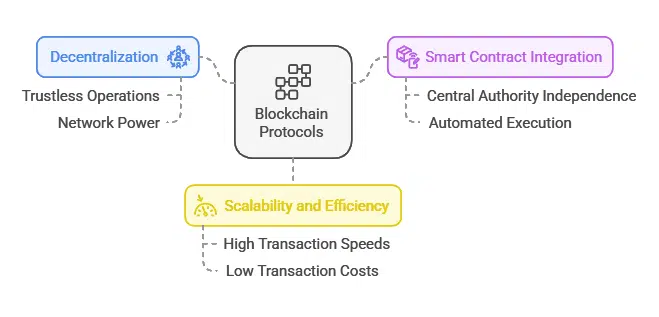
Blockchain protocols serve as the backbone of Web3, enabling seamless interactions and innovation. Here’s why they are indispensable:
- Foundation of Decentralization: Protocols power decentralized networks, eliminating intermediaries and ensuring trustless operations.
- Smart Contract Integration: They enable self-executing contracts that operate without the need for central authority.
- Scalability and Efficiency: Advanced protocols address Web3’s demand for high transaction speeds and low costs.
By exploring these blockchain protocols for Web3, you’ll gain insights into their unique features, capabilities, and applications.
Top 10 Blockchain Protocols for Web3
Let’s take a look!
1. Ethereum
Ethereum is often considered the pioneer of blockchain protocols for Web3. Launched in 2015 by Vitalik Buterin and a group of developers, Ethereum transformed the blockchain ecosystem by introducing smart contracts, which automate and secure transactions without requiring intermediaries.
As the first programmable blockchain, Ethereum laid the foundation for decentralized finance (DeFi), non-fungible tokens (NFTs), and countless decentralized applications (dApps).
Key Features of Ethereum
- Smart Contracts: Ethereum’s groundbreaking feature allows developers to create self-executing contracts.
- Developer Ecosystem: A robust community continuously enhances its ecosystem.
- ERC-20 Standard: This standard has facilitated the creation of countless tokens.
| Feature | Description |
| Consensus Mechanism | Proof of Stake (PoS) |
| Speed | ~15 transactions per second (TPS) |
| Scalability | Layer 2 solutions in progress |
Use Cases
- DeFi: Platforms like Uniswap and Aave.
- NFTs: Marketplaces such as OpenSea and Rarible.
- DAOs: Decentralized Autonomous Organizations revolutionizing governance.
2. Solana
Solana is a high-performance blockchain protocol designed to provide scalability without compromising security or decentralization. Launched in 2020, Solana is known for its ability to process thousands of transactions per second at a fraction of the cost.
This makes it ideal for developers building applications requiring high throughput and low latency, such as gaming and real-time financial systems.
Key Features
- Proof of History (PoH): A unique consensus mechanism that ensures high throughput.
- Scalability: Processes over 65,000 transactions per second.
- Low Costs: Affordable transaction fees for mass adoption.
| Feature | Description |
| Consensus Mechanism | Proof of History (PoH) |
| Speed | ~65,000 TPS |
| Fees | Average transaction fee ~$0.00025 |
Use Cases
- Gaming: Powering play-to-earn platforms.
- NFT Marketplaces: Low fees encourage artists and traders.
- DeFi Platforms: Enabling seamless financial interactions.
3. Polkadot
Polkadot is a blockchain protocol focused on interoperability. Launched by Dr. Gavin Wood, one of Ethereum’s co-founders, Polkadot connects multiple blockchains, allowing them to operate together seamlessly. This cross-chain communication ensures data and asset transfers across diverse ecosystems, fostering a multi-chain future for Web3.
Key Features
- Parachains: Independent chains that run parallel to the main network.
- Cross-Chain Communication: Facilitates data transfer across blockchains.
- Nominated Proof of Stake: A consensus mechanism ensuring security and efficiency.
| Feature | Description |
| Consensus Mechanism | Nominated Proof of Stake (NPoS) |
| Scalability | Supports multiple parachains |
| Interoperability | Cross-chain transactions enabled |
Use Cases
- Blockchain Bridges: Connecting Ethereum and other chains.
- Cross-Chain dApps: Expanding the potential of decentralized applications.
4. Binance Smart Chain (BSC)
BSC is known for its affordability and speed, making it one of the most accessible blockchain protocols for Web3 developers and users. Launched by Binance, one of the world’s largest cryptocurrency exchanges, BSC aims to provide a scalable solution for DeFi and token-based ecosystems.
Key Features
- Ethereum Compatibility: Supports Ethereum Virtual Machine (EVM).
- Dual-Chain Architecture: Facilitates seamless asset transfers.
| Feature | Description |
| Consensus Mechanism | Proof of Staked Authority (PoSA) |
| Speed | ~160 TPS |
| Fees | Low transaction fees |
Use Cases
- DeFi Projects: PancakeSwap and similar platforms.
- Token Swaps: Enabling rapid, low-cost exchanges.
5. Cardano
Cardano is a research-driven blockchain protocol, emphasizing security, scalability, and sustainability for Web3 applications. Developed with academic rigor, Cardano has earned a reputation for its methodical approach to innovation, making it ideal for long-term projects with high accountability requirements.
Key Features
- Proof of Stake (PoS): A more energy-efficient consensus algorithm.
- Layered Architecture: Separates transaction processing and smart contracts.
| Feature | Description |
| Consensus Mechanism | Proof of Stake (PoS) |
| Scalability | Increased through Hydra layer 2 |
| Sustainability | Environmentally conscious design |
Use Cases
- Academic Projects: Blockchain solutions for education.
- Government Applications: Enhancing transparency in governance.
- NFTs: Growing marketplace for eco-friendly digital art.
6. Avalanche
Avalanche is designed for speed and customizability, making it an attractive choice for blockchain protocols in Web3. By supporting application-specific subnets, Avalanche allows enterprises and developers to create highly optimized solutions tailored to unique needs.
Key Features
- Subnets: Application-specific blockchains for tailored solutions.
- High Throughput: Processes thousands of transactions per second.
| Feature | Description |
| Consensus Mechanism | Avalanche Consensus |
| Scalability | Supports custom subnets |
| Speed | High-speed transactions |
Use Cases
- Enterprise Applications: Custom solutions for businesses.
- DeFi Ecosystems: Expanding decentralized financial systems.
7. Tezos
Tezos is a blockchain protocol that stands out for its self-amending capabilities and focus on sustainability. Introduced in 2018, Tezos offers a robust on-chain governance system that enables stakeholders to vote on upgrades, reducing the risk of hard forks. This adaptability has made Tezos a preferred choice for projects emphasizing long-term viability and community involvement.
As one of the pioneering blockchain protocols for Web3, Tezos blends innovation with environmental consciousness, fostering a sustainable ecosystem for developers and users alike.
Key Features
- On-Chain Governance: Stakeholders directly influence the protocol’s evolution through voting.
- Energy Efficiency: Utilizes a proof-of-stake mechanism that minimizes energy consumption.
- Formal Verification: Ensures the security of smart contracts by mathematically validating their correctness.
| Feature | Description |
| Consensus Mechanism | Proof of Stake (PoS) |
| Governance | On-chain voting system |
| Scalability | Continuous upgrades for performance |
Use Cases
- Digital Collectibles: Artists and creators use Tezos for NFTs due to its low carbon footprint.
- Decentralized Voting: Enables transparent and tamper-proof elections.
- DeFi Solutions: Emerging ecosystem of lending and staking platforms.
8. Algorand
Algorand is a next-generation blockchain protocol that addresses the trilemma of decentralization, scalability, and security. Founded by cryptographer Silvio Micali in 2019, Algorand employs a unique Pure Proof of Stake (PPoS) consensus mechanism, ensuring fairness and fast transaction finality.
With its focus on reliability and efficiency, Algorand is considered one of the leading blockchain protocols for Web3, offering robust solutions for enterprises and developers seeking scalable infrastructure.
Key Features
- Pure Proof of Stake (PPoS): Randomly selects validators, ensuring decentralization and security.
- Immediate Finality: Transactions are confirmed in under 5 seconds, eliminating the risk of forks.
- Low Transaction Costs: Designed for high-volume applications with minimal fees.
| Feature | Description |
| Consensus Mechanism | Pure Proof of Stake (PPoS) |
| Speed | ~4.5 seconds per block |
| Fees | Fraction of a cent per transaction |
Use Cases
- Supply Chain Management: Tracks goods transparently from origin to consumer.
- Payment Systems: Enables fast and cost-effective cross-border transactions.
- DeFi Platforms: Supports lending, staking, and stablecoins.
9. Cosmos
Cosmos is often referred to as the “Internet of Blockchains” due to its focus on interoperability. Launched in 2019, Cosmos aims to create an interconnected network of blockchains that can exchange data and assets seamlessly.
Its modular architecture allows developers to create custom blockchains tailored to specific needs. As a foundational technology in blockchain protocols for Web3, Cosmos is paving the way for a seamlessly connected decentralized ecosystem.
Key Features
- Inter-Blockchain Communication (IBC): Facilitates cross-chain communication and transactions.
- Tendermint Core: A consensus engine offering fast finality and high throughput.
- Modular Framework: Simplifies the development of application-specific blockchains.
| Feature | Description |
| Consensus Mechanism | Tendermint BFT |
| Scalability | Enables multiple parallel blockchains |
| Interoperability | Cross-chain token and data transfers |
Use Cases
- Cross-Chain DeFi: Projects like Osmosis leverage Cosmos’ interoperability.
- Blockchain Bridges: Connects Ethereum and other major chains.
- Custom Blockchains: Enterprises build solutions on Cosmos SDK.
10. Hedera Hashgraph
Hedera Hashgraph is a unique distributed ledger technology that offers a fast, secure, and energy-efficient alternative to traditional blockchains. Unlike blockchains, Hedera uses a hashgraph consensus algorithm, which enables high throughput and low latency.
Backed by a council of global enterprises, Hedera is well-positioned for enterprise adoption and is gaining recognition as one of the innovative blockchain protocols for Web3.
Key Features
- Hashgraph Consensus: Utilizes directed acyclic graph (DAG) technology for efficiency.
- Governance by Enterprises: Managed by a council of industry leaders, including Google and IBM.
- Energy Efficiency: Consumes significantly less energy than traditional blockchains.
| Feature | Description |
| Consensus Mechanism | Hashgraph Consensus |
| Speed | ~10,000 TPS |
| Governance | Council of global enterprises |
Use Cases
- Micropayments: Ideal for small, high-volume transactions.
- Supply Chain Tracking: Ensures transparency and accountability.
- Identity Management: Powers secure digital identity solutions.
Comparative Table of Blockchain Protocols
Key Metrics Comparison
| Protocol | Consensus Mechanism | Key Feature | Example Use Case |
| Ethereum | Proof of Stake (PoS) | Smart Contracts | DeFi, NFTs |
| Solana | Proof of History (PoH) | High Speed | Gaming, DeFi |
| Polkadot | Nominated Proof of Stake | Multi-chain Interoperability | Cross-chain dApps |
| Binance SC | Proof of Staked Authority | Dual-Chain Architecture | Token Swaps |
| Cardano | Proof of Stake (PoS) | Layered Architecture | NFTs, Governance |
| Avalanche | Proof of Stake (PoS) | Customizable Subnets | Enterprise Applications |
| Tezos | Proof of Stake (PoS) | On-Chain Governance | Digital Collectibles |
| Algorand | Pure Proof of Stake | Immediate Finality | Financial Systems |
| Cosmos | Tendermint BFT | Interoperability | Token Swaps |
| Hedera | Hashgraph Consensus | Energy Efficiency | Micropayments |
Takeaways
Selecting the right blockchain protocols for Web3 depends on your specific requirements, such as scalability, transaction costs, and intended use cases. Whether you’re building a DeFi platform, launching an NFT marketplace, or developing a supply chain solution, the right protocol can make all the difference.
By understanding these blockchain protocols for Web3, developers and businesses can create solutions that align with their goals and provide long-term value.
As blockchain protocols for Web3 continue to evolve, we can expect innovations that enhance scalability, security, and interoperability. Staying informed about these advancements is essential for anyone involved in the Web3 space.
The future of decentralized internet relies on these protocols—and understanding them is the first step toward harnessing their potential.