Paid ads stop when the budget stops. Social reach can change without warning. Search traffic can rise or fall after an algorithm update.
Email gives a business something different: a way to keep communicating with people who have already chosen to hear from it.
That difference explains many of the benefits of email marketing. A subscriber can receive a product launch, useful guide, renewal reminder, onboarding message, event invitation, or post-purchase follow-up without the business paying for another ad impression each time.
Email is not automatically cheap or profitable. A poorly maintained list loses value. Irrelevant campaigns generate unsubscribes and complaints. Weak technical setup can hurt deliverability. And a large database is not much use if most people no longer care about the messages.
But when the fundamentals are handled well, email remains one of the more durable parts of a marketing system because it combines repeat communication, automation, segmentation, and measurable customer actions in one place.
What Actually Counts as Email Marketing?
Email marketing covers planned communication with people who have an appropriate reason to receive marketing messages from a business.
That may include newsletters, product updates, educational campaigns, event invitations, trial onboarding, abandoned-cart reminders, renewal emails, post-purchase follow-up, re-engagement campaigns, and promotional offers.
Not every business email belongs in the same bucket.
Receipts, shipping notices, account alerts, and password-reset messages are usually transactional or relationship communications. Depending on the jurisdiction, those messages may be treated differently from promotional email.
Cold sales outreach is different again. An unsolicited B2B pitch is not the same as a newsletter sent to someone who deliberately subscribed. The rules vary by country, recipient type, and how personal data was obtained.
For a small business, the safest operational approach is uncomplicated: collect addresses transparently, explain what people are signing up for, send through a reputable email platform, and make leaving straightforward.
The Economics Are Attractive, but the Famous ROI Figures Need Context
Email is often described as a low-cost marketing channel. That is broadly fair, but “low cost” should not be mistaken for “free.”
A serious program can involve spending on email software, CRM tools, design, copywriting, analytics, integrations, list management, domain authentication, and staff time. Many email platforms also become more expensive as contact counts or send volume grow.
The financial advantage comes later.
Once someone has legitimately subscribed, a business can communicate with that person repeatedly without buying another ad click or impression for every campaign. That is especially valuable for products or services with repeat purchases, renewals, long sales cycles, or ongoing customer education.
Industry research continues to show strong reported returns, but the headline number is often oversimplified.
Litmus’ 2025 email research, based on responses from nearly 500 marketing professionals, found substantial variation. Thirty-five percent reported earning between $10 and $36 for each dollar spent on email, while 30% reported $36 to $50. Another 5% reported returns above $50. At the same time, 21% said they did not measure email ROI at all.
That makes email look attractive, but it does not justify promising a particular return to every business.
A local service company, a SaaS startup, and an established ecommerce retailer will not produce the same economics. Their margins, list quality, purchase frequency, sales cycle, and measurement systems are too different.
For a business owner, the better question is not “What is the average email ROI?” It is:
What measurable business result does our email program produce relative to what it costs?
That result may be revenue. For other businesses, it could be qualified leads, booked consultations, upgrades, renewals, or repeat orders.
Why an Email List Is Different From a Social Following
A business may have 50,000 social followers and still reach only a portion of them with any one post. Distribution is controlled partly by the platform’s recommendation and ranking systems.
Email offers a more direct route.
Marketers often describe an email list as an “owned audience.” The phrase is useful but imperfect. A company does not own the people on its list or their attention. Subscribers can leave whenever they want, and their data remains subject to applicable privacy and marketing laws.
What the business does control more directly is the relationship with the list and the infrastructure used to communicate with it.
That becomes useful when another channel becomes unpredictable.
A customer might first discover a company through Google, LinkedIn, YouTube, a paid campaign, a podcast, a marketplace, or an event. If that person then chooses to join an email list, the business has another way to continue the relationship without depending entirely on the original discovery platform.
This is why email should usually be viewed as part of a wider acquisition and retention system, not as a replacement for every other channel.
Timing Is Where Email Becomes More Useful Than a Newsletter
A regular newsletter can work well, but some of the strongest email programs are built around customer actions rather than a fixed publishing calendar.
A person creates an account.
A free trial begins.
A customer places an order.
A subscription approaches renewal.
A shopper leaves products in a cart.
A previously active user stops returning.
Each event creates a different reason to communicate.
For a SaaS company, the first few days after signup may be the right time to explain account setup or direct users toward the features required to get value from the product. An ecommerce store has a different job. After a purchase, useful emails may cover delivery, care instructions, replenishment, or genuinely relevant complementary products.
The automation itself is not what makes those messages effective. Relevance does.
A business can build an elaborate seven-email sequence and still get poor results if the emails arrive at the wrong time or address problems the customer does not have.
This is why generic funnel templates are often overrated. They can provide structure, but they should not dictate the message.
Segmentation Usually Matters More Than Putting a First Name in the Subject Line
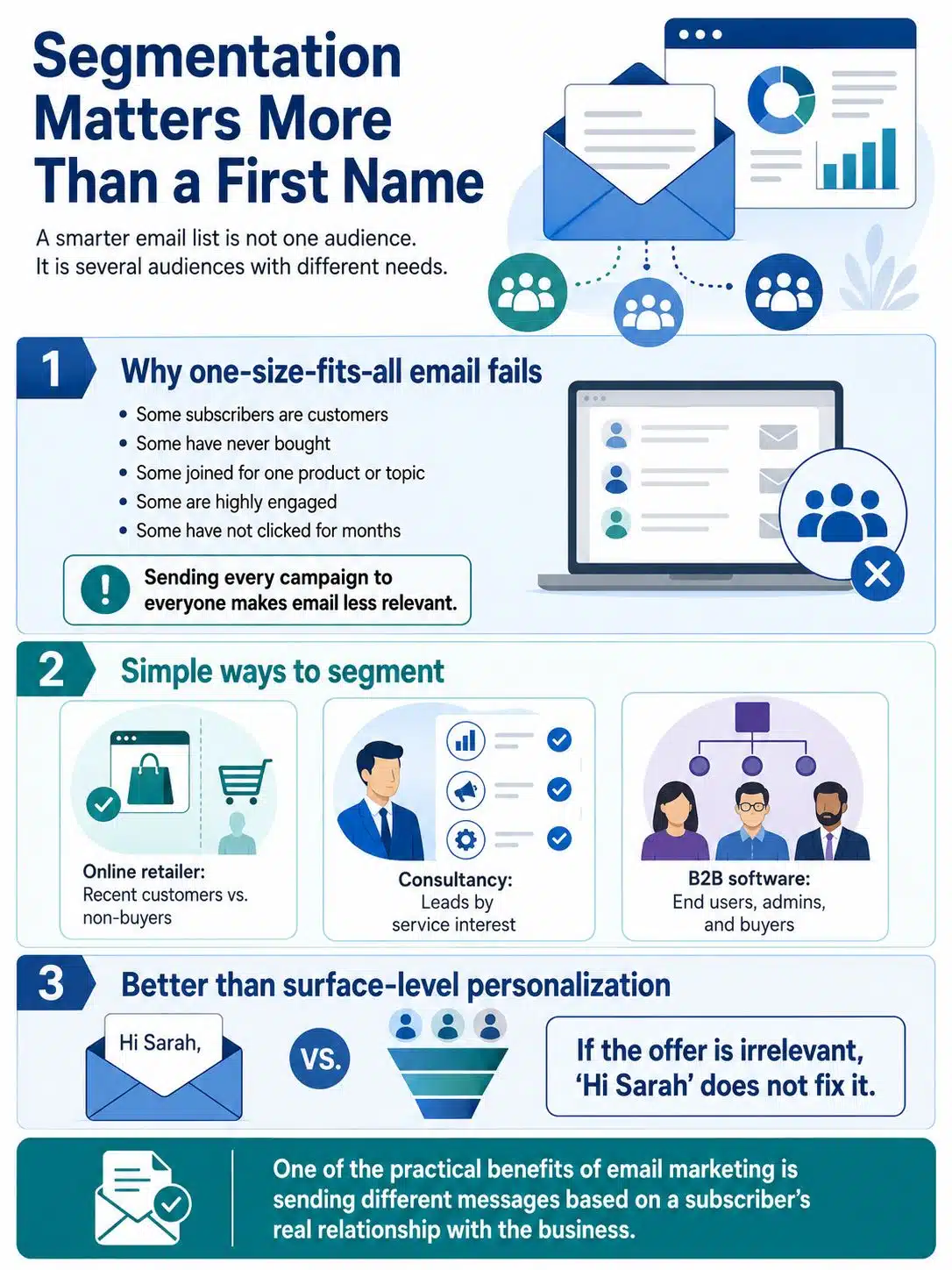
A mailing list is rarely one audience.
Some subscribers are customers. Some have never bought. Others joined because they wanted information about one specific product or topic. Some are highly engaged, while others have not clicked anything for months.
Sending every campaign to everyone is easy. It is also one of the fastest ways to make email less relevant.
Useful segmentation does not need to be complicated.
An online retailer might separate recent customers from subscribers who have never purchased. A consultancy could group leads by service interest. A B2B software company may need different messages for end users, account administrators, and people responsible for purchasing.
That is a more meaningful form of personalization than inserting a first name into every subject line.
If the offer is irrelevant, “Hi Sarah” does not fix it.
One of the more practical benefits of email marketing is the ability to change the message based on a subscriber’s actual relationship with the business.
Email Can Support a Sale Long Before the Customer Buys
Campaign reports often encourage businesses to think in short time frames: send an email, count the clicks, check the sales.
That can miss a large part of email’s contribution.
Before a purchase, email can distribute useful content, explain a complicated service, answer recurring objections, promote an event, or keep a company familiar during a long buying process.
During onboarding, it can help customers complete important setup steps.
After a purchase, it may encourage repeat orders, explain new features, support renewals, collect feedback, or re-engage inactive customers.
The difficult part is attribution.
A subscriber might read several educational emails, click a guide, leave the site, then return through Google a week later and buy. A last-click report may credit search for the sale even though email influenced the decision.
The reverse can happen too. Email may receive too much credit simply because it was the final tracked interaction.
Businesses with longer sales cycles should therefore look beyond immediate campaign revenue. Lead progression, product adoption, renewals, repeat purchases, and retention can all provide useful evidence of whether email is doing its job.
Open Rate Is No Longer a Clean Measure of Attention
Email platforms can provide valuable information: deliveries, bounces, clicks, unsubscribes, complaint data, and conversions.
Open rate deserves more caution.
Apple’s Mail Privacy Protection can hide the recipient’s IP address and privately download remote email content in the background. Because traditional open tracking often depends on loading remote content such as a tracking pixel, the sender cannot reliably determine whether every reported open represents a person actively reading the message.
That does not make open rate useless. It makes it less precise.
For most businesses, these metrics deserve more attention:
| Metric | Useful For | Main Limitation |
|---|---|---|
| Bounce rate | Finding unreachable addresses | Delivery does not mean inbox placement |
| Click rate | Measuring interaction | Not every click has business value |
| Conversion rate | Tracking the intended action | Requires accurate tracking setup |
| Unsubscribe rate | Monitoring audience loss | Some churn is normal |
| Spam complaints | Detecting recipient dissatisfaction | Small increases can hurt sender reputation |
| Revenue or qualified leads | Connecting email to business outcomes | Attribution may over- or under-credit email |
The strongest metric depends on the campaign.
A product launch may be judged by sales. An onboarding sequence may be better judged by account activation. A B2B campaign might exist to produce demo requests rather than direct purchases.
Choose the outcome before sending, not after seeing which number looks most impressive.
Email Does Not Replace SEO, Social Media, or Paid Acquisition
Channel comparisons often become too simplistic.
Search, paid advertising, social media, events, and email frequently do different jobs.
Search can capture people already looking for an answer or product. Paid advertising can create traffic quickly. Social platforms can introduce a brand to people who have never heard of it.
Email becomes more useful after that first contact.
A paid ad may lead to a webinar registration. Email can handle reminders and follow-up.
A search visitor might read one article and disappear. A relevant newsletter gives that reader the option to come back.
A conference attendee may become a sales prospect, with email supporting the conversation that follows.
This is also why a strong email ROI figure does not automatically mean a company should cut acquisition spending. A mailing list needs a continuing source of suitable new subscribers.
Email is particularly good at developing and retaining attention once it has been earned. It is less suited to creating all of that initial attention by itself.
Permission and Marketing Law Vary by Country
Email marketing compliance becomes risky when businesses assume that one rule applies everywhere.
It does not.
In the United States, CAN-SPAM sets requirements for commercial email including accurate sender information, non-deceptive subject lines, a valid physical postal address, and a functioning opt-out method. Qualifying opt-out requests must generally be honored within 10 business days.
CAN-SPAM does not impose a universal prior-consent requirement on every commercial email sent in the U.S. That does not mean mass unsolicited email is a sensible marketing strategy. Provider policies, other laws, reputation, and recipient expectations still matter.
UK rules are different.
Under the Privacy and Electronic Communications Regulations, unsolicited electronic marketing to individual subscribers generally requires consent unless an applicable exception, such as the customer soft opt-in, applies. Corporate subscribers are treated differently, although data-protection rules can still be relevant when an identifiable employee’s personal information is being processed.
The UK’s Information Commissioner’s Office also makes an important point that is easy to miss: an email address being publicly visible on a website or social network does not automatically mean the person has consented to marketing.
Its electronic-mail marketing guidance was updated in April 2026, reinforcing a broader practical lesson: compliance rules change.
Businesses marketing internationally should check the current requirements for the recipients they intend to contact. An old consent paragraph copied from another company’s privacy policy is not a substitute for that work.
Deliverability Is Now a Marketing Issue, Not Just an IT Issue
A campaign cannot generate much value if mailbox providers do not trust the sender.
Google’s current requirements for messages sent to Gmail accounts include baseline authentication and technical standards. Senders need SPF or DKIM authentication, valid DNS configuration, TLS for transmission, standards-compliant message formatting, and controlled spam levels.
Businesses sending more than 5,000 messages per day to Gmail accounts face additional requirements. These include both SPF and DKIM, a published DMARC record, domain alignment, and one-click unsubscribe support for marketing and subscribed messages.
Google currently recommends keeping the user-reported spam rate below 0.1% and preventing it from reaching 0.3% or higher.
Yahoo follows a similar direction. Its bulk-sender requirements include SPF, DKIM, DMARC, accessible unsubscribe mechanisms, and low complaint rates. Yahoo also identifies 0.3% as an important spam-complaint threshold.
A small business owner does not need to become an email engineer, but three terms are worth recognizing:
- SPF identifies servers permitted to send email for a domain.
- DKIM adds a cryptographic signature that receiving systems can verify.
- DMARC builds on SPF and DKIM and tells receiving providers how to handle authentication and alignment.
Most established email service providers provide step-by-step DNS instructions.
The mistake is postponing this work until the list is already large. Domain authentication is much easier to deal with during setup than during a deliverability crisis.
A Sensible Starting Setup for a Small Business
Beginners often build too much too early.
A new email program does not need dozens of automations, complicated lead scoring, or a large CRM migration.
Start with an email platform that covers the essentials: signup forms, list management, segmentation, basic automation, reporting, domain authentication, and whatever ecommerce or CRM connection is genuinely necessary.
Then authenticate the sending domain.
After that, work on the signup promise.
“Subscribe to our newsletter” is weak because it tells the reader almost nothing.
A clearer offer sets an expectation:
- “Get one practical bookkeeping lesson each Friday.”
- “Receive product restock alerts and launch updates.”
- “Get a monthly summary of new research and industry changes.”
The exact wording should match what the business can actually sustain.
A short welcome sequence can then deliver what was promised and guide the subscriber toward a sensible next action. That may be reading a guide, starting account setup, browsing a product category, registering for an event, or booking a consultation.
Do not choose a weekly schedule simply because marketing advice says newsletters should be weekly. A useful monthly email is better than four weak weekly ones.
Small Mistakes That Gradually Make Email Less Effective
Some problems are obvious, such as buying or scraping address lists. Others are quieter.
A company may use an attractive discount to collect thousands of addresses, then immediately switch to unrelated promotional emails. The signup worked, but the expectation was wrong.
Another common problem is treating the entire database as one audience because segmentation requires extra work.
Subject-line optimization can also go too far. A misleading line may increase opens while reducing trust.
Design is another area where businesses often spend effort in the wrong place. An elaborate template does not fix tiny mobile text, poor hierarchy, oversized images, confusing buttons, or several competing calls to action.
And automated campaigns need maintenance.
A two-year-old welcome sequence may still mention a discontinued feature. A renewal email may link to an outdated pricing page. A product recommendation may point to something no longer available.
Automation saves repetitive work, but it also lets old mistakes keep running unattended.
Review important sequences whenever products, offers, policies, pricing pages, URLs, or positioning change.
When Email Should Not Be the First Marketing Priority
Email becomes more valuable once a business has a realistic way to attract people who want continued communication.
A newly opened local restaurant, for example, may get more immediate value from local search visibility, Google Business Profile, maps, reviews, and social discovery than from building a sophisticated newsletter system.
An early-stage product with almost no website traffic has another problem. Six automated sequences will not matter if almost nobody reaches the signup form.
Complex B2B purchases have their own limits. Email can educate prospects and support follow-up, but it cannot replace product demonstrations, security assessments, procurement reviews, contract negotiations, or direct sales conversations.
This is where some email advice becomes too enthusiastic.
Email is excellent at distributing information and maintaining customer relationships. It cannot compensate for weak demand, a poor product, or an unclear offer.
Final Thoughts
The strongest benefits of email marketing come from the structure of the channel rather than any single ROI statistic.
A business can build a permission-based list, communicate repeatedly without paying for every individual impression, send messages when customer actions make them relevant, and connect those campaigns to measurable outcomes.
That is enough reason to take email seriously.
It is not a reason to overbuild it.
For a small company, the sensible starting point is a legitimate signup process, a properly authenticated sending domain, a clear promise to subscribers, one useful welcome sequence, and a campaign schedule the team can maintain without sending filler.
Then watch what happens beyond the open.
Clicks, conversions, qualified leads, repeat orders, renewals, unsubscribes, and complaint rates reveal far more about the health of an email program.
More sophisticated segmentation and automation can come later, once there is evidence that they will solve a real problem.
Email has survived repeated changes in digital marketing because direct communication with an interested audience remains useful. Its age is not the advantage. The useful part is what businesses can still do with it.