
You keep publishing great blog posts, but your search rankings do not budge. The traffic graph stays flat, and you wonder why your content does not get the spotlight it deserves. Maybe you feel stuck or think something is missing in your SEO strategy. Here is a key fact: “Content Velocity” may be what separates top-ranking sites from the rest. Sites that create fresh and useful content faster often climb higher in search results than slower ones.
This post will break down why “Content Velocity” matters, how it affects ranking today, and simple steps to boost yours fast. Stick around if you want real answers that move the needle!
What Is Content Velocity?
Think of content velocity like the frame rate (FPS) of your website. In gaming, a low frame rate makes everything look choppy and slow; in SEO, low content velocity makes your site look stagnant to search engines.
It isn’t just about dumping a ton of posts online. It tracks the speed, frequency, and consistency of your publishing schedule.
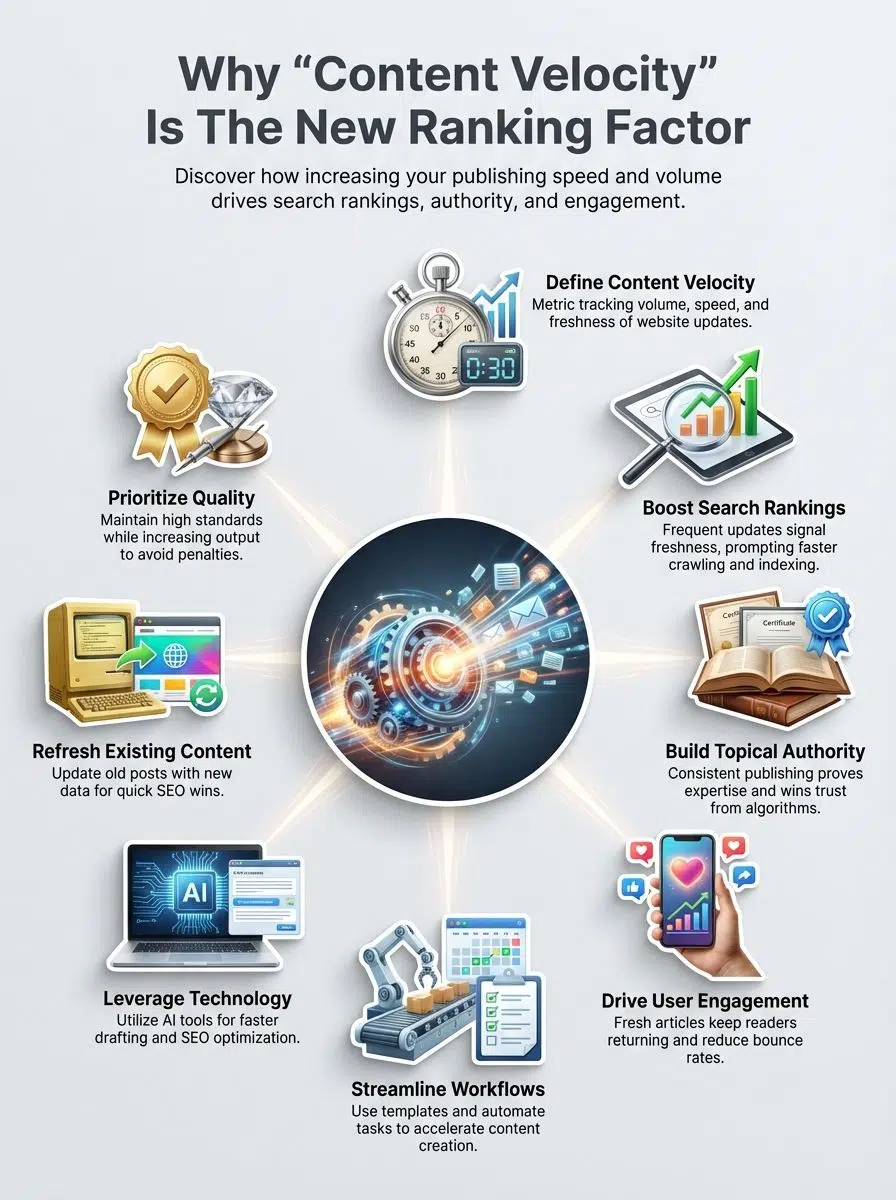
Definition and Key Components
Content velocity measures how often you publish new assets, whether that’s articles, videos, or product pages, and how quickly they go from a draft to a live URL.
Search engines use this “heartbeat” to decide how often to visit you. If you post once a month, Google’s bots (crawlers) might only stop by occasionally. If you post daily, they essentially set up camp on your server.
This concept relies on three main stats:
- Publication Frequency: Are you posting daily, weekly, or monthly?
- Content Volume: How many total pages are you adding to your site’s library?
- Indexing Speed: How fast does Google find and list your new page after you hit “publish”?
How It Is Measured
Google measures this through a mechanism called “Crawl Budget.” This is basically the amount of attention and resources Googlebot is willing to spend on your site. Tools like Google Search Console show this in the “Crawl Stats” report. If your velocity is high, you’ll see a spike in “Crawl Requests.”
Third-party tools also track this. Semrush’s Site Audit tool, for instance, allows you to monitor new pages and technical health over time, giving you a clear “velocity score” compared to your competitors.
Fast-moving sites like Polygon or The Verge score high here because they feed the engine constantly. Slower sites risk falling off the map, much like an abandoned multiplayer server.
Why Is Content Velocity Important?
Speed kills, in a good way. When you increase your velocity, you force search engines to pay attention. It’s the difference between grinding for XP slowly or using a booster to level up fast.
Improved Search Engine Rankings
Data backs this up. According to a 2025 blogging study by Orbit Media, bloggers who publish weekly are 2.5x more likely to report strong results than those who publish monthly.
When you publish frequently, you signal to Google that your site is “alive.” This triggers the “Query Deserves Freshness” (QDF) algorithm, which prioritizes newer content for trending topics.

Publish early, publish often; let Google know you’re alive!
Building Topical Authority
Velocity allows you to dominate a niche, or “map control,” as we call it in gaming. You can’t be an authority on “Gaming Laptops” with just one review. You need dozens of articles covering every GPU, screen size, and budget option. High velocity lets you build these “topic clusters” quickly.
Search engines see this rapid expansion and label you a trusted expert. Instead of being a one-hit wonder, you become the go-to wiki for your industry.
Enhancing Audience Engagement
Your readers have short attention spans. If they visit your site and see the last post was from 2023, they’re gone. Regular updates keep users coming back. It’s like a “Daily Login Bonus”; if people know there’s always something new, they form a habit of checking your site.
Whether it’s a breaking news story or a weekly guide, consistent output improves “Time on Site” and lowers bounce rates, which are critical engagement metrics for SEO.
The Importance of Content Velocity in SEO
We’ve talked about the “why,” now let’s talk about the technical mechanics. This is where we look under the hood at how the engine actually works.
Boosting Search Rankings via Freshness Signals
Google’s algorithms love fresh data. When you update frequently, you send continuous “freshness signals.” This is crucial for “Crawl Demand.” If Google sees that your site changes often, it will increase the frequency of its visits. This means your new articles get indexed in hours, not weeks.
It also helps with “long-tail keywords.” Each new post is a new lottery ticket, a new chance to rank for a specific question someone is typing into the search bar right now.
Strengthening Topical Authority
Think of this like filling out a skill tree. You want to unlock every perk in your category.
If you run a finance site, you can’t just write about “Stocks.” You need to rapidly cover “ETFs,” “Bonds,” “Crypto,” and “Roth IRAs.”
High velocity allows you to cover these gaps faster than your competitors. A site with 500 interlinked articles on a topic will almost always outrank a site with 50, even if the smaller site has slightly better graphics.
Indicating Active Website Operations
A stagnant site looks like a “dead game” to Google. Active operations signal reliability. A study by Botify confirmed that sites with higher publication frequency see a direct correlation with higher crawl rates. Googlebot simply doesn’t waste bandwidth on sites that haven’t updated their “patch notes” in six months.
By keeping the content pipeline full, you prove that your business is open, active, and ready to serve users.
The Core Dimensions of Content Velocity
Content velocity is like a fast-moving train; every piece you publish adds fuel, so hop on and keep reading to see what keeps it speeding up. It breaks down into three specific stats.
Volume of Content Created
This is your total output. How many items are you shipping? But be careful, volume alone isn’t enough. As HubSpot’s 2024 State of Marketing Report notes, 50% of marketers are increasing their content investment, meaning the competition is getting steeper.
You need enough volume to cover your topic completely. If your competitor has 100 pages on “Cloud Computing” and you have 10, you lose.
Speed of Content Production
This is your “Time to Live.” How long does it take to go from an idea on a Trello board to a live URL? In fast-moving industries, speed is everything. If a new Nvidia graphics card drops today, reviewing it next month is useless. Efficient teams use automation and templates to cut this time down. The faster you publish, the faster you get indexed.
Timeliness and Freshness
This is about relevance. Are you talking about today’s meta or last year’s? Timeliness is critical for news and trends. Google’s QDF algorithm specifically looks for this. If you are the first to cover a new trend, you get a “first-mover advantage” in rankings.
This earns you backlinks from other sites that are looking for a source to cite. Being first is often better than being best.
Industries Where Content Velocity Is Critical
Some fields play in “Hard Mode” where speed is the only thing that matters. If you’re in one of these, you can’t afford to lag.

Media and Publishing
This is the Formula 1 of content. Sites like CNN or The Verge publish dozens, sometimes hundreds, of articles a day. For them, velocity is the product. They use tools like Chartbeat to monitor real-time traffic and adjust headlines on the fly.
If they stop publishing for even an hour, they lose money. Their SEO strategy relies entirely on being the first result for breaking news.
E-commerce
Online stores like Newegg or Amazon are constantly updating inventory. But it’s not just products. Successful niche stores update their blogs daily with buying guides, comparisons, and “Best of 2026” lists. This captures buyers at different stages of the funnel.
For example, during Black Friday, velocity ramps up to hourly updates on deals. If you aren’t posting, you aren’t selling.
Healthcare
Trust is the currency here. Medical info changes fast, just look at how quickly guidelines shifted during the pandemic. Authorities like the Mayo Clinic have rigorous review cycles, but they also use APIs to deliver real-time updates for critical health news. They update their “Health Library” constantly to ensure accuracy.
In this field, “freshness” equals “safety.” Google’s “Your Money or Your Life” (YMYL) guidelines demand that health content be up-to-date.
Financial Services
Money never sleeps, and neither should your content. Sites like NerdWallet have massive teams dedicated to updating interest rates, credit card offers, and stock trends daily. A blog post about “Best Savings Rates” is useless if the data is a week old. Financial sites use velocity to ensure accuracy.
They often use dynamic widgets that update numbers automatically, ensuring the page content changes even if the text doesn’t.
Strategies to Increase Content Velocity
You don’t need a team of 100 writers to speed up. You just need a better “tech stack.” Here is how to boost your FPS.
Streamline Workflows and Processes
Stop treating every blog post like a college thesis. Create templates for your common post types (Reviews, How-Tos, Listicles). Use project management tools like Trello or Monday.com to visualize your pipeline. Identify the bottleneck: is it the writing, the editing, or the graphics?
Pro-Tip: Batch your work. Write three outlines on Monday, draft on Tuesday, and edit on Wednesday. Switching tasks kills momentum.
Leverage Technology and Automation
This is where you equip your “power-ups.” AI and automation are standard now.
- Generative AI: Use tools like Jasper or ChatGPT to generate outlines, meta descriptions, or brainstorm titles. Don’t let them write the whole thing, but let them do the heavy lifting.
- Optimization: Tools like SurferSEO or Clearscope help you write faster by telling you exactly which keywords to include as you type.
- Automation: Use Zapier to automatically create a Google Doc when you add a card to Trello, or to post to Slack when a draft is ready for review.
Refresh and Repurpose Existing Content
You don’t always need to create new levels; sometimes a “remaster” is better. Updating old content is the cheat code of content velocity. Take a post from 2024, update the stats to 2026, add a new section, and republish it. It counts as a “fresh” page to Google but takes half the work.
Also, turn that blog post into a YouTube Short, a Twitter thread, and a LinkedIn carousel. One idea, four pieces of content.
Hire Skilled Content Creators
If you want to scale, you eventually need to recruit a party. Look for writers who are “subject matter experts,” not just generalists. Platforms like Upwork or ProBlogger are good starting points, but vetting is key. A writer who knows the niche can write 1,000 words in an hour; a generalist will take five hours just to research.
Invest in a good editor. They are the gatekeepers who ensure your increased speed doesn’t ruin your quality score.
Balancing Quality and Quantity in Content Velocity
Here is the warning label: Do not spam. Google’s August 2025 Spam Update specifically targeted “scaled content abuse”, basically, people using AI to churn out thousands of low-quality pages.
If you pump out garbage, you get “Index Bloat.” This is when you have so many low-value pages that Google stops crawling your good stuff.
| Good Velocity (The Meta) | Bad Velocity (The Spam) |
|---|---|
| Updating old posts with new data | Reposting the same article with a new date |
| Covering a topic in depth with clusters | Creating 50 pages for “Best plumber in [City]” |
| Using AI for outlines and drafts | Publishing raw, unedited AI text |
| Result: Higher Rankings | Result: De-indexing or Penalties |
Quality must always be the priority. One amazing guide is worth ten mediocre stubs. Use tools like Grammarly to keep standards high, but never sacrifice value for speed.
Wrapping Up
Content velocity is the new meta for SEO. Sites that post fresh, useful content fast are climbing the leaderboards, while slower sites are getting left in the lobby. Google’s crawlers crave activity, and feeding them a steady diet of updates is the best way to boost your indexing speed and organic traffic.
But remember, it’s not just about spamming the “publish” button. You need a strategy that balances speed with quality. Whether you’re refreshing old guides, using AI to speed up workflows, or hiring a squad of writers, the goal is to build a library that users trust and search engines respect.
In digital marketing today, speed really does win the race. So, stop lagging behind, check your ping, optimize your workflow, and start moving fast.