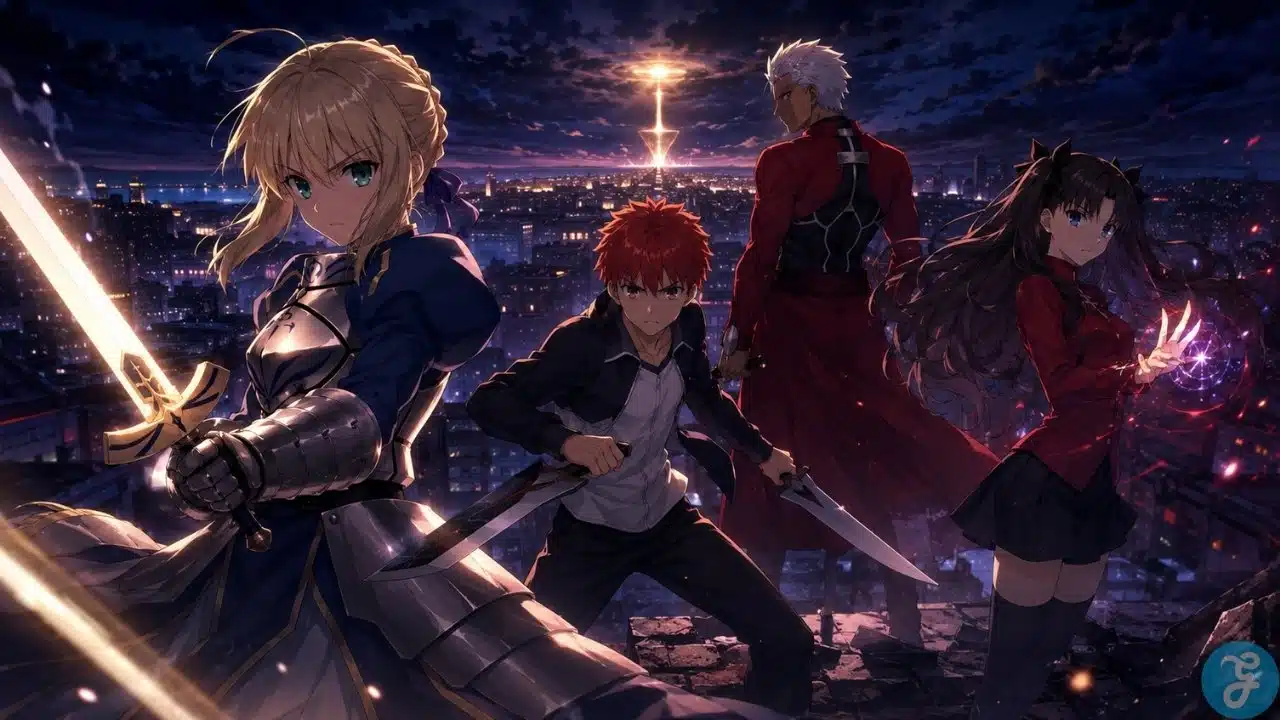
Ask ten Fate fans where to start and you may get ten different answers, which is exactly why the franchise feels so intimidating from the outside. But if the real question is what is the best Fate series anime, my answer is clear: Fate/Zero remains the strongest overall because it turns the Holy Grail War into a controlled tragedy of ideals, ambition, and moral collapse.
Still, “best” is not the same as “best starting point,” so I am ranking the major Fate anime by story strength, production quality, lore handling, action payoff, and how well each one works for anime-only viewers in 2026.
The Instant Verdict Matrix
| Search Intent | Best Fate Anime | Why It Wins |
|---|---|---|
| The Narrative Masterpiece | Fate/Zero | Best for dark psychological drama, adult characters, moral collapse, and a tightly controlled tragedy. |
| The Visual and Action Peak | Fate/stay night: Unlimited Blade Works | Best entry point for most anime-only viewers because it balances clean structure, high-speed action, and iconic ufotable fight direction. |
| The Cinematic Experience | Fate/stay night: Heaven’s Feel Trilogy | Best for dedicated fans who want the darkest Sakura route, movie-level animation, and the franchise’s most brutal emotional escalation. |
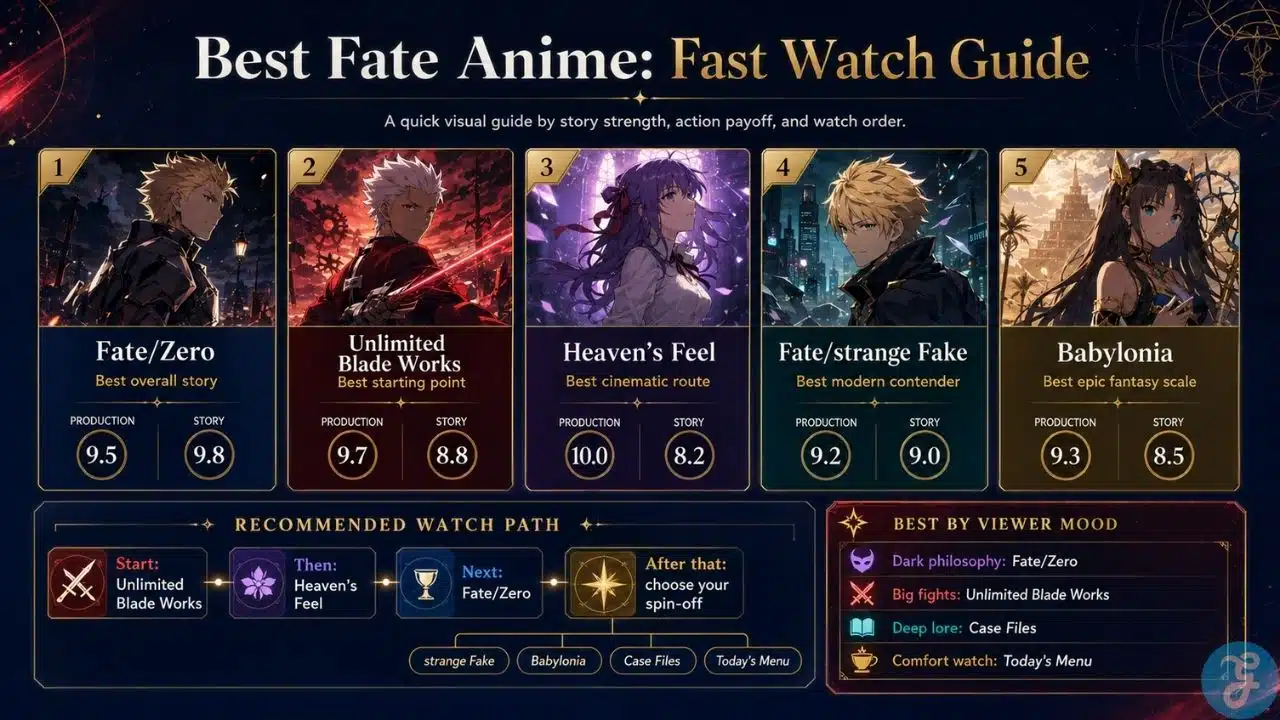
I ranked Fate/Zero as the best Fate series anime overall. I recommend Unlimited Blade Works as the best starting point. I see Heaven’s Feel as the best cinematic experience once you already understand the core Fate/stay night setup.
The Dual-Metric Evaluation Framework: How We Grade the Nasuverse
A Fate ranking falls apart when it treats every anime like the same kind of story. Fate/Zero, Unlimited Blade Works, Heaven’s Feel, Babylonia, Apocrypha, and strange Fake do not have the same job. Some adapt visual novel routes. Some adapt light novels. Some adapt mobile game chapters. Some are comfort-food spin-offs. That is why I separate spectacle from storytelling before deciding which Fate anime truly deserves the top spot.
Metric 1: Production and Choreography Value, 1–10
This score measures how well each anime uses the medium. I look at animation consistency, compositing, camera movement, lighting, sound design, fight choreography, and whether magical combat feels physical instead of becoming noisy light-show chaos.
ufotable naturally dominates this category because its Fate productions use layered digital effects, dramatic lighting, and strong action geography. A-1 Pictures and CloverWorks also deserve credit when they deliver kinetic movement, large-scale set pieces, and memorable impact frames, but the standard set by ufotable remains brutally high.
Metric 2: Narrative Integrity and Lore Fidelity, 1–10
This score measures whether the adaptation tells a complete, emotionally coherent story without burying viewers under Nasuverse terminology. Fate lore includes loaded ideas like the Root, Counter Force, Command Spells, Heroic Spirits, Reality Marbles, Noble Phantasms, and multiple versions of the Holy Grail War. A strong Fate anime does not need to explain every magical footnote, but it must explain enough for character choices to make sense.
This is where some visually excellent Fate entries lose points for me. The Heaven’s Feel movies look almost untouchable, but the movie format trims important character interiority. Unlimited Blade Works is an outstanding gateway, but it cannot fully carry Shirou Emiya’s internal monologues from the visual novel. Fate/Zero wins because its source structure gives it a cleaner television shape from the start.
Tier 1: The Undisputed Masterpieces
These are the Fate anime I think define the franchise for serious viewers. Each one has a real claim to the top spot, but they win for different reasons.
1. Fate/Zero — The Ultimate Psychological Deconstruction
Studio: ufotable
Released: 2011–2012
Format: 25 episodes
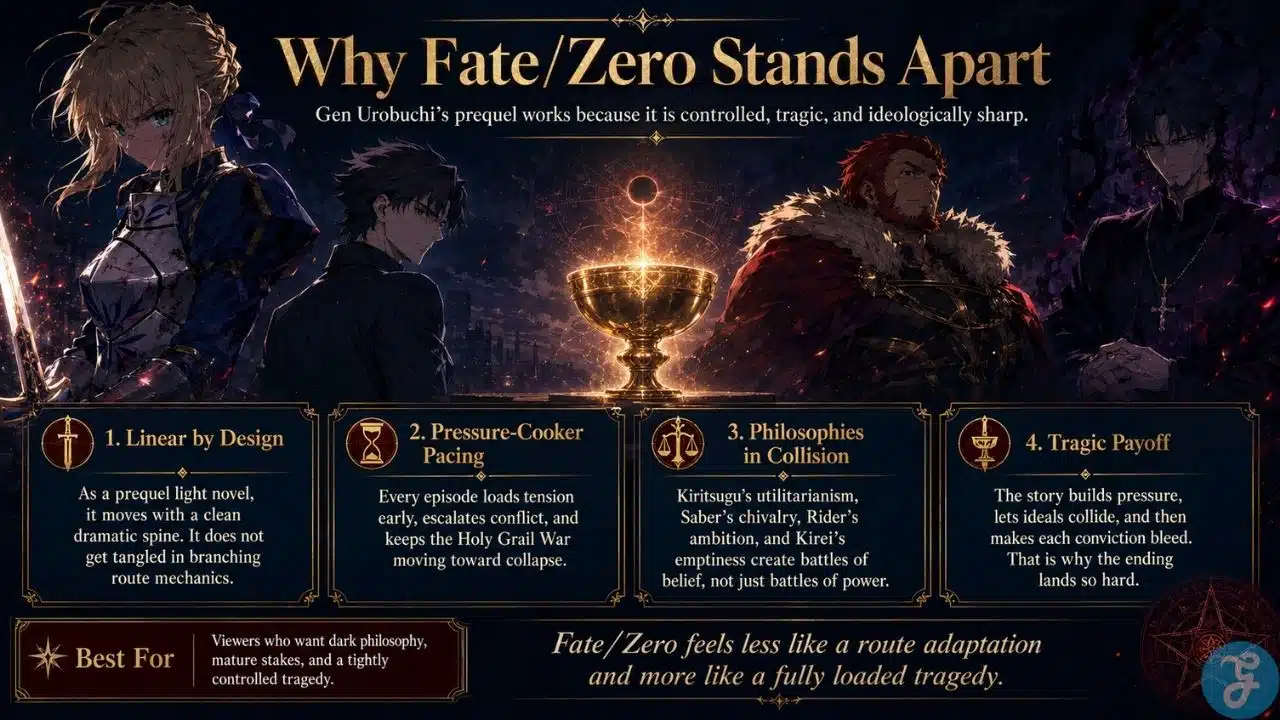
Fate/Zero is my pick for the best Fate series anime because it understands the Holy Grail War as a moral trap first and an action tournament second. The battles matter, but the real conflict is ideological. Kiritsugu Emiya believes saving the many can justify sacrificing the few. Saber clings to a rigid, noble vision of kingship. Rider sees conquest as charisma, appetite, and heroic scale. Gilgamesh treats everyone else like insects who have forgotten their place.
That clash gives Fate/Zero a weight most Fate adaptations struggle to match. Every major Master and Servant pair feels like a thesis about power, justice, faith, ambition, or human weakness. The show does not simply ask who will win the Grail. It asks what kind of person still wants the Grail after understanding the cost.
The reason Gen Urobuchi’s prequel stands apart for me is control. Fate/Zero moves like a tragedy with a loaded gun on the table. It does not wander through route mechanics. It does not need to protect a dating-sim structure. It builds pressure, lets opposing philosophies collide, and then makes every ideal bleed.
If you start with Fate/Zero, just know that it works beautifully as a standalone adult tragedy, but it also reveals background information that Fate/stay night originally uncovers more slowly. I still think it is worth watching early if you want the strongest anime immediately, but if you want a cleaner route-first experience, watch Unlimited Blade Works before coming here. Also, be extra ready for Episode 19. I will not spoil what happens, but it quietly changes how you understand one of the show’s most important moral wounds.
The Source Material Context
Fate/Zero began as a light novel prequel, and that matters. Unlike Fate/stay night, which comes from a visual novel with three major branching routes, Fate/Zero has a tight linear spine. That makes it easier to adapt into television without asking the viewer to understand alternate timelines, route logic, or missing internal monologues before the emotional drama starts.
It also helps that the cast is older and more experienced. These are not teenagers stumbling into mythic violence. Many of them already know what they want, which makes their collapse sharper. Kiritsugu, Kirei, Tokiomi, Kayneth, Waver, and the Servants enter the war with formed beliefs. Fate/Zero’s genius is that it slowly proves how brittle those beliefs are.
Production Strength
Fate/Zero is not ufotable’s most visually explosive Fate anime anymore, but it remains one of its most balanced. The action is readable, the compositing still holds up, and Yuki Kajiura’s music gives the show a cold ceremonial grandeur. The fights do not feel like empty highlight reels because every confrontation is tied to character pressure.
The Only Real Drawback
Fate/Zero spoils parts of Fate/stay night by design. As a prequel, it explains the previous Holy Grail War and reveals background information that the original Fate/stay night routes uncover more slowly. For a pure watch-order purist, that matters. For someone asking which Fate anime is best, it does not change my answer.
Dual Score:
Production: 9.5/10
Lore Fidelity: 9.8/10
2. Fate/stay night: Unlimited Blade Works
Studio: ufotable
Released: 2014–2015
Format: 26 episodes
Fate/stay night: Unlimited Blade Works is the Fate anime I recommend first to most newcomers who want the franchise to look as cool as its reputation. It has the iconic Holy Grail War setup, the Rin and Archer focus, Shirou Emiya’s “hero of justice” ideal, and enough explosive action to make the Nasuverse feel instantly addictive.
As an action production, UBW is still a benchmark. The early Archer vs. Lancer encounters show exactly why ufotable changed the visual identity of modern Fate anime. The camera does not just observe the fight. It whips, tracks, cuts, and reframes as the fighters move through streets, rooftops, courtyards, and bounded spaces. Spears feel fast. Blades feel heavy. Magic feels expensive.
This is also the entry that best sells Fate as a stylish supernatural battle anime. The glowing Command Spells, the Noble Phantasm reveals, the red-and-blue contrast between Archer and Lancer, the sparks, the digital debris, and the musical timing all work together. It is polished without becoming sterile.
If I were guiding a new viewer, I would usually say this: start with Unlimited Blade Works, then watch Heaven’s Feel, then go back to Fate/Zero if you want the heavier prequel tragedy. That order protects more of Fate/stay night’s route experience while still letting you enjoy Fate/Zero later as the grand explanation of the previous war.
The Visual Novel Gap Addressed
UBW’s weakness is not the plot. It is interiority.
The visual novel version of Shirou Emiya spends far more time inside his damaged psychology. You understand how broken he is, why his selflessness is not simply heroic, and why his ideal of becoming a savior is closer to trauma than optimism. The anime shows this visually, especially through repeated body language, dreamlike imagery, and confrontations with Archer, but it trims many of the internal trauma monologues that make Shirou feel deeply fractured on the page.
That is why some anime-only viewers read Shirou as stubborn or naive. In the visual novel, his stubbornness is the symptom of a wound. In the anime, the wound is present, but less verbally exposed. This does not ruin UBW. It just keeps it slightly below Fate/Zero as a complete adaptation.
Why It Ranks This High
UBW is the most practical answer for viewers who ask where to start. It gives the basic Grail War framework, introduces the emotional center of Fate/stay night, and delivers enough ufotable spectacle to hook almost anyone. It also avoids the heavier content barrier of Heaven’s Feel and the spoiler-heavy prequel problem of Fate/Zero.
If Fate/Zero is the franchise’s best tragedy, UBW is its best gateway.
Dual Score: Production: 9.7/10 | Lore Fidelity: 8.8/10
3. Fate/stay night: Heaven’s Feel Trilogy
Studio: ufotable
Released: 2017–2020
Format: 3 theatrical films.
Fate/stay night: Heaven’s Feel is the most visually overwhelming Fate anime ever made. As pure cinema, nothing else in the franchise hits quite like it. The trilogy turns the Sakura route into a horror-adjacent emotional collapse, where romance, abuse, guilt, body horror, family rot, and magical violence all close in around Shirou and Sakura.
The famous Saber Alter vs. Berserker battle is the obvious production flex, but the trilogy’s power is not only in scale. It is in atmosphere. Heaven’s Feel makes Fuyuki feel diseased. Shadows move like living trauma. Domestic spaces become unsafe. Familiar characters seem more fragile because the route removes the cleaner heroic framing of UBW and replaces it with moral compromise.
This is Fate at its darkest and most intimate. Shirou is no longer only arguing about ideals. He has to decide what one person is worth when saving that person may destroy the clean heroic dream he built his identity around. Sakura, meanwhile, becomes one of the franchise’s most tragic figures because the story finally forces the audience to face the cost of what other routes leave buried.
I would not watch Heaven’s Feel first. The films technically tell their own route, but they hit much harder after Unlimited Blade Works because you already understand the Fifth Holy Grail War, Shirou’s ideal, Rin’s position, Saber’s role, and the emotional expectations the Sakura route is about to break.
The Critical Gap Addressed
The Heaven’s Feel trilogy loses points for one reason: runtime compression.
The original route is dense, slow-burning, and psychologically heavy. The movies adapt the broad emotional shape extremely well, but they do not have enough room to fully develop every crucial supporting arc. Kirei Kotomine and Illya suffer the most from this. Both are essential to the route’s emotional and thematic payoff, yet the films move so fast that anime-only viewers may feel some late-stage moments arrive before the character groundwork has fully settled.
That does not make the trilogy weak. It makes it incomplete in a specific way. The production is close to perfect. The mood is superb. The major set pieces are franchise-defining. But the story would have benefited from more breathing room, especially in the second and third films.
Why Dedicated Fans Love it Most
Heaven’s Feel rewards viewers who already know the Fate/stay night structure. If you watch it after UBW, it feels like the franchise turning over a stone and showing you everything ugly underneath. If you watch it cold, it may still impress you visually, but some of the emotional weight will not land as hard.
That is why it ranks third overall. It is the cinematic peak, but not the cleanest standalone adaptation.
Dual Score: Production: 10/10 | Lore Fidelity: 8.2/10
Tier 2: The Elite Spin-offs and New Contenders
These entries are not the safest starting points, but I think they prove the Fate universe still has range. One is the most exciting modern contender. The other is the rare mobile game adaptation that actually works as mythic television.
4. Fate/strange Fake
Studio: A-1 Pictures
TV run: January–March 2026
Format: 13-episode season, following the earlier Whispers of Dawn prologue.
Fate/strange Fake is the strongest modern contender in the Fate anime lineup because it understands that the franchise needs chaos again. Ryohgo Narita, known for Durarara!! and Baccano!, brings a different rhythm to the Holy Grail War formula. Instead of the clean ritual structure of Fuyuki, strange Fake throws viewers into an American Grail War in Snowfield, where the rules feel unstable, the factions multiply fast, and the cast moves with dangerous unpredictability.
That American setting gives the series a different flavor immediately. The Nasuverse can sometimes feel trapped in the same sacred locations, old magical families, and familiar route arguments. strange Fake opens the windows. The result is messier, louder, and more volatile, but that is also the appeal.
I do not recommend strange Fake as a first Fate anime. It is much more rewarding after you know the basic Holy Grail War structure from Unlimited Blade Works or Fate/Zero. Once you understand the normal rules, strange Fake becomes more exciting because you can feel how aggressively it bends them.
Why It Ranks High
The scale is ridiculous in the best way. Gilgamesh and Enkidu appearing in the opening acts gives the anime instant mythic force. Their presence alone raises the ceiling of the conflict because both characters carry enormous franchise weight. When strange Fake leans into that scale, it feels less like a side project and more like Fate testing how much pressure the Holy Grail War concept can handle before it mutates.
A-1 Pictures also delivers strong kinetic energy. It does not look exactly like ufotable Fate, and it should not. strange Fake benefits from a more frantic, sharp-edged visual identity. The action feels fast, the character entrances have theatrical confidence, and Hiroyuki Sawano’s music gives the production a modern blockbuster pulse.
Why It is Not Top Three Yet
Fate/strange Fake is still not as complete as Fate/Zero, UBW, or Heaven’s Feel. Season 1 proves the concept beautifully, but a high-ranking Fate anime needs more than momentum. It needs payoff. Fate/Zero already has that. UBW already has that. Heaven’s Feel already has that, even with cuts.
So I place strange Fake at No. 4 for now. It may climb higher if later seasons deliver on the setup. As of 2026, it is the most exciting new Fate anime, but not yet the definitive best.
Dual Score: Production: 9.2/10 | Lore Fidelity: 9.0/10
5. Fate/Grand Order: Absolute Demonic Front – Babylonia
Studio: CloverWorks
Released: 2019–202
Format: 21 episodes
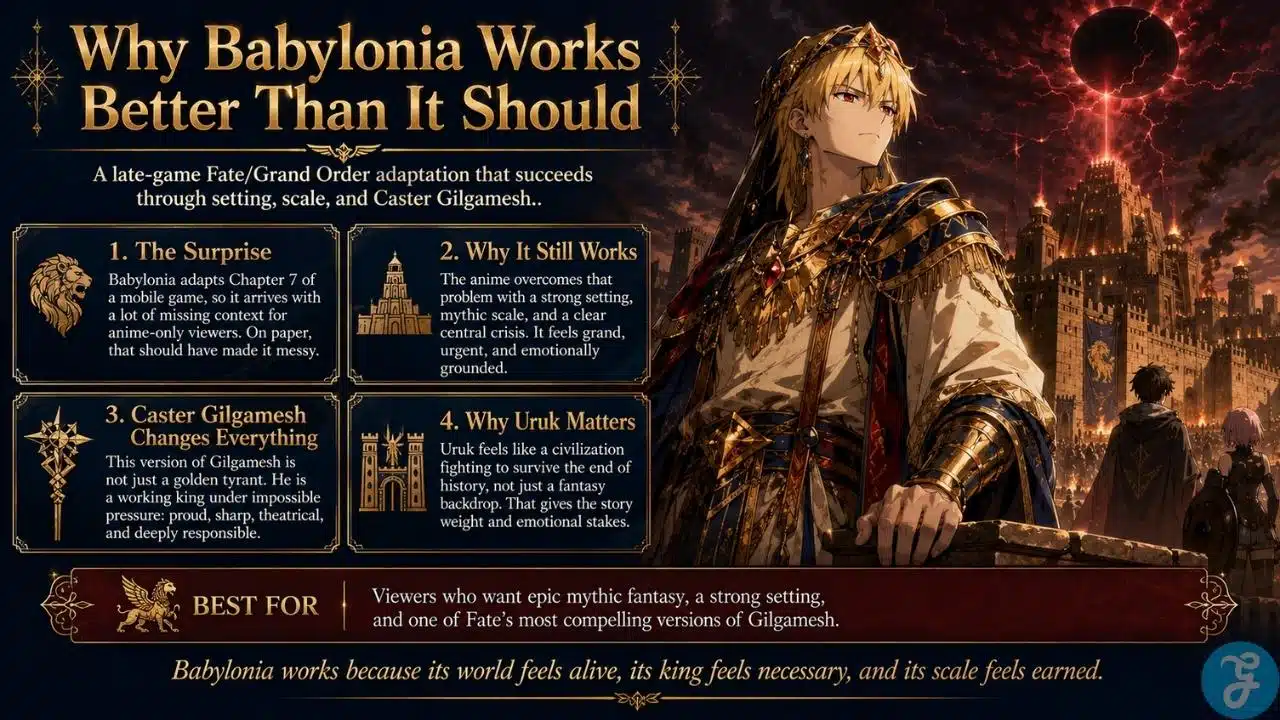
Fate/Grand Order: Absolute Demonic Front – Babylonia should have been a disaster for anime-only viewers. It adapts Chapter 7 of a mobile game, which means it arrives after a huge amount of game context. Yet somehow, it works far better than expected because Babylonia has a strong setting, a grand mythic scale, and one of the best versions of Gilgamesh in animated Fate.
The key is Caster Gilgamesh. Instead of the arrogant golden tyrant most viewers know, Babylonia presents him as a working king under impossible pressure. He is still proud, sharp, and theatrical, but he is also responsible. That shift gives the story emotional grounding. Uruk feels like a civilization trying to survive the end of history, not just a fantasy backdrop.
The show also understands scale. The conflict against Tiamat gives the final stretch a sense of apocalyptic weight that many game adaptations never achieve. CloverWorks pushes hard during the major battles, and while the production is not always as refined as ufotable’s best Fate work, the highs are genuinely huge.
I would not place Babylonia early in a beginner watch order. It is better after you already know Fate’s basic rules and accept that Grand Order is its own branch of the franchise. You can enjoy it without playing the mobile game, but you will feel the missing context.
The Anime-only Problem
Babylonia’s main weakness is context. It does not adapt the beginning of Fate/Grand Order. It adapts one of the most beloved later chapters. That means viewers can enjoy the spectacle and character moments, but they may feel like they entered the story through a side door.
Within its own game context, Babylonia is a strong adaptation. As a standalone Fate anime, it is impressive but less clean than the top four.
Dual Score: Production: 9.3/10 | Lore Fidelity: 8.5/10 within game context
Tier 3: The Mid-Tier and Niche Adaptations
These Fate anime are not bad. I just see them as more specialized. Some are for lore fans. Some are for action hunters. One is for people who are emotionally exhausted and just want dinner.
6. Lord El-Melloi II’s Case Files
Studio: TROYCA
Released: 2019
Format: 13 episodes plus special material.
Lord El-Melloi II’s Case Files is not built for viewers who only want Servants smashing Noble Phantasms into each other. It is built for people who want the Clock Tower, magical theory, inherited mysteries, mage politics, and the long emotional shadow of Fate/Zero’s Waver Velvet.
That is its strength and its limitation. As a detective-style Fate spin-off, it gives the universe texture. The show makes magecraft feel like an academic, political, and aristocratic system rather than just a combat tool. Waver’s growth into Lord El-Melloi II is also quietly satisfying because he still carries the emotional weight of the Fourth Holy Grail War.
The problem is that Case Files does not deliver the clean adrenaline most casual Fate searchers expect. It is slower, more talkative, and more interested in magical logic than battle royale tension. For lore purists, that is the point. For newcomers, it may feel like homework with excellent atmosphere.
I would watch this after Fate/Zero, not before it. Waver’s adult identity matters far more when you have already seen what shaped him during the Fourth Holy Grail War.
Best for: Viewers who already like Fate/Zero and want more Clock Tower politics, mystery structure, and Waver character growth.
7. Fate/Apocrypha
Studio: A-1 Pictures
Released: 2017
Format: 25 episodes.
Fate/Apocrypha has one of the most exciting concepts in the franchise: a 14 vs. 14 Great Holy Grail War. On paper, that sounds like Fate going bigger than ever. Two factions, overloaded Servant rosters, massive battles, and enough mythological firepower to make every episode feel like a tournament finale.
At its best, Apocrypha is thrilling. The sound design has weight, the combat can explode into genuinely memorable choreography, and the Karna vs. Sieg material gives action fans exactly the kind of high-stakes spectacle they came for. Mordred is also a major highlight because the show gives her enough attitude, vulnerability, and raw momentum to cut through the crowded cast.
But that crowding is the problem. Apocrypha has too many characters fighting for emotional space. The 14 vs. 14 structure creates scale, but it also dilutes development. Some Servants feel vivid. Others feel like cool designs waiting for more story than the anime can provide.
I would treat Apocrypha as a later side watch, not a foundation piece. Watch UBW or Zero first, then come here when you want a larger, messier faction-war version of Fate.
That is why Apocrypha lands in the middle tier for me. It has some outstanding moments, but it is not as disciplined as Fate/Zero, as clean as UBW, or as cinematically focused as Heaven’s Feel.
Best for: Viewers who want large-scale faction warfare and do not mind uneven character depth.
8. Today’s Menu for the Emiya Family
Studio: ufotable
Released: 2018–2019
Format: 13 short episodes.
Today’s Menu for the Emiya Family is not trying to be the best Fate battle anime. It is trying to heal the damage every other Fate anime caused. That alone makes it essential.
The premise is simple: the tragic Fate/stay night cast gets to cook, eat, relax, visit each other, and behave like people who are not trapped inside a supernatural death ritual. Shirou cooks. Saber eats. Rin softens. Sakura smiles. Lancer gets to be funny. The whole thing feels like an alternate universe built out of emotional mercy.
What makes it work is sincerity. The show does not parody Fate as much as it gently releases it. ufotable’s soft food animation, warm lighting, and relaxed pacing turn every episode into a small act of fan service in the best sense. Not cheap fan service. Emotional fan service.
It also proves something important about the Fate franchise. These characters are memorable not only because they suffer beautifully, but because fans want to imagine them living ordinary lives. Today’s Menu understands that better than almost any spin-off.
I would save this for after at least one serious Fate/stay night route. It works as comfort because you already know what these characters usually endure. Without that contrast, it is still charming, but it loses some of its quiet emotional joke.
Best for: Fans who already know Fate/stay night and want comfort, warmth, and zero Holy Grail trauma for once.
The Ultimate Categorical Breakdown: Which One Should YOU Watch?
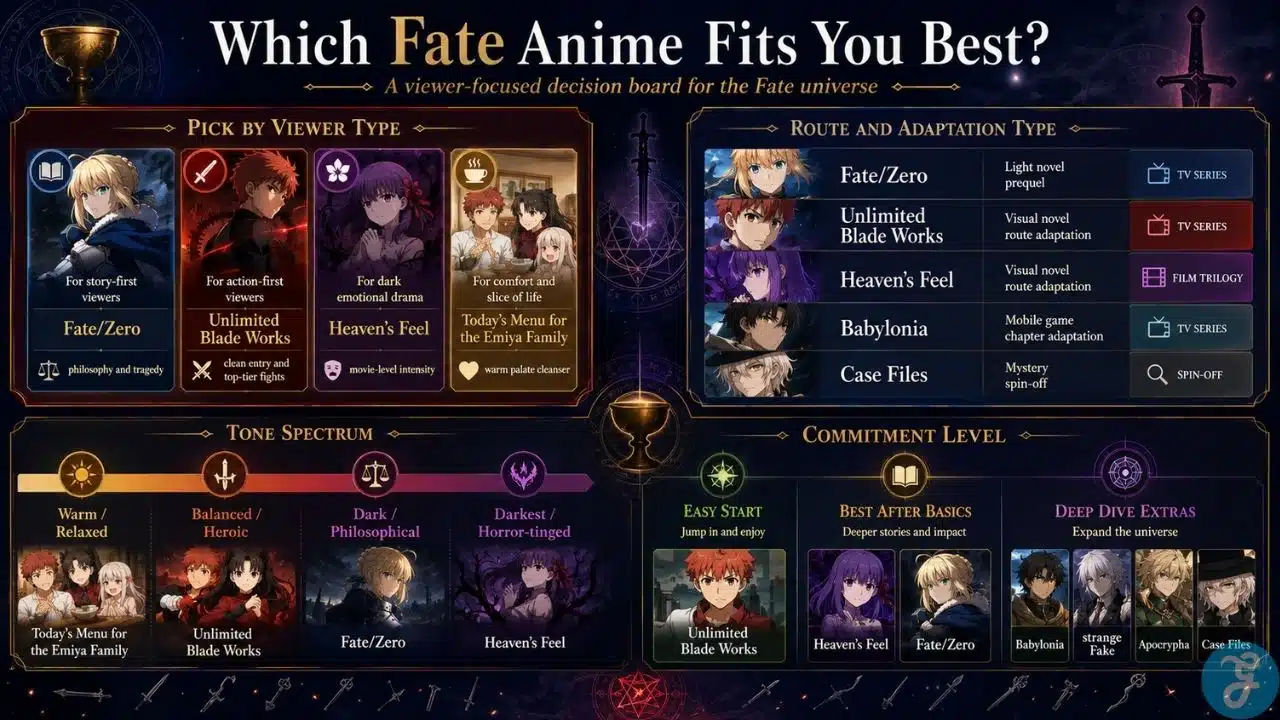
The best Fate anime depends on what kind of viewer you are. I would use this quick selector before committing to a watch order.
| Viewer Mood | Watch This | Why |
| You want gore, strategy, and dark philosophy | Fate/Zero | Adult cast, brutal moral conflict, tragic structure, and the best overall writing. |
| You want mind-blowing shonen-style fights | Fate/stay night: Unlimited Blade Works | The cleanest modern gateway with elite ufotable action choreography. |
| You want movie-level spectacle and darker romance | Heaven’s Feel Trilogy | The most cinematic Fate adaptation, best watched after UBW. |
| You want the newest high-energy Fate contender | Fate/strange Fake | Chaotic American Grail War, huge Servant scale, and modern A-1 action. |
| You want mythic fantasy and huge boss-battle energy | Fate/Grand Order: Babylonia | Massive stakes, Caster Gilgamesh, Uruk, and a grand finale against Tiamat. |
| You want world-building and magic lore | Lord El-Melloi II’s Case Files | Clock Tower politics, magecraft theory, and Waver’s post-Zero growth. |
| You want a big faction war | Fate/Apocrypha | 14 vs. 14 Servant warfare with uneven but exciting action highs. |
| You want comfort and zero stress | Today’s Menu for the Emiya Family | Peaceful cooking, warm character moments, and emotional recovery for Fate fans. |
My Two Cents on Type-Moon’s Animated Universe
So, what is the best Fate series anime in 2026? I still rank Fate/Zero as the absolute narrative peak of the franchise, while Unlimited Blade Works remains the best visual gateway and Heaven’s Feel stands as the most impressive cinematic achievement.
If you want the smartest, darkest, most complete Fate anime, choose Fate/Zero. If you want the easiest modern starting point, choose Unlimited Blade Works. If you already care about Shirou, Sakura, Rin, Saber, and the cost of the Holy Grail War, Heaven’s Feel will hit the hardest.
Frequently Asked Questions(FAQS) on The Best Fate Series Anime
Fate watch order debates can swallow the whole conversation, but I do not think they need to. The main thing is understanding that some entries are alternate routes, not direct sequels.
Can I skip the 2006 Studio DEEN Fate/stay night adaptation?
Yes, I think you can skip it if your goal is the best modern Fate anime experience. The 2006 Studio DEEN adaptation has nostalgic value, a memorable soundtrack, and historical importance, but it blends elements in a way that weakens the clean route structure of the original visual novel. Most new viewers are better served by starting with Unlimited Blade Works or Fate/Zero.
Do I need to play the visual novel to enjoy the best Fate anime?
No, but I think it helps if you understand one thing: Unlimited Blade Works and Heaven’s Feel are alternate routes, not normal sequels. Fate/stay night began as a visual novel with different narrative routes, including Fate, Unlimited Blade Works, and Heaven’s Feel. That is why the same starting premise can lead to very different character arcs and outcomes.
Should I watch Fate/Zero or Unlimited Blade Works first?
If you care about the cleanest emotional setup for Fate/stay night, I would start with Unlimited Blade Works. If you want the strongest anime immediately and do not mind prequel spoilers, I would start with Fate/Zero. The honest answer is that both orders work, but they create different experiences.
Is Heaven’s Feel a sequel to Unlimited Blade Works?
No. Heaven’s Feel is an alternate route from the same Fate/stay night foundation. I still recommend watching it after Unlimited Blade Works because UBW gives you a cleaner understanding of Shirou, Rin, Archer, Saber, and the Fifth Holy Grail War before Heaven’s Feel pushes the story into much darker territory.
Is Fate/strange Fake a good starting point in 2026?
Not really. Fate/strange Fake is exciting, modern, and visually strong, but it works better after you understand Fate’s basic Grail War language. Watch UBW or Fate/Zero first, then strange Fake will feel sharper, stranger, and more rewarding.
What is the best Fate anime for someone who only wants action?
Unlimited Blade Works is my first choice for action. Heaven’s Feel has the highest cinematic peaks, especially in its major battles, but UBW is easier to enter and more consistent as a full action gateway.
What is the best Fate anime for someone who hates confusing lore?
I would start with Fate/Zero if you want a complete adult tragedy, or Unlimited Blade Works if you want the main Fate/stay night setup. I would avoid jumping into Babylonia, Apocrypha, Case Files, or strange Fake first because they assume more comfort with the wider franchise.