


The shift toward a decentralized financial landscape has fundamentally changed how people interact with their money. By allowing third-party providers to access financial data through secure channels, the industry has moved away from traditional gatekeeping toward a more user-centric model. This evolution ensures that individuals have the tools they need to manage multiple accounts and initiate payments with unprecedented speed and security.
How We Selected Our 5 Best UK Open Banking Features
To identify the most impactful elements of this ecosystem, we evaluated various services based on their ability to solve real-world financial friction. Our selection process focused on identifying technologies that offer measurable improvements in transparency, ease of use, and cost reduction for the average consumer.
The following benchmarks were used to determine which features provide the most value to the modern banking customer.
| Evaluation Metric | Description of Focus Area | Impact Level |
| Data Accessibility | Ease of connecting multiple accounts into a single view | High |
| Payment Speed | Reduction in transaction time compared to card networks | Very High |
| Cost Efficiency | Ability to lower or eliminate fees for the end user | Medium |
| Security Protocols | Utilization of Strong Customer Authentication and encryption | Critical |
Once the selection criteria were established, we narrowed the field to the technologies that provide the most immediate benefit to daily financial management and long-term stability.
5 Strategic Ways UK Open Banking Empowers Consumers
Modern financial management requires a set of tools that can keep up with a fast-paced digital economy. These five specific features represent the current peak of what the regulated framework offers to help you regain mastery over your capital and spending habits.
The journey toward better financial health begins with having a clear, unified view of your money across every institution you use.
1. Comprehensive Account Aggregation
Managing finances often involves jumping between different apps to check various balances and transaction histories. Account aggregation solves this by pulling data from all your current accounts and credit cards into one central dashboard. This creates a holistic view of your net worth and spending patterns without the need for manual spreadsheets or constant app-switching.
Best for:
-
Individuals who hold accounts with multiple financial institutions and struggle with manual tracking.
Why We Chose It:
-
It provides a single source of truth for all monthly outgoings and income.
-
It enables more accurate budgeting by categorizing spend across different banks automatically.
-
It significantly reduces the time spent logging into various banking portals every week.
Things to consider:
-
You must re-authorize data access every ninety days to maintain the active connection between your accounts.
Beyond viewing your balances, the framework also revolutionizes how you move money during daily transactions and online shopping.
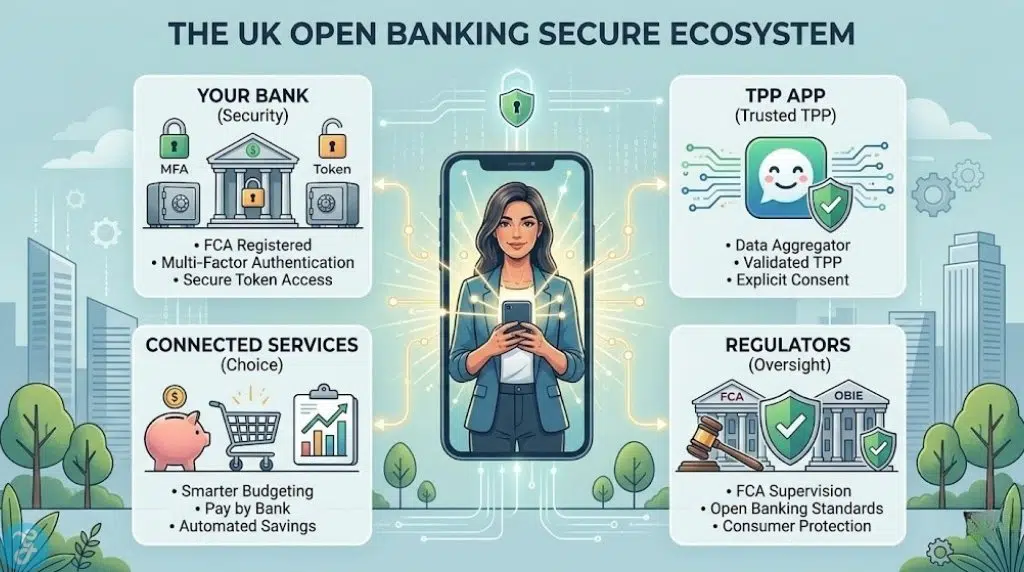
2. Direct Pay by Bank Integration
Traditional card payments often involve entering long numbers and waiting for multiple processing layers that can be intercepted or delayed. Pay by Bank allows you to authorize a direct transfer from your banking app at the point of sale, which is both faster and more secure. This method is becoming increasingly common on major e-commerce platforms like Amazon and eBay as we move through 2026.
Best for:
-
Online shoppers who want to avoid sharing sensitive card details with every merchant they visit.
Why We Chose It:
-
It uses biometric security from your own banking app to confirm and finalize every purchase.
-
It eliminates the risk of card expiry or cancellation affecting your important or time-sensitive payments.
-
It provides an instant update to your bank balance so you know exactly what remains for the month.
Things to consider:
-
Some smaller niche merchants might not yet offer this as a primary checkout option on their websites.
While one-off payments are convenient, managing recurring costs requires a more flexible and intelligent approach to cash flow.
3. Variable Recurring Payments (VRP)
Variable Recurring Payments offer a more flexible alternative to traditional Direct Debits or standing orders that can be difficult to manage. This technology allows you to authorize a provider to move money from your account within set limits, which is perfect for bills that fluctuate or for topping up investment accounts. It offers more control because you can set maximum limits that cannot be exceeded by the merchant.
Best for:
-
Managing subscriptions and household bills where the cost changes based on monthly usage.
Why We Chose It:
-
It provides more granular control and transparency than a standard Direct Debit mandate.
-
It allows for instant cancellation of recurring permissions through your own bank app at any time.
-
It supports smarter sweeping between your own accounts to avoid expensive overdraft fees.
Things to consider:
-
Commercial use for utility bills is currently in the early stages of a nationwide rollout.
Financial control also extends to your ability to access credit and prove your financial reliability to lenders through accurate data sharing.
4. Real-Time Credit Affordability Checks
Traditional credit checks often rely on old, historical data that might not reflect your current financial health or income. By sharing your transaction history through a secure link, lenders can see your actual income and spending habits in real time. This often leads to better interest rates and higher approval chances for people with thin credit files or self-employed income.
Best for:
-
Individuals looking to prove affordability for loans or mortgages based on current cash flow rather than past history.
Why We Chose It:
-
It uses actual, current cash flow data instead of relying solely on historical repayment records.
-
It can help identify regular income that traditional scoring models might miss during a standard review.
-
It speeds up the application process significantly by removing the need for manual paper bank statements.
Things to consider:
-
Your data is only shared with your explicit consent for a specific, time-limited purpose.
The final pillar of financial control is the ability to grow your wealth through automated and effortless habits that don’t require manual effort.
5. Automated Sweeping and Micro-Savings
Saving money can be difficult when it is done manually at the end of every month when funds may be low. Automated sweeping tools use data access to monitor your balance and move small amounts of spare cash into a savings or investment account. This “set and forget” approach helps build a financial cushion without having a noticeable impact on your daily lifestyle.
Best for:
-
Building an emergency fund or reaching specific savings goals without having to remember to transfer money.
Why We Chose It:
-
It makes saving effortless by using small, unnoticeable amounts that accumulate over time.
-
It helps avoid expensive overdraft fees by keeping a healthy buffer in your main current account.
-
It allows you to participate in higher-interest savings accounts without the need for manual transfers.
Things to consider:
-
You should monitor your overall liquidity to ensure you have enough funds for unexpected large bills.
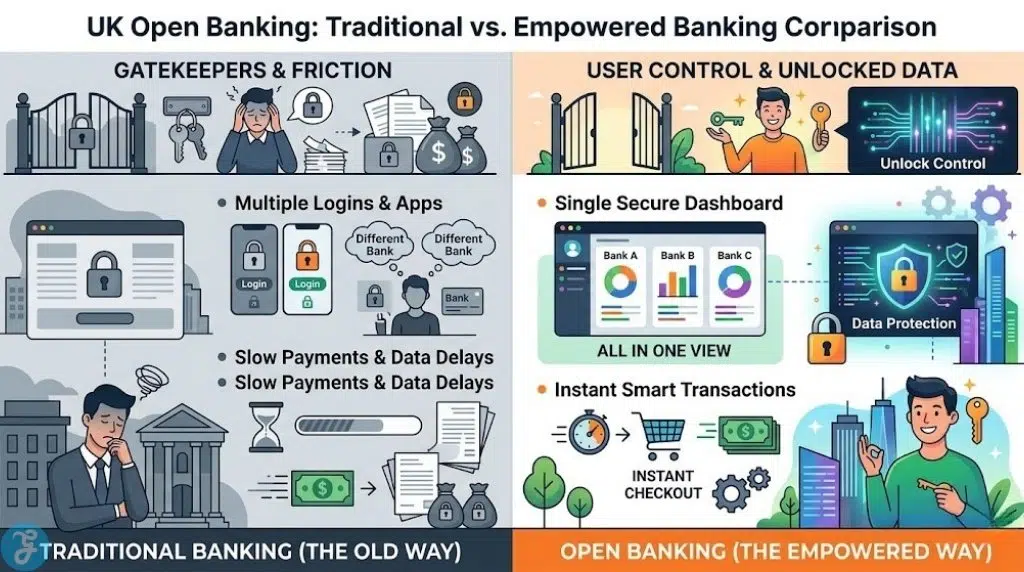
An Overview Of UK Open Banking and Consumer Benefits
Understanding how these different components interact is essential for a holistic view of your financial readiness in a digital age. The following summary provides a quick reference for the various categories of the digital ecosystem and how they impact your results.
To help you visualize the priority levels of these services, the data below compares the ease of setup against the long-term financial impact.
| Service Category | Setup Effort | Financial Impact | Data Privacy Level |
| Aggregation | Low | Medium | High |
| Payments | Low | High | Very High |
| Credit Checks | Medium | Very High | High |
| Automated Saving | Medium | High | High |
Our Top 3 Picks and Why?
While all features are important, some carry more weight due to their impact on your daily convenience and financial security.
-
Pay by Bank: This is the most significant leap in payment security for online shoppers and reduces fraud risk.
-
Account Aggregation: Prevents financial “blindness” by showing your total wealth across all institutions in real time.
-
Variable Recurring Payments: The easiest way to regain control over recurring subscription costs and prevent overcharging.
How to Choose the Right UK Open Banking Tools by Yourself?
Developing a personal framework for digital banking can save you hours of administrative work and protect your sensitive data. By categorizing tasks based on your own financial needs, you can handle the basics and leave the complex data analysis to regulated third-party apps.
-
Security Verification: Always ensure every app you use is registered with the Financial Conduct Authority (FCA).
-
Data Transparency: Focus on providers that clearly explain what data they need, why they need it, and for how long.
-
Functional Benefit: Choose tools that solve a specific problem, such as debt management, savings growth, or mortgage readiness.
To help you decide which tools to integrate into your daily routine, consider the following logic based on your current financial goals.
The choice of tool often depends on whether you are looking for a bird’s-eye view of your wealth or a more secure way to handle transactions.
| Choose Automated Aggregation if… | Choose Direct Payments if… |
| You have more than three separate bank accounts or credit cards. | You want to avoid credit card interest and processing fees. |
| You struggle to track your total monthly spending across institutions. | You prioritize biometric security during the digital checkout process. |
| You want to see all your balances in one place for easier budgeting. | You need instant confirmation of your remaining balance after a buy. |
The Final Checklist
-
[ ] Verify the provider is listed on the official FCA register or the Open Banking Directory.
-
[ ] Read the data permission screen carefully to see exactly what is being shared.
-
[ ] Set a calendar reminder to review and renew your data permissions every ninety days.
-
[ ] Check if your main bank supports the specific feature or VRP you want to use.
-
[ ] Ensure you have the latest version of your banking app installed for biometric security.
Taking Command of Your Financial Future
By following this structured approach, you turn a complex regulatory framework into a set of powerful personal tools for success. Taking a few minutes to authorize these connections does not just save you time on administration; it ensures that your financial life remains transparent, secure, and entirely under your own command in an increasingly digital world.
Frequently Asked Questions About UK Open Banking
Is my money safe when using these services?
Answer: Yes, because your bank will never share your login details or passwords with any third party. You only authorize a secure, encrypted token that gives the provider access to specific data for a limited time.
Can I stop sharing my data at any time?
Answer: You have complete control and can revoke access through your banking app or the third-party app immediately. Access also automatically expires after ninety days unless you choose to manually renew it.
Does using these apps cost anything?
Answer: Most consumer-facing apps that use this technology are free for the end user to download and use. Providers often make money through premium features or by charging merchants for faster, secure payment processing.
Will sharing my data affect my credit score?
Answer: Using these tools for credit checks can actually help improve your score by providing a more accurate picture of your affordability. Standard data sharing for budgeting and aggregation does not negatively impact your credit file.
What happens if there is a fraudulent transaction?
Answer: You are still protected by the same consumer rights and fraud protections as traditional banking. Your bank and the regulated provider are responsible for investigating and resolving any unauthorized activity.






















