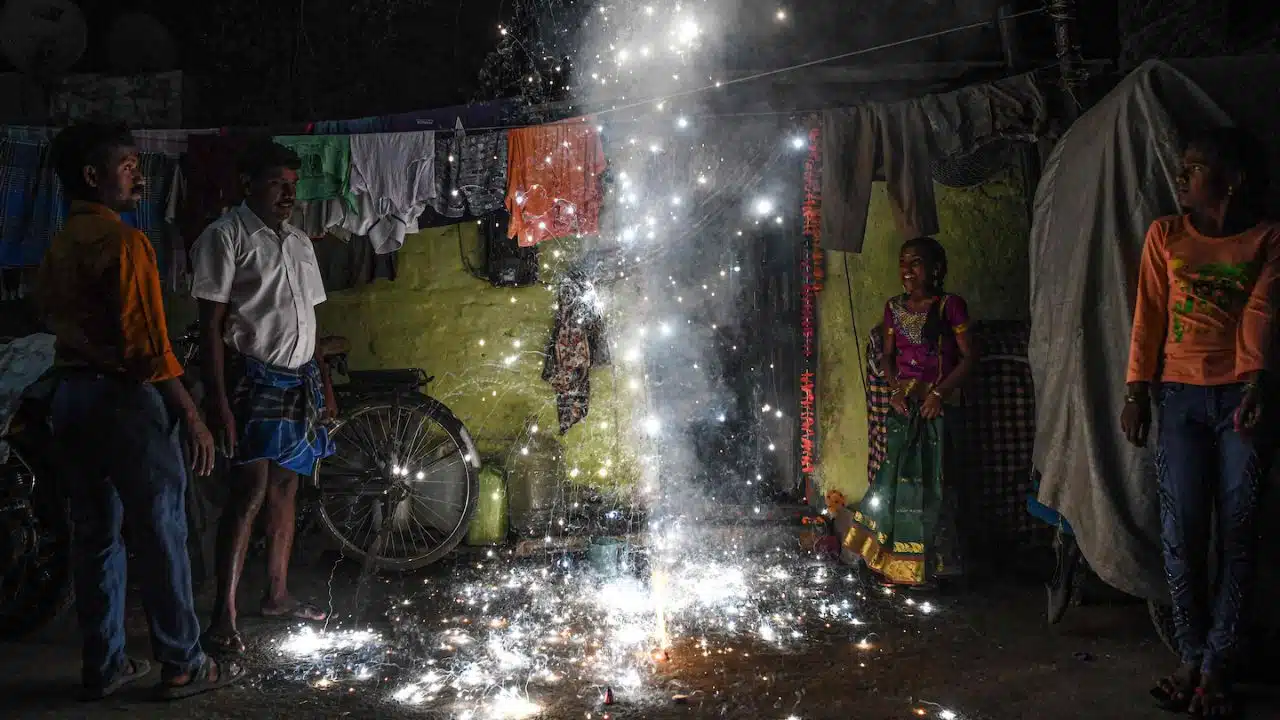
New Delhi woke to a familiar post-Diwali nightmare today as a toxic haze chokes Delhi, blanketing the national capital in a pungent smog that pushed air quality deep into the ‘Severe’ category. The pollution spike occurred despite a Supreme Court-mandated ban on traditional firecrackers, rendered ineffective by widespread violations overnight.
The city’s average Air Quality Index (AQI) surged to 445 at 8:00 AM IST, a drastic jump from the 305 (“Very Poor”) recorded just 24 hours prior. This alarming spike is attributed to a combination of emissions from illegal firecrackers, a resurgent contribution from farm fires, and meteorological conditions that trapped pollutants near the ground.
Key Facts: The Morning After
- ‘Severe’ Air Quality: Delhi’s average AQI hit 445 (Severe) at 8:00 AM, Oct 21. Several hotspots, including Anand Vihar and RK Puram, recorded levels nearing 480. (Source: CPCB)
- Hazardous Particle Levels: PM2.5 (fine particulate matter) levels crossed 600 µg/m³ in many locations post-midnight, more than 10 times the 24-hour national safe limit of 60 µg/m³. (Source: SAFAR)
- Ban Breached: Widespread bursting of illegal, high-emission firecrackers was reported across the National Capital Region (NCR), defying the official ban.
- Dual Drivers: While firecrackers caused the sharp overnight spike, analysis attributes 18% of the PM2.5 load to stubble burning in neighboring states, creating a high pollution baseline. (Source: SAFAR)
- Emergency Response: The Commission for Air Quality Management (CAQM) has activated GRAP Stage IV measures, banning non-essential construction and the entry of most trucks into Delhi.
A Predictable Emergency: The Data
The grim data released this morning confirms the fears of environmentalists and health experts. The Central Pollution Control Board (CPCB) real-time dashboard showed a rapid deterioration in air quality as Diwali celebrations peaked on Monday night.
Data 1: City-Wide AQI Spike (Oct 20 vs. Oct 21) The city’s 24-hour average AQI, which stood at 305 (Very Poor) at 4:00 PM on October 20, breached the ‘Severe’ threshold (401+) by 1:00 AM and settled at 445 by 8:00 AM on October 21.
Hotspots Veer into ‘Severe Plus’
Several monitoring stations recorded air quality far exceeding the “Severe” mark, a level that affects healthy people and seriously impacts those with existing diseases.
- Anand Vihar: 480
- RK Puram: 472
- Punjabi Bagh: 475
- Mundka: 478
The primary pollutant in all locations was PM2.5, fine particulate matter small enough to lodge deep in the lungs and enter the bloodstream.
Data 2: Peak PM2.5 Concentration The System of Air Quality and Weather Forecasting and Research (SAFAR), managed by the Indian Institute of Tropical Meteorology (IITM), reported that PM2.5 levels in many areas saw a “dramatic spike” between 1:00 AM and 4:00 AM on October 21.
Concentrations peaked at over 600 µg/m³, a level considered hazardous by any international standard. (Source: SAFAR Bulletin, Oct 21, 2025, . For context, the World Health Organization‘s (WHO) 24-hour guideline for PM2.5 is just 15 µg/m³.
‘Green’ Efforts Fail Against Widespread Violations
The 2025 Diwali celebration was meant to be different. Following directives from the Supreme Court and the National Green Tribunal (NGT), authorities had imposed a blanket ban on the sale, storage, and use of all firecrackers except “green crackers”—low-emission alternatives developed by CSIR-NEERI.
However, enforcement on the ground proved tobe a near-total failure.
A City Under Auditory and Chemical Assault
Residents across the NCR, from Ghaziabad to Gurugram, reported incessant bursting of loud, high-emission firecrackers starting early in the evening and continuing well past 3:00 AM.
“It sounded like a warzone after 9 PM,” said Rakesh Kumar, a resident of Mayur Vihar Phase 1. “We sealed our windows, but the smoke still seeped in. My six-year-old daughter, who has asthma, was coughing all night. What is the point of these ‘bans’ if they are just on paper?“
Data 3: Enforcement Actions Delhi Police confirmed the challenge of enforcing the ban in a city of 20 million. In a press release issued this morning (Oct 21, 2025), officials reported:
- 152 arrests made for the sale or use of illegal firecrackers.
- Over 2,000 kilograms of banned fireworks were seized in targeted raids in the 72 hours leading up to Diwali.
Despite these efforts, the volume of illegal fireworks detonated suggests that enforcement only scratched the surface.
The ‘Perfect Storm’: Stubble and Meteorology
While firecracker emissions were the clear trigger for the overnight spike, experts note they were added to an already-polluted atmosphere.
Farm Fires Add to the Burden
The SAFAR model, which provides forecasts on the contribution of external pollution sources, painted a concerning picture.
“The contribution of stubble burning (biomass fires) from neighboring Punjab and Haryana, which had been low last week, significantly increased to 18% of Delhi’s PM2.5 concentration on October 20,” the SAFAR bulletin stated. (Source: SAFAR-IITM, Oct 21, 2025).
This high baseline meant that the additional load from firecrackers was catastrophic.
Trapped by the Weather
Meteorology played its traditional role as an antagonist. The India Meteorological Department (IMD) reported that “calm, cool” conditions dominated the night.
Low wind speeds (5-8 km/h) and a drop in temperature led to a phenomenon known as temperature inversion, where a layer of warm air traps the cold, pollutant-filled air close to the ground, preventing its dispersal.
Official Response and Expert Analysis
Faced with a public health emergency, the Commission for Air Quality Management (CAQM) convened an emergency meeting early Tuesday.
Government Activates GRAP Stage IV
The CAQM immediately invoked the final, most severe stage of the Graded Response Action Plan (GRAP). Key measures under Stage IV include:
- Transport Ban: A complete ban on the entry of all truck traffic into Delhi (except for essentials like LNG/CNG tankers and vehicles carrying essential goods).
- Construction Halt: A stop on all linear public projects (roads, flyovers) and all other non-essential construction and demolition activities.
- Advisory: The government has issued a strong advisory urging private companies and government offices to implement 50% work-from-home (WFH) capacity.
‘A Predictable, Systemic Failure’
Experts argue that this annual crisis is no longer a surprise and reflects a deep systemic failure.
In a statement, Dr. Anumita Roychowdhury, Executive Director at the Centre for Science and Environment (CSE), criticized the reliance on last-minute measures.
What to Watch Next
The immediate forecast offers little relief. The IMD predicts that similar calm wind conditions and foggy mornings will persist for at least the next 48 hours. This means the ‘Severe’ haze is likely to linger over the capital until at least Thursday (Oct 23), posing significant health risks to millions.
The long-term focus now shifts to the strict ground implementation of GRAP Stage IV and whether neighboring state governments can control the peak of farm fires, which is expected to intensify in the coming weeks.
As the toxic haze chokes Delhi, residents are left with a familiar, choking reality, forcing them to choose between celebrating a festival and the fundamental right to breathe clean air.