
Distance learning relies on stable connections and interactive environments. Transitioning away from generic corporate meeting software allows institutions to deploy the most effective live virtual classroom platforms available today. By choosing independent American developers, educational organizations can access specialized digital spaces designed specifically for pedagogy rather than standard business conferences.
Establishing the right technological foundation requires a strict evaluation process to ensure long term reliability.
How We Selected Our 15 Best Live Virtual Classroom Platforms in USA
We bypassed the massive corporate communication tools to find developers who actually understand instructional design. Filtering the market required a strict look at infrastructure and educational utility to highlight independent studios.
-
Geographic Baseline. Operated and headquartered entirely within the United States as independent entities.
-
Independence. Verified as independent SMEs rather than subsidiaries of massive tech monopolies.
-
Pedagogical Tools. Proven inclusion of specialized teaching aids like interactive whiteboards and breakout rooms.
-
Data Security. Complete adherence to student privacy regulations and secure cloud hosting.
Understanding these core requirements helps identify the most robust digital environments for modern educators.
Whom This is for
This evaluation serves instructional designers, university IT administrators, and online school directors seeking to replace outdated conferencing software with dedicated teaching environments. It is also an essential guide for independent tutors and professional trainers who require high levels of student interaction in a synchronous setting.
With the audience defined, we can examine the specific developers leading the industry.
Evaluating the Top 15 Live Virtual Classroom Platforms in the USA
The following independent studios are actively reshaping how academic institutions conduct synchronous online learning. Here is our curated breakdown of the standout developers driving digital education forward.
Starting with platforms built directly on top of familiar frameworks provides an easy transition for hesitant faculty.
1. Class Technologies
Operating out of Washington DC, Class Technologies built their specialized instructional environment directly on top of the Zoom infrastructure. They take a universally understood video backbone and layer it with dedicated teaching tools like automated attendance and interactive quizzes. It completely transforms a standard corporate meeting window into a structured digital classroom.
Best for:
-
Institutions already familiar with Zoom but needing dedicated educational features.
Why We Chose It:
-
It leverages world class video stability while providing a custom interface for teachers.
-
The system includes a dedicated proctoring view that allows instructors to monitor student screens during digital exams.
Things to consider:
-
Requires a baseline institutional understanding of Zoom architecture to deploy effectively across a campus.
The 2026 Edge:
-
Upgraded engagement dashboards that track exactly how much time a student spends speaking versus listening.
Reimagining the seating chart requires platforms that focus entirely on group collaboration.
2. Engageli
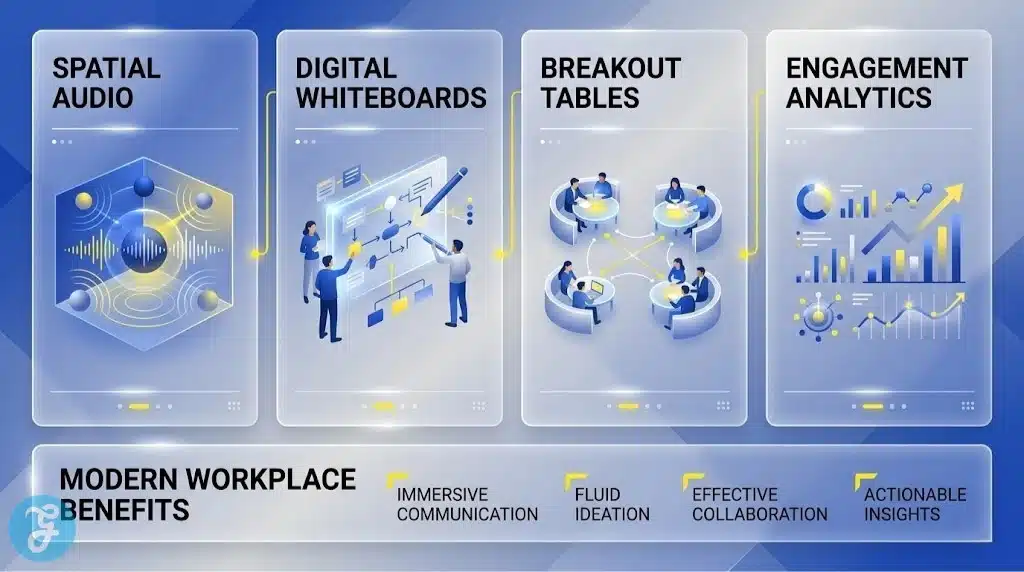
Headquartered in San Mateo, California, Engageli completely abandons the traditional grid of video squares. Their platform organizes students into digital tables where they can collaborate privately while still listening to the main lecture. This unique architecture naturally encourages peer to peer discussion without requiring the instructor to manually build clunky breakout rooms.
Best for:
-
Large university lectures that want to incorporate active learning and small group discussions seamlessly.
Why We Chose It:
-
The digital table layout mimics the physical design of modern collaborative classrooms.
-
Instructors can seamlessly jump from table to table to answer specific group questions privately.
Things to consider:
-
The distinct interface requires a brief onboarding period for students used to standard video grids.
The 2026 Edge:
-
Automated seating assignments based on student academic performance to balance group dynamics perfectly.
Creating a sense of spatial awareness completely changes how students interact online.
3. InSpace
Based in Burlington, Vermont, InSpace utilizes proximity based audio to create a fluid digital campus. Students are represented by small video circles that can move freely around a digital canvas. As a student moves their circle closer to another person, their audio becomes louder, which replicates the natural flow of physical classroom conversations.
Best for:
-
Digital networking events, foreign language practice, and interactive lab sessions.
Why We Chose It:
-
It completely eliminates the awkwardness of one person speaking while fifty people listen in silence.
-
The software allows educators to design custom backgrounds that look like laboratories or campus quads.
Things to consider:
-
The free roaming nature of the platform can be distracting during highly structured lectures.
The 2026 Edge:
-
Advanced directional audio capabilities that make digital group work feel incredibly realistic.
Complex corporate training demands software with massive analytical capabilities.
4. Jigsaw Interactive
Located in Atlanta, Georgia, Jigsaw Interactive provides a multi dimensional teaching environment designed for high stakes corporate training and complex higher education. The software forces active participation by requiring students to interact with 3D models and complete live assessments. It captures thousands of data points to prove a student actually learned the material.
Best for:
-
Corporate workforce development and specialized technical training programs.
Why We Chose It:
-
It features four distinct digital panes that allow simultaneous viewing of video and interactive assessments.
-
The system generates incredibly detailed reports on individual student engagement down to the second.
Things to consider:
-
The heavy feature set makes it slightly overpowered for a standard middle school history class.
The 2026 Edge:
-
Enhanced biometric attention tracking that flags when a student looks away from their primary monitor.
Evaluating soft skills requires specialized video assessment infrastructure.
5. Bongo
Operating out of Loveland, Colorado, Bongo focuses heavily on experiential learning and video based assessment. While it functions as a live streaming platform, its true power lies in allowing students to record and submit video presentations for peer review. It is a vital tool for teaching communication skills in a purely digital environment.
Best for:
-
Business schools and communications departments teaching public speaking or negotiation.
Why We Chose It:
-
It provides structured video assignments where peers can leave time stamped feedback directly on a recording.
-
The platform integrates flawlessly into every major institutional learning management system.
Things to consider:
-
The platform emphasizes video assignments over massive lecture broadcasting.
The 2026 Edge:
-
Automated conversational analysis that grades a student on filler words and speaking cadence.
Broadcasting to massive digital audiences requires specialized presentation tools.
6. Shindig
Based in New York City, Shindig was designed to handle massive digital assemblies and online campus events. The platform allows a central speaker to broadcast to thousands of attendees while still enabling audience members to form spontaneous private video chats. It successfully scales the intimacy of a small classroom to the size of an auditorium.
Best for:
-
University town halls, massive guest lectures, and digital alumni events.
Why We Chose It:
-
Hosts can invite an audience member to the main digital stage with a single click to ask a live question.
-
The software allows participants to network privately without interrupting the main presentation.
Things to consider:
-
It is built for massive scale and may feel unnecessarily vast for a small seminar of five students.
The 2026 Edge:
-
Automated stage management tools that queue up student questions perfectly for the main speaker.
Independent tutors need platforms that bundle instruction with business management.
7. BrainCert
Headquartered in Herndon, Virginia, BrainCert provides a unified platform combining a live virtual classroom with a complete commercial learning management system. Instructors can host live video sessions and securely process student payments all within the same digital ecosystem. It is an all in one solution for freelance educators.
Best for:
-
Freelance tutors and independent training companies selling their own educational content.
Why We Chose It:
-
It features a built in shopping cart and Stripe integration to monetize live training sessions instantly.
-
The digital whiteboard includes advanced mathematical equation editors and coding syntax highlighters.
Things to consider:
-
The interface is highly utilitarian and focuses on raw functionality over flashy modern aesthetics.
The 2026 Edge:
-
Upgraded global payment gateways that simplify currency conversion for international tutoring clients.
Visual thinkers require infinite digital canvases for complex problem solving.
8. Pencil Spaces
Operating from San Francisco, California, Pencil Spaces completely centers the digital learning experience around a massive collaborative whiteboard. Instead of prioritizing video feeds, the platform focuses entirely on shared digital workspaces where students and teachers can draw and map out complex ideas in real time.
Best for:
-
Mathematics tutoring, architectural design reviews, and highly visual brainstorming sessions.
Why We Chose It:
-
The infinite digital canvas allows for sprawling mind maps and complex equation solving.
-
It utilizes low bandwidth so students with poor internet connections can still participate smoothly.
Things to consider:
-
The platform minimizes video presence to maximize the whiteboard space.
The 2026 Edge:
-
Advanced geometry tools that automatically straighten hand drawn shapes into perfect digital diagrams.
Immersive environments offer an entirely new dimension to online learning.
9. Frame
Located in La Jolla, California, Frame builds accessible virtual reality classrooms that run directly in a standard web browser. Educators can construct custom 3D environments where students navigate as digital avatars. They can gather around 3D models of historical artifacts or conduct simulated chemistry experiments together.
Best for:
-
Schools exploring the educational metaverse without requiring expensive virtual reality headsets.
Why We Chose It:
-
It provides deep spatial immersion simply by sending a web link to the student.
-
Instructors can import their own 3D assets to create highly specialized digital laboratories.
Things to consider:
-
Navigating a 3D avatar requires more technical comfort from the student than simply turning on a webcam.
The 2026 Edge:
-
Enhanced physics engines that allow digital avatars to interact realistically with the 3D educational models.
Mobile first communication is essential for keeping modern students engaged.
10. Pronto
Headquartered in Springville, Utah, Pronto bridges the gap between casual messaging apps and formal video conferencing. The platform provides an intuitive chat interface that instantly escalates into live video broadcasting with a single tap. It is designed to mimic the social media platforms that students already use daily.
Best for:
-
Community colleges and large universities aiming to increase student engagement through mobile devices.
Why We Chose It:
-
It has high adoption rates because the mobile application feels exactly like modern social media.
-
The platform includes real time message translation so international students can read peer chats in their native language.
Things to consider:
-
It lacks the heavy architectural tools needed for complex document editing during a live call.
The 2026 Edge:
-
Automated summary features that compile missed chat logs into a brief recap for absent students.
Recording and cataloging live sessions requires massive digital video infrastructure.
11. Panopto
Based in Seattle, Washington, Panopto specializes in capturing, streaming, and archiving academic video. While known for its massive video library capabilities, its live webcasting tools are incredibly robust. It allows universities to broadcast high definition lectures globally while automatically indexing every spoken word.
Best for:
-
Institutions needing to securely archive and search massive volumes of live lecture recordings.
Why We Chose It:
-
Students can search a recorded lecture for a specific keyword and jump exactly to that moment in the video.
-
The system flawlessly handles multi camera setups for complex scientific demonstrations.
Things to consider:
-
It is an enterprise grade platform that requires significant institutional investment.
The 2026 Edge:
-
Automated chapter generation that perfectly breaks down a two hour live lecture into digestible segments.
Analyzing teaching methodologies requires specialized observation tools.
12. Vosaic
Operating out of Lincoln, Nebraska, Vosaic provides a live video platform dedicated strictly to observational learning and performance analysis. The software allows supervisors to watch live teaching sessions and drop specialized feedback pins directly onto the timeline. It is essential infrastructure for teacher training programs.
Best for:
-
Colleges of education monitoring student teachers during their physical or digital classroom practicums.
Why We Chose It:
-
It allows mentors to provide highly specific, timestamped feedback on a teacher’s performance.
-
Completely secure cloud hosting ensures sensitive classroom observations are protected.
Things to consider:
-
The platform is hyper focused on observation and analysis rather than general student broadcasting.
The 2026 Edge:
-
Enhanced mobile integration allowing supervisors to tag live video using a tablet while sitting in a physical room.
Ensuring completely brand independent meetings requires highly customizable software.
13. MegaMeeting
Located in Encino, California, MegaMeeting provides a completely white labeled video conferencing solution. The platform runs entirely via WebRTC directly in the browser. It allows independent tutoring companies to completely strip away external branding and present the classroom as their own proprietary technology.
Best for:
-
Private tutoring agencies wanting a fully branded, seamless client experience.
Why We Chose It:
-
Students never have to download a dedicated desktop application to join a class.
-
Agencies can host the platform directly on their own custom domain names.
Things to consider:
-
It offers a clean but relatively basic feature set compared to heavily specialized pedagogical tools.
The 2026 Edge:
-
Upgraded high definition audio codecs that significantly reduce background noise for students in busy environments.
Managing external webinars alongside internal classes requires flexible hosting software.
14. BigMarker
Headquartered in Chicago, Illinois, BigMarker provides a highly customizable platform that functions as both a marketing webinar tool and a live educational space. It requires zero downloads and features interactive handouts and live polls. It is perfect for schools that host both enrolled classes and public recruitment seminars.
Best for:
-
Universities needing a single platform to handle both internal academics and external public webinars.
Why We Chose It:
-
It features incredibly robust automated email sequences for class reminders and follow ups.
-
The system supports massive audience sizes without sacrificing interactive tools like live Q and A sessions.
Things to consider:
-
The platform includes heavy marketing features that a standard high school teacher will likely never use.
The 2026 Edge:
-
Upgraded modular interfaces allowing educators to drag and drop video panes anywhere on the screen during a live broadcast.
Building a sense of physical presence in a digital room requires high fidelity networking.
15. Remo
Operating from a distributed headquarters based in Delaware, Remo focuses on creating digital event spaces that look like physical conference halls. Students move between virtual buildings and tables to network and collaborate. It is the most effective tool for replicating the social aspects of a campus environment in a digital format.
Best for:
-
Digital career fairs, campus orientations, and collaborative workshops.
Why We Chose It:
-
The bird’s eye view of the digital floor plan makes it easy for students to see who is talking to whom.
-
It encourages spontaneous networking that is often lost in traditional video conferencing software.
Things to consider:
-
The platform is designed for networking and may feel cluttered for a standard lecture.
The 2026 Edge:
-
Advanced spatial awareness tools that automatically lower the volume of background tables to prevent audio overlap.
An Overview Of Live Virtual Classroom Platforms in USA
Reviewing these varied digital environments side by side helps administrators clarify their institutional priorities. The following data points highlight the primary functional differences between these independent providers.
Overview Comparison Table
Examining these distinct providers clarifies the best approach for specific online learning environments.
| SME Developer | Headquarter Location | Core Focus Area | Primary Function |
| Class Technologies | Washington, DC | Zoom Enhancement | Custom Teaching Interface |
| Engageli | San Mateo, CA | Collaborative Learning | Digital Table Seating |
| InSpace | Burlington, VT | Proximity Networking | Spatial Audio Chat |
| Jigsaw Interactive | Atlanta, GA | Corporate Training | Multi Dimensional Analytics |
| Bongo | Loveland, CO | Experiential Learning | Video Assessment |
| Shindig | New York, NY | Massive Assemblies | Interactive Broadcasting |
| BrainCert | Herndon, VA | Freelance Education | Integrated LMS and Sales |
| Pencil Spaces | San Francisco, CA | Visual Tutoring | Infinite Digital Whiteboard |
| Frame | La Jolla, CA | Immersive 3D | Web Based Metaverse |
| Pronto | Springville, UT | Mobile Engagement | Rapid Chat and Video |
| Panopto | Seattle, WA | Video Archiving | Searchable Lecture Capture |
| Vosaic | Lincoln, NE | Observational Learning | Performance Analysis |
| MegaMeeting | Encino, CA | White Label Hosting | Brand Independent Video |
| BigMarker | Chicago, IL | Hybrid Events | Webinars and Classrooms |
| Remo | Wilmington, DE | Digital Networking | Virtual Floor Plan Chat |
Evaluating these diverse tools naturally leads to our primary recommendations for specific teaching scenarios.
Our Top 3 Picks and Why?
Narrowing down the field highlights three developers making exceptional contributions to digital pedagogy. Engageli completely revolutionizes the digital layout by organizing students into collaborative tables, which proves that online learning does not have to be an isolating experience. InSpace offers a creative solution to digital fatigue by utilizing spatial audio to make networking feel natural and fluid. Finally, Pencil Spaces delivers unmatched utility for STEM educators by focusing entirely on a low bandwidth, highly responsive digital whiteboard for complex problem solving.
Selecting the right digital infrastructure requires balancing the technical capabilities of the software with the actual needs of the teaching staff.
How to Choose the Right Live Virtual Classroom Platforms by Yourself?
Implementing a new synchronous learning environment successfully means finding a platform that aligns with your specific pedagogical philosophy and budget constraints.
The Selection Framework:
Identify the Teaching Style. Decide if your faculty primarily lectures to massive crowds or relies heavily on small peer to peer breakout sessions.
Evaluate the Bandwidth Requirements. Ensure the software functions smoothly even if your student demographic lacks access to high speed internet.
Check LMS Integration. Verify that the platform connects seamlessly to Canvas, Blackboard, or Moodle to automatically sync attendance data.
Analyze the Analytics. Require the developer to provide proof that their engagement tracking actually measures learning rather than just mouse clicks.
Applying this framework directly to your specific campus needs allows you to match the right developer to your university.
Decision Matrix
Matching your specific institutional priorities with the right developer ensures a seamless digital transformation.
| Choose This SME… | If You Prioritize… |
| Engageli or InSpace | Fostering organic peer to peer collaboration and destroying the traditional video grid. |
| Class Technologies or Jigsaw | Layering heavy analytics and proctoring tools over a stable video environment. |
| Pencil Spaces or BrainCert | Teaching complex visual subjects using highly responsive digital whiteboards. |
| Panopto or BigMarker | Archiving massive digital lectures and hosting large scale public webinars securely. |
Before signing a long term institutional contract, running through a rapid technical verification process is vital.
The Final Checklist
Running through this quick verification process guarantees you are adopting a secure, scalable platform.
-
Verify the developer complies entirely with federal regulations regarding student privacy and data encryption.
-
Ensure the platform allows students to join via a standard web browser without demanding heavy desktop installations.
-
Test the platform’s mobile application to check for basic functionality and ease of use on smaller screens.
-
Confirm the developer provides dedicated onboarding training for faculty members transitioning from legacy software.
-
Check that the software includes built in closed captioning features to comply strictly with modern accessibility standards.
Implementing these systems successfully requires a deep understanding of what synchronous education actually represents.
The Illusion of Perfect Digital Replication
The rapid expansion of educational technology has created a false belief that software can perfectly replicate the physical classroom. The uncomfortable truth is that even the most advanced live virtual classroom platforms struggle to capture the subtle human nuances of a physical lecture hall. As universities pour massive funding into hyper analytical tracking software, they often prioritize surveillance over genuine pedagogical connection. Relying entirely on biometric engagement scores to determine if a student is learning fundamentally ignores the complex realities of digital fatigue.
The future of online education does not rely on building more intense tracking algorithms to force attention. It relies on educators leveraging these specialized digital tools to create deeply engaging, collaborative experiences that respect the limitations of the screen. True digital learning happens when institutions stop trying to copy the physical classroom and start designing entirely new methods of intellectual connection.
To further clarify the implementation of these digital systems, addressing common technical concerns is essential.
Frequently Asked Questions (FAQs) About Live Virtual Classroom Platforms
Why should a school use specialized platforms instead of standard corporate video tools?
Corporate tools are built for business meetings where one person presents and everyone else listens. Specialized educational platforms include built in pedagogical tools like seating charts, interactive whiteboards, and nuanced engagement tracking designed specifically to foster student learning.
Do these educational platforms integrate with standard learning management systems?
Yes, reputable independent developers build their software using Learning Tools Interoperability standards. This ensures the live classroom connects securely with systems like Canvas or Blackboard to automatically sync grading rubrics and attendance records.
How do these platforms manage digital classroom disruptions?
Educational platforms provide instructors with deep moderation controls that are often missing from corporate software. Teachers can universally mute microphones, lock digital whiteboards, and restrict private chats to maintain a highly focused learning environment securely.
Are specialized virtual classrooms accessible for students with disabilities?
Independent American developers strictly adhere to Web Content Accessibility Guidelines. Their platforms typically feature integrated screen reader support, high contrast visual modes, and automated closed captioning to ensure equal access for all enrolled students.
Can students participate effectively using only a mobile phone?
Modern independent platforms utilize highly responsive architecture that scales perfectly to mobile devices. While complex document editing might be difficult on a small screen, students can easily watch lectures, participate in polls, and join audio discussions using only a smartphone.