

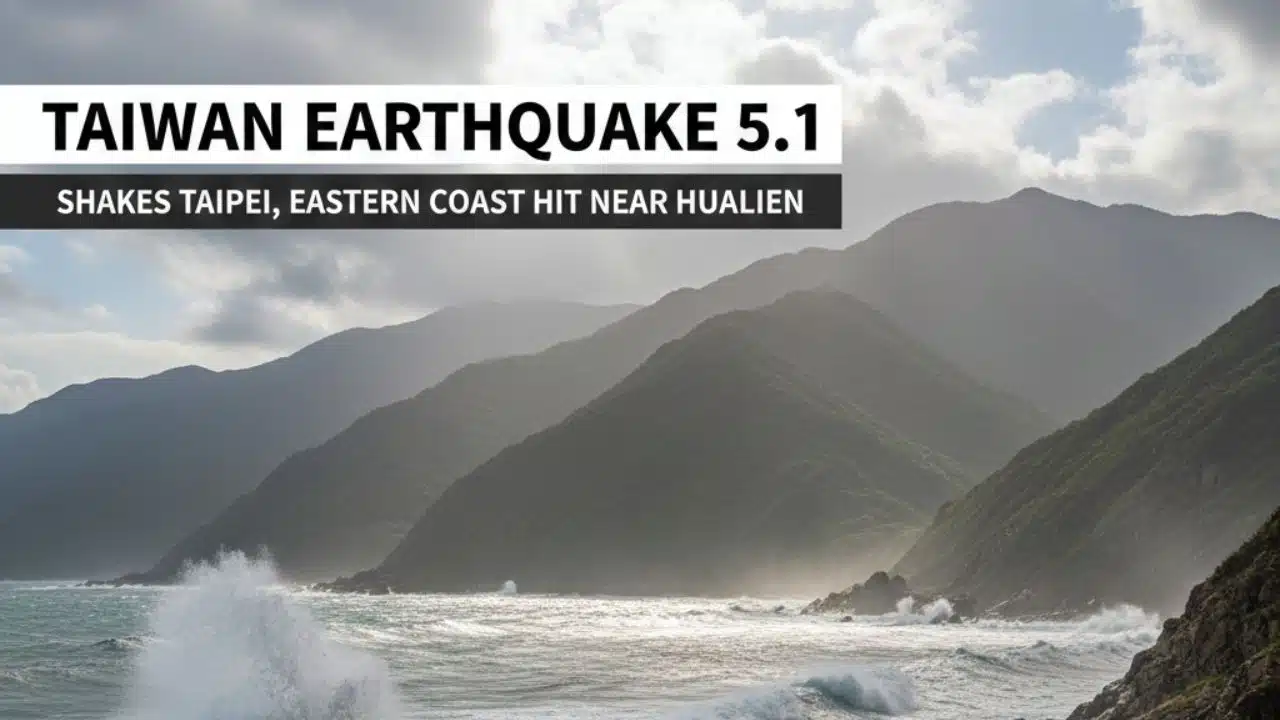
A Taiwan earthquake 5.1 struck off the island’s eastern coast on Thursday, December 18, 2025, causing buildings to sway in Taipei and surrounding regions. The epicenter was located near Hualien at a moderate depth. Authorities confirmed no immediate reports of damage, injuries, or fatalities.
Overview of the Taiwan Earthquake 5.1 Event
A magnitude 5.1 earthquake was recorded off the eastern coast of Taiwan in the early hours of December 18, 2025, according to seismic monitoring data. The earthquake occurred offshore near Hualien County, a region that frequently experiences seismic activity due to Taiwan’s tectonic location.
Despite the moderate magnitude, the tremor was widely felt across northern Taiwan, including in Taipei, where residents reported brief shaking of buildings. Emergency authorities stated that no structural damage or casualties were reported in the immediate aftermath.
The earthquake’s depth was approximately 31.6 kilometers, which contributed to noticeable surface shaking while limiting destructive impact.
Where the Earthquake Occurred and Why It Was Felt in Taipei
The earthquake’s epicenter was located offshore near Hualien, a city on Taiwan’s east coast that sits close to major geological fault lines. Although Taipei lies more than 300 kilometers from Hualien, tremors were felt clearly in the capital.
This phenomenon occurs because:
-
Seismic waves can travel long distances through solid rock
-
Taipei has many high-rise buildings that amplify motion
-
Moderate-depth earthquakes spread energy efficiently across regions
Urban residents in Taipei reported gentle but noticeable swaying, particularly in high-rise apartments and office towers. However, the shaking lasted only a short time, reducing the likelihood of damage.
Key Earthquake Data Summary
| Parameter | Details |
|---|---|
| Date | December 18, 2025 |
| Time | Early morning local time |
| Magnitude | 5.1 |
| Depth | Approximately 31.6 km |
| Epicenter | Offshore eastern Taiwan near Hualien |
| Areas Felt | Hualien, Taipei, northern Taiwan |
| Damage | None reported |
| Casualties | None reported |
Why Eastern Taiwan Is Prone to Earthquakes
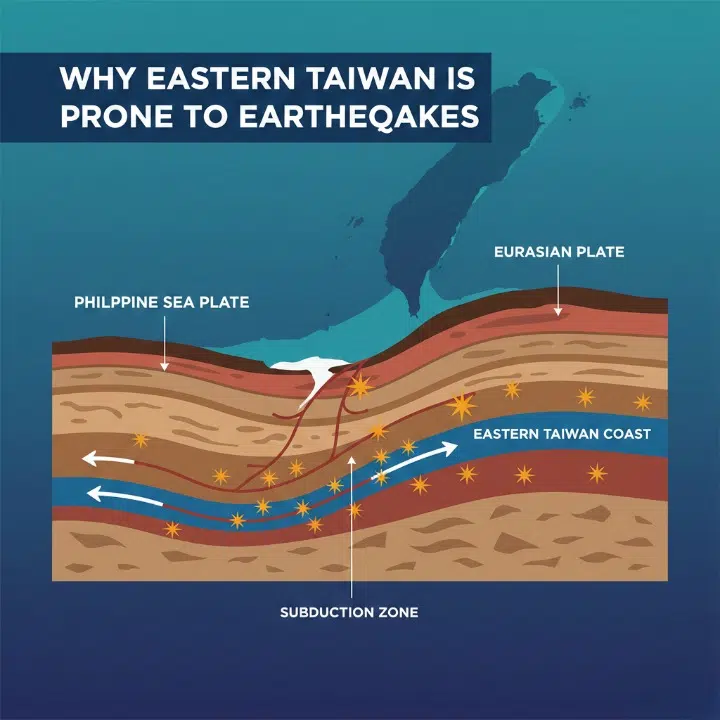
Taiwan is one of the most earthquake-prone regions in the world. The island sits at the convergence of the Philippine Sea Plate and the Eurasian Plate, making it a geologically active zone.
Eastern Taiwan, including Hualien, experiences particularly frequent seismic activity due to:
-
Plate collision and subduction processes
-
Ongoing mountain-building forces
-
Numerous active faults offshore and on land
These forces continuously accumulate stress beneath the Earth’s surface, which is released periodically as earthquakes.
Taiwan and the Pacific Ring of Fire
Taiwan is part of the broader Pacific Ring of Fire, a horseshoe-shaped belt surrounding the Pacific Ocean known for frequent earthquakes and volcanic activity.
Characteristics of the Ring of Fire
| Feature | Impact on Taiwan |
|---|---|
| Active plate boundaries | Frequent earthquakes |
| Subduction zones | Deep and shallow seismic events |
| Crustal deformation | Mountain uplift and faulting |
This geological reality means that earthquakes like the Taiwan earthquake 5.1 are not unusual, although each event is closely monitored due to the island’s dense population.
Recent Seismic Activity Near Hualien
The December 18 earthquake follows a series of recent tremors in eastern Taiwan. Earlier in December, a magnitude 5.7 earthquake was recorded near Hualien, reminding residents and authorities of the region’s seismic volatility.
While these events are not directly linked in a predictive sense, clusters of earthquakes can indicate heightened tectonic movement along fault systems.
Experts stress that earthquakes cannot be accurately predicted, but historical patterns help authorities plan infrastructure and emergency responses.
How Taiwan Monitors Earthquakes
Taiwan operates one of the most advanced earthquake monitoring systems in Asia. Seismic data is collected through a dense network of sensors across the island and offshore areas.
Earthquakes are evaluated based on:
-
Magnitude, measuring energy release
-
Depth, influencing surface impact
-
Intensity, describing shaking strength at different locations
Taiwan uses a local intensity scale to communicate how strongly shaking was felt in various regions, helping emergency responders assess risk quickly.
Building Standards and Earthquake Preparedness
Taiwan’s experience with past destructive earthquakes has significantly shaped its building codes and disaster preparedness policies.
Following major earthquakes, including the devastating 1999 Chi-Chi earthquake, Taiwan strengthened regulations to ensure:
-
Reinforced concrete structures
-
Regular inspections of older buildings
As a result, many modern structures can withstand moderate earthquakes like the Taiwan earthquake 5.1 with minimal damage.
Public Response and Safety Measures
There was no public panic following the earthquake. Transportation systems, including high-speed rail and metro services, continued operating normally after brief safety checks.
Authorities reminded the public to remain cautious and to follow standard earthquake safety practices, such as:
-
Securing heavy furniture
-
Staying alert for possible aftershocks
-
Avoiding damaged structures if shaking occurs again
Emergency services remained on standby but were not required to respond to major incidents.
Aftershocks: What Residents Should Expect
Aftershocks are common following earthquakes, especially in tectonically active zones. While no significant aftershocks were immediately reported, smaller tremors may occur in the hours or days following the main quake.
However, aftershocks:
-
Are usually weaker than the main event
-
Decrease in frequency over time
-
Cannot be precisely predicted
Authorities continue to monitor seismic activity closely and will issue updates if conditions change.
Why Moderate Earthquakes Still Matter
Even though a magnitude 5.1 earthquake is considered moderate, it serves as an important reminder of Taiwan’s seismic reality.
Such events help:
-
Test emergency response systems
-
Reinforce public awareness
-
Highlight the importance of preparedness
Experts emphasize that preparedness, not prediction, remains the most effective way to reduce earthquake risk.
The Taiwan earthquake 5.1 on December 18, 2025, briefly shook buildings across northern Taiwan, including Taipei, without causing damage or injuries. The epicenter near Hualien underscores the ongoing tectonic activity along Taiwan’s eastern corridor.
While the event passed without incident, it highlights the importance of robust infrastructure, effective monitoring systems, and public preparedness in one of the world’s most earthquake-prone regions.
























