
The higher education landscape across South Africa has reached a critical turning point regarding student wellbeing in 2026. As institutions move through this year, the focus has shifted from reactive crisis management toward proactive and culturally grounded systems of care. Universities are no longer viewing mental health as a secondary administrative burden but as a fundamental requirement for academic success and graduate employability. This shift is particularly evident in how institutions are leveraging technology and massive peer networks to reach students who were previously left behind.
How We Selected Our 7 Mental Health Response Strategies
To provide a comprehensive view of the 2026 landscape, we analyzed the latest health induction messages and the proceedings from the most recent Siyaphumelela Conference. Our selection prioritizes strategies that demonstrate scalability and a deep understanding of the unique socio-economic challenges facing local students. We focused on the integration of digital tools with traditional peer based support to find a balance between high tech efficiency and high touch empathy.
The following benchmarks were used to evaluate the effectiveness of these institutional responses.
-
Scale of Reach: Focusing on programs that can support students across rural, township, and urban campuses.
-
Cultural Competence: Prioritizing interventions that respect and reflect the diverse life experiences of South African youth.
-
Accredited Value: Evaluating tools that provide students with tangible certifications or skills for their future careers.
-
Ease of Access: Assessing the speed with which a student can access support without needing a complex formal referral.
By filtering these initiatives through the current health and social challenges, we identified the seven most impactful ways universities are leading the change.
7 Innovative Strategies Addressing the Students’ Mental Health Crisis in South Africa
The current era of campus support is defined by the removal of barriers to access. These seven strategies highlight the sophisticated ways universities are addressing the complex needs of their student populations this year.
1. NQF-Accredited Mental Intelligence Modules
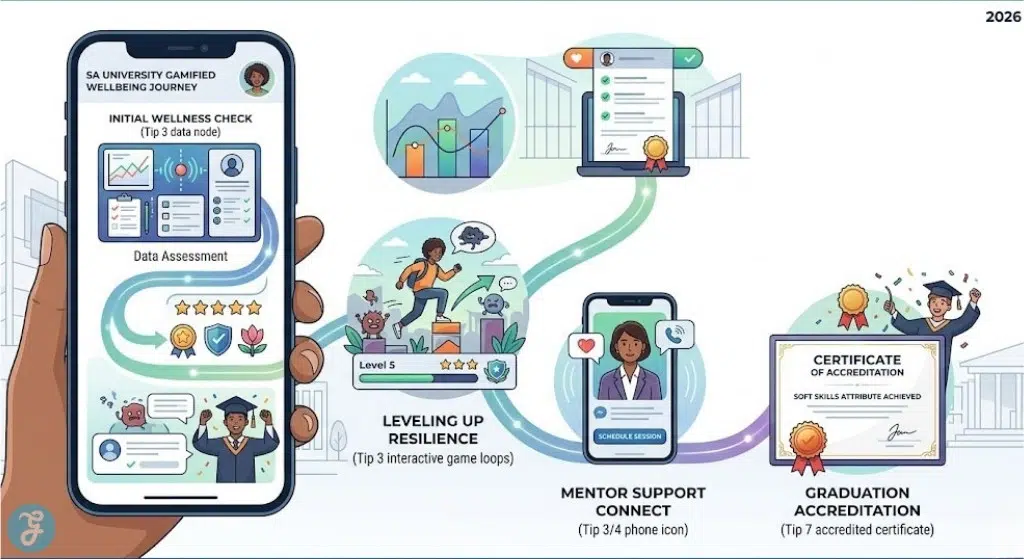
Under the leadership of HIGHER HEALTH, many institutions have integrated an NQF Level 5 hybrid learning programme into their standard induction. Module 3 of this accredited curriculum specifically targets mental and emotional intelligence. This approach turns mental health education into a formal part of the academic journey, providing students with a certificate they can add to their professional profiles while building the resilience needed to complete their degrees.
Best for:
-
First year students who need to build emotional foundations alongside their academic technical skills.
Why We Chose It:
-
It destigmatizes mental health by treating it as a legitimate and measurable professional skill.
-
The hybrid format allows students to engage with the material at their own pace.
-
It provides a clear exit outcome that is recognized by future employers.
Things to consider:
-
Students must be encouraged to enroll in these modules as a supplement to their primary degree requirements.
As students gain these foundational skills, they are increasingly supported by a massive network of their own peers on the ground.
2. The 10,000-Strong Peer Educator Network
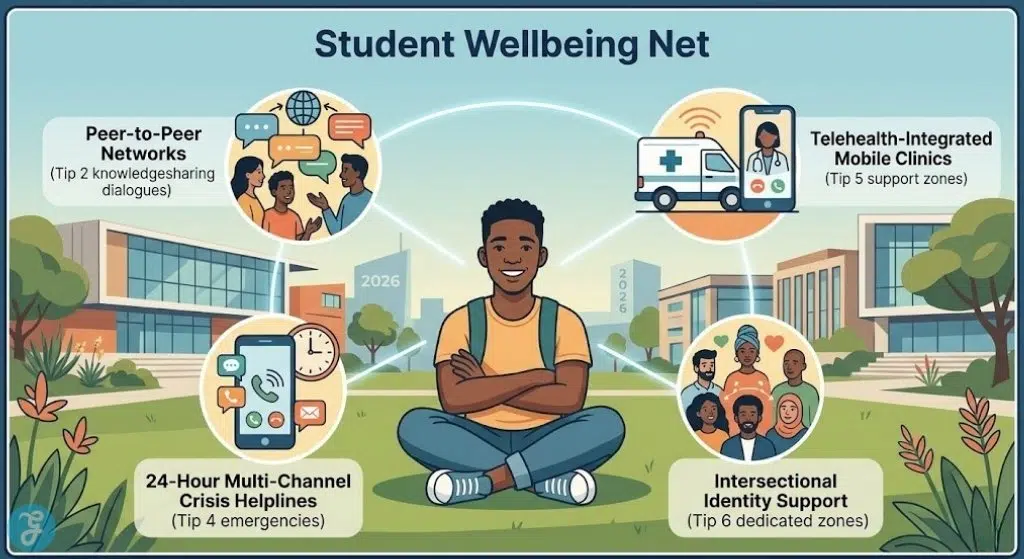
South African universities have scaled up their peer led interventions to a historic level in 2026. With over 10,000 trained peer educators and frontline workers across the sector, the first point of contact for a struggling student is often a classmate. These peer mentors are trained to conduct knowledge sharing dialogues that address mental health, addiction, and abuse in a way that feels relatable and safe for young people.
Best for:
-
Students who feel intimidated by traditional clinical settings and prefer a more horizontal support structure.
Why We Chose It:
-
Peers are often the first to notice the subtle signs of distress in their friends and colleagues.
-
It bridges the gap between the student body and professional campus health clinics.
-
The dialogues are designed to be culturally relevant and sensitive to local contexts.
Things to consider:
-
Peer educators require continuous professional supervision to prevent burnout.
To complement this human network, universities are deploying digital detection tools to reach students in low resource settings.
Modern campus portals now include early health detection risk screening programmes. These digital tools allow students to conduct their own psychosocial assessments in private. By identifying risks such as academic stress or depression early, the system can automatically suggest the most appropriate level of care, ranging from peer support to professional clinical intervention.
Best for:
-
Tech-savvy students who prefer to assess their own wellbeing before seeking in person help.
Why We Chose It:
-
It allows for intervention before a student reaches a point of absolute crisis.
-
Digital screenings remove the fear of being judged during a first consultation.
-
The data helps universities identify which specific departments need more wellness resources.
Things to consider:
-
Universities must ensure that student data is kept strictly confidential and used only for care purposes.
When a student moves from moderate distress into a state of emergency, a specialized crisis infrastructure is now available 24/7.
4. 24-Hour Multi-Channel Crisis Helplines
The 2026 response includes a dedicated national crisis helpline (0800 36 36 36) that operates around the clock. This service provides immediate trauma counseling and referrals for mental health, substance abuse, and gender based violence. By offering support through multiple channels including voice and text, universities ensure that help is never more than a few taps away, regardless of a student’s location.
Best for:
-
Immediate intervention during a mental health emergency or after a traumatic event.
Why We Chose It:
-
It provides a reliable safety net for students outside of regular campus office hours.
-
The service is specifically designed to handle the intersection of mental health and social challenges.
-
It offers a direct link to emergency clinical services if a student is at high risk.
Things to consider:
-
Universities must ensure that this number is visible in every common room and digital portal.
Beyond digital and phone support, mobile wellness services are physically bringing care to underprivileged campuses.
5. Telehealth-Integrated Mobile Wellness Clinics
Many TVET and CET colleges are now serviced by HIGHER HEALTH mobile wellness units that act as rolling health hubs. These units provide mental health screenings and social support in rural areas where campus infrastructure might be limited. In 2026, these mobile units are fully integrated with telehealth platforms, allowing a student in a remote area to consult with a specialist psychologist based in a major city.
Best for:
-
Students at satellite campuses that do not have the budget for a full time in house counseling department.
Why We Chose It:
-
It addresses the geographic inequality that has historically plagued the South African education sector.
-
The integration of telehealth allows for more specialized care than a general nurse can provide on site.
-
It creates a healthier learning environment by bringing a variety of health services to a single point.
Things to consider:
-
The reliability of the mobile clinic schedule is essential for students to feel they can depend on the service.
The success of these clinics often depends on how well they address the specific social triggers that impact mental health.
6. “Let’s Talk About It” Awareness Series
University counseling services in 2026 have moved toward a more conversational and public approach to destigmatization. The “Let’s Talk About It” series includes podcasts, campus dialogues, and social media content that addresses the hidden struggles of student life. By creating inclusive spaces to discuss topics like academic pressure and identity, universities are acknowledging that wellbeing is deeply shaped by social environments.
Best for:
-
Vulnerable student groups who require specialized support that understands their specific social stressors.
Why We Chose It:
-
It moves away from a clinical model toward a more nuanced and empathetic framework.
-
Public dialogues normalize the act of seeking help for mental health challenges.
-
It builds a culture of responsibility and resilience across the entire student population.
Things to consider:
-
Content must be updated regularly to stay current with the evolving needs of student communities.
Finally, the long term response involves building resilience directly into the definition of student success.
7. Resilience and Graduate Attribute Training
Leading universities are now defining student success as more than just passing exams. The current trend involves including soft skills like empathy, conflict resolution, and self motivation as core graduate attributes. By training students to be resilient and self aware, universities are preparing them to navigate the stresses of the modern workplace while protecting their own mental health.
Best for:
-
Senior students preparing to transition from the university environment into the competitive job market.
Why We Chose It:
-
These skills have been shown to increase academic performance and career satisfaction.
-
It positions the university as a partner in a student’s lifelong personal growth.
-
Employers in 2026 are increasingly looking for graduates who possess high levels of emotional intelligence.
Things to consider:
-
Faculty members must be trained to integrate these soft skills into their traditional teaching.
Comparing South African Student Support: Legacy vs. 2026
The shift in the response to the crisis is visible in the transition from ad hoc counseling to a structured national ecosystem. The following table illustrates how the institutional approach has evolved over the last decade.
The data below represents the average levels of support and integration across the South African post school sector this year.
| Support Category | Legacy Approach (Prior to 2020) | 2026 Strategic Response |
| Primary Support Model | Reactive clinical counseling | Proactive peer led ecosystem |
| Digital Integration | Minimal or non existent | Automated risk screening and telehealth |
| Geographic Reach | Primarily urban and main campus | Mobile clinics for rural and TVET hubs |
| Curriculum Status | Extra curricular and optional | NQF accredited for soft skills |
| Social Intersection | Limited focus on social triggers | Integrated intersectional framework |
Our Top 3 Critical Success Factors and Why?
While all seven strategies contribute to a healthier campus, these three are the most vital for sustaining progress through the 2020s.
-
Peer-to-Peer Knowledge Sharing: The scale of the peer network is the only way to reach millions of students across diverse and dispersed campuses.
-
Digital Risk Detection: Technology is the primary tool for overcoming the shortage of specialized mental health professionals.
-
Accredited Life Skills: Integrating wellbeing into the curriculum ensures that mental health is prioritized as a core component of success.
How to Access Mental Health Support on Campus?
Navigating the various levels of support can be daunting for a student in need. The 2026 system is designed to provide multiple points of entry so that help is always accessible regardless of the severity of the situation.
-
Start with a Peer Educator: If you want a casual, relatable conversation or need to know where to find more help, look for a peer mentor in your residence or department.
-
Visit the Campus Health Clinic: For clinical screenings, physical health issues, or professional counseling, make an appointment with your campus nurse.
-
Use the Higher Health App: Download the latest mobile tools for daily wellbeing tracking, interactive modules, and direct links to support.
-
Call the 24-Hour Helpline: In an emergency or if you need to talk to someone immediately outside of office hours, use the 0800 36 36 36 number.
The following table provides a guide for choosing the right level of support based on your current feelings.
| Reach out to a Peer Mentor if… | Contact the 24-Hour Helpline if… |
| You are feeling lonely or homesick. | You are experiencing a mental health crisis. |
| You want to join a wellness dialogue. | You have been a victim of violence or trauma. |
| You need help with time management. | You are struggling with thoughts of self harm. |
The Student Wellbeing Checklist
-
Enroll in the HIGHER HEALTH NQF Level 5 Civic and Soft Skills programme this semester.
-
Save the 24 hour crisis number 0800 36 36 36 into your phone contacts.
-
Identify the peer educators or campus care workers in your faculty.
-
Download the institution recommended wellness apps for daily screenings.
-
Attend at least one “Let’s Talk About It” dialogue session this year.
Reimagining Student Success through Wellness
The transformation of South African higher education into a wellbeing focused sector represents a profound commitment to the next generation of leaders. By addressing the Students’ Mental Health Crisis in South Africa through a combination of accredited education, massive peer networks, and innovative digital tools, universities are creating an environment where academic achievement and personal health go hand in hand. The goal for 2026 and beyond is to ensure that no student is left behind due to a lack of support.
Frequently Asked Questions (FAQs) on Students’ Mental Health Crisis in South Africa
Do I have to pay to use the campus mental health services?
Answer: No, the majority of the support services mentioned, including the 24 hour helpline and campus counseling, are provided for free to students at public universities and colleges.
Is my information kept confidential if I talk to a peer educator?
Answer: Peer educators are trained to respect privacy, but they are also required to refer serious cases to professional clinicians to ensure the student’s safety.
Can I get a certificate for the mental health modules I complete?
Answer: Yes, successful completion of the HIGHER HEALTH Civic and Soft Skills modules results in a certificate that can be added to your CV.
What if my campus doesn’t have a full time psychologist?
Answer: Most campuses are now supported by HIGHER HEALTH mobile wellness units or telehealth platforms that provide access to off site specialists.
How do I become a peer educator myself?
Answer: You can contact your institution’s student support services or the local HIGHER HEALTH office to find out about the next round of peer mentor training