


Modern IT environments face a variety of challenges ranging from phishing to ransomware to bot attacks. There are threats against enterprise security, software products, and cloud environments. Bad actors are using AI to make their attacks more effective. With threats from every direction, a holistic security approach includes security operations, cloud work protection platforms (CWPP), and product security.
The Role of Security Operations in Cyber Defense
The term security operations (SecOps for short) describes the collaboration between security and operations teams within an organization.
Over the years, the number of IT operations roles has grown. These roles have also become more specialized. As a result, silos have cropped up. SecOps aims to bring down those silos so IT security teams and IT operations teams can work together to prioritize network and data security while mitigating risk and maintaining excellent performance.
The SecOps team makes sure security is a fundamental part of every project and that it’s built in at the earliest stages of project development. Team members include highly skilled IT and security professionals who monitor threats and assess risk across an organization.
The SecOps Team and the Security Operations Center
This team works within a security operations center (SOC). A SOC is a centralized hub that can be physical, virtual, or both. Having a centralized hub makes it easier for security personnel to collaborate for monitoring, detecting, and responding to threats.
A modern SOC relies upon automation and AI to manage the huge number of security alerts and threat investigations they have to conduct every day. AI and machine learning (ML) specifically help SecOps teams quickly identify security alerts without generating the noise of low-value alerts. Together, AI and ML comb through multiple sources to detect threats across the organization.
Best Practices for Strengthening SecOps
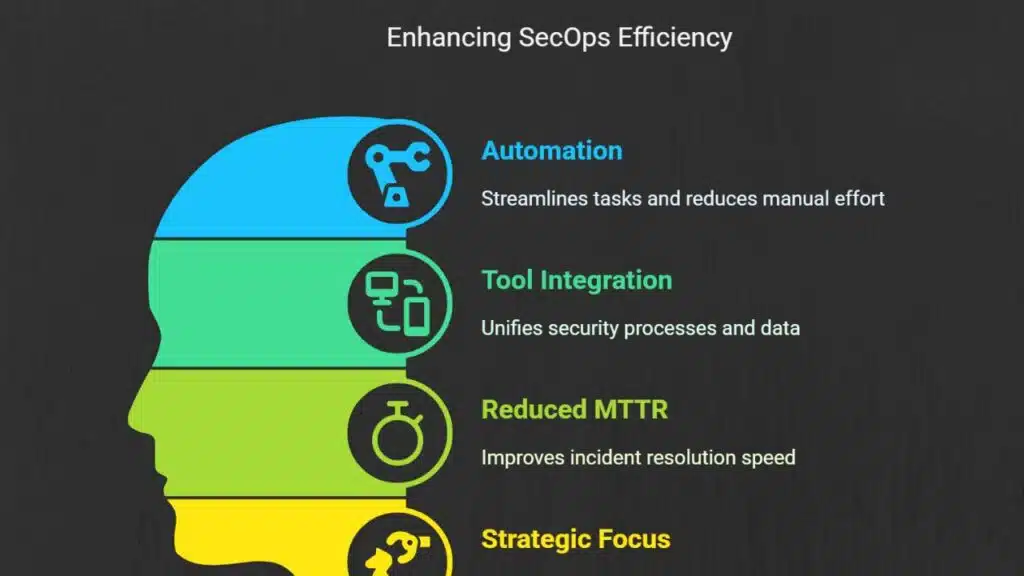
Automation and integrating tools are vital best practices for strengthening SecOps and ultimately improving the whole organization’s security posture. Here’s why:
- It reduces mean time to repair, a metric to measure the speed of resolving incidents. By automating manual tasks during the. investigation and response processes, SecOps team members will miss fewer alerts and spend less time investigating.
- There will be fewer manual tasks, so security analysts can spend more time on strategic initiatives.
- Integrating security tools into a centralized platform unifies logging, alert correlation, and an orchestrated response.
CWPP: Securing Cloud Workloads
A cloud work protection platform is a security solution designed to protect workloads in cloud environments.
Today, workloads can be hosted on a range of infrastructures, from traditional virtual machines to modern containers and serverless functions. Clouds can be private, public, or hybrid. CWPPs maintain the integrity, confidentiality, and availability of workloads.
CWPPs secure cloud-native applications, containers, and virtual machines. These security solutions protect workloads from threats when they’re operational as well as when they’re in transit (being moved, copied, or modified). Here’s how it keeps these workloads safe:
- Vulnerability management
- Host intrusion detection/prevention
- Compliance management
- Image analysis
- Runtime protection
- Behavioral monitoring of workload
Common Cloud Security Challenges
Cloud workloads can be hosted on various platforms, such as Amazon Web Services’ Elastic Compute Cloud, Microsoft Azure’s virtual machines, or Google Cloud’s containerized applications. Each of those platforms presents a potential attack vector. They also add heterogeneity and dynamism to cloud environments; SecOps teams now must concern themselves with securing multiple platforms, and with keeping data safe when it’s at rest and in transit.
CWPPs help SecOps teams solve these common challenges by simplifying the ecosystem. They offer comprehensive visibility into diverse cloud workloads. So, regardless of which platform the workload runs on, teams can secure it.
Key Features of CWPP
There are three key features of CWPP:
- Workload visibility
- Runtime protection
- Compliance monitoring
Workload Visibility
CWPPs provide granular visibility into cloud service providers and both hybrid and private environments. They give the SecOps detailed insights into applications, databases, and computing tasks so they can quickly detect anomalies and security threats. Greater visibility also allows the SecOps team to keep track of workloads and makes it easier to understand and manage the attack surface.
Runtime Protection
This feature monitors and protects workloads as they run in a cloud environment. Runtime protection defends against attacks and unauthorized activities in real time.
This type of protection is different from other kinds of protection. It identifies vulnerabilities that might pass through static analysis. Because runtime protection works when workloads run in the cloud, it can catch malicious behavior that might not be triggered in a controlled environment.
Compliance Monitoring
Organizations in highly regulated industries must comply with mandates ranging from HIPAA to PCI DSS and GDPR. To help maintain compliance, CWPPs provide automated monitoring and security configurations that meet regulatory requirements. In addition, CWPPs offer compliance dashboards so SecOps teams can see workloads’ compliance statuses.
Product Security
Product security is a set of processes, strategies, and actions to protect hardware, software, and other services. Protection layers are built in at every stage of the product’s lifecycle. It starts with product design and continues from there. Design teams evaluate and mitigate potential risks as the product moves through the design process so vulnerabilities don’t lead to breaches.
The Role of DevSecOps in Building Secure Products
DevSecOps is the combination of development and SecOps. The teams share a culture of responsibility for product security throughout the development lifecycle.
Product security starts from the moment developers begin working on the project. They run automated security scans, implement threat modeling, and mitigate vulnerabilities at every stage.
Key Components of Product Security
There are three key components of product security:
- Secure coding
- Vulnerability management
- Third-party risk assessment
Secure Coding
The concept of secure coding is about developing software resistant to vulnerabilities. Developers do this by applying security best practices, techniques, and tools at the beginning of the development process. Secure coding prevents vulnerabilities such as SQL injections, buffer overflows, and cross-site scripting.
Vulnerability Management
When a design team is creating a new product, they can’t control everything that goes on outside of the four walls of the organization. However, they can attempt to mitigate those risks. That’s where vulnerability management comes in.
Vulnerability management monitors the entire supply chain for threats. It involves creating relationships with third-party partners and suppliers as well as being aware of threats coming from inside the organization. Effective vulnerability management also requires developing workflows to react to security threats so they don’t derail the project.
Third-Party Assessment
You can’t always tell where your vulnerabilities lie. A third-party risk assessment involves hiring an outside expert to evaluate the potential threats in your environment.
When you understand where your vulnerabilities are, you can develop a remediation plan that strengthens your cybersecurity posture.
Breaches Due to Weak Product Security
There have been several breaches due to weak product security (especially because of third parties) in 2024 alone:
- The Bank of America breach: In February 2024, Bank of America announced its customer data was compromised through a cybersecurity incident involving Infosys McCamish. Millions of customers were affected.
- American Express breach: In March 2024, an American Express vendor experienced a breach that leaked sensitive customer data.
- The HealthEquity breach: HealthEquity, a health savings account provider, experienced a breach as a result of a compromised vendor. Over four million customers were affected.
Cybersecurity: A Joint Responsibility
Securing the enterprise and the products it produces requires a combination of the right mindset (product security), the right tools (CWPP to safeguard cloud workloads), and the right people (a SecOps team and DevSecOps for development). By building security into products from the beginning of the development lifecycle, organizations will be better positioned to protect themselves and their customers against evolving threats.

























