

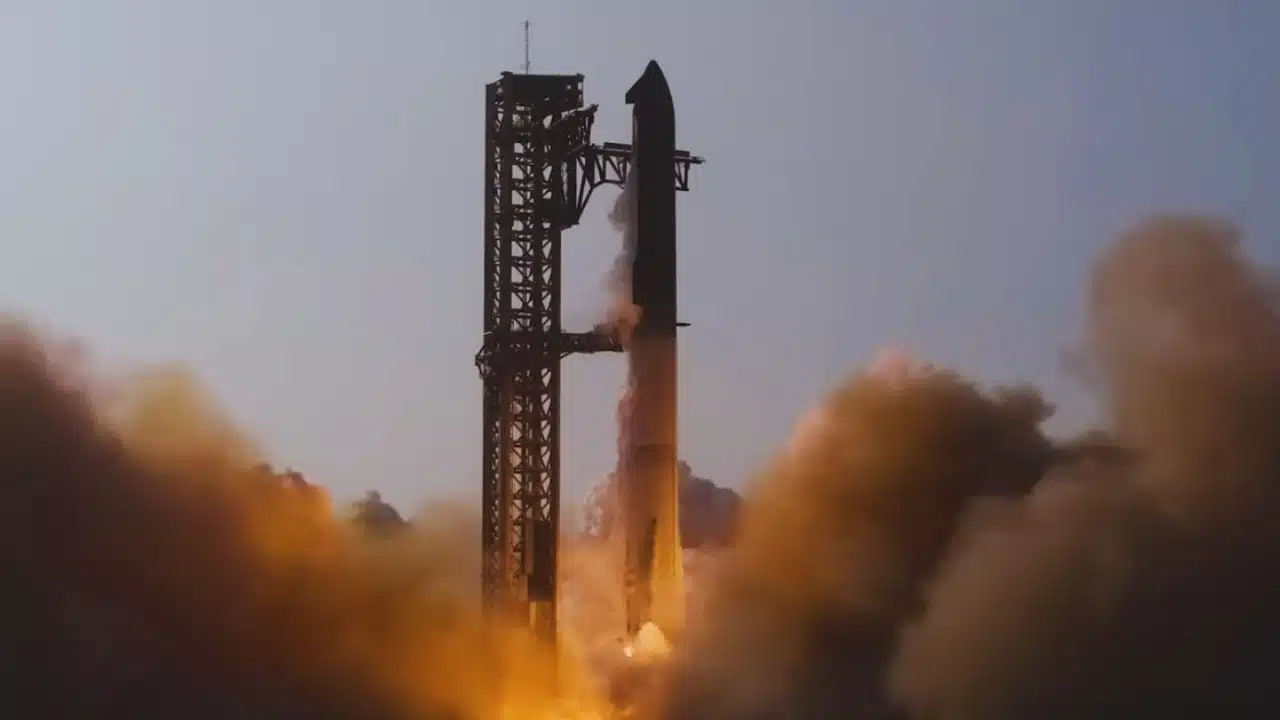
SpaceX’s ambitious plan to launch the 10th test flight of its massive Starship rocket ended in disappointment on Sunday evening, August 24, 2025. The launch attempt, scheduled from the company’s Starbase facility near Boca Chica Beach in South Texas, was halted shortly after fueling operations began.
According to SpaceX, the pause was triggered by a ground system malfunction during propellant loading. The company announced on X (formerly Twitter): “Standing down from today’s tenth flight of Starship to allow time to troubleshoot an issue with ground systems.”
The company has since indicated that alternative launch windows remain open on Monday, August 25, and Tuesday, August 26, provided engineers can isolate and fix the issue.
What This Test Flight Aims to Achieve
Flight 10 is designed as a critical systems demonstration for both the Super Heavy booster and the Starship upper stage. SpaceX planned a high-risk, high-data mission:
- Super Heavy Booster (Booster 16) would perform a series of controlled burns, then execute a hover maneuver over the Gulf of Mexico before splashing down.
- Starship Upper Stage (Ship 37) would attempt a suborbital flight, testing in-space engine restarts and simulating the deployment of eight Starlink satellite models.
- Re-entry would test newly reinforced heat shields and stronger flaps, two systems that failed during earlier missions. The flight would conclude with the spacecraft’s splashdown in the Indian Ocean.
If successful, this test would prove greater reusability potential—a key milestone for reducing the cost of human and cargo transport beyond Earth.
Why Starship Matters for NASA and SpaceX
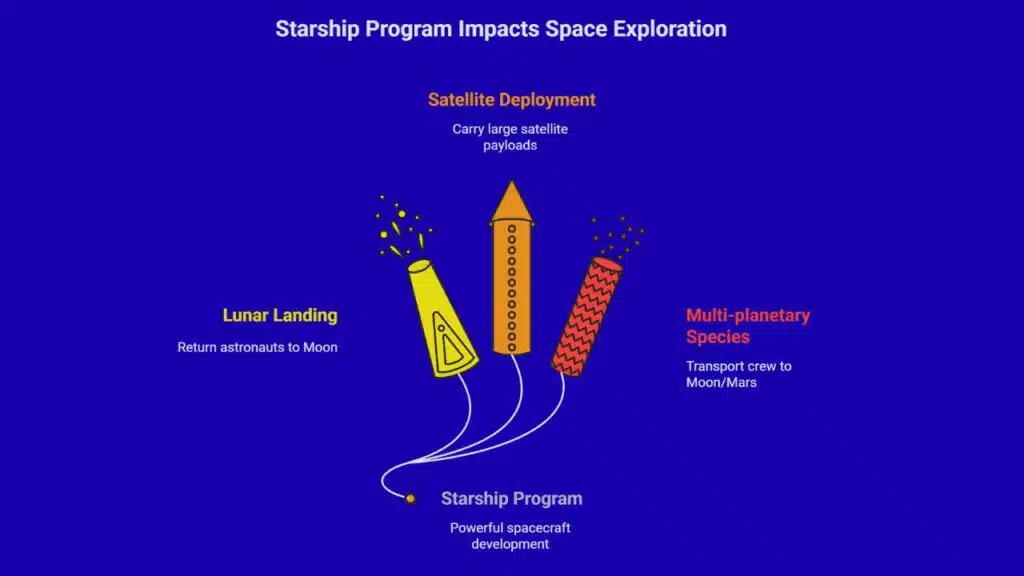
The Starship program is not just a private venture. NASA has contracted SpaceX to develop a lunar landing system using Starship under its Artemis program. NASA aims to return astronauts to the Moon in 2027, marking the first crewed lunar landing since Apollo 17 in 1972.
For SpaceX founder Elon Musk, the goals are even more ambitious. Starship is intended to:
- Carry large payloads of satellites into orbit, including entire batches of Starlink satellites.
- Enable crew and cargo transport to the Moon and Mars, supporting Musk’s long-term vision of making humanity a “multi-planetary species.”
- Potentially act as a point-to-point Earth transport vehicle, carrying passengers between continents in under an hour.
Every test brings SpaceX closer to proving whether this massive spacecraft—currently the largest and most powerful rocket ever built—can achieve these goals.
A Troubled Year for Starship Testing
The postponement underscores a difficult year for Starship development. In 2025 alone:
- Flight 7 (January) ended with the rocket breaking apart mid-flight after a fire damaged its engines.
- Flight 8 (March) suffered multiple engine shutdowns, leading to loss of control before re-entry.
- Flight 9 (May 27) saw the rocket’s upper stage lose orientation during re-entry, preventing the release of simulated Starlink satellites.
- June 18: Ship 36, intended for Flight 10, exploded on the launch pad during a static fire engine test. Investigators pointed to a pressure vessel failure in the nose section.
Despite these failures, Musk and SpaceX remain publicly optimistic. Musk has said that each setback provides crucial engineering data, comparing it to the company’s early struggles with the Falcon 1 rocket, which failed three times before finally reaching orbit in 2008.
SpaceX’s Development Philosophy: Fail Fast, Learn Faster
Unlike traditional aerospace companies that spend years fine-tuning designs before flight, SpaceX adopts a “build, fly, fail, fix” philosophy.
This approach allows the company to test hardware in real conditions, identify flaws quickly, and rapidly iterate. Although this has resulted in dramatic explosions and fiery failures, it has also accelerated development timelines. The successful evolution of the Falcon 9 rocket, now NASA’s workhorse vehicle, is a testament to this method.
As Musk once said, “Success is uncertain, but entertainment is guaranteed.” For SpaceX, failure is not the end—it’s part of the process.
Broader Implications for Space Exploration
The stakes for Starship go beyond SpaceX.
- For NASA: The Artemis program depends on Starship to safely land astronauts on the Moon. Delays or failures could push back NASA’s 2027 timeline.
- For the global space industry: If Starship succeeds, its massive lift capacity (over 100 metric tons to orbit) could make it the dominant rocket for launching satellites, deep space missions, and even interplanetary travel.
- For SpaceX’s finances: Each Starship vehicle costs tens of millions of dollars, and repeated failures represent significant financial losses. However, if reusability works as intended, long-term savings could be transformative.
- For Mars colonization: Musk’s ultimate dream relies on Starship’s ability to carry large groups of people and cargo across interplanetary distances. These test flights are the stepping stones toward that vision.
Looking Ahead: The Next Launch Attempt
SpaceX engineers are now racing to address the ground system issue that halted Sunday’s attempt. If repairs and tests proceed smoothly, Flight 10 could launch as early as Monday, August 25, or Tuesday, August 26.
Observers will be watching closely, as the mission aims to validate critical upgrades and prove whether Starship is edging closer to reliability.
For now, fans of space exploration must wait a little longer—but each delay serves as a reminder of just how complex and challenging rocket science truly is.
The Information is Collected from NPR and CNN.






















