
In a move to combat the accelerating crisis of AI-generated deepfakes, Sony has deployed the industry’s first in-camera Sony video authenticity technology compliant with the C2PA open standard. The announcement, made October 30, 2025, extends its existing digital signature system from still photos to video, providing a ‘digital birth certificate’ that validates the time, place, and integrity of footage from the moment of capture.
This technology is being rolled out immediately to some of Sony’s most popular professional cameras, including the Alpha 9 III and the Cinema Line FX3. It represents a critical piece of technical infrastructure for news agencies, broadcasters, and documentary filmmakers struggling to maintain public trust in an era where seeing is no longer believing.
The move comes not a moment too soon. The proliferation of sophisticated, generative AI has created a firehose of convincing, synthetic content, with devastating potential for misinformation, fraud, and personal harassment. Sony’s solution aims to draw a clear line in the sand, offering a verifiable, end-to-end chain of custody for professional video content.
A ‘Digital Birth Certificate’ for Video: What Sony Announced
Sony’s system, first trialed for still images with partners like The Associated Press (AP) in 2023 and 2024, is now tackling the more complex challenge of video.
The core of the technology is compliance with the C2PA (Coalition for Content Provenance and Authenticity) standard. C2PA is an open-standard body co-founded by Adobe, Microsoft, and Truepic, which Sony joined as a steering committee member in March 2022. This standard creates a “Content Credential,” which is a secure, tamper-evident set of metadata cryptographically bound to the media file.
This credential acts as a ‘digital birth certificate’, allowing a newsroom editor, or eventually a member of the public, to verify:
- That the video was captured by a specific, genuine camera.
- When and where the video was captured (if enabled).
- That the video has not been altered since its capture.
“We are committed to advancing technologies that enhance the trustworthiness of digital content,” said Olivier Bovis, Head of Media Solutions at Sony Europe, in a statement regarding Sony’s collaboration with the BBC on C2PA standards.
While other manufacturers, like Leica and Nikon, have integrated C2PA-compliant credentials for still images into their cameras (such as the Leica M11-P), Sony’s announcement marks the first comprehensive, commercially available solution for video.
How It Works: From Lens to Verification
Sony’s solution is a two-part system, combining its proprietary hardware with the open C2PA standard.
In-Camera Signing and 3D Depth
At the moment of capture, the camera’s hardware chipset creates a digital signature that is embedded in the video file. Critically, this signature includes proprietary metadata that Sony says provides an extra layer of security.
The most significant of these is 3D depth information captured by the camera’s sensor system. This metadata can be used during the verification process to confirm that the camera was recording a three-dimensional, real-world scene, rather than a flat, two-dimensional image (like a photograph or another video playing on a screen). This is a direct counter-measure to simple “playback” fakes, adding a layer of validation that AI-generated content cannot presently spoof.
The Workflow for News Organizations
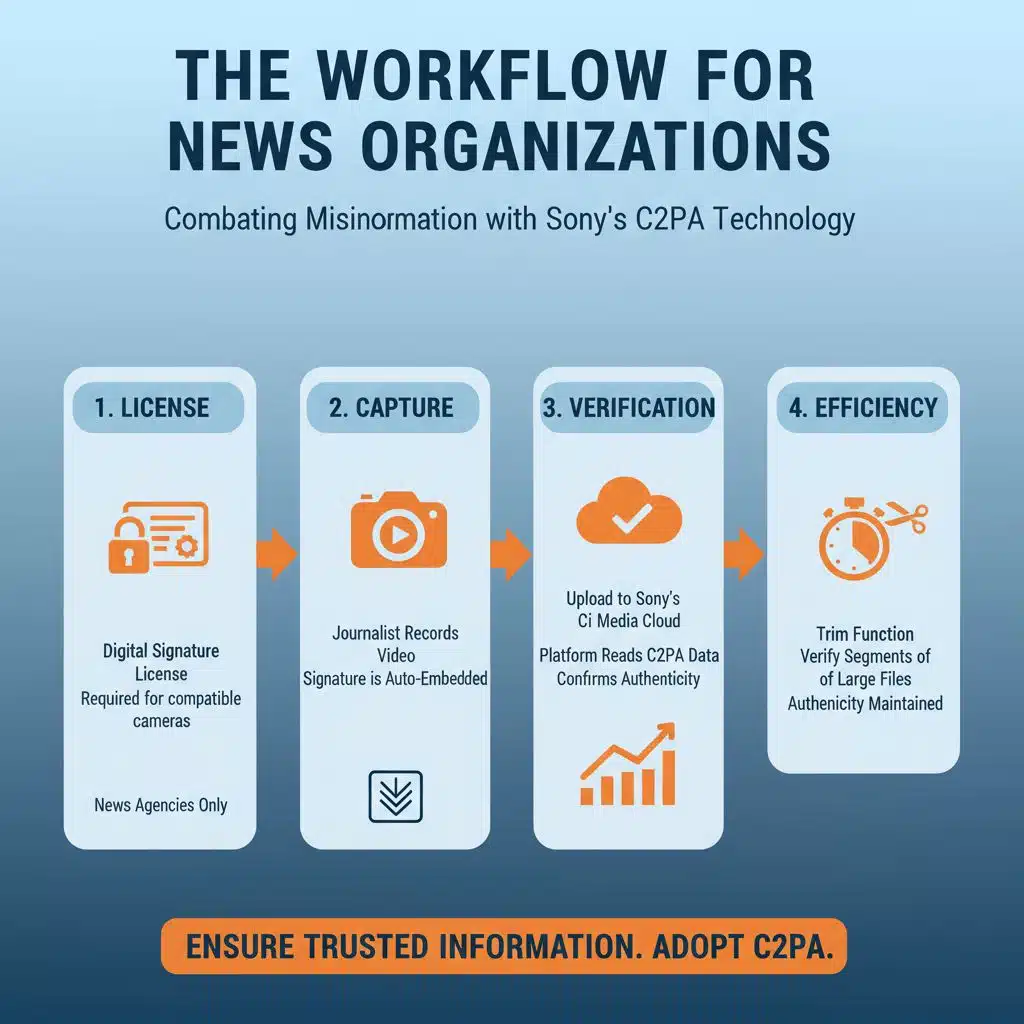
This feature is not intended for casual consumers—at least, not yet. Sony is targeting professional news organizations, which are on the front lines of the information war.
- License: News agencies must purchase a digital signature license to “activate” the C2PA function in their compatible cameras.
- Capture: The journalist captures video, and the signature is automatically and irrevocably embedded.
- Verification: The file is then uploaded to Sony’s Ci Media Cloud. The cloud platform can read the C2PA-compliant signature and display the asset’s “Content Credentials,” confirming its authenticity.
- Efficiency: For fast-paced news environments, Sony has also included a “trim function” that allows specific segments of a large video file to be verified without compromising the authenticity signature of the clip.
The Expanding Rollout: Which Cameras Are Supported?
Sony is aggressively rolling out this feature via firmware updates and in new models. The summer 2025 launch of the PXW-Z300 camcorder was the first to support video authentication, and this new announcement massively expands the roster.
C2PA Video Authenticity Support Schedule:
| Camera Model | Support Type | Availability |
| Alpha 1 II (A1 II) | C2PA Video | October 2025 (at launch) |
| Alpha 9 III (A9 III) | C2PA Video | October 2025 (Firmware Update) |
| Cinema Line FX3 | C2PA Video | October 2025 (Firmware Update) |
| Cinema Line FX30 | C2PA Video | October 2025 (Firmware Update) |
| Alpha 7R V (A7R V) | C2PA Video | From November 2025 (Firmware Update) |
| Alpha 7 IV (A7 IV) | C2PA Video | From November 2025 (Firmware Update) |
| Alpha 1 (A1) | C2PA Video | From November 2025 (Firmware Update) |
| Alpha 7S III (A7S III) | C2PA Video | Scheduled for 2026 |
| PXW-Z300 | C2PA Video | Summer 2025 (at launch) |
This list notably includes the Alpha 7S III, a workhorse for videographers, though its update is slated for 2026. The inclusion of the more affordable FX30 and A7 IV suggests Sony’s ambition to make this the new professional standard.
A ‘Tidal Wave’ of Digital Deception
Sony’s investment is a direct response to the exponential growth of deepfakes, which poses a threat to everything from global elections to financial markets and personal security.
The numbers are staggering.
- Exponential Growth: The volume of deepfake videos shared online is projected to skyrocket from an estimated 500,000 in 2023 to 8 million by 2025, representing a 900% annual growth rate.
- Financial Fraud: The economic impact is catastrophic. Fraud losses facilitated by generative AI are projected to climb from $12.3 billion in 2024 to $40 billion by 2027.
- Targeted Attacks: The threat is accelerating in key economies. North America, for instance, witnessed a 1,740% increase in detected deepfake fraud between 2022 and 2023.
Beyond the financial threat, the most voluminous and insidious use of deepfake technology remains Non-Consensual Intimate Imagery (NCII), or “deepfake porn.” Multiple analyses consistently find that 96% to 98% of all deepfake videos are NCII, and 99% to 100% of the victims in these videos are women.
While Sony’s technology is aimed at news, its implementation establishes a technical framework that could one day help protect all individuals from digital impersonation.
Analysis: A ‘Crucial’ Step, Not a Silver Bullet
Sony’s leadership on this front has been lauded by its partners. Jatin Aythora, Director of BBC R&D, who has collaborated with Sony on C2PA testing, called the cross-industry effort “crucial in helping us develop tools that ensure the authenticity of digital content.
However, experts caution that C2PA is not a silver bullet that will “fix” the deepfake problem. It is an “opt-in” system.
- It Verifies Provenance, It Doesn’t Detect Fakes: A C2PA-verified video is certified as authentic to its source. A video without C2PA credentials is not automatically a fake—it is simply unverified. The challenge for newsrooms and platforms will be how to treat this unverified content.
- The “Authenticated” Deepfake: A malicious actor could, in theory, use a C2PA-enabled camera to record a screen playing a deepfake, and the system would “authenticate” the recording of that screen. This is precisely why Sony’s inclusion of 3D depth metadata is so important, as it provides a technical check against this specific workaround.
- The Professional Barrier: By making the solution a paid service for professionals, Sony is targeting the most critical vector: trusted news. But it leaves the consumer and social media space—where 98% of deepfakes proliferate—largely untouched for now.
This is the start of a new arms race. As authentication technology becomes standard, malicious actors will focus on discrediting it, while generative AI continues to improve. Sony has just provided the first major piece of armor for videographers in this fight.
What to Watch Next
The successful launch of Sony’s video solution puts pressure on rivals like Canon, Nikon, and Panasonic to follow suit with their own C2PA-compliant video workflows.
The key metrics to watch will be:
- Adoption: How many major news agencies—like the AP, Reuters, and AFP—will pay to adopt this workflow across their global operations?
- Platform Support: Will YouTube, X (formerly Twitter), and Meta (Facebook/Instagram) integrate C2PA verification, adding a “verified” badge to videos in users’ feeds?
- Consumer Rollout: How long before this technology moves from a $5,000 professional camera to a $1,000 consumer model, or even a smartphone?
For now, Sony has fired a definitive, technical shot against the “liar’s dividend”—the ability for bad actors to dismiss real footage as fake, and to pass fake footage as real. The goal is not to eliminate fakes, but to make authenticity verifiable.
The Information is Collected from MSN and Yahoo.