Traditional security awareness training fails when organizations treat compliance modules as a substitute for actual security culture. While annual courses teach employees how to identify phishing, recognize threats, and follow policies, mandatory training cannot overcome punitive environments, slow tools, or leadership pressure to bypass safety protocols.
Modern frameworks, such as NIST guidelines, treat security learning as a continuous behavioral program rather than an administrative checklist. To build a resilient human firewall, security awareness training must be paired with operational support, psychological safety, and leadership buy-in. Aligning formal training with daily business incentives ensures employees act on their security knowledge without fear of friction or retaliation.
Compliance Completion Is Not the Same as Behavior Change
Training completion is worth measuring. Organizations may need it for internal policy, contracts, governance, or regulatory obligations. If a course is mandatory, management should know who has completed it.
But completion answers only one question: Did the employee finish the material?
It does not tell you whether the employee can apply the lesson when a believable request arrives during a busy afternoon.
A NIST study of U.S. federal cybersecurity awareness programs illustrates the gap. Training completion was the most commonly used effectiveness measure, reported by 84% of surveyed programs. Phishing-simulation click rates were also widely used. More than half of respondents believed their leadership viewed compliance metrics as the most important measure of success.
The study applies to federal programs rather than every organization, but the management problem is familiar: participation is easy to count. Behavior is harder. A dashboard showing 100% completion can coexist with slow incident reporting, weak payment verification, widespread policy workarounds, or senior managers who routinely expect exceptions. That is why completion should remain a compliance measure, not become a proxy for security culture.
Security Awareness Training Competes With the Way Work Actually Gets Done
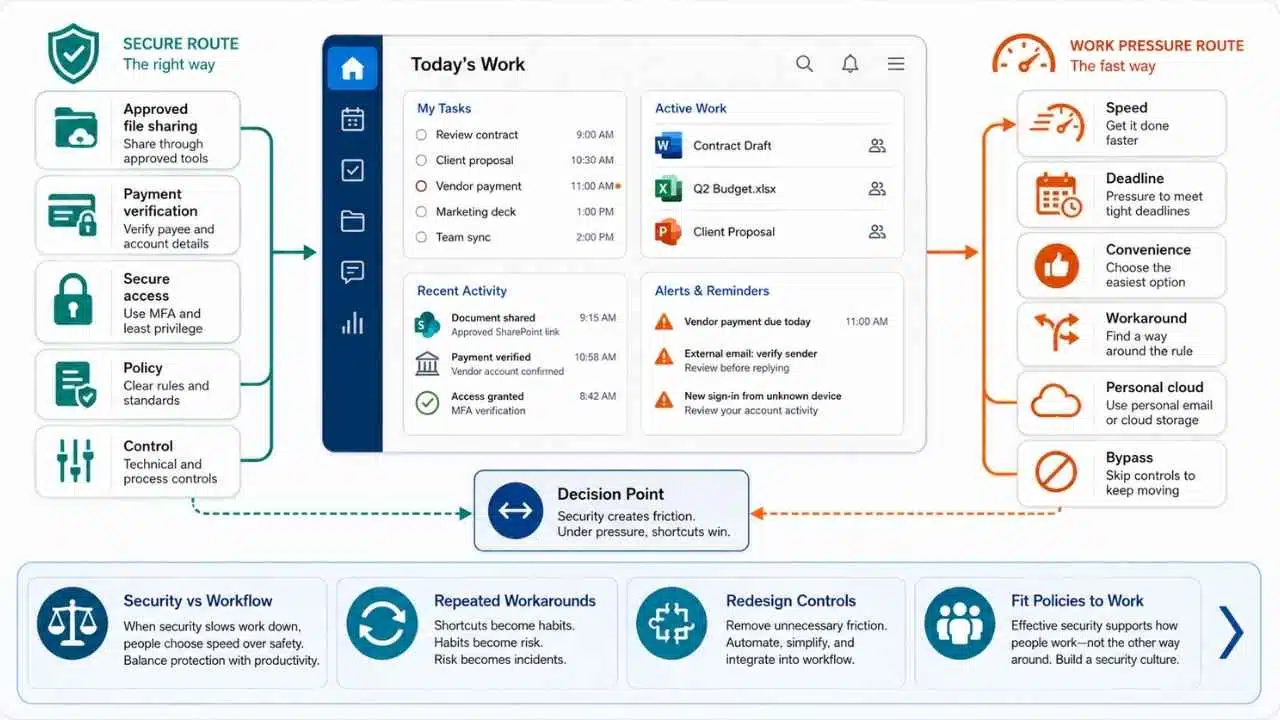
Employees make security decisions while trying to accomplish something else. They are helping customers, closing sales, processing invoices, deploying code, approving expenses, sharing files, or trying to meet a deadline.
If the secure route consistently makes those tasks harder, training has competition. Consider a company that requires an approved file-sharing system but makes external sharing cumbersome enough that employees start using personal cloud accounts. Or a finance team told to verify payment changes while being judged almost entirely on processing speed.
The official rule is clear. The workplace incentive is clearer. Current UK National Cyber Security Centre guidance treats this conflict as part of security culture. Policies that do not fit real work can turn security into an obstacle, while informal workplace norms can make bypassing controls look efficient or helpful.
Repeated workarounds should therefore trigger more than another reminder email. Sometimes employees need better training. Sometimes the control needs redesigning. Knowing the difference is part of managing human risk well.
People Notice What Leaders Actually Do
Leadership behavior can undermine an awareness program faster than poor course content. If senior managers bypass access controls because they are inconvenient, request approval exceptions whenever deadlines are tight, or treat security checks as bureaucracy for everyone else, employees learn something important.
They learn which rules are genuinely mandatory. The NCSC’s security culture principles put leadership at the center of this problem. Leaders are expected to model secure behavior, support an environment where people can raise concerns, and remove incentives that push staff toward unsafe choices.
This makes security culture an executive responsibility, not just an IT or HR project. A security team can document the correct procedure. HR can assign training. IT can implement the control.
Managers influence whether following it feels normal. If senior employees regularly receive exemptions, the message from the annual awareness course will always be weaker than the behavior people observe every week.
Reporting Culture Matters as Much as Threat Recognition
Awareness programs often spend considerable effort teaching employees how to recognize suspicious messages. Recognition is only useful if the next step works.
Can the employee report the message quickly? Do they know where the report goes? Will someone respond? More importantly, what happens if they already clicked?
An employee who expects embarrassment or punishment has a reason to delay saying anything. That can turn a small incident into a larger one simply because defenders lose time.
NCSC guidance recommends easy reporting routes and an environment where employees can admit honest mistakes and ask for help. It also makes an important distinction between psychological safety and the absence of accountability.
Not every mistake should be treated as misconduct. Deliberately ignoring a critical control after repeated warnings is different from clicking a convincing phishing message and reporting it immediately.
A healthy reporting culture makes that distinction clear. From an incident-response perspective, “I clicked this two minutes ago” is far more useful than silence.
Phishing Simulations Can Become the Wrong Competition
Phishing simulations are attractive because they produce numbers executives can understand. A department had a 15% click rate last quarter. It is now 8%. Improvement seems obvious.
The number needs context. Simulation difficulty can change. So can employee workload, targeting, frequency, and the mix of people included. A click rate also says little about whether employees reported the message, sought help after making a mistake, or recognized a real attack later.
The NCSC has warned that poorly handled phishing simulations can damage trust, particularly when employees fear punishment or embarrassment. Its guidance favors a positive reporting culture over exercises designed mainly to catch people out.
Research is also more complicated than the simple claim that more phishing training always produces safer behavior.
A large 2025 randomized study involving more than 19,500 employees found limited practical effects from the annual and embedded phishing training approaches examined. That does not show that all simulations or phishing education are useless. It does show why organizations should be careful about presenting declining simulation click rates as proof that human risk has been solved.
If simulations are used, measure more than failure. Look at reporting, speed of reporting, repeated patterns, and whether the exercise improves the relationship between employees and the security team. The exercise should test the system, not merely the employee.
Generic Training Misses Role-Specific Risk
A receptionist, software developer, accounts-payable employee, system administrator, salesperson, and CEO do not make the same security decisions. Their training should not be identical beyond the basic foundation.
Finance teams may need practice with changed bank details, unusual invoices, or requests to bypass payment controls. Help-desk employees may face attempts to manipulate password resets and account recovery.
Developers need guidance relevant to the software and infrastructure they build. Privileged administrators need training around elevated access.
Executives may face highly tailored impersonation, credential theft, and fraudulent requests. NIST Cybersecurity Framework 2.0 distinguishes general workforce awareness from additional training for specialized roles.
That is a useful design principle. A single annual course can establish a common baseline. It cannot cover every high-risk decision in enough depth to be useful. Role-specific training should focus on the mistakes that would actually matter in that job.
Better Culture Also Means Better Security Rules
Repeated policy violations are not always evidence of careless employees. Sometimes they are evidence of a bad process. A control may be technically reasonable but operationally difficult. An approval may take far too long. An internal policy may be scattered across several documents. A secure tool may lack a feature people genuinely need to do their work.
Eventually, unofficial workarounds appear. Those workarounds can create serious risk, but blaming employees without examining the process misses part of the problem.
NCSC culture guidance recommends rules that are understandable, accessible, maintained, and tested against real workflows. It warns against both extremes: excessively detailed rules become hard to manage, while vague policies leave people unsure what is expected.
When employees repeatedly bypass the same control, ask:
- Is the requirement clear?
- Can people find the current policy?
- Does the approved process work quickly enough?
- Is the approved tool suitable for the task?
- Do managers follow the same procedure?
- Is there an escalation route when the normal process genuinely does not fit?
Security teams should not remove necessary controls whenever someone complains about friction. They should investigate recurring friction before assuming another awareness module will fix it.
Make Secure Behavior Easier Than the Workaround
Some of the most useful improvements to security culture are ordinary operational changes.
- A one-click phishing-reporting button.
- A supported password manager.
- A clear process for verifying supplier bank-account changes.
- Easy access to security staff when something looks wrong.
- Appropriate multi-factor authentication.
- A usable approved method for sharing files with external partners.
- These changes matter because people naturally respond to friction.
- If reporting a suspicious message requires finding an obscure internal portal and completing a form, deleting the email is easier.
- If obtaining approved software takes weeks while creating an online account takes minutes, shadow IT becomes predictable.
- Security controls cannot always be effortless. Some friction is necessary.
- But the safer route should not be unnecessarily harder than the unsafe one.
- Training can explain what people should do. The organization has to make that action practical.
Stop Treating Employees as the Security Perimeter
The phrase “humans are the weakest link” is memorable. It is not a very useful security architecture. People make mistakes. Attackers know that and deliberately exploit authority, urgency, distraction, trust, fatigue, and familiarity.
No realistic amount of training will make every employee identify every malicious request. Organizations should design around that fact.
Awareness needs to sit alongside technical and procedural controls such as appropriate authentication, least privilege, email filtering, endpoint protection, payment verification, logging, access management, and tested incident response.
Training a finance employee to recognize fraud does not replace independent approval for sensitive payments. Teaching people about credential theft does not remove the value of stronger authentication.
Teaching employees to recognize phishing does not mean the mail system should pass every suspicious message through and expect perfect human judgment. Employees should contribute to security. They should not be expected to function as the final control every time another layer fails.
Measure Behaviors That Actually Matter
Completion rates can stay on the dashboard. They should not be the whole dashboard. NIST’s current learning-program guidance encourages organizations to evaluate behavioral change and outcomes as part of the program lifecycle. Reporting a suspected phishing message is one example of the kind of behavior that can be measured.
Depending on the organization’s risk profile, useful indicators may include:
- how quickly suspicious activity is reported;
- reporting rates during phishing exercises;
- recurring causes found in real incidents;
- adoption of required security controls;
- repeated policy workarounds;
- employee confidence in seeking security help;
- findings from exercises and incident reviews;
- behavior trends over time.
These measures still need interpretation. More reports do not automatically mean more incidents. Employees may simply be reporting events that previously went unnoticed. Likewise, a department with zero reported problems may not be exceptionally secure. It may have a reporting problem.
Metrics influence what people optimize for. If management rewards the appearance of zero incidents, employees may learn that silence produces the better number.
What Culture Change Looks Like in Practice
“Improve security culture” is not useful advice unless something changes in daily work. A stronger culture usually becomes visible in fairly ordinary ways.
- Leaders follow the same controls: Seniority does not automatically create an exemption.
- Reporting is easy: Employees know how to raise a concern and can do it quickly, including after making a mistake.
- Policies fit real work: Repeated workarounds trigger a review of the process as well as the employee’s decision.
- Training changes by role: Finance, engineering, executives, privileged IT staff, and the wider workforce receive different depth where their risks differ.
- Security explains important rules: Employees understand what a control is protecting rather than experiencing it as unexplained bureaucracy.
- Useful reporting receives support: A false alarm is preferable to making employees afraid to ask.
- Incidents produce operational learning: Reviews examine technology, process, incentives, management decisions, and human actions instead of ending with the person who clicked.
None of this requires a slogan about culture. It requires repeated management decisions that make secure behavior normal.
Final Thoughts
Security awareness training still deserves a place in an organization’s defenses. It simply cannot compensate for the environment employees return to after the course ends. Training can explain how phishing works. It cannot stop a manager from rewarding unsafe shortcuts. It can teach reporting procedures, but it cannot create trust in the reporting process. It can explain an approved workflow, but it cannot make a badly designed workflow usable.
The practical next step is not necessarily another training module. Look at where employees struggle to follow the behavior the organization already teaches. Review reporting friction. Examine recurring exceptions. Check whether senior leaders follow the controls. Separate high-risk roles from generic workforce training. Measure behavior alongside completion.
Then keep the technical defenses strong enough to assume that people will occasionally make mistakes. That is when security awareness stops being something employees finish and becomes part of how the organization actually works.