A beginner can open an investing app in minutes, but knowing what to do after that is harder. Some platforms add progress bars, badges, price alerts, leaderboards, or rewards to make the experience feel more engaging. Gamified investing apps can lower the barrier to learning and help users follow a plan. The same features may also make trading feel urgent, exciting, or competitive.
The effects depend on the feature and the person using it. In a UK experiment involving more than 9,000 consumers, the Financial Conduct Authority (FCA) found that some digital engagement practices—including push notifications and points with prize draws—could increase trading frequency and risk-taking. That is a reason to look closely at app design, not proof that every feature harms every investor.
The four benefits below are most useful when they support a decision the investor has already considered. The three risks deserve extra attention when the app nudges users toward more activity.
Gamified Investing App Features: Benefits and Risks
Features such as progress trackers, alerts, rewards, and leaderboards can make investing easier to follow but may encourage frequent checking or trading. Their value depends on how they shape choices.
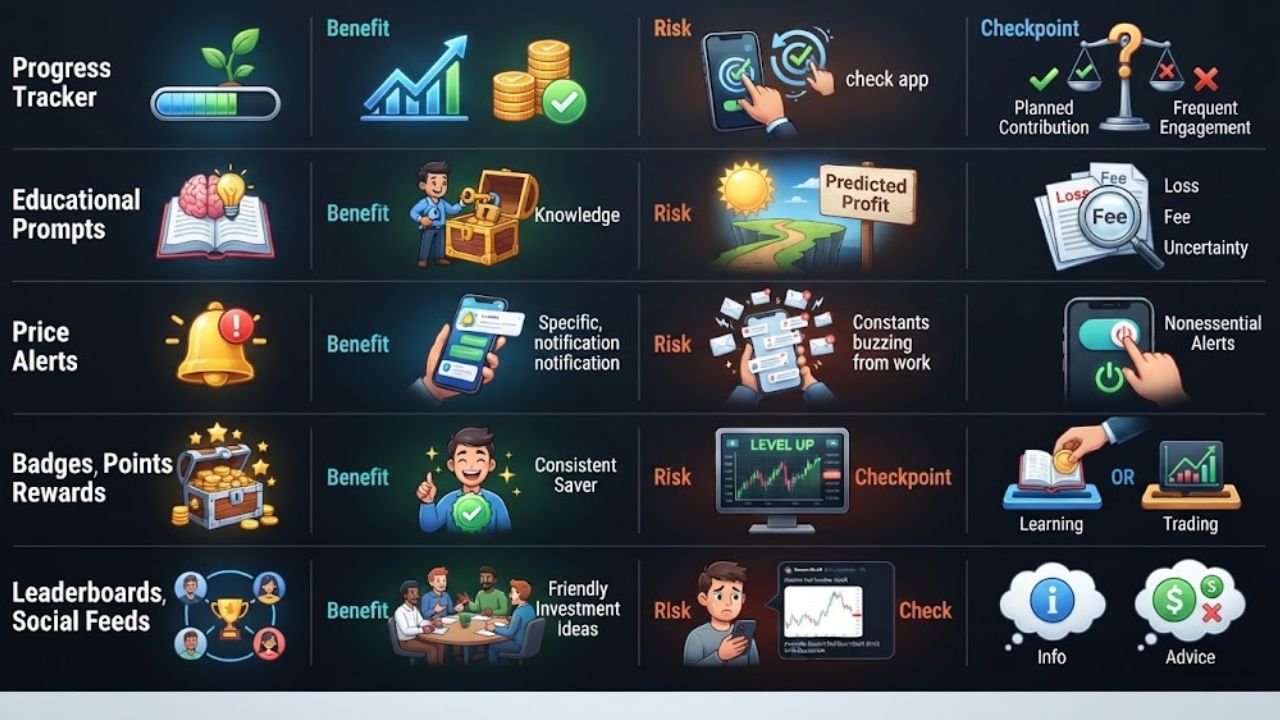
| App feature | Potential benefit | Risk to watch for | What to check |
|---|---|---|---|
| Progress tracker or goal display | Makes a savings or investing plan easier to monitor | May reward app activity instead of progress toward a real goal | What action earns progress: planned contributions or frequent engagement? |
| Educational prompts or simulations | Helps beginners explore unfamiliar concepts | Simplified examples may make investing seem more predictable than it is | Does the material explain losses, fees, and uncertainty? |
| Price alerts and notifications | Brings selected account or market updates to the user’s attention | Can prompt unplanned trades or excessive checking | Can nonessential alerts be turned off? |
| Badges, points, or rewards | May make learning or planned actions feel engaging | Can make trading feel like a game or achievement | Is the reward tied to learning, or to placing trades? |
| Leaderboards or social feeds | Shows what other users are discussing | Can encourage comparison or crowd-following | Is the information being treated as a discussion topic rather than investment advice? |
1. They Can Make Investing Easier to Approach
A confusing account setup or unfamiliar terminology can put off a first-time investor. A clear interface, plain-language explanations, and easy-to-find account information can make the first steps less intimidating. Some gamified investing apps also include educational content, although the quality and depth vary.
The benefit is access and clarity, not the game-like design by itself. The U.S. Securities and Exchange Commission has noted that app-based platforms can expand market access and may serve as investor education tools. An easy sign-up process, however, does not tell a user whether an investment is suitable or how much they could lose.
Before depositing money, a beginner should be able to explain what they are buying, why it fits their goals, and what risks apply. If the app makes trading easy but leaves those questions unanswered, the interface is doing only part of its job.
2. Progress Tools May Help Users Follow a Plan
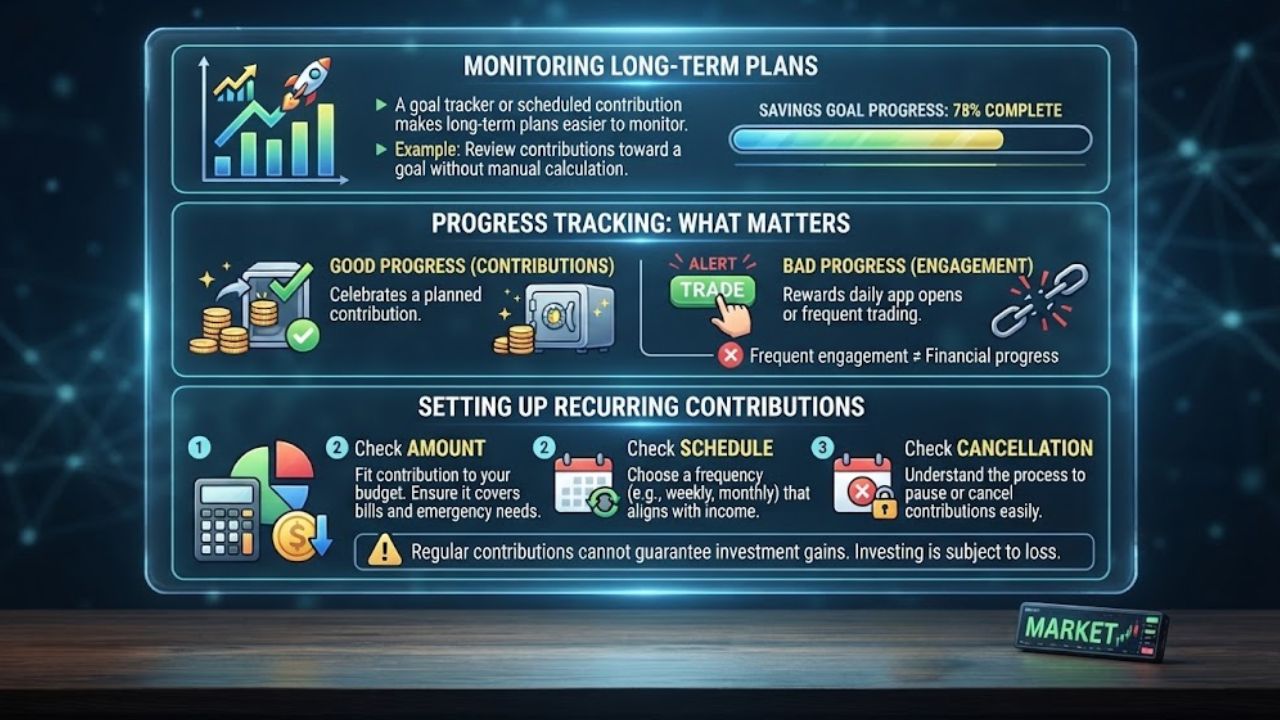
A goal tracker or scheduled contribution can make a long-term plan easier to monitor. For example, someone saving toward a goal could use a progress display to review contributions without having to calculate them manually.
But a progress bar is useful only if it tracks something that matters. A gamified investing apps feature that celebrates a planned contribution is different from a streak that rewards opening the app every day or trading often. Frequent engagement is not the same as financial progress.
Set recurring contributions only after checking the amount, schedule, and cancellation process. Make sure the amount fits your budget and does not leave you short for bills or emergency needs. A regular contribution cannot guarantee investment gains, and investing remains subject to loss.
3. Simulations Can Make Unfamiliar Concepts Easier to Explore
Some platforms offer practice environments or visual explanations of investment concepts. These can help new investors understand how a portfolio might change before they commit real money. They are useful as teaching aids, but practice results should not be treated as a forecast.
Check what the simulation leaves out. A simplified scenario may not reflect the uncertainty, costs, or emotional pressure involved in a real investment. Prefer educational tools that explain losses, diversification, fees, and time horizon alongside possible returns. A lesson that highlights only successful picks risks teaching confidence without judgment.
A randomized study published in Management Science found that price-trend notifications helped participants with accurate beliefs learn, but reinforced mistakes among participants whose beliefs were inaccurate. Feedback can clarify a decision, or strengthen a mistaken one.
4. A dashboard can Help Users review what they Own
An account overview may show holdings, transactions, cash, and changes in value in one place. That visibility can help users notice an unfamiliar transaction or check whether their investments still match their plan.
The downside is the temptation to check too often. A daily movement in value does not necessarily require action, particularly for someone investing toward a distant goal. In gamified investing apps, colorful alerts and frequently refreshed figures can make ordinary price changes feel more significant than they are.
Use the dashboard to review information at a pace that suits your plan. If frequent updates make you anxious or trigger trades, reduce notifications or limit how often you check. A useful display should make important details easier to find, not turn every market move into a prompt.
5. Prompts can Lead to More Trading than Intended
Price alerts can bring relevant information to a user’s attention. Repeated notifications, trending-stock prompts, or reminders to return to the app can also encourage trades the user had not planned to make.
The FCA experiment tested flashing prices, push notifications, trader leaderboards, and points with prize draws. Push notifications and points with prize draws increased the number of trades in the experiment by 11% and 12%, respectively. The results describe tested features and participants; they do not predict how every investor will respond.
More trades do not automatically produce better results. Depending on the account and jurisdiction, trading may also involve costs or tax consequences. Consider turning off nonessential alerts and deciding in advance what would justify changing your plan. A notification is not, on its own, a reason to buy or sell.
6. Rewards Can Make a Risky Decision Feel Like a Win
Badges, points, or celebratory animations can make a trade feel like an achievement. That emotional cue may draw attention away from the possibility of loss or from the question of whether the investment belongs in the user’s plan. In gamified investing apps, the feeling of winning can arrive before the investor knows whether the decision was sound.
The Management Science study found an average 5.17% increase in trading volume associated with hedonic gamification. The researchers also found that most of the trading difference between people who preferred gamified platforms and those who preferred nongamified ones reflected self-selection, rather than the design itself. The result is more nuanced than saying that rewards cause investors to trade more.
Before acting, ask: What am I buying? Why does it fit my goals? How much could I lose? If the main reason for placing a trade is to earn a reward or preserve a streak, step away and reconsider.
7. Social Features Can Turn Investing into a Contest
Leaderboards, popular-stock lists, and social feeds make other users’ activity visible. That can expose investors to ideas, but it does not show whether an investment fits their finances, knowledge, or risk tolerance. Posts may leave out losses, time horizons, or other details that shaped another person’s choice.
Treat social activity as a subject to investigate, not as advice. A popular investment is not automatically a sound one, and a sudden burst of online enthusiasm is not a deadline for your own decision. Some gamified investing apps make it easy to follow the crowd; users still need to check the underlying information and consider their own plan.
The Detail: Many Comparisons Miss
“Gamified” covers very different features. A tracker for planned contributions is not the same as a leaderboard or a prompt triggered by a price move. Features, available investments, fees, and protections also vary by country. Check which company provides the service, which regulator oversees it, and what terms apply where you live.
The FCA’s 2025 analysis found that returns were worse among users of apps with higher levels of digital engagement practices. It also found more frequent trading and a higher incidence of large losses in that group. The FCA cautions that these results show an association; they do not prove that app design caused the outcomes. Other differences between users or platforms may help explain the findings.
Final Thoughts
Gamified investing apps can make investing easier to explore, monitor, and learn about. The strongest choice is a platform that gives clear information and leaves room to think before acting. Review its alerts, rewards, fees, and risk explanations before funding an account. A badge, streak, or trending-stock prompt should never be the reason you put money at risk.
Frequently Asked Questions (FAQs) About Gamified Investing Apps
Are gamified investing apps safe for beginners?
They may help beginners learn or manage an account, but an app’s design cannot make an investment safe or suitable. Check the provider, available products, fees, and risk information before depositing money.
Does gamification always lead to more trading?
No. Research suggests that certain features can influence trading behavior, but the effect varies. Some studies also find that people who prefer gamified platforms may already differ from other investors.
How can I reduce pressure to trade?
Turn off nonessential alerts, avoid making decisions from social feeds, and set a clear reason for any change to your plan. If you cannot explain why a trade fits your goals, wait before acting.