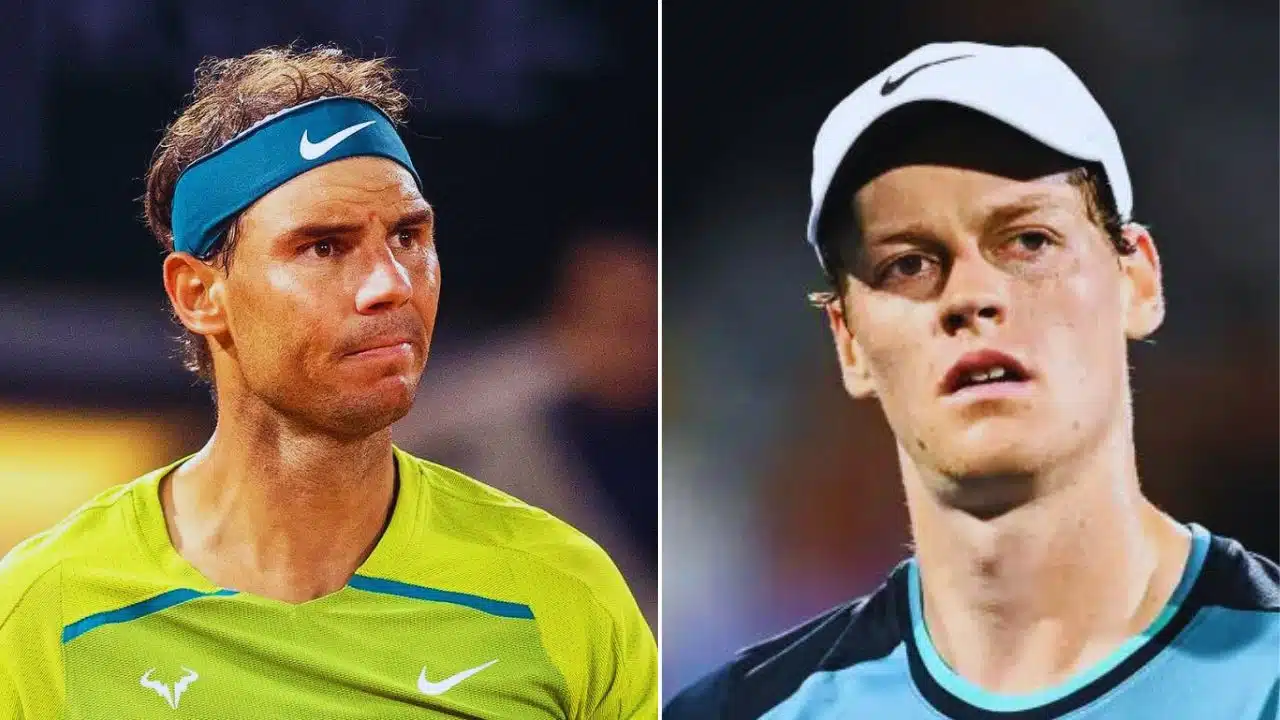
Rafael Nadal, one of tennis’s most respected figures, has come forward to defend Jannik Sinner, the current world number one, amid a growing controversy surrounding a recent doping case. The Italian tennis star tested positive for a banned substance earlier this year but avoided punishment, leading to widespread debate within the tennis community. Nadal, however, insists that Sinner would never have considered doping and emphasizes that the Italian was not given special treatment because of his top-ranking status.
The Incident: Sinner’s Positive Test for Clostebol
The controversy began in March when Jannik Sinner tested positive for clostebol, a synthetic anabolic steroid known for its muscle-building properties. Clostebol, while less potent than other anabolic steroids, is still on the World Anti-Doping Agency’s (WADA) list of banned substances due to its potential to enhance athletic performance. The positive test raised immediate concerns, given Sinner’s status as one of the sport’s rising stars.
However, the circumstances surrounding the positive test were anything but straightforward. According to the details that emerged during the investigation, the banned substance was inadvertently introduced into Sinner’s system by his physiotherapist. The physio had applied a spray containing clostebol to treat a cut on his own hand and then proceeded to carry out treatments on Sinner without realizing that the substance could be transferred. This led to a trace amount of clostebol being detected in Sinner’s body during routine anti-doping tests.
Tribunal Clears Sinner: The Role of Intent and Context
The case was reviewed by an independent tribunal, which plays a crucial role in adjudicating such matters within professional tennis. The tribunal concluded that Sinner did not intentionally ingest the substance, and the amount found in his system was extremely low—less than a billionth of a gram. This minuscule quantity further supported the argument that Sinner’s exposure to the steroid was accidental.
The tribunal’s decision to clear Sinner of any wrongdoing was based on several key factors, including the context of the positive test, the lack of intent, and the credibility of the explanation provided. The panel took into account that clostebol can be present in certain medical treatments, and it was plausible that the contamination was entirely unintentional. As a result, Sinner was allowed to continue competing without facing any sanctions, a decision that has since sparked significant debate.
Backlash from the Tennis Community: Accusations of Double Standards
The decision to clear Sinner did not sit well with everyone in the tennis world. As the Italian star arrived at the U.S. Open, the controversy followed him, with several players and commentators expressing their concerns over what they perceived as double standards in the anti-doping system. Critics argued that other athletes had faced provisional suspensions and more severe penalties for similar offenses, leading to questions about the consistency of anti-doping enforcement.
The controversy was further fueled by high-profile players who voiced their opinions on the matter. Novak Djokovic, another top player and frequent advocate for fairness in the sport, called for “clear protocols” and “standardized” approaches to doping cases. He suggested that the current system might lack the transparency needed to ensure all players are treated equally.
Australian tennis star Nick Kyrgios went even further, stating that Sinner should have been banned regardless of whether the doping was accidental or planned. Kyrgios’s comments reflect a broader concern among some players that the sport’s reputation could be tarnished if perceived leniency is allowed in such cases.
Nadal’s Defense: Trusting the Anti-Doping System
Amid the ongoing debate, Rafael Nadal took a firm stance in defense of Sinner and the integrity of the anti-doping system. Speaking on the Spanish television show El Hormiguero, Nadal expressed his belief in the good faith of people, particularly in the case of his fellow players. “I have a virtue or a deficit, which is that in the end, I usually believe in people’s good faith. I know Sinner, and I don’t believe that Sinner has ever wanted to dope,” Nadal said, highlighting his personal trust in Sinner’s character.
Nadal’s comments were not just about Sinner’s innocence but also about the importance of trusting the systems in place to uphold the sport’s integrity. “I don’t think we have to like it only when it is resolved in the way we think. In the end, justice is justice, and I believe in justice,” Nadal continued, emphasizing that the decisions made by the tribunal should be respected, even if they are unpopular with some.
The ITIA’s Role and Decision
The International Tennis Integrity Agency (ITIA), an independent body established in 2021 by the sport’s governing organizations, was responsible for handling Sinner’s case. The ITIA’s mandate is to ensure that tennis remains free from corruption and doping, and its decisions are critical in maintaining the sport’s integrity. After a thorough investigation, the ITIA concluded that there was no intentional wrongdoing on Sinner’s part, and he was therefore cleared to compete.
The ITIA’s ruling was based on the evidence presented, which included the low levels of clostebol found in Sinner’s system and the credible explanation provided by his team. Sinner himself maintained his innocence throughout the process, consistently stating that the presence of clostebol in his system was entirely accidental.
Reactions from Other Players: Calls for Consistency
The ITIA’s decision did not go unquestioned, particularly by players like Djokovic and Kyrgios. Djokovic’s call for “clear protocols” suggests that the current procedures might be perceived as inconsistent, leading to confusion and frustration among players who believe that the rules should be applied uniformly.
Kyrgios’s demand for a ban, regardless of intent, reflects a more hardline stance on doping, one that prioritizes the sport’s image over individual circumstances. His comments indicate a desire for stricter enforcement to ensure that any appearance of doping, whether intentional or not, is met with firm consequences.
Nadal’s Belief in Fair Treatment
Rafael Nadal remained confident that Sinner was not treated differently because of his status in the tennis world. “I’m totally confident that if he has not been sanctioned, it is because those who have judged this case have seen very clearly that there were no sanctions to be imposed,” Nadal stated, reaffirming his trust in the tribunal’s impartiality.
Nadal also acknowledged that opinions on the matter would vary, but he stood by his belief that the decision was fair and just. “I do not believe that because he is Sinner, he will not be sanctioned, and because he is someone else, he will be sanctioned. I really believe it, and I am convinced of it,” Nadal added, underscoring his faith in the system’s fairness.
Despite the controversy surrounding him, Jannik Sinner continued to focus on his game. The top-seeded Italian remained a strong contender in the U.S. Open, with his next match scheduled against American Tommy Paul in the tournament’s fourth round. Sinner’s ability to maintain his performance on the court amidst the ongoing debate speaks to his resilience and determination.
As the tournament progresses, all eyes will be on Sinner, not just for his performance but also for how the ongoing controversy might impact his career and the broader conversation around doping in tennis.
The Information is Collected from ESPN and Yahoo.