


The Publisher GEO Playbook starts with one uncomfortable truth: media sites cannot survive AI search by acting like it is still 2016. The old game was rankings, clicks, pageviews, social shares, newsletter growth, and maybe a heroic little Discover spike if Google was feeling generous. That game still matters, but it is no longer the full board.
AI search is changing how people discover information. Google says AI Overviews and AI Mode surface relevant links, use query fan-out across subtopics and data sources, and can show supporting web pages beyond classic search results. In May 2026, Google also said it was improving AI Search links to help users find relevant websites, deep insights, and original content from across the web. Lovely words. Also a giant warning sign for publishers still producing generic explainers like a content mill wearing press credentials.
For publishers, GEO is not about tricking AI into citing your articles. That is the fast road to spam, and Google has already clarified that its spam policies include attempts to manipulate generative AI responses in Search. GEO for media sites is about becoming source-worthy: original, structured, trusted, fast, specific, and useful enough that AI systems can cite you without looking foolish.
Why The Publisher GEO Playbook Matters Now
AI search is no longer a side experiment. Reuters reported from Google I/O 2026 that AI Overviews had about 2.5 billion monthly users, while AI Mode had about 1 billion monthly users, according to Sundar Pichai. That means publisher visibility is no longer only about the ten blue links, featured snippets, and news carousels. It is also about whether your reporting becomes part of the AI-generated answer layer.
That shift is brutal for lazy publishing. A rewritten commodity article has very little citation value. AI systems do not need the 47th version of the same press release with a different headline. They need reliable source material: original reporting, named sources, clear context, data, timelines, expert explanation, and enough structure to extract meaning quickly.
The original GEO research paper found that techniques such as adding citations, quotations from relevant sources, and statistics could improve source visibility in generative engines by up to 40% across diverse queries. That does not mean stuffing random numbers into every paragraph like confetti at a desperate SEO party. It means evidence-backed content is easier to cite than vague content with confidence issues.
What GEO Means For Media Sites
Generative Engine Optimization, or GEO, means optimizing content so AI answer engines can understand, trust, cite, and recommend it. For publishers, that goal is more specific: make every important story, explainer, analysis, review, and evergreen page usable as a reliable source.
The difference between SEO and GEO is not a replacement. It is an expansion.
| Area | Traditional Publisher SEO | Publisher GEO |
|---|---|---|
| Main goal | Rank and earn clicks | Get cited, mentioned, and trusted in AI answers |
| Core unit | Page or article | Extractable evidence, passages, entities, and source reputation |
| Content value | Relevance and ranking strength | Relevance, trust, originality, and citation-worthiness |
| Key risk | Ranking loss | Being summarized without being cited or ignored completely |
| Best asset | Optimized article | Original reporting plus clear source structure |
| Measurement | Rankings, traffic, CTR | AI citations, source mentions, referral patterns, branded demand |
The publisher that wins in GEO is not always the one that publishes the most. It is the one that produces the clearest, most trustworthy source material in its category. Terrible news for websites whose strategy is “rewrite what everyone else wrote, but faster.”
How Media Sites Get Cited In AI Answers
AI search systems do not cite pages because the publisher believes the article is important. They cite pages because the content helps answer the query. That means the page must be retrievable, understandable, credible, and useful in context.
Google says there are no special technical requirements to appear in AI Overviews or AI Mode beyond being indexed and eligible for Google Search with a snippet. It also says the best practices for SEO remain relevant. Translation: technical SEO still matters, but “indexed” is only the entry ticket. Being worth citing is the actual competition.
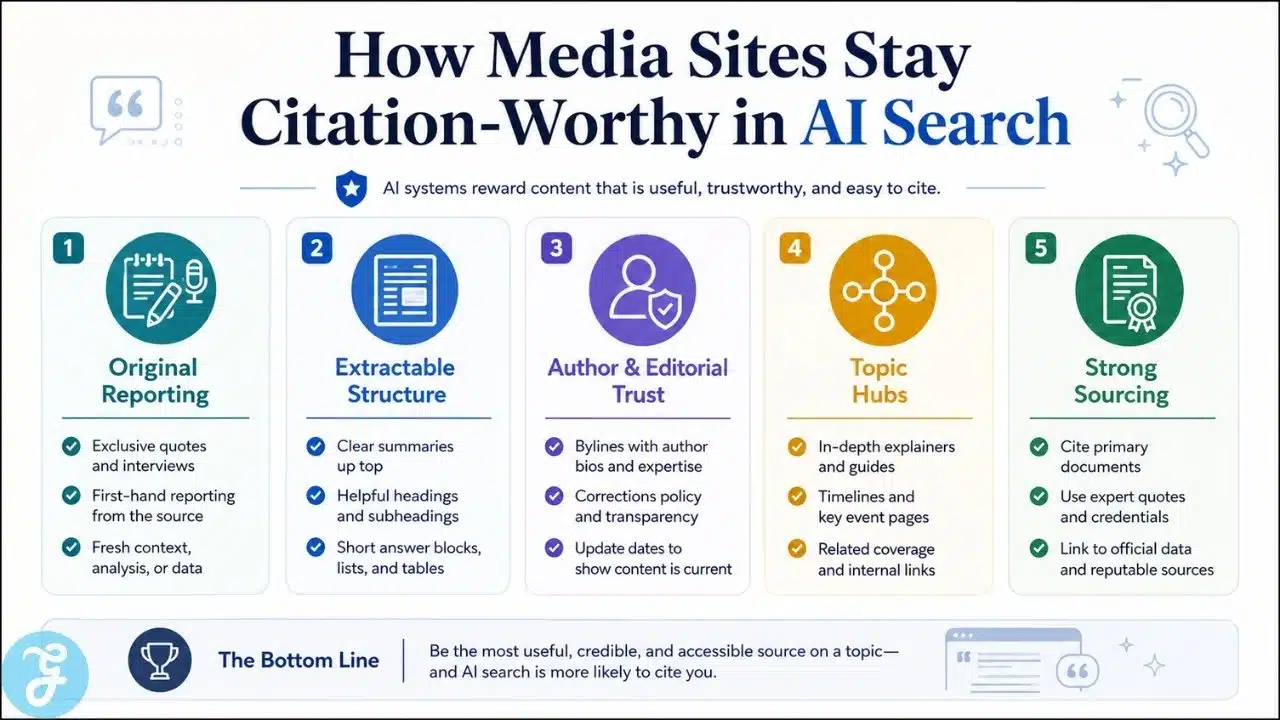
For publishers, citation-worthy pages usually have:
- A clear answer or news angle near the top.
- Named entities and context that AI systems can understand.
- Original reporting, exclusive data, quotes, or expert analysis.
- Transparent authorship and editorial credibility.
- Clean headings and extractable sections.
- Updated timestamps where freshness matters.
- Proper sourcing and outbound references.
- Strong internal links to related background coverage.
- Fast, crawlable, non-chaotic page experience.
The goal is not to write for robots. The goal is to make good journalism and useful publishing easier for robots to understand without ruining it for humans. Apparently, that is now the job. Congratulations, everyone.
The Publisher GEO Playbook For Staying Cited
This is the practical part. Media sites need a system, not a prayer. GEO should sit inside editorial strategy, SEO, product, newsroom operations, and audience development.
1. Build Source-Worthy Original Reporting
If your article only repeats what other outlets already said, it has weak citation gravity. AI systems can summarize the original source, the official announcement, or a stronger analysis instead.
Publishers should prioritize content that adds something real:
- Original interviews.
- First-hand reporting.
- Expert comments.
- Local details.
- Timelines.
- Documents.
- Data points.
- Screenshots.
- Case examples.
- Comparison context.
- Reporter analysis.
This matters even more because Google’s AI Search updates emphasize authentic voices, useful information, relevant websites, deep insights, and original content. Publishers should take that wording seriously instead of pretending “original content” means changing five sentences from a wire story.
2. Make Every Article Extractable
AI systems need clean passages. Readers do too, by the way, but apparently we needed machines to remind us.
A citation-friendly article should have a clean structure:
- One clear summary at the top.
- Short paragraphs.
- Specific H2 and H3 headings.
- Definitions where needed.
- Lists for steps or takeaways.
- Timelines for ongoing stories.
- Comparison blocks for analysis.
- Data boxes for key numbers.
- FAQs only when they genuinely answer reader questions.
Do not bury the useful answer under eight paragraphs of setup. This is journalism, not a Netflix mystery.
3. Strengthen Author And Editorial Signals
For media sites, authorship matters. If the article is about health, law, finance, climate, AI, politics, or public safety, the author and editorial process should be visible. A faceless “Staff Writer” byline on sensitive analysis is not exactly screaming trust.
Publisher pages should show:
- Author name.
- Author expertise or beat.
- Bio page.
- Recent related articles.
- Editorial standards.
- Corrections policy.
- Fact-checking process where relevant.
- Update history for changing stories.
This is not cosmetic. It helps readers understand why the article deserves trust, and it helps search systems connect entities, expertise, and topical authority.
4. Create Topic Hubs, Not Lonely Articles
A single article can rank. A topic hub can build authority.
Media sites should create strong internal coverage clusters around major beats: AI, climate, health, finance, entertainment, sports, policy, consumer tech, sustainability, or whatever the publication actually covers well. A topic hub gives AI systems and readers a clearer picture of what the site knows.
A good hub includes:
| Hub Element | Why It Helps GEO |
|---|---|
| Main explainer | Gives stable background context |
| News updates | Keeps the topic fresh |
| Timeline | Helps AI and readers follow developments |
| Expert analysis | Adds interpretation, not just facts |
| Data/resource page | Creates citation-worthy reference material |
| Related internal links | Builds topical relationships |
| Author/beat visibility | Shows consistent editorial expertise |
This is how publishers move from “we wrote about this once” to “we are a source on this topic.”
5. Publish Citation Assets, Not Just Articles
A standard article is not always the best citation asset. Sometimes AI systems and readers need a clean reference page.
Publishers should create more:
- Explainers.
- Timelines.
- Glossaries.
- Data trackers.
- Fact sheets.
- Resource pages.
- Comparison guides.
- “What we know so far” pages.
- Live update summaries.
- Expert Q&A pages.
These assets are easier to cite because they are built to answer recurring questions. The article reports the moment. The citation asset owns the context.
6. Use Better Sourcing Without Becoming A Link Dump
Source quality matters. GEO rewards verifiable claims, but that does not mean every sentence needs three links and a nervous footnote.
Media sites should use citations carefully:
- Link to official reports, court filings, government data, academic papers, company statements, and primary documents.
- Name experts clearly.
- Explain why a source matters.
- Avoid vague “reports say” language when specificity is possible.
- Add dates to time-sensitive claims.
- Update outdated references.
The original GEO paper found citations, quotations, and statistics can boost visibility, but the point is trust, not decoration. Weak sourcing with lots of links is still weak sourcing. It just has accessories.
What Media Sites Must Stop Doing
Some habits are now more dangerous than they look.
Publishers should stop:
- Rewriting commodity stories with no original angle.
- Publishing thin AI summaries with no reporting.
- Using anonymous bylines on expert-heavy topics.
- Creating vague evergreen content with no update plan.
- Hiding dates on time-sensitive content.
- Stuffing unrelated internal links.
- Publishing unverified claims to be first.
- Treating schema as a substitute for quality.
- Letting ads destroy readability.
- Creating AI-bait pages that no human would finish reading.
Google’s AI feature guidance says AI Overviews and AI Mode may use multiple related searches across subtopics and data sources to generate responses. That means weak pages are not only competing with one result. They are competing with a wider source universe. If your article adds nothing, AI can simply go elsewhere.
The Technical GEO Checklist For Publishers
Technical basics still matter. A brilliant story that cannot be crawled, rendered, indexed, or understood is basically journalism trapped in a basement.
Here is the practical checklist:
| Technical Area | What Publishers Should Do |
|---|---|
| Indexability | Make sure important pages can be indexed and shown with snippets |
| Structured data | Use relevant Article, NewsArticle, Author, Organization, FAQ, and Breadcrumb markup where appropriate |
| Internal linking | Connect articles to hubs, author pages, explainers, and related coverage |
| Page speed | Keep templates fast, especially on mobile |
| Paywall handling | Use proper structured data for paywalled content |
| Canonicals | Avoid duplicate confusion across syndicated or republished content |
| Sitemaps | Keep news and XML sitemaps clean and updated |
| Freshness signals | Show clear publish and update dates |
| Ads and UX | Avoid layouts that bury the main content |
| Crawl access | Do not block critical content behind scripts or messy rendering |
Google says pages must be indexed and eligible to show a snippet to appear as supporting links in AI Overviews or AI Mode. That is the floor. Not the ceiling.
How Newsrooms Should Change Their Workflow
A publisher GEO strategy cannot live in a forgotten SEO spreadsheet. It has to become part of editorial workflow.
Before publishing, editors should ask:
- What original value does this piece add?
- What query or user need does it answer?
- Is the main answer clear near the top?
- Are names, dates, places, and entities clearly stated?
- Are sources named and linked where useful?
- Does this connect to an existing topic hub?
- Does the headline match the actual article?
- Is the byline credible for the topic?
- Is this worth citing six months from now?
- Should this become a timeline, explainer, or evergreen page?
That last question is important. Not every story should disappear into the archive after 48 hours. Some stories deserve to become durable reference assets.
How To Measure Publisher GEO Performance
GEO measurement is messy. Anyone selling perfect AI citation attribution should be approached with the same caution as a man selling “guaranteed Google rankings” from a Gmail address.
Still, publishers can track useful signals:
| Metric | Why It Matters |
|---|---|
| AI citations | Shows whether pages appear as cited sources in AI answers |
| Brand/source mentions | Tracks whether the publication is named in answers |
| Referral traffic from AI platforms | Shows direct traffic where available |
| AI Overview/AI Mode visibility | Helps monitor Google AI Search exposure |
| Query-level citation tracking | Reveals which questions trigger your source |
| Branded search growth | Shows rising recognition |
| Evergreen traffic stability | Shows whether reference assets keep earning demand |
| Topic hub performance | Measures authority beyond single articles |
| Newsletter/subscription assists | Captures value beyond raw clicks |
Google’s own AI Overviews help page describes AI Overviews as snapshots with links to dig deeper, which means the publisher’s goal is not only appearing but becoming the link users choose when they want depth.
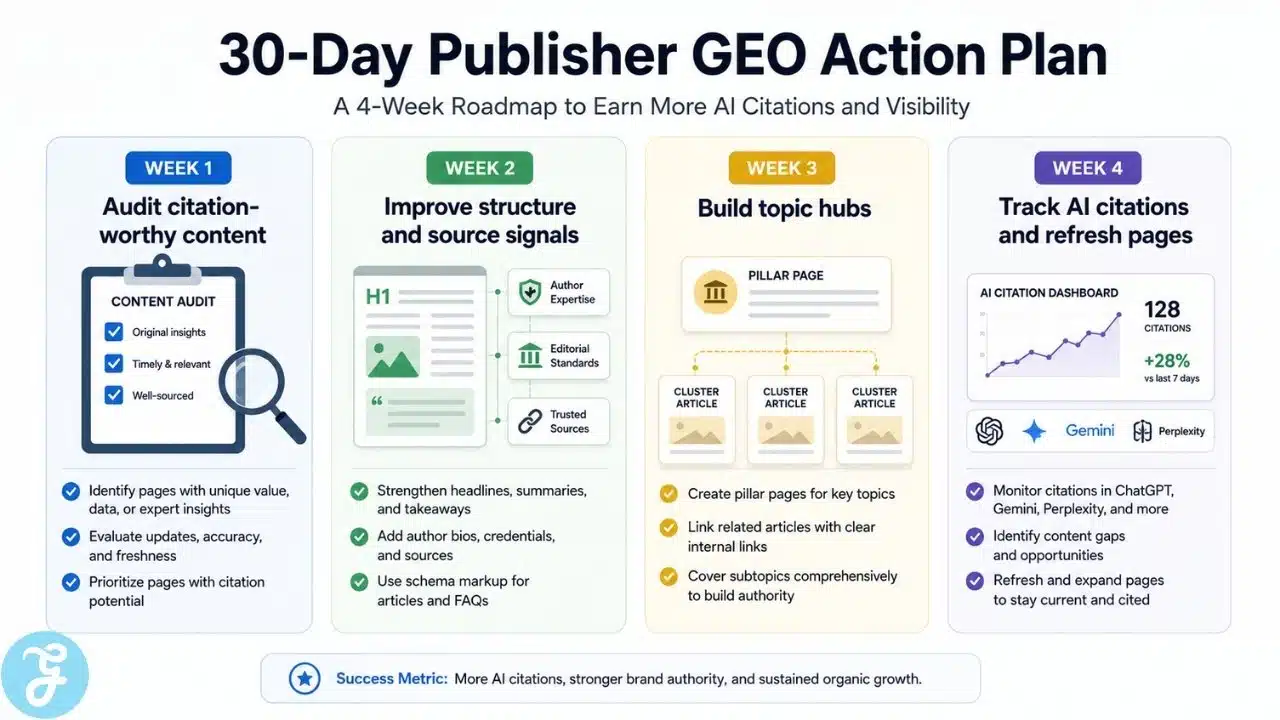
The 30-Day Publisher GEO Action Plan
Media sites do not need to rebuild the entire newsroom in one month. Start with the assets that matter most.
Week 1: Audit Citation-Worthy Content
Find your strongest existing explainers, evergreen pages, investigative pieces, guides, timelines, and high-authority beat coverage. Identify which pages already have strong expertise and which ones are just ranking because the internet has low standards.
Week 2: Fix Structure And Source Signals
Update headings, add summaries, improve sourcing, add dates, clarify authorship, link to topic hubs, and make the page easier to extract. This is not glamorous work. It is also exactly the kind of work that improves content survival.
Week 3: Build Topic Hubs
Choose three to five priority topics and connect your best coverage. Add a main explainer, timeline, key resources, latest news, and analysis. Make it obvious that your site owns the topic.
Week 4: Track AI Citations And Refresh Pages
Test key prompts across Google AI Search experiences, Perplexity, ChatGPT search, and other relevant answer engines. Track where your site appears, where competitors appear, and what type of content gets cited. Then refresh the pages that almost deserve citation but are not quite there.
The Final Playbook For Staying Cited
The Publisher GEO Playbook is not about gaming AI answers. It is about making media content too useful, clear, original, and trusted to ignore.
Publishers that stay cited will not be the ones publishing the most recycled articles. They will be the ones with original reporting, strong topic hubs, visible expertise, clean structure, reliable sourcing, updated reference pages, and enough editorial discipline to stop publishing content that adds nothing.
The AI search era is not kind to filler. It is not kind to vague rewrites. It is not kind to sites that confuse volume with authority.
But it can reward publishers that do the hard work: report better, explain better, structure better, source better, and build trust where machines and humans can both see it.
In short: stop writing articles that merely exist. Build sources worth citing.






















