

The 3D printing industry is continually gaining popularity across different industries. It’s true that PETG is one of the most popular 3D printing materials alongside ABS and PLA.
Its features make it a desirable 3D printing material. The best part about digital printing with PETG is that it isn’t as difficult as you’d imagine. Before you learn how to print successfully with PETG, we’ve prepared some vital basic information.
You are going to understand the following by reading this article wholly:
- What exactly is PETG?
- What are the benefits and downsides of printing with PETG?
- Where can you print 3D models using PETG?
- Top tips for using PETG 3D printing material
Let’s get started!
What Exactly is PETG?
PETG (Polyethylene Terephthalate Glycol) is a PET-based thermoplastic filament – it is a modified version of PET with glycol hence PETG. PETG is one of the most popular 3D printing materials. In fact, it can be used as an alternative for either PLA or even ABS 3D printing thermoplastics. FDM 3D printers primarily use this 3D thermoplastic filament to print high-resolution 3D models.
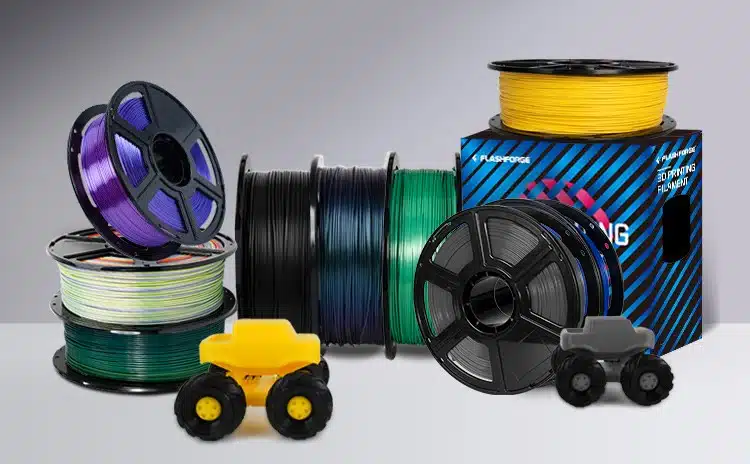
The printed 3D models have smooth and shiny surfaces. It is essential to note that PETG is a tough and durable thermoplastic filament with remarkably low shrinkage rates. It has many uses, as you’ll see later in this article.
The best part about printing with PETG is that it does not produce strong odors – it is almost odorless. However, the absence of strong fumes does not mean inhaling the fumes produced during printing is safe.
PETG produces small particles, which are certainly not good for your health. It would be best if you’d print using PETG in an environment with proper ventilation.
PETG Thermoplastic Filament Specifications
|
Thermoplastic Features |
Specifications |
|
Cost |
Inexpensive |
|
Strength |
Excellent strength and mechanical abilities |
|
Flexibility |
Decent flexibility compared to ABS and PLA |
|
Dimensional accuracy |
Excellent dimensional accuracy (± 0.03mm probability) |
|
Color options |
Wide range of colors, including a transparent option |
|
Outdoor performance |
Excellent outdoor performance with high strength and resistance |
|
Thermoplastic Resistance |
Specifications |
|
Heat resistance |
Excellent heat resistance, including UV radiation |
|
Water resistance |
Decent water resistance |
|
Chemical resistance |
Superior performance on chemical resistance in comparison to other thermoplastic filaments |
|
Impact resistance |
Excellent impact resistance |
|
Fire |
Excellent performance on flame retardation |
|
Thermoplastic Printing |
Specifications |
|
Heat bed temperature |
75 °C – 90 °C |
|
Nozzle (extruder) temperature |
230 °C – 250 °C |
|
Build Surface |
Painter’s tape, glue stick |
|
Cooling fan |
Required (at 20% – 50%) |
|
Enclosure |
Not necessary |
What are the Benefits and Downsides of Printing with PETG?
Pros
Printing with PETG thermoplastic filament has six core benefits. Check them out:
- High strength, heat, water, chemical & impact resistance – PETG has exceptional mechanical strength, making it ideal for printing 3D models across various industries.
In addition, it has excellent resistance to heat and chemicals. The thermoplastic filament has a decent resistance to water.
- Cost-effective – While PETG is more expensive than PLA and ABS, it is still cost-effective. It offers high-quality 3D models at an affordable cost.
- Almost odorless when printing – similar to PLA, printing with PETG does not produce strong odors. However, avoiding inhaling the fumes produced when printing would be best.
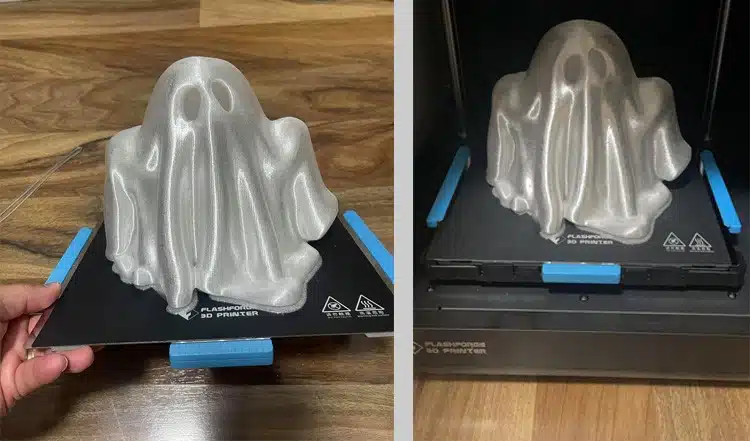
- Smooth and shiny finish – Printing with PETG produces strong models with smooth and shiny surfaces. In other words, the finish is beautifully aesthetic.
- Availability of multiple colors – PETG thermoplastic filament has many colors to choose from. These colors also include a transparent option. Multiple color choices are beneficial because they enable you to color-code your 3D models.
- Food safe and industrially recyclable – PETG has a chemically neutral reaction toward food material. You can, therefore, print custom plastic plates, water bottles, etc., using this thermoplastic.
It is additionally industrially recyclable, meaning you’ll have to get rid of it in an environmentally responsible way after use.
Cons
While printing with PETG has many benefits, it has three main downsides. Check them out:
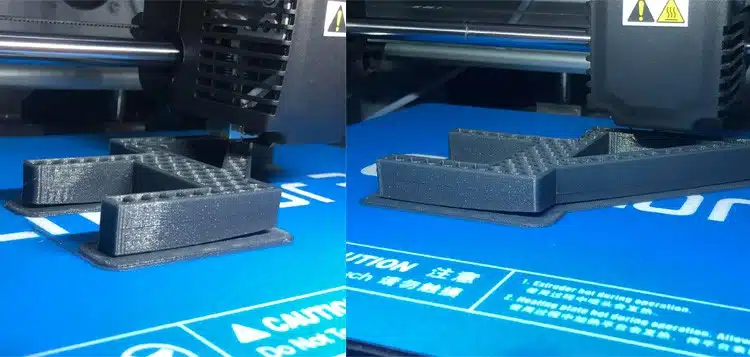
- PETG is prone to oozing and stringing – PETG has poor bridging characteristics making it prone to oozing and stringing. You’ll need to experiment with bridging and retraction settings
In addition, the process consumes more time – post-processing is necessary to eliminate all the blemishes on the 3D model’s surface.
- PETG has a negative environmental impact when disposed of in an environmentally irresponsible way. Since PETG is primarily composed of plastic material, it will take years to decompose, especially if exposed to marine life.
Luckily enough, PETG is industrially recyclable. Consider getting rid of it after use in an environmentally responsible way
- PETG can become brittle if it is not printed well – especially if you fail to pay extra attention to the heat bed and extruder’s temperature. In addition, PETG also gets brittle after absorbing a significant amount of moisture.
In summary:
|
Pros |
Cons |
|
High strength with exceptional heat, chemicals, water, and impact resistance. |
Prone to oozing and stringing. |
|
Cost-effective. |
Negative environmental impact if disposed of improperly. |
|
Almost odorless when printing. |
The filament can become brittle due to improper printing and significant absorption of moisture. |
|
Smooth and shiny finish |
|
|
Wide range of colors to select from (including a transparent option) |
|
|
Food-safe and industrially recyclable |
|
Which Industries benefit most from PETG 3D Printing
PETG 3D printed models serve a wide range of industries. Check them out:
- Engineering for rapid prototyping – you can develop functional prototypes by printing with PETG, e.g., electronics parts. The best part about using PETG is its excellent dimensional accuracy, which matters greatly when printing functional prototypes.
In addition, its heat, chemical, water, and impact resistance are also essential to the engineering industry.
- Food industry – since PETG has a chemically neutral reaction toward food materials, you can use it to print custom plastic plates or even water bottles.
- Medical industry – PETG is popularly used in the medical industry to print high-quality, smooth and shiny dental braces.
- Used to print packaging for consumer products, e.g., liquid soap bottles, cosmetics, snap fits, battery lids, etc.
How Can You Make 3D Printing with PETG Successful?
Check out these six best practices to employ for a successful printing process when printing with PETG:
- Watch your printing temperature – As you’ve read earlier in this article, using the wrong temperature will make your PETG 3D model brittle. You should ensure that your printer’s heat bed and nozzle’s (extruder) temperature is within the recommended range.
- In addition to watching your printing temperature, it would be best to watch your cooling fan speed. Too much cooling fan speed will make your PETG model crack. The ideal cooling fan speed should be between 20% – 50%.
- Invest in a good build surface, as PETG requires excellent bed adhesion. Consider using a glue stick or hair spray to enhance adhesion which will help prevent the printed model from curling off the build surface.
- Keep refraction speeds below 40mm/s, as it’ll help reduce stringing. Strings are thin plastic hairs that run across your 3D model and need to be removed post-processing.
- It would be best to store your PETG thermoplastic filament in a dry environment because it is hygroscopic. PETG filament will become brittle after absorbing a significant amount of environmental moisture.
- Use a support material to print 3D models with complex geometries. PETG works remarkably well with PVA filament – a soft, biodegradable support material.
Final Thoughts
Printing with PETG is highly beneficial to a wide range of industries. This thermoplastic filament is strong, versatile, and resistant to heat, chemicals, water, and impact. As the 3D printing industry continues to gain popularity, PETG has a bright future.
Consider using the six best practices outlined in this article to make your 3D printing with PETG process a success.





















