Teachers do not have a shortage of professional-development content. They have a shortage of time, relevant support and opportunities to turn training into better classroom practice.
That is where online teacher professional development can be genuinely useful.
A school no longer has to put every teacher in the same room for a full afternoon simply to introduce a new instructional approach. Background material can be completed independently. Demonstrations can be recorded. A subject specialist can work remotely with teachers across several schools. Follow-up discussions can happen a week after teachers have actually tried the technique.
But moving professional development online does not automatically improve it.
A two-hour webinar can be just as forgettable as a two-hour lecture in a conference room. A large course library may look impressive during procurement and still have little effect on teaching. And a self-paced programme is not particularly flexible if staff have to complete it at home because no working time has been set aside.
The more meaningful shift is not from face-to-face CPD to online CPD. It is from professional development as an occasional event toward professional learning that can continue between meetings, lessons and coaching sessions.
Online CPD Is Growing, but Face-to-Face Learning Is Not Disappearing
The latest OECD Teaching and Learning International Survey, TALIS 2024, shows that professional learning remains widespread. Across participating education systems, between 87% and 100% of lower-secondary teachers had taken part in at least one professional-learning activity during the previous year.
Courses, workshops and seminars were still the most common format.
Digital participation was more prominent in certain types of learning. Among teachers who undertook self-initiated professional learning, 36% participated virtually or online. The figure was 33% for teacher networks and formal qualification programmes, and 30% for education conferences.
That is enough to show that online professional learning is no longer a niche format. It does not show that schools are abandoning in-person development.
In practice, the more useful model is often mixed.
A teacher can watch a 20-minute demonstration before a department meeting rather than spending part of that meeting watching it with everyone else. The group can then use their limited time together to analyse the approach, plan how to adapt it and discuss where it may fail with their students.
Likewise, a remote coaching conversation may make sense when the specialist is based two hours away. A difficult behaviour-management rehearsal with a new teaching team may be better handled in person.
The delivery method should be chosen around the work teachers need to do, not around a preference for digital or physical training.
Flexible Access Does Not Solve the Workload Problem
Convenience is one of the strongest arguments for online CPD, particularly for teachers who work in remote locations, have caring responsibilities or cannot easily travel to central training sessions.
But convenience can be overstated.
TALIS 2024 found that 63% of teachers across OECD education systems identified lack of time because of other responsibilities as a barrier to professional learning. Almost 60% reported conflicts with their work schedule, while 46% cited cost.
Distance also remains a more significant obstacle for rural teachers in many participating systems.
Online delivery can remove the journey. It cannot create another two hours in the week.
That distinction matters for school leaders. If an in-person training afternoon is replaced by six online modules that staff are expected to complete after school, the programme has become easier for the organisation to schedule, not necessarily easier for teachers to complete.
Protected time is therefore more important than the promise that a course is “available anytime.”
For most schools, the better arrangement is to use asynchronous material for information teachers can reasonably review independently, then preserve scheduled professional-learning time for the harder work: planning, practice, discussion and feedback.
Good Professional Development Still Needs More Than Content
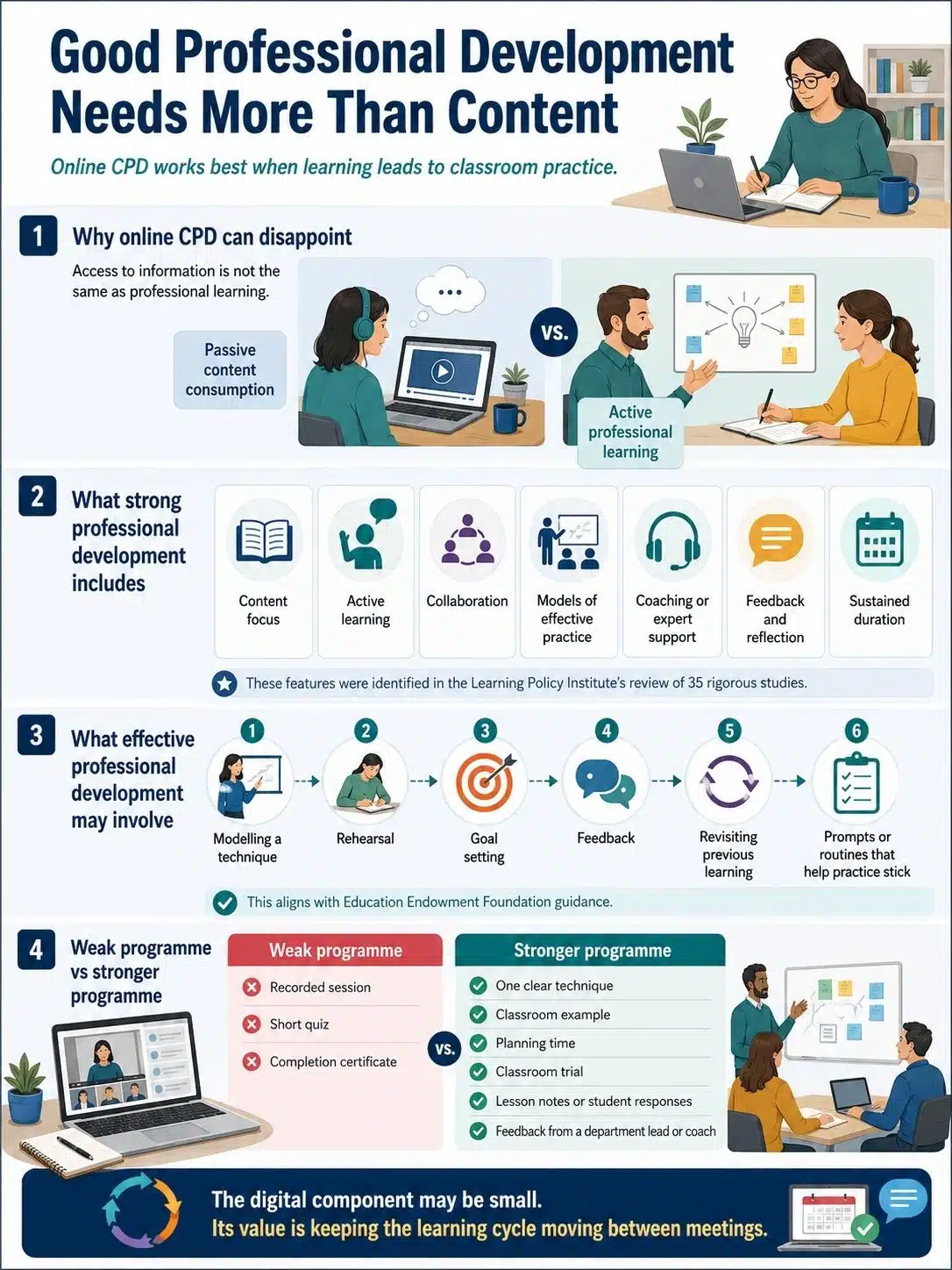
One reason online CPD can disappoint is that it is easy to confuse access to information with professional learning.
The Learning Policy Institute’s review of 35 rigorous studies of teacher professional development found recurring characteristics among programmes associated with improvements in teaching practice and student outcomes. These included a strong content focus, active learning, collaboration, examples of effective practice, coaching or expert support, feedback and reflection, and enough duration for teachers to work with what they were learning.
The Education Endowment Foundation’s guidance points in a similar direction. Effective professional development may involve modelling a technique, rehearsing it, setting goals, receiving feedback, revisiting previous learning and creating prompts or routines that help a new practice stick.
None of those things requires a particular platform.
That is the weakness in the “Netflix for teacher training” model sometimes used to sell professional-development libraries. Hundreds of videos create choice, but choice is not the same as instructional improvement.
Imagine that a school wants teachers to improve classroom questioning.
A weak programme might assign a recorded session, a short quiz and a completion certificate.
A more useful programme could introduce one questioning technique, show what it looks like in a classroom, give teachers time to plan where they will use it and then ask them to try it during the following week. At the next meeting, teachers could bring lesson notes or anonymised examples of student responses. A department lead or coach could then help them refine the next attempt.
The digital component may be quite small. Its value comes from keeping the learning cycle moving between meetings.
Course Libraries Are Often Overrated. Coaching Is Usually Harder to Replace.
For a school buying professional-development technology, course volume is easy to compare. Coaching quality is much harder.
That can distort purchasing decisions.
A platform offering 2,000 modules sounds more substantial than one built around a smaller number of structured programmes with coaching and follow-up. Yet most teachers do not need thousands of possible things to study. They need help working on the next instructional problem that actually matters.
Coaching deserves particular attention.
A major meta-analysis published in 2018 examined 60 causal studies of teacher coaching and found positive average effects on instructional practice, with smaller positive effects on student achievement. It also found that coaching effects tended to weaken as programmes became larger, which is an important warning for districts trying to scale support.
This evidence is about coaching broadly, not specifically online coaching. A video call does not become effective simply because it is labelled coaching.
Remote delivery can nevertheless solve a real access problem. A rural school may not be able to employ a specialist literacy, mathematics or special-education coach locally. A district may have one experienced instructional specialist serving several sites. Remote sessions can make regular contact more practical.
The quality questions remain the same: Does the coach understand the subject and context? Is there continuity? Is feedback specific? Does the teacher have time to apply it?
If classroom video is part of the process, another set of questions appears. Schools need clear rules covering consent, access, retention, storage and student privacy. Those requirements vary by jurisdiction, so they should be settled before teachers begin uploading recordings—not after the first privacy concern appears.
The Platform Has to Work on an Ordinary School Day
Online professional development is often designed as though every teacher has reliable broadband, a recent laptop, headphones, a quiet room and permission to install whatever software the programme requires.
That assumption does not travel well.
The World Bank’s Technology for Teaching work has examined teacher professional development using high-tech and low-tech approaches, including synchronous and asynchronous formats designed for settings with limited infrastructure.
For some schools, that may mean high-quality video meetings and a full learning-management system. Elsewhere, downloadable resources, mobile-friendly pages, recorded audio, messaging tools and low-bandwidth video may be far more realistic.
Even in relatively well-connected schools, small technical problems matter. A platform that performs poorly on older Chromebooks, requires repeated logins, handles captions badly or cannot save progress reliably can turn a reasonable 30-minute module into an irritating hour.
These are not minor UX details when hundreds of teachers are expected to use the system repeatedly.
Before signing a contract, schools should test the programme on the devices and networks teachers actually use rather than relying solely on a vendor demonstration running on ideal equipment.
Online Networks Are Most Useful When They Have a Job to Do
Professional learning can also become less constrained by school boundaries.
A physics teacher in a small secondary school may have no same-subject colleague in the building. An online network can connect that teacher with others planning similar courses. The same is true for specialist roles such as multilingual education, special education or instructional coaching.
But creating a digital community is easy. Maintaining a useful one is not.
A forum with the instruction “share ideas and resources” often produces an initial burst of activity followed by silence.
A group built around actual work has a better chance.
Teachers might compare how students handled a particular assessment task, study misconceptions in the same mathematics topic, review several approaches to teaching a difficult text or return three weeks later to discuss whether an agreed classroom change helped.
The platform gives teachers a place to meet. A clear professional purpose gives them a reason to return.
AI Training Needs to Go Beyond Prompt Tutorials
Artificial intelligence has created a particularly obvious need for continuing professional learning because the tools and the policy questions around them are changing quickly.
TALIS 2024 found that 38% of teachers across OECD education systems had participated in professional learning about using AI for teaching and learning. At the same time, 29% reported a high need for further professional learning in this area—the highest average level of reported need among the topics covered.
Schools should be cautious about responding with a one-off “How to use AI” webinar.
Teachers may need to understand what an AI tool can do, but they also need to make decisions about reliability, bias, student data, assessment, academic integrity and when human judgment should override an automated output.
UNESCO’s 2024 AI Competency Framework for Teachers reflects that broader requirement. It identifies 15 competencies across five areas: a human-centred mindset, ethics of AI, AI foundations and applications, AI pedagogy, and AI for professional learning. The framework also describes progression through Acquire, Deepen and Create levels.
That is a better way to think about AI-related CPD than training teachers on a particular product menu.
Individual applications will change. The professional questions will remain.
What School Leaders Should Check Before Paying for a Platform
The procurement conversation should begin with the instructional problem, not the feature list.
Before buying an online CPD system, school and district leaders should ask:
- What specific teaching practices or staff needs is this programme supposed to improve?
- Will teachers do anything with the content besides watch, read and take quizzes?
- Can they see credible examples of the practice being taught?
- Is there structured follow-up after teachers try something in class?
- Who provides feedback, and what expertise do those people have?
- Does the programme work on existing school devices and normal network conditions?
- Are captions, transcripts and downloadable materials available where appropriate?
- How are classroom video, student work and other sensitive material handled?
- Will teachers receive scheduled time to participate?
- What will the school measure besides logins and certificates?
The last question is especially important.
Online platforms make completion data very easy to produce. Administrators can see who logged in, what teachers opened and whether a module was marked complete. Those numbers are useful for administration. They say very little about whether classroom practice changed.
Completion Rates Are Not the Same as Impact
TALIS 2024 offers a useful reality check. Although participation in professional learning was very high, only 55% of teachers across OECD systems said the activities they had completed during the previous year had affected their teaching “quite a bit” or “a lot.”
That figure should not be directly compared with the 82% reported in TALIS 2018 because the OECD changed the question and response scale.
For schools, the broader lesson is more useful than either percentage: attendance alone is a weak outcome.
What should be measured instead depends on the programme.
A training series on lesson planning might look for changes in planning documents. Coaching on classroom discussion could use observation notes and teacher reflection. A programme focused on assessment might examine the quality of tasks or how teachers respond to student work.
Student outcomes can matter, particularly for larger and longer interventions, but demanding an immediate test-score increase from every short piece of professional learning creates another kind of bad measurement.
Evidence should match the practice the programme is trying to change.
A Better Way to Organise Online CPD
Schools do not need to digitise every part of professional development.
A more sensible sequence is often:
Use online material to introduce knowledge or demonstrate a technique. Give teachers protected time to plan how they will use it. Let them try it with students. Then bring people together—online or face-to-face—for feedback, problem-solving and the next round of practice.
That pattern also helps schools decide which technology is worth paying for.
If the platform makes it easier to distribute useful material, connect teachers with specialists, preserve examples, organise feedback or continue a professional conversation between meetings, it is doing useful work.
If it mainly provides another place for teachers to watch videos and accumulate certificates, its value is much harder to defend.
Final Thoughts
Online teacher professional development is becoming an established part of CPD, but the stronger direction is blended rather than fully remote.
Schools can use digital formats to reduce travel, reach specialist expertise, connect teachers across locations and keep professional learning active between scheduled sessions. None of that removes the need for protected time, strong subject knowledge, practice, feedback and professional conversation.
For school leaders, the practical next step is not to ask how much CPD can be moved online. Start with one important teaching problem and decide what teachers need to learn, practise and discuss in order to improve it. Then choose the mix of online, coaching and face-to-face support that makes that process workable.
Technology earns its place when it helps professional learning continue after the course window closes.