On-page SEO is where a page proves whether it deserves attention. A site can have a clean technical setup, a solid sitemap, decent backlinks, and a good publishing schedule. But if the page itself is weak, unclear, badly structured, or mismatched with search intent, the rest of the SEO work has to fight harder than it should. That is why on-page SEO elements still matter in 2026.
Search has changed. Users now see AI Overviews, featured snippets, video results, image packs, forum discussions, shopping panels, and traditional blue links. But every search experience still depends on content that can be found, understood, trusted, and used.
On-page SEO is not about sprinkling keywords into random places. That version of SEO is tired and easy to spot. Modern on-page optimization is about making the page clear for readers and search systems at the same time.
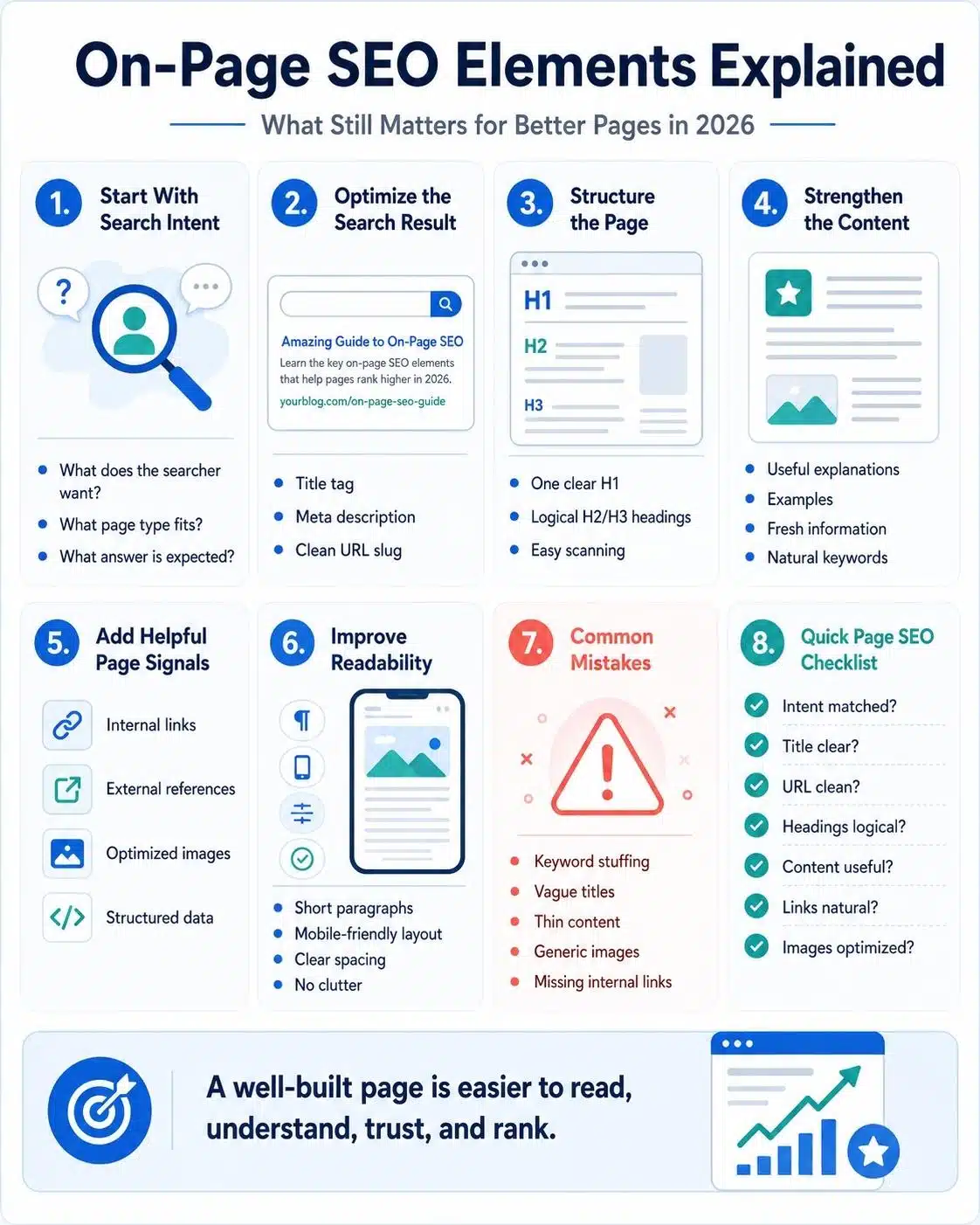
A strong page should answer a real query, use a clear title, support the title with a useful meta description, structure the content with logical headings, explain the topic properly, use internal links naturally, optimize images, and make the page easy to read on mobile.
That sounds basic because it is. The problem is that many pages still get the basics wrong.
What Are On-Page SEO Elements?
On-page SEO elements are the parts of a web page that can be optimized directly on the page itself.
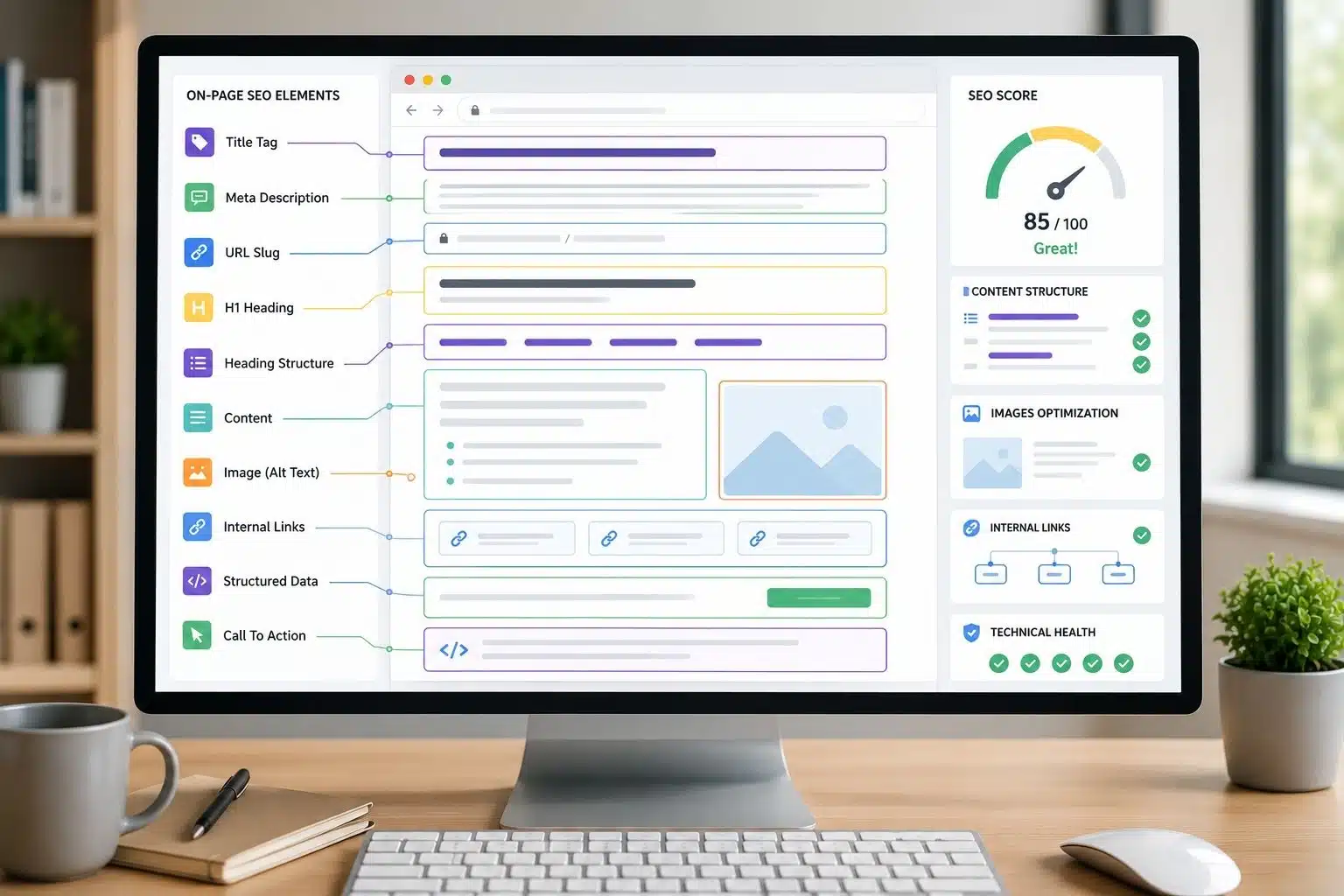
These include:
- Title tag
- Meta description
- URL slug
- H1 heading
- H2 and H3 heading structure
- Introduction
- Main content
- Keyword usage
- Search intent alignment
- Internal links
- External links
- Image file names
- Alt text
- Structured data
- Readability
- Content freshness
- Mobile experience
- Page layout
- Calls to action where relevant
Some of these are visible to readers. Others sit in the page code or metadata. But they all help shape how the page is understood. A useful way to think about on-page SEO is simple: The page should make sense before ranking is even discussed.
If the title promises one thing, the introduction says another, the headings jump around, the URL is messy, and the content never answers the main question, the page is not properly optimized. It may contain keywords, but it does not create a strong search experience.
That is the difference between real on-page SEO and decoration.
Why On-Page SEO Still Matters in 2026
On-page SEO matters because every search result begins with a page. Technical SEO helps search engines access the page. Off-page SEO can build authority around it. But the page itself still has to satisfy the searcher. That is where many SEO strategies quietly fail.
A page may be indexed, but not be useful enough. It may rank for a few impressions, but not earn clicks. It may get traffic, but visitors leave quickly because the structure is poor or the answer is buried. It may look good visually, but the content does not match the query. On-page factors help fix those gaps.
Strong on-page SEO can improve:
- Topic clarity
- Search intent match
- Reader trust
- Snippet quality
- Internal navigation
- Content depth
- Accessibility
- Conversion paths
- AI search readability
- Long-term content maintainability
It does not guarantee rankings. Nothing does. But it gives a page a better chance because the page becomes easier to understand and easier to use. In 2026, that matters even more because search results are more crowded. If a page is vague, generic, or poorly structured, it is easier to ignore.
On-Page SEO vs Technical SEO vs Off-Page SEO
SEO is usually grouped into three broad areas.
- On-page SEO focuses on the content and visible page elements. This includes title tags, headings, internal links, images, keywords, readability, and structured content.
- Technical SEO focuses on access and performance. This includes crawling, indexing, canonicals, redirects, sitemaps, robots.txt, mobile usability, speed, and site architecture.
- Off-page SEO focuses on signals outside the page. This includes backlinks, brand mentions, digital PR, reviews, and reputation.
These areas overlap. For example, internal linking is partly on-page and partly site architecture. Structured data is on-page but technical in implementation. Page experience affects both users and SEO. A good title tag is on-page, but it also affects search result performance.
The point is not to put every task into a perfect box. The point is to understand that on-page optimization is where editorial quality and SEO structure meet.
Start With Search Intent Before Optimizing Anything
Search intent should come before every on-page decision. A page about “best SEO tools” should not look like a definition article. A page about “what is on-page SEO” should not open with a software comparison. A page about “on-page SEO checklist” should give a checklist, not only theory.
Search intent shapes:
- Title tag
- Meta description
- H1
- Heading structure
- Content depth
- Examples
- Visuals
- Internal links
- CTA style
- FAQ questions
For the keyword on-page SEO elements, the searcher likely wants a clear explanation of what those elements are and how they work together. They may also want a practical page SEO checklist.
That means this article should not only define on-page SEO. It should show the actual elements, explain how to use them, and warn against common mistakes. A page that misses intent is not under-optimized. It is aimed at the wrong target.
Title Tag: The First Search Signal
The title tag is one of the most important on-page SEO elements because it often becomes the clickable title in search results.
A strong title tag should be:
- Clear
- Unique
- Accurate
- Search intent aligned
- Naturally keyword-focused
- Specific enough to earn attention
For this article, a good SEO title is:
On-Page SEO Elements Explained: 2026 Checklist
It includes the focus keyword naturally and tells readers what kind of page they will get.
A weaker title would be:
SEO Tips for Better Rankings
That is too broad. It could mean anything.
Another weak title:
On-Page SEO Elements On-Page Optimization On-Page Factors Page SEO Checklist
That is not a title. It is a keyword pile. A title tag should not try to carry the whole article. Its job is to identify the topic and make the result worth opening.
Meta Description: The Search Result Pitch
The meta description does not work like a ranking switch. It works more like a search result pitch. A good meta description helps the reader understand what the page covers and why it may be useful.
For this article, a strong meta description could be:
Learn on-page SEO elements, on-page optimization tips, key on-page factors, and a practical page SEO checklist for 2026.
It is clear. It uses the focus and secondary keywords naturally. It does not overpromise.
A weak version would be:
This article explains everything about SEO and why it is very important for websites today.
That says almost nothing. Search engines may rewrite snippets based on the query, but writing a useful meta description still gives them a better option. It also forces the editor to clarify the page’s purpose before publishing. That is valuable by itself.
URL Slug: The Page Address Should Make Sense
A clean URL helps both users and search engines understand the page topic.
For this article, the suggested slug is: /on-page-seo-elements/. It is short, readable, and evergreen.
A weaker version would be:
/on-page-seo-elements-on-page-optimization-on-page-factors-page-seo-checklist-2026/
That is too long and stuffed.
Another weak version: /post?id=42891
That gives no useful context. The URL does not need every keyword variation. It only needs to describe the page clearly. Good URLs are boring in the best way. They are stable, readable, and easy to manage later.
H1: Confirm the Page Topic Immediately
The H1 is the main visible heading on the page. It should confirm that the reader landed in the right place.
A strong H1 for this topic is:
On-Page SEO Elements Explained: What Still Matters for Better Pages in 2026
This tells the reader the article is about on-page elements, not broad SEO, not technical SEO, and not off-page authority. The H1 and title tag can be similar, but they do not have to be identical. The title tag works in search results. The H1 works on the page.
What matters is alignment. If the title tag says “On-Page SEO Checklist,” but the H1 says “How to Build Backlinks,” the page creates confusion immediately. Search clarity starts at the top.
Heading Structure: Make the Page Easy to Scan
Headings organize the article. A good heading structure helps readers scan the page and helps search systems understand the major sections.
For SEO content, the usual structure is:
- One H1 for the main topic
- H2s for major sections
- H3s for supporting details
- H4s only when deeper nesting is genuinely useful
The goal is not to stuff keywords into every heading. The goal is to make the article’s outline clear.
Weak heading:
Important Things
Better heading:
Common On-Page SEO Mistakes to Avoid
The better version tells the reader what comes next. For long guides, headings are not decoration. They are navigation. If the headings alone do not explain the article’s flow, the structure needs work.
Introduction: Prove Relevance Quickly
The first few paragraphs matter.
A reader should know very quickly:
- What the page is about
- Why the topic matters
- What the page will help them understand
- Whether the article matches their search
A weak introduction wastes time with a broad background.
Example:
“SEO has become very important in today’s digital world. Every business needs SEO to grow online and reach more people.”
That could appear in almost any SEO article. It does not prove relevance.
A stronger introduction starts closer to the reader’s actual problem:
“On-page SEO is where a page proves whether it deserves attention.”
That line gives the article a clear angle. The introduction does not need to be dramatic. It needs to be specific.
Main Content: Depth Beats Surface-Level Coverage
Good on-page SEO depends heavily on content quality. A page should cover the topic deeply enough to satisfy the search intent. That does not always mean writing more words. It means answering the right questions properly.
A strong page usually includes:
- Clear explanation
- Practical examples
- Common mistakes
- Comparisons were useful
- Checklists
- Specific warnings
- Updated context
- Natural internal links
- Reader-first structure
Thin content often fails because it says the obvious and stops.
For example, a weak section on title tags might say:
“Title tags are important for SEO. Use keywords in title tags.”
That is technically true, but not useful enough. A stronger section explains what title tags do, how to write them, where people go wrong, and what a good example looks like. Depth is not about word count. It is about usefulness.
Keyword Usage: Natural, Clear, and Controlled
Keywords still matter, but forced keyword placement damages readability. For this article, the focus keyword is on-page SEO elements. Secondary keywords include on-page optimization, on-page factors, and page SEO checklist.
These should appear naturally across:
- Title tag
- H1
- Introduction
- At least one H2 or H3
- Body content
- Final section
- Meta description
- URL slug where appropriate
But the article should not repeat the same phrase until it sounds mechanical.
Bad sentence:
“On-page SEO elements are important on-page SEO elements because on-page SEO elements improve on-page optimization.”
Better sentence:
“Strong on-page optimization brings the visible parts of a page into alignment with search intent.”
The second version sounds human and still supports the topic. Search engines understand related language. Readers appreciate normal writing.
Internal Links: Guide Readers to the Next Useful Page
Internal links help readers move through related content. They also help search engines understand relationships between pages.
A page about on-page SEO can naturally link to guides about:
- Keyword research
- Title tag optimization
- Meta descriptions
- Header tags
- URL structure
- Crawling and indexing
- Modern SEO fundamentals
The link should appear where the reader would actually benefit from it.
Bad internal linking looks like this:
“Read our keyword research guide, title tag guide, meta description guide, URL guide, header guide, and SEO guide.”
That feels like a link dump. Better internal linking is placed inside relevant sections. For example, a section about choosing the right keyword can naturally reference keyword research fundamentals. A section about the title tag can naturally point to title tag optimization. A section about URL slugs can naturally connect with URL structure SEO.
Internal links should feel like reader paths, not SEO decorations.
Anchor Text: Descriptive, Not Forced
Anchor text is the clickable text used in a link. Good anchor text tells readers what they will get after clicking.
Better:
keyword research fundamentals
Weak:
click here
Also weak:
best amazing complete 2026 keyword research fundamentals guide for SEO strategy
The best anchor text is usually short, descriptive, and natural inside the sentence. Do not use the same exact anchor text every time if it feels forced. Variation is normal. A site should not look like every internal link was added by a machine after the article was written.
Images: Useful Visuals, Not Decoration
Images can improve on-page SEO when they support the content.
For this topic, useful images might include:
- On-page SEO checklist infographic
- Screenshot-style layout of a well-optimized page
- Visual showing title, URL, heading, content, image, and internal link elements
- Comparison of weak vs strong page structure
Images should not be added only to fill space.
Good image optimization includes:
- Descriptive file names
- Useful alt text
- Compressed file size
- Correct dimensions
- Responsive display
- Lazy loading where appropriate
- Captions, when they help readers
Alt text should describe the image. It should not be a keyword dumping zone.
Bad alt text:
“on-page SEO elements on-page optimization on-page factors page SEO checklist”
Better alt text:
“Diagram showing key on-page SEO elements on a web page layout”
That is clearer and more useful.
External Links: Support Trust When Needed
External links are useful when they help verify a claim, explain a source, or guide readers to official documentation. For SEO content, links to official Google Search Central documentation often make sense. For medical, legal, finance, or technical content, authoritative sources matter even more.
But external links should not be random. A page does not become better because it links to 30 sources. It becomes better when the right claims are supported by the right references.
Use external links when they help the reader trust the page. Avoid linking only for appearance. Trust is built through accurate writing, clear sourcing, honest limits, and useful examples.
Structured Data: Help Search Engines Understand the Page
Structured data is code that gives search engines more context about the page. It can help identify content types such as articles, FAQs, products, recipes, reviews, events, breadcrumbs, videos, and more. Structured data does not guarantee rich results. It also does not replace good content.
The visible page and structured data should match. If the page does not show FAQ content, do not add fake FAQ schema. If the page is not a review page, do not mark it as one. If the structured data exaggerates what the page contains, that creates risk.
For an article like this, relevant structured data may include:
- Article schema
- Breadcrumb schema
- FAQ schema if FAQs are visible on the page
- Image metadata where appropriate
Structured data works best when it describes real page content accurately.
Readability: Make the Page Easier to Finish
Readability is not about making content childish. It is about reducing friction.
A readable page uses:
- Short paragraphs
- Clear headings
- Natural sentence length
- Examples
- Bullets where helpful
- Specific language
- No unnecessary jargon
- Smooth transitions
- Enough spacing
- Mobile-friendly formatting
Long blocks of text can make even useful content feel heavy. This matters on mobile. A paragraph that looks fine on a desktop can become a wall on a phone.
Readable content keeps people moving. On-page SEO is not only about search engines understanding the page. It is also about humans being able to finish it.
Content Freshness: Update Pages That Need It
Some content does not need frequent updates. Other content ages quickly. SEO guides, software tutorials, legal explainers, product comparisons, financial content, and technical documentation should be reviewed regularly. Freshness does not mean changing the year in the title and calling it done.
A real update may include:
- Checking outdated claims
- Replacing old examples
- Reviewing search intent
- Updating screenshots
- Fixing broken links
- Improving internal links
- Adding missing sections
- Removing obsolete advice
- Updating metadata if needed
For on-page SEO content, freshness matters because search features, AI experiences, structured data rules, and user behavior change over time. An outdated page can still rank for a while. But eventually, readers notice. So do search systems.
Page Experience: Helpful Design Supports SEO
Page experience is not only a technical issue. It affects how people interact with content.
A page can be well-written but still frustrating if it has:
- Intrusive popups
- Slow loading
- Poor mobile spacing
- Ads covering the content
- Tiny font size
- Broken layout
- Hard-to-click buttons
- Confusing navigation
- Shifting elements
On-page optimization should include the actual reading experience. A clean page layout helps readers stay focused. It makes headings easier to scan, images easier to understand, and links easier to use.
SEO teams sometimes separate content and UX too much. Readers do not experience them separately. They experience the page as one thing.
Calls to Action: Match the Page Purpose
Not every page needs an aggressive call to action. An informational guide should usually guide the reader to the next useful step. A product page may need a stronger conversion action. A service page may invite contact. A newsletter page may ask for a sign-up. The CTA should match the intent.
For an educational SEO cluster article, a useful CTA might be:
- Read the related guide
- Use the checklist
- Review existing pages
- Follow the series
- Explore the full SEO foundation
A bad CTA interrupts the reader too early or asks for too much before trust is built. On-page SEO should support the user journey, not hijack it.
A Practical Page SEO Checklist
A useful page SEO checklist should cover the page before and after publishing.
Before publishing:
- Is the primary keyword clear?
- Does the page match search intent?
- Is the title tag specific and unique?
- Is the meta description useful?
- Is the URL clean and readable?
- Is there one clear H1?
- Do H2s and H3s follow a logical structure?
- Does the introduction confirm the topic quickly?
- Does the content answer the main query properly?
- Are examples included where helpful?
- Are internal links placed naturally?
- Are images optimized with useful alt text?
- Are external sources used when needed?
- Is structured data accurate?
- Is the page readable on mobile?
- Is the page free from obvious clutter?
After publishing:
- Check indexability
- Inspect the URL in Search Console
- Monitor impressions and clicks
- Review queries the page that appears for
- Improve title and snippet if CTR is weak
- Add internal links from related pages
- Refresh the content when needed
- Watch for cannibalization with similar pages
A checklist is useful, but only if it leads to judgment. Ticking boxes is not the same as making a better page.
Common On-Page SEO Mistakes
Most on-page SEO mistakes are not dramatic. They are small weaknesses repeated across many pages.
1. Optimizing Before Understanding Intent
This is the biggest mistake. If the page type is wrong, small SEO edits will not fix it. A comparison query needs comparison content. A beginner’s query needs explanation. A checklist query needs a checklist.
2. Stuffing Keywords Into Every Section
Keyword repetition can make a page sound unnatural. Use the focus keyword and related terms where they fit. Then write normally.
3. Writing Vague Titles
A title like “SEO Guide” is usually too broad. Strong titles name the topic, angle, and value clearly.
4. Ignoring Meta Descriptions
A missing or generic meta description may not ruin rankings, but it weakens search result presentation.
5. Using Headings as Decoration
Headings should organize content. They should not be used only because a theme makes them look nice.
6. Publishing Thin Content
A page that repeats basic advice without examples, context, or practical detail is easy to ignore.
7. Forgetting Internal Links
A strong page with no internal links is harder to discover and weaker inside the content cluster.
8. Using Generic Images
Stock-style images that add no meaning do little for the reader. Visuals should explain, compare, summarize, or support the article.
9. Letting Old Pages Decay
Old content can lose relevance quietly. Review important pages before they become outdated.
How On-Page SEO Elements Work Together
No single on-page element carries the whole page. The title tag sets the search expectation. The meta description supports the click. The URL gives the page a clean address. The H1 confirms the topic. Headings organize the page. Content satisfies the intent. Internal links connect related ideas. Images support understanding. Structured data adds machine-readable context.
When these elements align, the page feels intentional. When they conflict, the page feels messy.
For example:
- Title: On-Page SEO Checklist
- URL: /seo-tips/
- H1: How to Get More Website Traffic
- Content: Mostly about backlinks
- Meta description: Generic digital marketing summary
That page is confused. A stronger page keeps every element pointed at the same core topic. That is the real purpose of on-page optimization.
On-Page SEO and AI Search in 2026
AI search does not remove the need for on-page SEO. It makes clarity more important. AI-powered search features still need to understand what a page is about, whether it is useful, how it is structured, and whether it answers the query. Pages with clear headings, direct explanations, original examples, accurate metadata, and helpful internal context are easier to process.
But writing only for AI is a mistake. That often creates stiff, generic content. The better approach is simple: write for readers, structure for search systems, and maintain technical clarity. A page that helps humans understand a topic usually gives search systems better material to work with. That is not a trick. It is the foundation.
How On-Page SEO Fits Into a Modern SEO Foundation
On-page SEO sits in the middle of the full SEO process. Keyword research helps decide what the page should target. Crawling and indexing determine whether search systems can access it. Title tags, meta descriptions, headings, URLs, content, images, and links shape how the page is understood. Internal linking connects it to related pages. Technical SEO keeps the site accessible and stable.
A complete SEO foundation usually includes:
- Keyword research
- Crawlability
- Indexability
- Clean URLs
- Title tags
- Meta descriptions
- Heading structure
- Helpful content
- Internal linking
- Image optimization
- Structured data
- Page experience
- Content updates
On-page SEO brings many of these pieces together at the page level. That is why it should not be treated as a last-minute checklist after writing. It should shape the article from the outline stage.
Frequently Asked Questions About On-Page SEO Elements
1. What Are On-Page SEO Elements?
On-page SEO elements are the page-level parts that can be optimized to help users and search engines understand content. They include title tags, meta descriptions, URLs, headings, main content, keywords, internal links, images, structured data, and readability.
2. Why Are On-Page SEO Elements Important?
They help clarify what a page is about, how it matches search intent, and why it may be useful. Strong on-page SEO makes a page easier to read, easier to understand, and easier to connect with related content.
3. What Is the Difference Between On-Page SEO and On-Page Optimization?
On-page SEO is the broader practice of improving page-level SEO elements. On-page optimization is the process of adjusting those elements, such as titles, headings, content, links, and images, to make the page stronger.
4. What Are the Most Important On-Page Factors?
Important on-page factors include search intent, title tag, H1, heading structure, content depth, keyword use, internal links, image optimization, meta description, URL clarity, and page experience.
5. How Many Keywords Should a Page Use?
A page should focus on one main intent, not a fixed number of keywords. Use one primary keyword and natural supporting terms that help explain the topic.
6. Do Meta Descriptions Affect Rankings?
Meta descriptions mainly affect how the page appears in search results and whether users understand the page before clicking. They are not a magic ranking lever, but they support search presentation.
7. Are Internal Links Part of On-Page SEO?
Yes. Internal links are an important on-page SEO element because they guide readers to related pages and help search engines understand site structure.
Build Pages That Make Sense Before They Rank
A strong page is not built by accident. It starts with the right intent. Then the title, description, URL, headings, content, images, links, and structure all need to support the same purpose. That is the real value of on-page SEO elements.
They do not exist to make a page look optimized. They exist to make the page clearer, more useful, easier to understand, and easier to trust.
In 2026, search is more fragmented, but the standard is simple. A page still needs to answer a real question better than the alternatives. It needs to be readable. It needs to be organized. It needs to avoid fake depth and keyword stuffing. It needs to help the reader move forward.
The best on-page optimization does not feel forced. It feels like a well-built page. That is what search systems and readers both need.