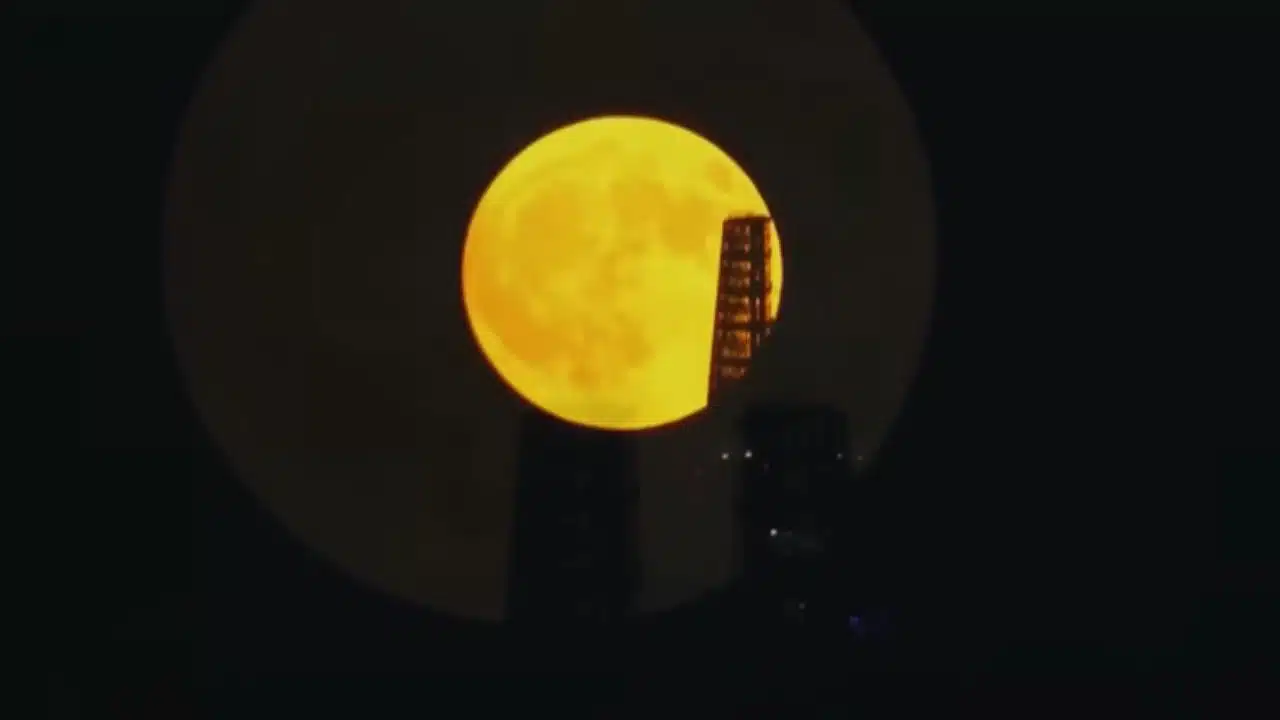
This week brings not one but two awe-inspiring night-sky spectacles: November’s full Beaver Supermoon and the Southern Taurid meteor shower, both reaching their peak visibility in the same 24-hour window. For astronomy lovers, photographers, and casual stargazers alike, this is a rare chance to experience the moon at its biggest and brightest — with the potential of catching streaks of light from ancient comet debris blazing through Earth’s atmosphere.
According to The Old Farmer’s Almanac, November’s full moon will reach peak illumination at 8:19 a.m. Eastern Time (ET) on Wednesday, November 5, 2025. Because the moon will have already set in North America by that time, observers will want to step outside on Tuesday evening or Wednesday night to see it glowing full and luminous near the horizon.
The Meaning Behind the “Beaver Moon”
Each full moon has a name rooted in seasonal cycles observed by Native American tribes and early European settlers. November’s full moon is traditionally called the Beaver Moon — a reference to the time when beavers prepare for winter, repairing dams, building lodges, and storing food before rivers and ponds freeze.
Among other Indigenous communities, this moon also goes by different names that reflect regional traditions:
- The “Digging Moon” (Tlingit people), marking the season when animals dig for roots and burrow for warmth.
- The “Deer Rutting Moon” (Dakota tribes), tied to the mating season for deer.
- The “Frost Moon” (Cree nation), signaling the first widespread frosts of the cold season.
These ancestral names remind us that the night sky was once humanity’s calendar — a rhythm that guided harvests, hunting, and community life.
What Makes This a “Supermoon”
A supermoon occurs when the full moon coincides with the point in its elliptical orbit closest to Earth, known as perigee. At this distance — roughly 221,800 miles (357,000 kilometers) from our planet — the moon can appear up to 14 percent larger and 30 percent brighter than when it’s at its farthest point, or apogee.
While the difference may not be immediately obvious to the naked eye, the combined effect of its size and brightness makes a supermoon especially striking when viewed near the horizon at moonrise or moonset, when it looms large against trees, buildings, or mountains.
This Beaver Supermoon marks the second in a trio of consecutive supermoons for 2025 — following October’s Hunter’s Moon and preceding December’s Cold Moon, which will be the final supermoon of the year.
“It’s so subtle that the human eye doesn’t quite pick up the ‘super’ part,” said Dr. Alissa Bans, director of undergraduate studies in physics at Emory University. “But it’s still worth celebrating — technically, this is the moon at its biggest and brightest, even if the change is small.”
When and Where to Watch
The ideal viewing times depend on your location, but the moon will appear almost full for roughly three nights, from Monday evening (Nov 3) through Thursday morning (Nov 6).
To get the best experience:
- Find a clear eastern or western horizon — coastal areas, open fields, and hilltops offer unobstructed views.
- Check local moonrise times (for example, around 5:15 p.m. local time in Dhaka; around 6:30 p.m. in New York).
- Avoid bright city lights, which wash out the moon’s contrast and the faint stars nearby.
- Bring binoculars or a telescope to observe surface features like the Tycho crater, the lunar seas, and rugged highlands in sharp relief.
If weather or clouds block your view, the Virtual Telescope Project will host a livestream of the supermoon rising over Manciano, Italy, beginning at 2 p.m. ET (7 p.m. GMT) on Wednesday.
The Southern Taurid Meteor Shower: Subtle, But Spectacular
Coinciding with the Beaver Supermoon is the Southern Taurid meteor shower, a slow-moving but photogenic display of shooting stars. The shower originates from debris shed by Comet 2P/Encke, which orbits the Sun every 3.3 years — the shortest known period for any comet. As Earth passes through its trail, dust grains and pebbles burn up in our atmosphere, producing long, glowing streaks of light.
Key Facts
- Peak period: Late night Nov 4 – early morning Nov 5 (around 8 a.m. ET / 1 p.m. GMT).
- Average rate: About 5 meteors per hour under dark skies.
- Radiant point: Near the constellation Taurus, which rises in the east after sunset.
- Visibility: Best from the Northern Hemisphere, though visible worldwide.
The Taurids are not known for quantity — they are relatively sparse — but their meteors are slow, bright, and often fiery, producing spectacular “Halloween fireballs.” These larger fragments can light up the entire sky for several seconds and sometimes leave glowing trails that persist for minutes.
“This year’s encounter is particularly interesting because Earth may pass through a denser region of fresh material,” said Robert Lunsford of the American Meteor Society. “That means a higher likelihood of seeing bright fireballs, even if the total number of meteors is small.”
A Bright Moon
The main obstacle this week is ironically the same supermoon that makes the sky beautiful. Its intense brightness will outshine fainter meteors, reducing the number you’ll be able to see.
Still, it’s not hopeless. The Taurids’ slow movement and high brightness mean the most dramatic fireballs can still cut through the moonlight — especially before the moon climbs too high or after it sets.
For best results:
- Head to a dark-sky location well away from city lights.
- Watch between 9 p.m. and midnight local time, before the moon reaches its zenith.
- Let your eyes adjust to the dark for 20 minutes, and avoid using your phone or flashlight.
- Lie back comfortably and keep your gaze about 45 degrees above the horizon.
Upcoming Meteor Showers to Mark on Your Calendar
Even after the Taurids fade, the night sky has plenty more to offer before the end of 2025:
| Meteor Shower | Peak Dates | Expected Rate | Notes |
| Northern Taurids | Nov 11–12 | 5–10/hr | Similar to the Southern Taurids but peaks a week later. |
| Leonids | Nov 16–17 | 15–20/hr | Known for fast, bright meteors radiating from Leo. |
| Geminids | Dec 13–14 | 120/hr | The year’s most reliable shower; brilliant and multicolored. |
| Ursids | Dec 21–22 | 10/hr | Subtle but visible around the winter solstice. |
The Final Supermoon of 2025
After November’s Beaver Moon, only one more supermoon remains this year — the Cold Moon on December 4, 2025. It will appear slightly smaller and higher in the sky, signaling the arrival of winter and marking the conclusion of the year’s lunar cycle.
Why These Events Matter
Beyond their visual beauty, supermoons and meteor showers reconnect us with nature’s cosmic rhythm — something easy to forget in our brightly lit, screen-filled cities. They remind us that Earth is part of a dynamic system, orbiting and interacting with ancient celestial bodies that have circled the Sun for millions of years.
Watching these events doesn’t require fancy equipment or scientific knowledge — just patience, curiosity, and a bit of wonder. Whether you’re a seasoned astrophotographer or someone stepping outside for a few quiet minutes, this week’s sky is offering a reminder: the universe is always performing; we only need to look up.
| Event | Date (Peak) | Visibility Tips |
| Beaver Supermoon | Nov 5 (8:19 a.m. ET) | Best viewed on the nights of Nov 4 – 5; look east after sunset. |
| Southern Taurids Meteor Shower | Nov 5 (8 a.m. ET) | Look east after sunset Nov 4 – early Nov 5; best chance before moonrise or after moonset. |
| Livestream Option | Nov 5 (2 p.m. ET) | Virtual Telescope Project live from Italy. |
The November night sky offers a rare and beautiful convergence — the radiant Beaver Supermoon glowing at its brightest and the Southern Taurid meteor shower streaking faint trails across the heavens. Together, they form a cosmic duet reminding us how vibrant and alive our skies remain, even amid city lights and screens.
Though the supermoon’s brightness may drown out some of the fainter meteors, patience often rewards the watcher — a single Taurid fireball can illuminate the entire sky, leaving a glowing trail that lingers long after it fades. Whether you’re in the city or countryside, all you need is a clear view, a few quiet moments, and a willingness to look up.
So, step outside this week — let the silver glow of the supermoon guide your gaze, and maybe, just maybe, you’ll catch a streak of cosmic light carving across the November darkness. The universe performs nightly; we only have to pause long enough to watch.
The Information is Collected from Yahoo and CNN.