Norway’s Government Pension Fund Global (GPFG), commonly known as the “Petroleum Fund,” is no longer just a savings account for oil revenues; in 2026, it has transformed into a high-tech, data-driven geopolitical heavyweight. With a projected value of over NOK 20.5 trillion at the start of the year, the fund has moved “all-in” on artificial intelligence and set a new global benchmark for “Nature Expectations.” Navigating the Norway Petroleum Fund model 2026 requires understanding how a single nation’s discipline has successfully decoupled its economy from the volatility of fossil fuels while exerting unparalleled influence on global boardrooms.
Our Selection Methodology
To compile these 17 facts, we synthesized the Norges Bank Investment Management (NBIM) Strategy 2028, the 2026 Norwegian National Budget, and the newly released “Nature Expectations” guidelines from March 2026. We prioritized 2026-specific data points, such as the revised 2.8% spending target and the integration of listed and unlisted real estate teams. Our criteria focused on the structural innovations and ethical pivots that differentiate the Norwegian model from other sovereign wealth funds (SWFs) in the current fiscal year.
17 Must-Know Facts About Norway’s Petroleum Fund Model
The Norwegian model is defined by a unique combination of extreme transparency and clinical long-term discipline.
1. The Fund Enters 2026 Valued at NOK 20.5 Trillion
As of the January 2026 fiscal opening, the GPFG is projected to be worth approximately NOK 20,500 billion, more than double its value in 2020.
-
Best for: Understanding the sheer scale of Norway’s national wealth relative to its population.
-
Things to consider: This astronomical growth is driven largely by nominal returns from global equity surges rather than new oil revenue alone.
This record value provides Norway with a degree of fiscal freedom that insulates the domestic economy from global recessions.
2. It Now Owns 1.5% of All Listed Companies Globally
On average, the fund holds a 1.5% stake in every listed company on earth, making it a “universal owner” with massive voting power.
-
Best for: Geopolitical analysts assessing Norway’s soft power in international corporate governance.
-
Things to consider: This ownership share means Norway is inherently exposed to the entire global economy, not just specific sectors.
Because of this breadth, the fund’s health is a direct reflection of global market stability.
3. The “3% Rule” is Being Undercut in 2026
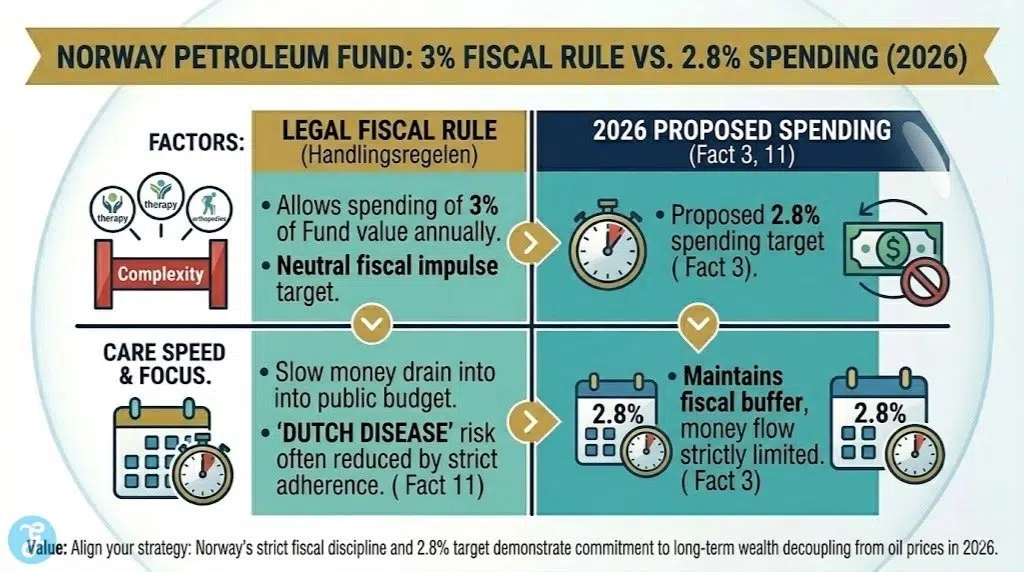
While the legal “Handlingsregelen” (Fiscal Rule) allows the government to spend 3% of the fund’s value annually, the 2026 budget proposes spending only 2.8%.
-
Best for: Economists monitoring Norway’s commitment to preventing “Dutch Disease” (inflation caused by resource wealth).
-
Things to consider: Even at 2.8%, the transfer to the state budget is estimated at NOK 579.4 billion, financing over a quarter of all public expenditures.
Spending below the 3% threshold ensures the fund continues to grow in real terms for future generations.
4. “All-In on AI” Strategy for 2026-2028
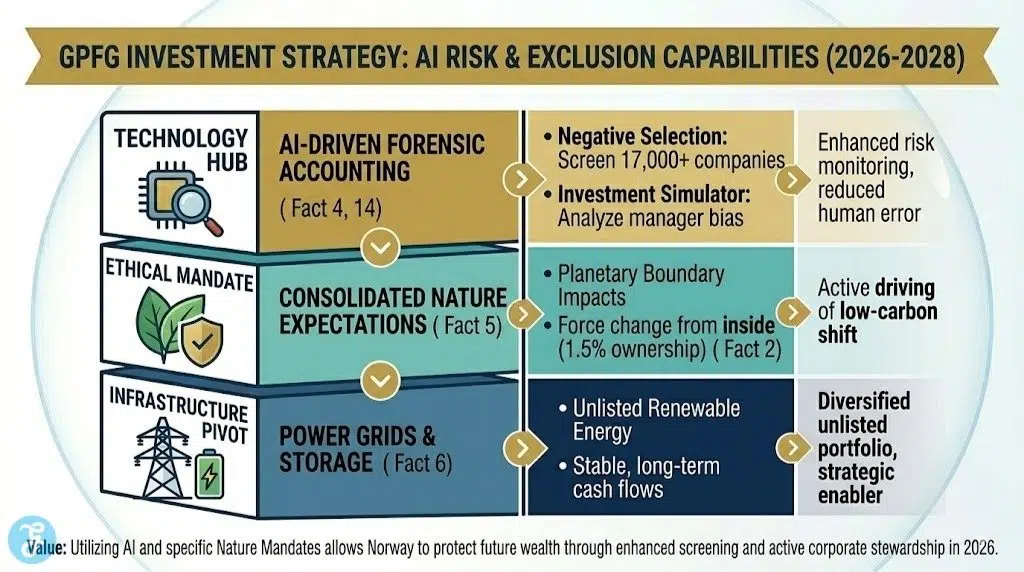
Under the newly launched Strategy 2028, NBIM has committed to being a leader in applying AI to asset management, aiming to halve manual processes by 2027.
-
Best for: Tech-forward investors looking for a roadmap in institutional AI integration.
-
Things to consider: The fund uses AI specifically for “negative selection”—identifying companies likely to underperform due to forensic accounting red flags.
AI is no longer a peripheral tool in Oslo; it is the core engine for risk monitoring and automated fixed-income trading in 2026.
5. The March 2026 “Nature Expectations” Pivot
In early 2026, the fund consolidated its environmental guidelines into a single, rigorous “Nature Expectations” document for all portfolio companies.
-
Best for: ESG (Environmental, Social, and Governance) specialists and corporate boards.
-
Things to consider: The fund now expects companies to report on their “planetary boundary” impacts, specifically land, freshwater, and marine ecosystem degradation.
These guidelines are not suggestions; they form the basis for voting against board members who fail to manage nature-related risks.
6. Renewable Energy Infrastructure is Expanding to “Grids”
Moving beyond just wind and solar, the 2026 strategy prioritizes unlisted investments in power grids and energy storage.
-
Best for: Understanding the shift toward “enabling” infrastructure for the global energy transition.
-
Things to consider: Transmission infrastructure is seen as a strategic enabler that provides stable, long-term cash flows similar to traditional real estate.
By investing in the “pipes” of the green economy, Norway is diversifying its unlisted portfolio away from pure generation risk.
7. Listed and Unlisted Real Estate Teams are Now Unified
For the first time in 2026, the fund has fully integrated its teams for listed and unlisted real estate to evaluate risk-adjusted returns more holistically.
-
Best for: Commercial real estate professionals and institutional fund managers.
-
Things to consider: This allows the fund to pivot quickly between buying physical buildings and buying shares in REITs (Real Estate Investment Trusts) based on pricing.
The unified strategy targets high-growth sectors like logistics and data centers over traditional office space.
8. The “Council on Ethics” Operates Independently
Unlike many other SWFs, the body that recommends exclusions (like tobacco, certain weapons, or severe human rights violations) is independent of the investment managers.
-
Best for: Ethical investors and human rights advocates.
-
Things to consider: If the Council on Ethics recommends an exclusion, NBIM is generally required to divest, regardless of the company’s financial performance.
This separation of “conscience” from “wallet” is the cornerstone of the fund’s global reputation for integrity.
9. Net Zero 2050 is a Non-Negotiable Mandate
By 2026, the fund has mandated that all companies in its portfolio must have a credible plan to reach Net Zero emissions by 2050.
-
Best for: Monitoring the transition of the fund from a passive observer to an active driver of the low-carbon shift.
-
Things to consider: The fund prioritizes “engagement” over “divestment,” preferring to force change from the inside through its 1.5% ownership.
Norway believes it is more effective to vote a board out than to sell a stock and lose all influence.
10. The Fund is Heavily Weighted Toward the United States
Despite its global mandate, over 52% of the fund’s assets are currently invested in the US, across equities, bonds, and property.
-
Best for: Portfolio managers assessing geographic concentration risk.
-
Things to consider: The value of US Treasury bonds held by the fund reached a record $199 billion at the start of 2026.
This concentration means the Norwegian welfare state is effectively pegged to the health of the American tech and financial sectors.
11. It Acts as a “Fiscal Shock Absorber”
The 2026 budget utilizes the fund to maintain a “neutral fiscal impulse,” preventing the Norwegian economy from overheating or crashing.
-
Best for: Policy makers looking for a model of macroeconomic stability.
-
Things to consider: When oil prices drop, the fund fills the gap; when they soar, the fund absorbs the excess to prevent domestic inflation.
This “buffer” role is why Norway remains one of the most stable economies in the OECD.
12. The “SDFI” Funnels Direct Cash into the Fund
The State’s Direct Financial Interest (SDFI) allows the Norwegian state to own shares in oil fields directly, with all net cash flow (estimated at NOK 521 billion for 2026) going straight into the GPFG.
-
Best for: Understanding the plumbing of how oil becomes “pension” wealth.
-
Things to consider: This is separate from the tax revenue paid by oil companies like Equinor; it is pure ownership profit.
The SDFI system ensures that the “economic rent” of Norway’s natural resources is captured entirely by the public.
13. Transparency is Absolute (And Searchable)
The fund publishes a real-time list of every single stock and bond it owns, including its voting record on every board resolution.
-
Best for: Journalists, researchers, and retail investors who want to follow the “smart money.”
-
Things to consider: You can search the NBIM website to see exactly how Norway voted on executive pay at Apple or climate goals at Shell.
This radical openness prevents corruption and ensures public trust in how the nation’s wealth is managed.
14. Behavioral Analysis Mitigates “Human Error”
In 2026, the fund is increasingly using an “Investment Simulator” to debrief with external managers on their decision-making biases.
-
Best for: Psychology and finance professionals interested in behavioral economics.
-
Things to consider: The goal is to enhance “decision quality” by identifying when managers are acting on emotion rather than data.
This scientific approach to investing is a direct reflection of CEO Nicolai Tangen’s focus on “winning culture” and psychological resilience.
15. The Fund is a “Trust for the Future,” Not a Pension
Despite its name, the Government Pension Fund Global does not actually pay out pensions; it is a long-term capital pool for when oil runs out.
-
Best for: Correcting the common misconception that the fund is a social security pot.
-
Things to consider: The money is intended to finance the Norwegian welfare state “forever,” not just for current retirees.
The fund’s time horizon is measured in decades and centuries, not fiscal quarters.
16. Extreme Cost Efficiency (Less than 0.05%)
The management costs of the fund are incredibly low, often staying below 0.05% of the total assets under management.
-
Best for: Comparing institutional fee structures.
-
Things to consider: By keeping management in-house and using automated trading, Norway keeps more of its returns for the public.
High returns are meaningless if they are eaten up by fees; the Norwegian model is the gold standard for institutional efficiency.
17. The 2026 “Neutral” Fiscal Impulse
Adjusting for support to Ukraine and other international commitments, the 2026 budget is designed to have a 0.1% neutral impact on domestic activity.
-
Best for: Macro-investors looking for indicators of Norwegian interest rate trends.
-
Things to consider: The government is carefully avoiding an “expansionary” stance to help the central bank (Norges Bank) manage inflation.
This coordinated effort between the fund’s spending and the central bank’s goals is the hallmark of the Norwegian “Iron Triangle” of fiscal policy.
Strategic Analysis
The 2026 evolution of the fund signifies a shift from a “passive index tracker” to an “active AI-led owner.” The table below highlights the key strategic transitions occurring this year.
| Strategic Pillar | Pre-2026 Focus | 2026 Global Shift | 2026 Result |
| Technology | Data Collection | “All-in on AI” | 50% reduction in manual tasks |
| Ethics | Climate/Water focus | Consolidated “Nature Expectations” | Global board-level accountability |
| Real Estate | Separate Unlisted/Listed | Fully Integrated Property Strategy | Higher risk-adjusted returns |
| Infrastructure | Wind and Solar | Power Grids and Storage | Strategic energy transition enabler |
Our Top 3 Picks And Why?
-
The 2.8% Spending Target: This is our top pick because it demonstrates Norway’s supreme self-control. In a year where global politicians are tempted to spend for popularity, Norway is saving more than required by its own rules.
-
The “All-In on AI” Mandate: We chose this because it represents the future of institutional finance. By using LLMs for forensic accounting and behavioral analysis, the fund is effectively “armoring” its portfolio against fraud and human bias.
-
The 2026 Nature Expectations: This is a critical pick because it sets a new floor for corporate behavior globally. When a $2 trillion investor tells a company to report on its “marine ecosystem impact,” the company listens.
Preparation Checklist
-
[ ] Monitor the 2026 Investment Conference (April 28) for updates on the “Winning Culture” and AI scaling.
-
[ ] Audit your own portfolio for “Nature Risk” compliance to align with the fund’s new 2026 standards.
-
[ ] Review the fund’s “Negative Selection” list periodically to identify sectors with high forensic accounting risks.
-
[ ] Track the “3:12” and “SINK” tax reforms in Norway, as they reflect the fiscal pressure and fund-reliance of the 2026 budget.
-
[ ] Ensure any interaction with the “RealMe” or “Skatteverket” portals utilizes the latest 2026 biometric security features.
The Legacy of the “Generational Trust”
The Norway Petroleum Fund model 2026 is proof that a nation can transform a finite natural resource into a permanent engine for social stability. By embracing AI, enforcing rigorous nature-related ethics, and maintaining a disciplined 2.8% spending rate, Norway has moved beyond the “resource curse” that plagues so many other oil-rich nations. In 2026, the fund is not just a pile of money; it is a sophisticated instrument of global governance and a testament to the power of long-term thinking. As other nations struggle with debt and volatility, Norway’s vault remains a beacon of how to build a future that is both wealthy and responsible.
FAQs
Does the fund invest in Norway?
No, by law, the GPFG only invests outside of Norway to prevent the domestic economy from being overwhelmed by oil money.
How much oil money is left?
While production is declining, high prices and new developments mean Norway still expects a net cash flow of NOK 521 billion in 2026.
No, the fund is owned by the people of Norway as a whole and is managed by the central bank.