As automated systems integrate into healthcare, finance, criminal justice, and creative industries, societies face profound moral and regulatory challenges. Understanding the core ethical dilemmas of artificial intelligence allows policymakers, developers, and citizens to establish guardrails that protect human rights while fostering technological progress.
Navigating these challenges requires balancing rapid technological innovation with global guidelines like the UNESCO Ethics of AI Framework.
| Ethical Dilemma | Primary Impact Area | Key Risk / Stake | Regulatory / Mitigation Approach |
| 1. Algorithmic Bias | Justice, Hiring, Credit | Perpetuating historical discrimination | Dataset auditing & debiasing standards |
| 2. Job Displacement | Labor Markets & Economy | Mass unemployment & income inequality | Reskilling initiatives & economic safety nets |
| 3. Privacy & Surveillance | Civil Liberties | Constant monitoring & data harvesting | Strict data privacy laws (e.g., GDPR) |
| 4. Autonomous Weapons | Global Security & Defense | Removal of human moral agency in warfare | International treaty bans on lethal AI |
| 5. Synthetic Disinformation | Media & Governance | Loss of trust in public information | Cryptographic provenance & digital watermarking |
| 6. IP & Ownership | Creative Industries | Uncompensated extraction of human work | Fair-use reform & artist licensing models |
| 7. Black Box Opacity | Healthcare, Law, Finance | Inability to audit critical decisions | Mandated “Explainable AI” (XAI) systems |
| 8. Environmental Footprint | Global Climate Goals | High energy consumption & carbon output | Energy-efficient architectures & green compute |
| 9. Alignment & Existential Risk | Human Autonomy | Loss of human control over superintelligence | AI safety research & alignment protocols |
9 Ethical Dilemmas of Artificial Intelligence
1. Algorithmic Bias and Systemic Discrimination
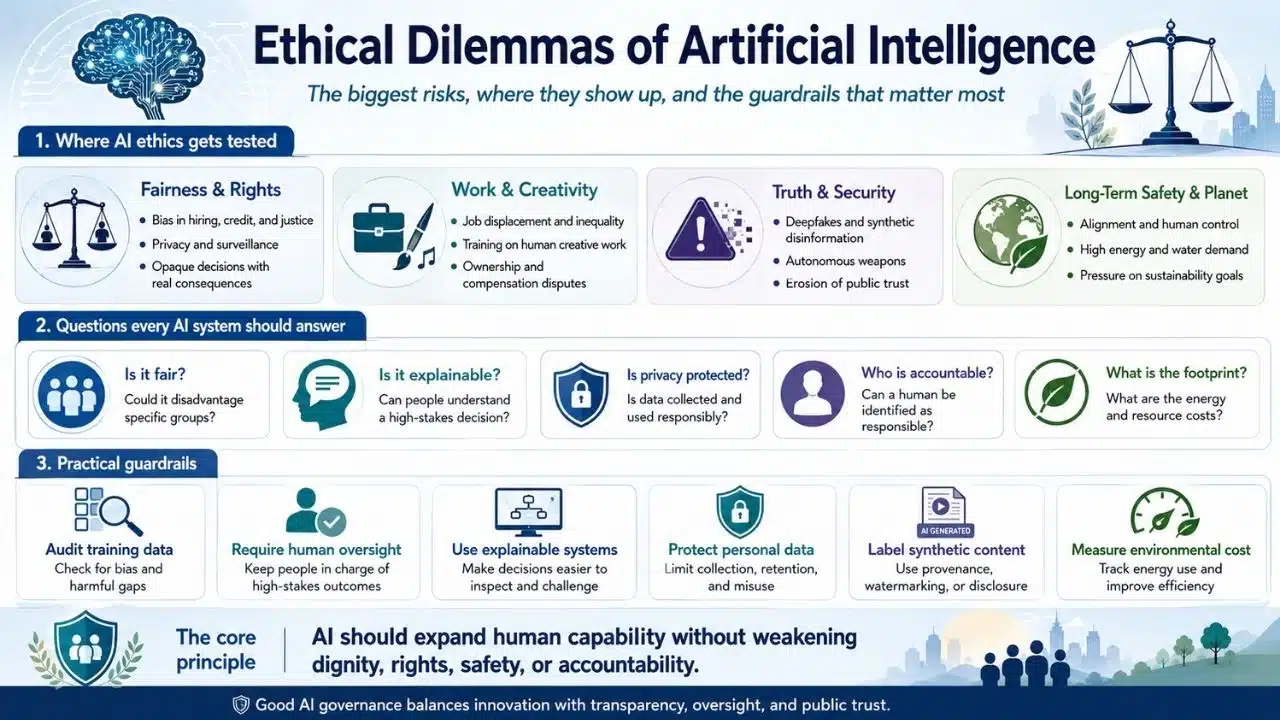
AI models learn from historical data, which often reflects societal prejudices and structural inequalities. When deployed in credit scoring, automated hiring, or predictive policing, biased algorithms can systematically discriminate against marginalized communities, reinforcing historical harms under the guise of objective mathematics.
2. Workforce Displacement and Economic Inequality
The rapid automation of cognitive and physical labor threatens to displace millions of workers across diverse sectors. While AI generates new industries, the transition speed risks widening the wealth gap between tech capital owners and displaced workers who lack immediate access to reskilling programs.
3. Erasure of Privacy and Pervasive Surveillance
Advanced pattern recognition enables real-time facial tracking, predictive behavioral profiling, and mass data harvesting without explicit consent. This constant monitoring threatens individual autonomy and creates infrastructure that can be weaponized by authoritarian regimes.
4. Lethal Autonomous Weapons Systems (LAWS)
Delegating life-or-death decisions to autonomous algorithms in military conflicts raises critical moral questions. Removing human judgment from warfare risks lowering the barrier to armed conflict and leaves crucial decisions regarding human life to cold mathematical probabilities.
5. Synthetic Media, Deepfakes, and Institutional Erosion
Generative models can synthesize convincing audio, video, and text, blurring the line between authentic reality and digital manipulation. This capability enables targeted disinformation campaigns that weaken public trust in democratic elections, journalism, and legal evidence.
6. Intellectual Property and Creative Exploitation
AI models train on billions of copyrighted books, artworks, codebases, and musical compositions without clear compensation or attribution to original creators. This practice challenges existing copyright frameworks and threatens the economic livelihood of creative professionals.
7. The “Black Box” Problem and Lack of Accountability
Deep neural networks operate through complex vector calculations that humans cannot easily interpret. When an AI system misdiagnoses a medical patient or denies a home loan, establishing legal liability and moral accountability becomes exceedingly difficult without transparent decision paths.
8. Resource Consumption and Environmental Strain
Training and serving large-scale AI models consumes massive amounts of electricity and fresh water for cooling data centers. Balancing rapid AI development with global sustainability commitments presents a growing ecological challenge.
9. Long-Term Alignment and Existential Safety
As systems become increasingly autonomous, ensuring their goals remain strictly aligned with human values becomes critical. The technical challenge of defining, verifying, and enforcing ethical constraints on advanced systems remains an unresolved frontier in computer science.
Constructing a Responsible Framework for Tomorrow
Navigating the complex ethical dilemmas of artificial intelligence is not merely a theoretical exercise—it is an urgent prerequisite for building a stable, equitable future. As machine learning models continue to reshape critical infrastructure, human autonomy, and global economies, the decisions made today regarding governance, algorithmic auditing, and deployment standards will dictate the social contract for generations to come.
Ultimately, technological progress must not come at the expense of human dignity, privacy, or moral agency. Resolving these ethical challenges requires active collaboration between technologists, policymakers, ethicists, and the public to ensure that artificial intelligence remains a transparent tool designed to augment human potential rather than undermine it.
Frequently Asked Questions (FAQs) Ethical Dilemmas of Artificial Intelligence
What is the most urgent ethical dilemma of artificial intelligence today?
While long-term risks gather headline attention, immediate issues like algorithmic bias in hiring and justice systems, along with the spread of synthetic disinformation, represent the most pressing daily challenges.
Can artificial intelligence ever possess moral agency?
No. Current and foreseeable AI models lack subjective consciousness, moral intent, and qualitative feeling. They execute probabilistic calculations based on training data, meaning moral responsibility always rests with human creators and operators.
How are international bodies addressing the ethical dilemmas of artificial intelligence?
Global institutions are developing standardized frameworks—such as the EU AI Act and UNESCO’s guidelines—to enforce transparency, ban high-risk applications, and establish accountability standards across borders.