
If you are planning to relocate to Aotearoa or just visiting for an extended period, you absolutely need to understand how the New Zealand healthcare system works. A lot of people arrive with the grand assumption that doctors and hospitals will not cost them a single cent. While the country does offer fantastic public services, the reality is a bit of a mixed bag.
You will never face massive hospital bills for genuine emergencies, but you will still need to open your wallet for everyday check-ups, prescriptions, and trips to the dentist. Te Whatu Ora, or Health New Zealand, manages the national medical network to ensure everyone gets life-saving care regardless of their income. Let us look closely at what is covered, what is not, and how you can navigate the medical landscape without any nasty surprises to your bank account.
1. The Public Healthcare System Is Broad but Not Entirely Free
New Zealand runs a heavily subsidised public health model that is funded by general taxation. When locals tell you that medical care is free, they are almost exclusively talking about public hospital treatments and acute emergencies. If you get rushed to the emergency room for an appendix removal or require long-term cancer treatment, you will walk out without a massive financial burden hanging over your head. However, primary care, which includes popping down to your local family doctor for a sore throat, is a completely different story. The government pays a large chunk of the consultation fee behind the scenes, but you still pay a co-payment at the reception desk. This specific setup keeps national taxes somewhat reasonable while still protecting everyday people from catastrophic medical debt that plagues other nations. It is a balancing act between public funding and personal responsibility.
Who Qualifies for Subsidised Care?
You do not get free medical perks just by stepping off a plane in Auckland. To use the public system, you must be a citizen or permanent resident of New Zealand or Australia. You also qualify if you hold a valid work visa that lasts for a minimum of two years. If you are on a short-term working holiday or a simple tourist visa, you have to pay the full retail price for everything you use. This is exactly why securing comprehensive travel or expat medical insurance is non-negotiable before you arrive.
| Feature | Description | Cost to Eligible Patient |
| Emergency Rooms | Acute hospital care and trauma response | Free |
| Hospital Surgery | Required non-elective and acute surgeries | Free |
| Primary Care | General family doctor and nurse visits | Subsidised (Co-payment required) |
| Specialist Care | Hospital-based specialist outpatient clinics | Free |
2. General Practitioner (GP) Visits Have Co-Payments
Your general practitioner is your main point of contact for everyday health issues and general well-being. These medical clinics are entirely private businesses, which means they are free to set their own prices for patient consultations. The government gives them continuous funding to keep these costs manageable for patients, but adults still usually pay a co-payment for every standard fifteen-minute appointment. You might pay anywhere from $15 to $65 depending on where the specific clinic is located, the demographics of the area, and your age group. Weekend or after-hours medical clinics charge significantly higher rates, sometimes pushing well past $100 for a single brief visit. It is highly recommended to budget for these visits, especially during the winter months when seasonal illnesses spread rapidly through communities.
How to Lower Your GP Fees?
The biggest mistake newcomers make is going to a medical clinic as a casual patient. You must formally enrol with a primary health organisation to get the cheap, subsidised rates. Once enrolled, the government funding kicks in for your personal visits. Some clinics operate under the Very Low Cost Access programme, getting extra government cash to keep adult fees under $20. Finding a clinic with open enrolment spots can sometimes take a few weeks, so you should register as soon as you sign a lease for your new home.
| Age Group | Enrolment Status | Average Cost Estimate |
| Children (Under 14) | Enrolled | Free |
| Teens (14 to 17) | Enrolled | $13 to $40 |
| Adults (18+) | Enrolled | $15 to $65 |
| Any Age | Casual (Not Enrolled) | $70 to $120+ |
3. The Accident Compensation Corporation (ACC) Covers Injuries
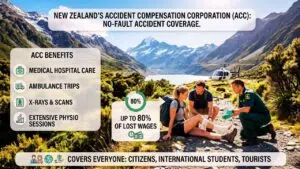
ACC is arguably the best and most unique part of the New Zealand healthcare system. It is a massive no-fault insurance scheme that covers personal accidental injuries for absolutely everyone inside the country. It simply does not matter if you are a lifelong citizen, an international student, or a tourist passing through for the weekend. If you sprain your ankle on a hiking trail, get hurt in a major car crash, or burn your hand cooking dinner, ACC steps in to pay for your medical care. They cover expensive hospital trips, ambulance rides, x-rays, and even extensive physical therapy sessions. They also pay up to 80 percent of your lost wages if you cannot go back to work because of the specific injury you sustained.
No-Fault Coverage Explained
The no-fault rule is entirely unique on a global scale. It means ACC does not care who caused the accident or whose fault it was. Because this comprehensive scheme exists, it is generally illegal to sue someone for personal injury in New Zealand. You cannot drag a reckless driver to court for hurting you in a crash because ACC steps in to cover your financial losses instead. This keeps the legal system completely unclogged and ensures injured people get immediate help rather than waiting years for a lawsuit to finally settle.
| Injury Scenario | Does ACC Cover It? | Type of Financial Support Provided |
| Motor vehicle accident | Yes | Medical care, rehabilitation, and lost wages |
| Weekend sports injury | Yes | Physio, surgery if needed, and rehabilitation |
| Tripping over at home | Yes | Medical care and recovery support |
| General illness or disease | No | None (Covered by standard public health) |
4. Prescriptions Carry a Small Fee with a Built-in Safety Net
When your family doctor writes a medical script, you take it to a local community pharmacy to get it filled. A dedicated government agency called Pharmac actually decides which drugs the government will fund for the public. They aggressively negotiate and buy medicines in massive bulk for the whole country to keep consumer prices incredibly low. In 2024, the government brought back the standard $5 co-payment for most prescription items. This simply means a fully funded medication will only cost you a five-dollar coin, regardless of its actual market value. If your doctor happens to prescribe something that Pharmac does not cover, you will unfortunately have to pay the actual retail market price for that drug, which can be expensive.
Understanding the Prescription Safety Net
If you suffer from a chronic illness, those small five-dollar fees can add up fast and strain your budget. The government created a prescription safety net to help vulnerable people. Once you or your dependent family members pay for twenty prescription items in one single year, you hit the maximum cap. After that point, all your fully funded prescriptions are completely free until the next calendar year begins. You just need to make sure you use the exact same pharmacy consistently or keep your receipts so the staff can accurately track your total item count.
| Prescription Type | Typical Cost | Important Notes |
| Fully Funded Drug | $5 per item | Standard fee for most adults |
| Partially Funded Drug | Varies wildly | Government pays part, you pay the rest |
| Unfunded Drug | Full retail price | Can cost hundreds of dollars monthly |
| Children Under 14 | Free | Applies to fully funded items only |
5. Dental and Optical Care Are Mostly Private
Do not expect the government to pay for your teeth or your eyes when you arrive. Adult dental care operates entirely in the private sector and is completely disconnected from the public hospitals. It is widely known across the country for being quite expensive. A basic check-up with a standard clean will set you back around $100 to $150. If you need a complex root canal or a dental crown, you are looking at thousands of dollars out of pocket. The exact same rule goes for seeing a local optometrist. You pay out of pocket for your regular eye exams, new glasses, and contact lenses unless you have a specific, severe medical eye condition that requires a public hospital specialist.
The Exception for Children and Teens
The government clearly knows that early dental care prevents massive health problems later on in life. Because of this logical approach, basic dental care is free for kids from birth right up to their 18th birthday. Dedicated dental therapists usually operate out of mobile clinics that visit primary schools directly. When kids hit high school age, they are referred to local private dentists who contract with the government to provide free annual check-ups and fillings for teens.
| Medical Service | Public or Private Sector | Estimated Patient Cost |
| Adult Dental Exam | Private | $100 to $150 |
| Adult Tooth Extraction | Private | $200 to $400 |
| Adult Routine Eye Exam | Private | $60 to $100 |
| Child Dental (Under 18) | Public | Free |
6. Comprehensive Maternity Care Costs Nothing
Having a new baby in New Zealand is a financially stress-free experience for eligible permanent residents. The maternity system is incredible and focuses heavily on community midwifery rather than immediate hospital intervention. The government fully covers your entire pregnancy journey from the very first blood test to the delivery room. You absolutely do not pay for routine ultrasounds, hospital birthing stays, or epidurals. The primary goal is to make sure expectant mothers get top-tier medical attention without ever worrying about how to afford it. This allows young families to focus on their new child instead of stressing over mounting medical debt.
Choosing Your Lead Maternity Carer
When you find out you are pregnant, your first major job is to find a Lead Maternity Carer. In the vast majority of cases, this will be a fully registered local midwife. Your chosen midwife guides you through the entire nine months of gestation. They deliver the baby at the public hospital or a local birthing centre and visit you at home for up to six weeks after the birth to check on the baby. If your pregnancy suddenly becomes high-risk, your midwife simply transfers your care to a free public hospital obstetrician for specialist defence against complications.
| Maternity Service | Cost to Eligible Patient | Standard Provider |
| Routine Pregnancy Check-ups | Free | Midwife or General Practitioner |
| Standard Ultrasounds | Free | Local Radiology Clinics |
| Hospital Labour and Delivery | Free | Public Hospital or Birthing Centre |
| Postnatal Home Visits | Free | Lead Maternity Carer |
7. Public Hospitals Handle Emergencies Free of Charge
If you wake up in the middle of the night with severe chest pains, you call an ambulance or go straight to the nearest emergency department. All acute and emergency care is handled by the public hospital network at absolutely no cost to eligible patients. The facilities are highly modern, and the clinical staff are exceptionally trained. You will never be asked to hand over a credit card before receiving life-saving trauma surgery. Ambulances are also heavily subsidised for residents, though you might pay a small part-charge of around $100 depending on which specific region of the country you live in.
The Reality of Elective Surgery Waitlists
While terrifying emergencies are sorted instantly, non-urgent issues require a massive amount of patience. These are called elective surgeries. Things like total hip replacements, knee reconstructions, or tonsil removals go onto a massive public waiting list. You are ranked solely by how bad your physical condition is, not by how long you have been waiting in the queue. Because public hospitals are constantly busy dealing with acute emergencies and trauma, you could easily wait months or even years for a surgery that improves your quality of life but is not strictly life-saving.
| Treatment Type | Urgency Level | Expected Public Wait Time |
| Severe Car Crash Trauma | Immediate | None |
| Sudden Heart Attack | Immediate | None |
| Total Knee Replacement | Elective / Non-Urgent | Many months to over a full year |
| Standard Hernia Repair | Elective / Non-Urgent | Several months |
8. Mental Health Services Are Available but Stretched
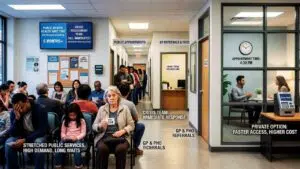
Mental health is technically a core part of the public system, but it is currently facing a lot of severe pressure and underfunding. If someone is in a severe crisis or poses an immediate danger to themselves, public psychiatric emergency teams will step in immediately for free. For everyday issues like clinical depression, severe anxiety, or profound grief, the process is unfortunately a bit slower. Your family doctor is your first stop for help. They can prescribe necessary medication or refer you to a local community therapist for ongoing support. The demand for these services is incredibly high across the nation.
Finding the Right Support
Many primary health organisations offer a handful of free counselling sessions for people dealing with mild mental health issues. However, the official waitlists for free public psychologists and psychiatrists are often very long and frustrating. Because of the massive system backlog, many people who desperately need ongoing talk therapy choose to pay out of pocket for a private psychologist or local counsellor. Some premium private health insurance plans also offer small annual allowances to help cover these expensive therapy bills.
| Mental Health Need | First Point of Contact | Cost and Expected Wait Time |
| Severe Mental Crisis | Crisis Assessment Team | Free / Immediate response |
| Mild to Moderate Depression | General Practitioner | GP Fee / Short wait for appointment |
| Short-term Talk Therapy | PHO Counsellor | Free / Often faces long waitlists |
| Private Psychology | Private Therapist | $150+ per hour / Much shorter wait |
9. The Community Services Card Offers Extra Financial Relief
Living in New Zealand can be quite expensive, and unexpected medical fees can easily squeeze a tight household budget. The government issues the Community Services Card to actively help low-income earners, university students, and welfare beneficiaries afford their basic health needs. If you meet the strict income threshold, you apply for this card directly through the Ministry of Social Development. It essentially acts as a discount pass at medical centres and community pharmacies. It is a vital lifeline for thousands of families trying to keep their heads above water.
How to Apply for the Card?
You do not get this discount card automatically unless you are already receiving specific government welfare benefits. You have to actively fill out a detailed application form and conclusively prove your total household income. Once approved, the card is valid for a set period, usually a full year, before you need to reapply and renew it. Holding this card makes a massive financial difference, dropping GP visits to under $20 and heavily reducing the cost of after-hours emergency doctor visits.
| Healthcare Benefit | Without Card | With Community Services Card |
| Enrolled Adult GP Visit | $40 to $65 | $15 to $19.50 |
| Standard Prescription Items | $5 | Often totally free or heavily reduced |
| After-Hours Doctors | High full retail fee | Subsidised lower rate |
| Emergency Dental Work | Full expensive price | Special government subsidy available |
10. Private Insurance Is a Popular Add-On for Faster Service
Even with free public hospitals and subsidised local doctors, about one-third of the entire population buys private medical insurance. Private coverage absolutely does not replace the public network. Instead, it works alongside it to give you more options. You still go to the public hospital in an ambulance if you get hit by a bus. But if you need an elective surgery like a shoulder reconstruction, private insurance lets you skip the public waitlist completely. It essentially buys you speed, comfort, and the ability to choose your own surgeon.
Weighing the Costs and Benefits
Getting private cover completely depends on your household budget and personal medical history. Major providers offer many different tiers of coverage. Some cheap policies only cover major hospital surgeries, while premium comprehensive plans will happily pay for your GP visits, routine dental check-ups, and new glasses. Many corporate companies offer basic health insurance as a perk to their loyal employees. If you can afford the monthly premiums, it provides incredible peace of mind knowing you will never be stuck on a year-long waitlist for a painful joint issue.
| System Feature | Public Healthcare System | Private Health Insurance |
| Elective Surgery Wait Times | Very Long (Months or Years) | Very Fast (Weeks) |
| Choice of Specialist | No (Assigned by the hospital) | Yes (You pick your doctor) |
| Hospital Room Type | Shared ward with others | Often a private room |
| Financial Cost | Free for eligible patients | Monthly premium required |
Final Thoughts
Navigating the New Zealand healthcare system is all about understanding the delicate balance between public funding and private costs. The country does a phenomenal job of protecting its residents from life-ruining medical bills when genuine emergencies strike out of nowhere. The ACC scheme alone is a world-class safety net that takes the financial panic out of accidents and injuries.
While you definitely do have to budget for your dentist, your eye doctor, and those pesky GP co-payments, the overall standard of care is incredibly high. Make sure you enrol with a local clinic as soon as you settle in, carefully look into private insurance if you want to skip elective waitlists, and enjoy the peace of mind that comes with living in Aotearoa safely.
Frequently Asked Questions (FAQs) About New Zealand healthcare system
1. Are telehealth appointments common in New Zealand?
Yes, telehealth is incredibly common now. Since 2020, almost all local medical centres offer phone or video consultations for their enrolled patients. There are also several online-only doctor services where you can get basic prescriptions or medical certificates without ever leaving your living room. They usually charge a flat fee similar to a standard in-person visit.
2. Does the system provide gender-affirming healthcare?
Yes, gender-affirming care is fully covered under the public health network, including hormone replacement therapy and specific necessary surgeries. However, because these complex surgeries are technically considered elective, the public waitlists for gender-affirming surgeries are extremely long, leading some patients to seek expensive private care instead.
3. Is healthcare accessible in rural parts of the country?
Rural areas do have medical centres, but they constantly struggle with severe doctor and nurse shortages. You might have to drive a very long distance to reach a major hospital or see a specific specialist. To fix this ongoing issue, the government sometimes offers rural clinics extra financial funding and heavily utilises telehealth services to bridge the gap.
4. Can tourists get prescriptions filled?
If you are visiting from overseas and run out of your regular medicine, you can easily see a local doctor to get a New Zealand prescription. You will have to pay the expensive casual rate for the doctor visit and the full, unsubsidised retail price for the medication at the pharmacy.
5. Do expats need to undergo medical checks for a visa?
Yes, if you are applying for a work or resident visa that lasts longer than twelve months, Immigration New Zealand will usually require you to undergo a full medical examination and a chest x-ray. This ensures you have an acceptable standard of health and will not place an undue burden on the public health system.