Netflix has officially entered a new phase of content creation by deploying generative artificial intelligence (AI) to develop a major visual effects (VFX) sequence in its new sci-fi series The Eternaut. This marks a significant milestone as the first time the streaming giant has incorporated AI-generated imagery into a full scene in one of its original films or series.
During its second-quarter 2025 earnings call, Netflix co-CEO Ted Sarandos confirmed the use of generative AI to create a scene depicting the collapse of a building in Buenos Aires, Argentina. This moment is a crucial turning point in The Eternaut, a live-action adaptation of the legendary Argentine graphic novel El Eternauta, originally written by Héctor Germán Oesterheld with artwork by Francisco Solano López. The story, widely regarded as one of Latin America’s most influential sci-fi epics, explores themes of resistance, survival, and alien invasion, set against the backdrop of a dystopian Buenos Aires.
AI Helped Achieve the Unthinkable Within Budget
According to Netflix, the decision to use generative AI stemmed from both creative and budgetary considerations. The production team faced a scenario where creating such a large-scale VFX scene using traditional methods would have been prohibitively expensive and time-consuming. Instead of relying solely on conventional CGI workflows, the team turned to AI to generate the complex scene, which included realistic structural damage, smoke effects, collapsing debris, and environmental physics—all rendered in a fraction of the typical timeline.
By utilizing advanced generative AI models trained to simulate physical destruction and urban landscapes, Netflix was able to complete the scene nearly ten times faster than through traditional VFX pipelines. The cost efficiency was just as significant, allowing the production to achieve blockbuster-level effects within the constraints of a more modest streaming series budget.
This shift is being viewed not only as a cost-saving tactic but also as a transformative method that can enable filmmakers to experiment creatively without the financial barriers that typically limit visual storytelling in lower-budget projects.
A Strategic Move in Netflix’s AI Integration Journey
This isn’t the first time Netflix has explored AI integration across its platform. In May 2025, the company announced the rollout of an AI-powered search tool for its mobile app. This feature allows subscribers to use conversational language when searching for content, such as entering phrases like “something relaxing for a rainy evening” or “feel-good movies with dancers.” The AI system analyzes these queries using natural language processing to deliver highly personalized recommendations based on user mood, tone, and intent rather than rigid keyword searches.
In addition to improving user experience through smarter search, Netflix is also exploring the use of AI to enhance its advertising infrastructure. One of the innovations under development is the ability to integrate brand messages and promotional content into the viewing environment in a way that complements the aesthetic and mood of the show. For instance, ads could be presented with backgrounds or animations that mimic the color palette and style of Stranger Things or other popular originals, creating more immersive and less disruptive ad breaks.
This signals Netflix’s growing interest in not just producing content more efficiently with AI, but also delivering and monetizing it in more intelligent, viewer-friendly ways.
What AI in VFX Means for the Industry
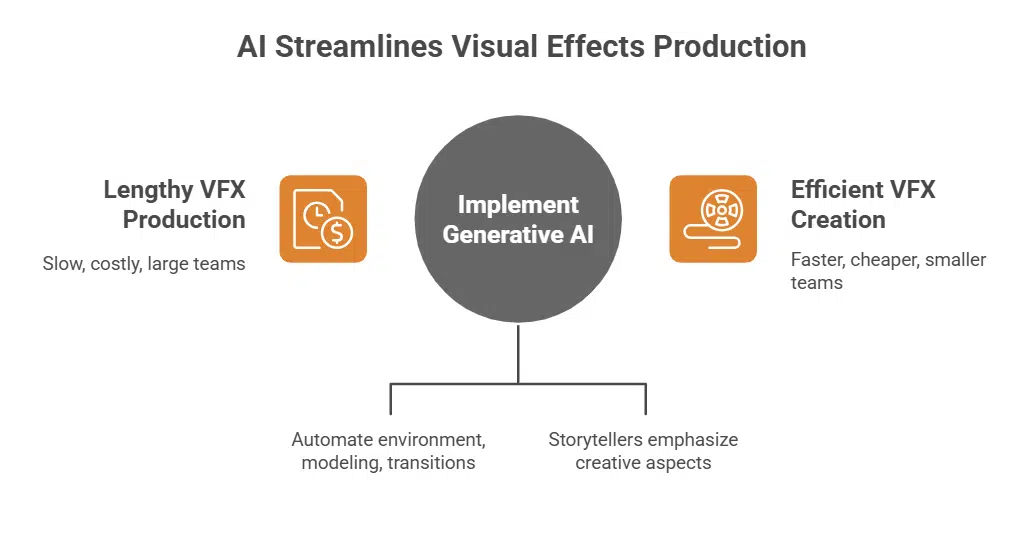
Netflix’s adoption of generative AI in The Eternaut signals a broader trend in the entertainment industry. Studios and visual effects companies are increasingly exploring machine learning technologies to streamline complex and time-consuming tasks. These include environment generation, character modeling, scene transitions, motion capture clean-up, and even color grading. With tools like Runway, Sora by OpenAI, and NVIDIA’s Omniverse gaining popularity, the creative possibilities are expanding rapidly.
The visual effects industry has traditionally required vast teams of artists, engineers, and render farms, with large budgets and extended post-production timelines. AI is now poised to redefine this model by enabling smaller teams to achieve visually rich scenes faster, more affordably, and with fewer logistical constraints.
However, this evolution isn’t without controversy. The growing reliance on generative AI has been a point of concern for labor unions and creative professionals. Writers, actors, and visual artists have expressed fear that AI tools could reduce the need for human talent, diminish job security, and threaten the artistic integrity of storytelling. These concerns were part of the recent debates during the Writers Guild of America (WGA) and SAG-AFTRA strikes in 2023–2024, where protections against AI-generated content were at the center of negotiations.
Netflix, however, maintains that its AI strategies are designed to support—not replace—creators. The goal, according to company executives, is to allow storytellers to focus on the narrative while letting technology handle the technical burdens.
A Closer Look at The Eternaut Series
The Eternaut is one of Netflix’s most ambitious international productions in 2025. Based on the graphic novel originally published in the 1950s, the story follows a group of survivors navigating an alien invasion after a deadly snowfall covers Buenos Aires. The toxic snow, which kills anyone exposed to it, is just the beginning of a greater threat involving invisible invaders and oppressive forces.
The series captures the emotional, political, and philosophical undertones of the original work, which was widely interpreted as a metaphor for Argentina’s authoritarian regime. The show has drawn attention both for its cultural importance and its cinematic scale, with AI-powered effects helping bring to life scenes that would have been unimaginable under standard TV budgets.
What Comes Next for AI at Netflix
Netflix’s investment in generative AI appears to be just beginning. The company is actively researching additional ways to use AI throughout the production lifecycle, from script development and storyboarding to post-production and marketing. Future updates may include AI tools for dynamic subtitles, real-time dubbing in multiple languages, or even personalized content trailers that match a user’s viewing behavior.
By taking these steps, Netflix aims to stay ahead in a highly competitive streaming market where innovation and cost-efficiency are key to maintaining global dominance. While ethical and creative debates around AI are ongoing, the company’s latest move with The Eternaut sets a precedent that could reshape how the entertainment industry approaches storytelling, production, and user engagement in the AI age.