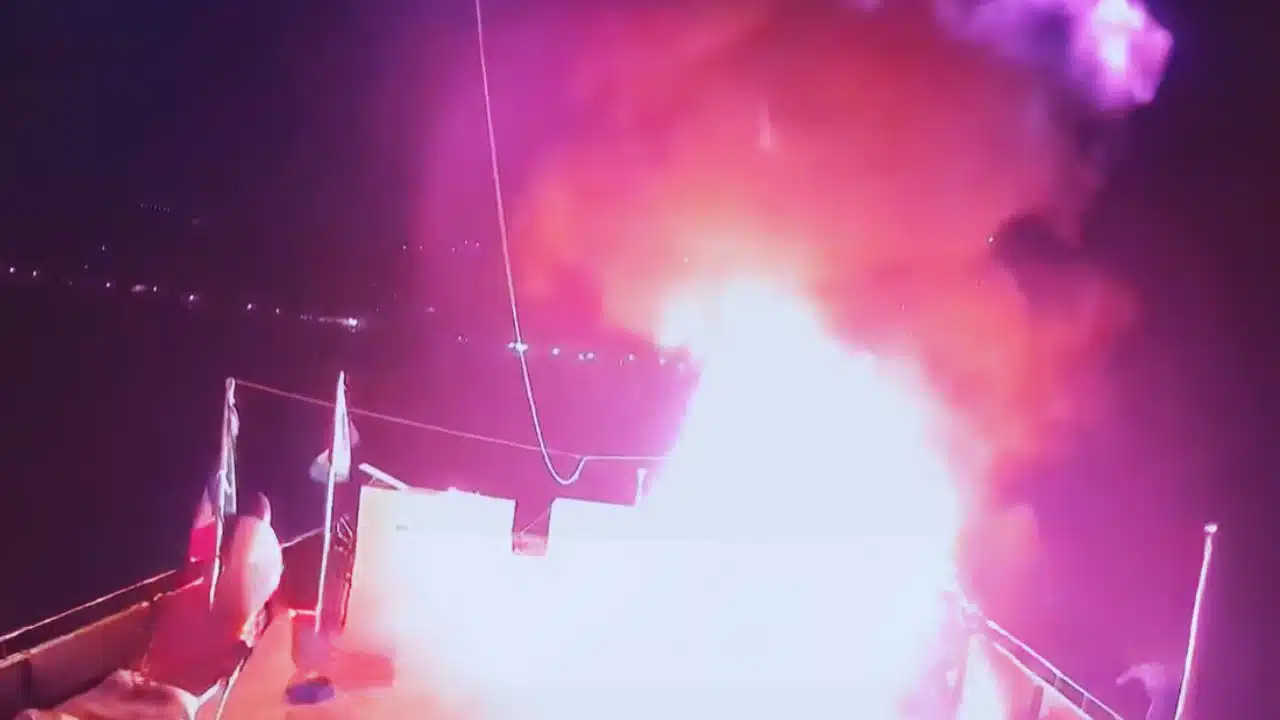
A bombshell News has revealed that Israeli Prime Minister Benjamin Netanyahu personally approved covert military operations targeting two Gaza-bound humanitarian aid ships last month. According to two U.S. intelligence officials briefed on the matter, Israeli forces launched drones from a submarine positioned in the Mediterranean Sea, striking the vessels on September 8 and 9 as they were docked near the Tunisian coastal town of Sidi Bou Said.
The drones allegedly dropped incendiary devices, sparking fires aboard both ships. While no casualties were reported and crews managed to extinguish the flames, the incidents have drawn sharp condemnation from flotilla organizers and renewed scrutiny over the legality of Israel’s long-standing naval blockade of Gaza. The U.S. officials spoke to News Portals on condition of anonymity because they were not authorized to discuss national security matters publicly.
International Law and Humanitarian Concerns
Under international humanitarian law and the laws of armed conflict, the use of incendiary weapons against civilian objects or populations is strictly prohibited. Legal scholars note that if confirmed, these attacks could amount to violations of maritime law and human rights conventions, since the vessels were carrying activists and humanitarian volunteers, not combatants.
The incident highlights the ongoing tension between Israel’s claims of national security and the humanitarian community’s right to deliver aid to besieged populations. Critics say Israel’s actions, if verified, represent a dangerous precedent of targeting civilian missions under the justification of enforcing its blockade.
The Global Sumud Flotilla
The ships attacked — the Family (Portuguese-flagged) and Alma (British-flagged) — were part of the Global Sumud Flotilla, an international maritime campaign aimed at breaking Israel’s blockade of Gaza.
- The flotilla consists of over 40 vessels with participants from 47 countries, including humanitarian workers, lawmakers, activists, and veterans.
- Its stated goal is to deliver food, medicine, water purification systems, and other aid to Gaza’s population, which has suffered under nearly two decades of blockade.
- Among the participants are Swedish climate activist Greta Thunberg, several European parliamentarians, and U.S. veterans, including Marine Corps veteran Jessica Clotfelter and organizer Greg Stoker.
The flotilla has repeatedly stressed that it operates nonviolently and within international maritime law, describing its mission as both a humanitarian lifeline and a political statement against what they call Israel’s policy of “collective punishment.”
Details of the September Attacks
On September 8, the Portuguese-flagged Family was struck. According to flotilla organizers, Portuguese lawmaker Mariana Mortágua had been on board the night before, but attackers waited until high-profile passengers had disembarked. A day later, on September 9, the British-flagged Alma was attacked in a nearly identical manner.
Video footage released by the flotilla — later obtained by News media— shows a fireball descending from above onto one of the vessels, igniting flames. While the stationary cameras did not capture the drones themselves, the group argues the evidence rules out claims that the blaze started from inside the boats or from a mishandled flare gun, as suggested by pro-Israel social media accounts.
Tunisian authorities, however, issued a statement suggesting the initial inspection pointed to an internal explosion aboard the vessel, not an aerial attack. This conflicting account has fueled debate and calls for an independent investigation.
Escalating Harassment at Sea
The flotilla reported additional incidents later in September as it sailed south of Greece. According to organizers:
- At least 15 drones flew at low altitude over the ships.
- 13 explosions were heard around the flotilla.
- Objects were dropped onto at least 10 boats, damaging decks and equipment.
- Communications systems were jammed, disrupting coordination between vessels.
Although no lives were lost, organizers accused Israel of engaging in a pattern of intimidation designed to frighten or disable their mission without provoking global outrage.
Israel’s Naval Blockade and Justifications
Israel imposed its naval blockade on Gaza in January 2009, following Hamas’ takeover of the coastal enclave after a violent conflict with Fatah. The blockade bans most maritime traffic and is enforced by the Israel Defense Forces (IDF).
- Israel argues the blockade is necessary to prevent weapons smuggling to Hamas, which it and several Western governments classify as a terrorist organization.
- Critics, including the United Nations, human rights groups, and the International Committee of the Red Cross, argue the blockade amounts to collective punishment of Gaza’s 2.3 million residents.
- Despite repeated international criticism, Israel has maintained the policy, occasionally easing restrictions under international pressure.
In this case, the Israeli military has not responded to told any News’ request for comment about the alleged drone strikes. Israeli officials often dismiss such flotillas as political stunts or provocations disguised as humanitarian missions.
Reaction from Flotilla Organizers
The Global Sumud Flotilla issued a strongly worded statement:
“Whether the purpose of these attacks was to kill us, scare us away, or disable our boats, they recklessly endangered civilians and humanitarian volunteers. The world must take note: attempts to silence, intimidate, or obstruct our commitment to the Palestinian cause and people will not succeed. We call for urgent, independent investigations into these attacks and full accountability for those responsible.”
The group added that the attacks, if confirmed, expose a “pattern of arrogance and impunity” in Israel’s actions that demand eventual reckoning.
International Fallout
The reports come as Israel has already intercepted most of the flotilla vessels attempting to reach Gaza. Dozens of activists, including Greta Thunberg, European lawmakers, and American citizens, have been detained.
- A U.S. State Department spokesperson told that Washington is monitoring the situation and assisting detained American citizens. However, the spokesperson also criticized the flotilla, calling it a “deliberate and unnecessary provocation” at a sensitive time when the Trump administration is trying to advance a Gaza ceasefire plan.
- European politicians, particularly from Portugal, Spain, and the UK, have demanded answers about the safety of their citizens on board.
- Human rights organizations are calling for a UN-led independent investigation into the Tunisian incidents and Israel’s broader conduct toward the flotilla.
Voices from On Board
American participants have shared emotional testimonies about the experience. Speaking via Zoom to by News media Chicago before the interception:
- Greg Stoker, a U.S. veteran leading a delegation, said: “We are a civilian aid mission, carrying humanitarian supplies in full accordance with international humanitarian and maritime law.”
- Jessica Clotfelter, a Marine Corps veteran, added: “The images coming out of Gaza over the past two years are heartbreaking. I’ve cried every single day on this boat as the violence has escalated since we set off on August 31.”
Their remarks underscore the emotional toll and deep sense of responsibility felt by activists risking detention or worse to challenge the blockade.
What Happens Next
The flotilla episode underscores the deepening rift between Israel and humanitarian groups, as well as between Israel and its allies over the balance between security concerns and humanitarian law. Calls for international investigations are likely to grow louder, especially given the involvement of high-profile activists and lawmakers.
If independent confirmation emerges that incendiary drones were used against civilian aid ships in Tunisian waters, the legal and diplomatic consequences could be severe. For now, flotilla organizers insist their mission is not over, vowing to continue efforts to challenge the blockade and draw global attention to the humanitarian crisis in Gaza.
The Information is Collected from CBS News and BBC.