Have you ever stared at photos of the Swiss Alps and imagined packing your bags for good? It is a beautiful dream. Many people try to make that dream a reality, only to encounter strict rules and confusing paperwork. “Moving to Switzerland: The Hardest Visas to Get” is a popular search for a reason.
Getting in is definitely not a walk in the park. Whether it’s a fresh start in a new job or a long-awaited family reunion, understanding the exact permit categories can make all the difference. Clear knowledge of these permits speeds up planning and reduces stress.
Here are the exact steps to make moving to Switzerland much smoother. Grab a cup of coffee and explore the process together.
Overview of Switzerland’s Visa System
Switzerland sets very clear rules for anyone wanting to live or work there long-term. Every permit has its own set of hoops to jump through. Reading the fine print early on can save you a massive headache later.
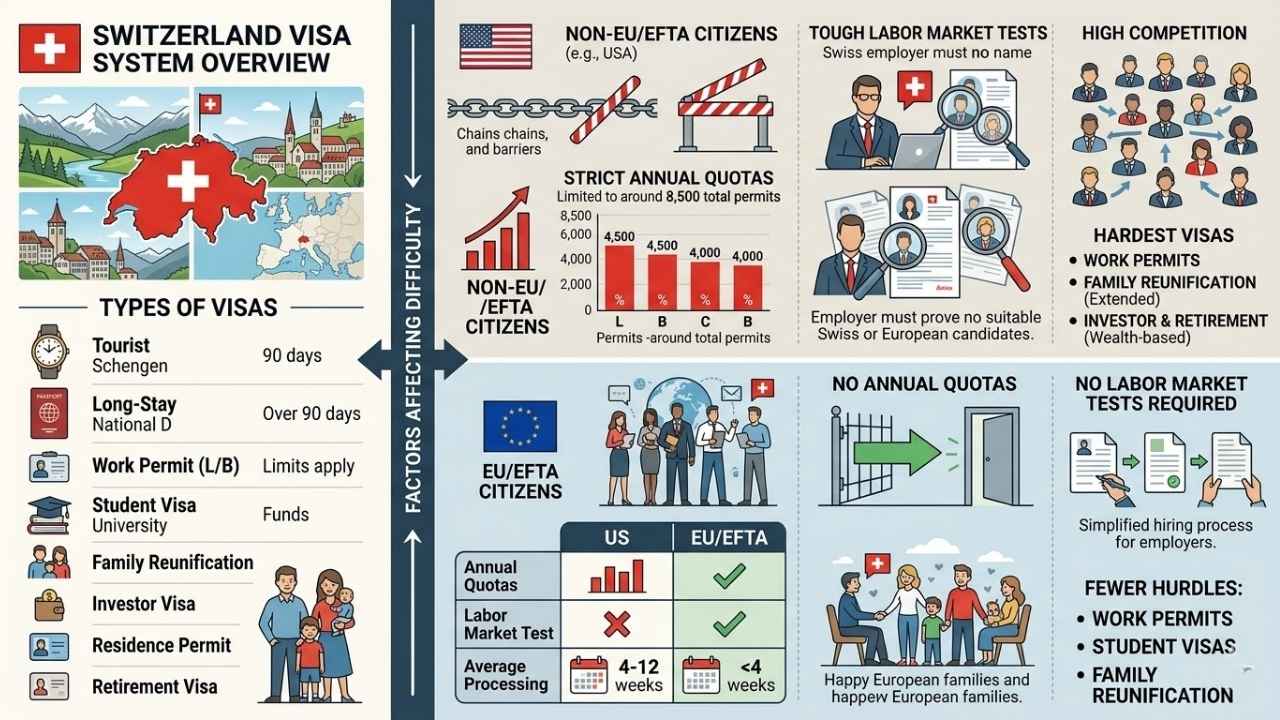
Types of visas available
Moving to Switzerland means you need the exact right paperwork. Your purpose for moving decides your category.
To keep things simple, we can split the most common options into two groups.
- Tourist Visa (Schengen Visa): This lets US citizens visit for up to 90 days within a 180-day period without a special visa.
- Long-Stay Visa (National D Visa): Staying over 90 days? You need this ticket in for work or study.
- Work Permit: Non-EU/EFTA nationals face strict quotas here. A Swiss employer must offer you a job before officials issue this permit.
- Student Visa: You need proof of admission to a Swiss university and enough funds to qualify.
Here are the options for family and long-term living:
- Family Reunification Visa: Spouses and minor children have good chances. Extended family like siblings usually struggle due to tight rules.
- Investor Visa: Only large business investments that benefit the local economy get approval.
- Residence Permit: Anyone staying long-term applies for this after arrival.
- Retirement Visa: Wealthy retirees from the US can apply if they show strong financial stability and health insurance.
General requirements for visa applications
Getting approved is not easy. Officials check every single detail. You need all your documents perfectly organized before applying.
Instead of a massive checklist, focus on these five core categories:
- Application & Identity: You must submit a completed long-stay application form, recent passport photos, and a valid passport with at least two blank pages.
- Financial & Housing Proof: Show bank statements to prove you can support yourself. You also need a rental agreement and valid Swiss health insurance.
- Background Checks: Supply a clean criminal record certificate. Many cantons request this to ensure community safety.
- Travel Details: Show flight reservations or a travel itinerary. Pay the required processing fee, which is often around CHF 100 for a standard permit.
- Specific Category Proof: Work visas require your employer to prove they could not hire a local. Family visas require marriage or birth certificates.
Factors That Make Some Swiss Visas Harder to Obtain
Some Swiss permits feel incredibly slippery and tough to catch. A maze of rules and fierce competition can easily make your head spin.
Strict quotas and labor market tests
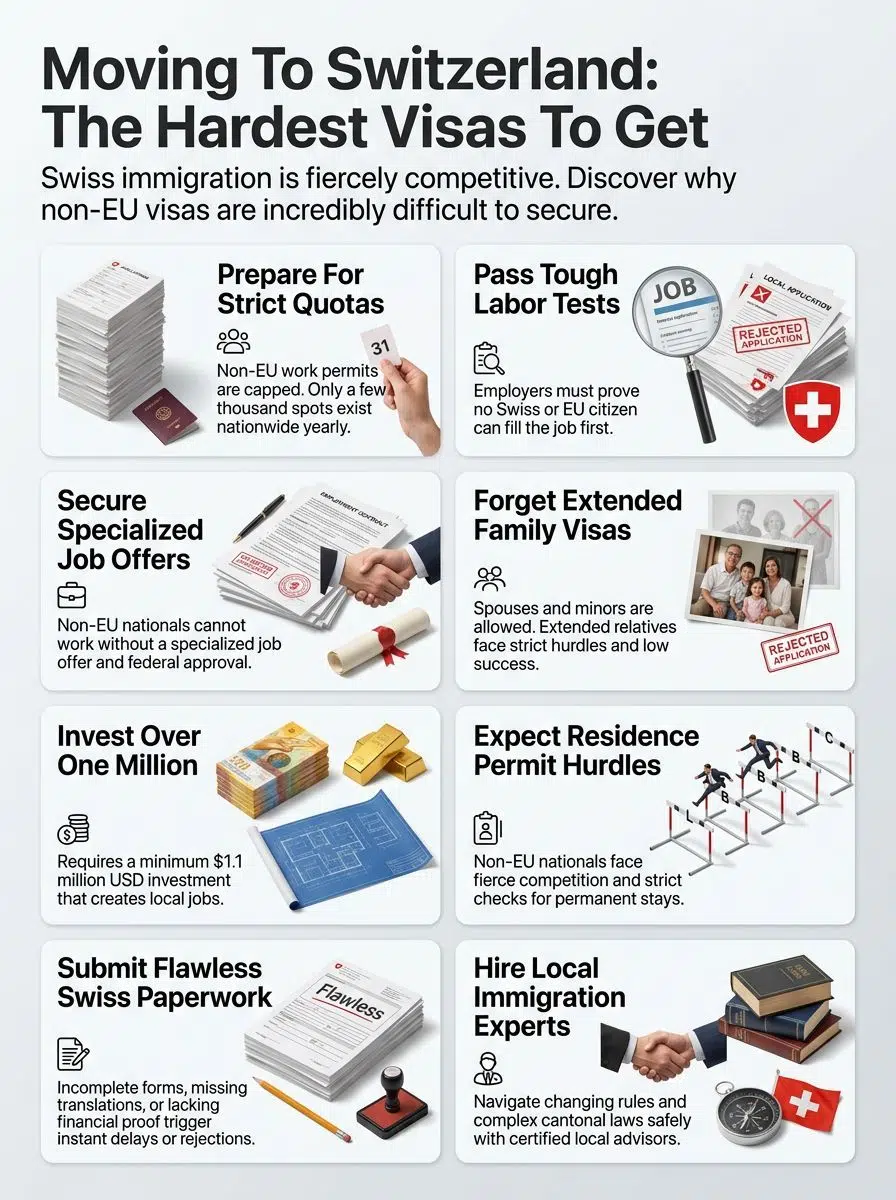
Switzerland limits how many non-EU or EFTA nationals can get work permits each year. In 2026, the government capped these spots at roughly 8,500 total permits for third-country nationals. This includes 4,500 short-term L permits and 4,000 long-term B permits.
Swiss employers must also pass tough labor market tests. They have to prove they could not find a suitable Swiss or European citizen for the job.
This makes the application process slow and very competitive for expats from the USA. Even with a willing Swiss sponsor, you have no guarantee of approval. The national quotas and close government oversight keep the hurdles high.
Preference for Swiss and EU/EFTA nationals
Swiss immigration rules heavily favor people from European Union countries. The Free Movement of Persons Agreement makes moving much easier for these groups. They usually do not face strict quotas or hard labor market tests.
European Union nationals can move with very few requirements. Meanwhile, US citizens must secure a National D Visa just to stay past 90 days.
This preference means non-Europeans face tough competition for every single available slot. Securing immigration status from outside Europe requires patience and perfect timing.
High competition for limited slots
Openings fill up extremely fast for popular categories like investor and work permits. A Swiss employer needs to search locally before offering you a job. This extra step delays the process and makes it even harder to win one of those precious spots.
Standing out is just as important as having strong qualifications. To give you an idea of the gap, look at how different the process is depending on your passport.
| Feature | US Citizens (Non-EU/EFTA) | EU/EFTA Citizens |
|---|---|---|
| Annual Quotas | Yes (Strictly capped around 8,500 total) | No quotas apply |
| Labor Market Test | Required (Must prove no local candidate exists) | Not required |
| Average Processing | 4 to 12 weeks | Usually under 4 weeks |
Moving To Switzerland: The Hardest Visas To Get
The rules shift frequently, and the bar stays incredibly high. Many people end up waiting much longer than they initially planned.
Work visas for non-EU/EFTA nationals
Getting a job offer as an American feels like jumping through hoops. Switzerland sets strict limits on these permits, and spots often run out by mid-year. Only applicants with highly specialized skills usually get through.
The State Secretariat for Migration does a final, rigorous check on every single application. A US citizen cannot just arrive in Zurich and start working. You need to land a job first, then pass checks at both the cantonal and federal levels.
The rules change based on your industry. Tech and engineering jobs have more openings than retail or administration. Many who dream of living in the Alps get frustrated by how hard it is to get a foot in the door.
Family reunification visas for extended relatives
Getting permission for extended relatives can feel like finding a golden ticket. The Swiss government keeps these approvals tightly controlled. Only close family, such as spouses and children under 18, usually get a quick green light.
Extended relatives, like siblings or adult children, face massive hurdles. You must prove you can financially support them without any state aid.
Applications for extended family can stretch out for months with zero promise of success. For many expats, this strict policy means spending holidays away from loved ones.
Investor visa requirements
Investor programs have incredibly strict rules for non-EU applicants. Swiss authorities want to see a real impact on their local economy. You cannot just leave money sitting in a passive bank account.
Wealthy expats generally choose between two specific paths to get this permit:
- The Business Investor Route: You must invest a minimum of CHF 1 million (about $1.1 million USD) into a Swiss company. This business must actively create local jobs.
- The Lump-Sum Taxation Route: This option requires paying a fixed annual tax based on your living expenses, not your income. Depending on the canton, this costs between CHF 250,000 and CHF 1 million every year.
Long-term residence permits
These permanent approvals are tough to get if you hold a US passport. Swiss rules always give preference to their European neighbors first.
You need a valid reason, like continuous employment or marriage, to be considered. The ultimate goal is the C Permit, which grants permanent residency. Most US expats must live in Switzerland for a full 5 to 10 years before they can even apply for it.
The Swiss government maintains strict quotas each year. Even with perfect documentation, approval takes a long time. You really have to keep your ducks in a row.
Challenges Specific to Work Visas
One wrong move, and your chance might disappear completely.
Job offer requirements
Employers must post open jobs on the EURES network to attract European talent first. If no Swiss or European citizen wants the role, then you might get an offer. The bar is extremely high for foreign workers.
Only jobs needing very special skills or senior experience qualify. You also need a written contract as proof of employment for your application. Moving for work remains out of reach without that signed document.
Cantonal and federal approval processes
First, the local canton reviews your application to check your skills and the job offer. They prioritize locals and European neighbors for every open role.
After that local review, federal authorities step in to verify everything matches national quotas. Even with a strong job offer, you may wait 4 to 12 weeks for answers. Heavy competition and paperwork roadblocks cause frequent delays.
About 40% of long-stay applications face extra questions before approval comes through. There are absolutely no shortcuts in this system.
Industry-specific restrictions
Certain jobs are practically impossible for non-EU/EFTA nationals to access. The government protects fields like local law, healthcare, and public services. However, some specific sectors actively look for foreign experts to fill talent gaps.
If you want a better chance of approval, target these high-demand industries:
- Pharmaceuticals and Life Sciences: Companies like Novartis and Roche frequently sponsor specialists.
- Financial Services and Banking: Major firms in Zurich often need international tech and finance experts.
- Information Technology: Software engineers and data scientists remain in high demand across the country.
Tips for the Swiss Visa Process
Getting through the maze takes patience and crystal-clear planning. Even a small slip can send your application back to square one.
Understanding eligibility criteria
Knowing the basic rules is essential before you book a flight. Skipping any step can sink your plans fast. Keep these core rules in mind as you start planning:
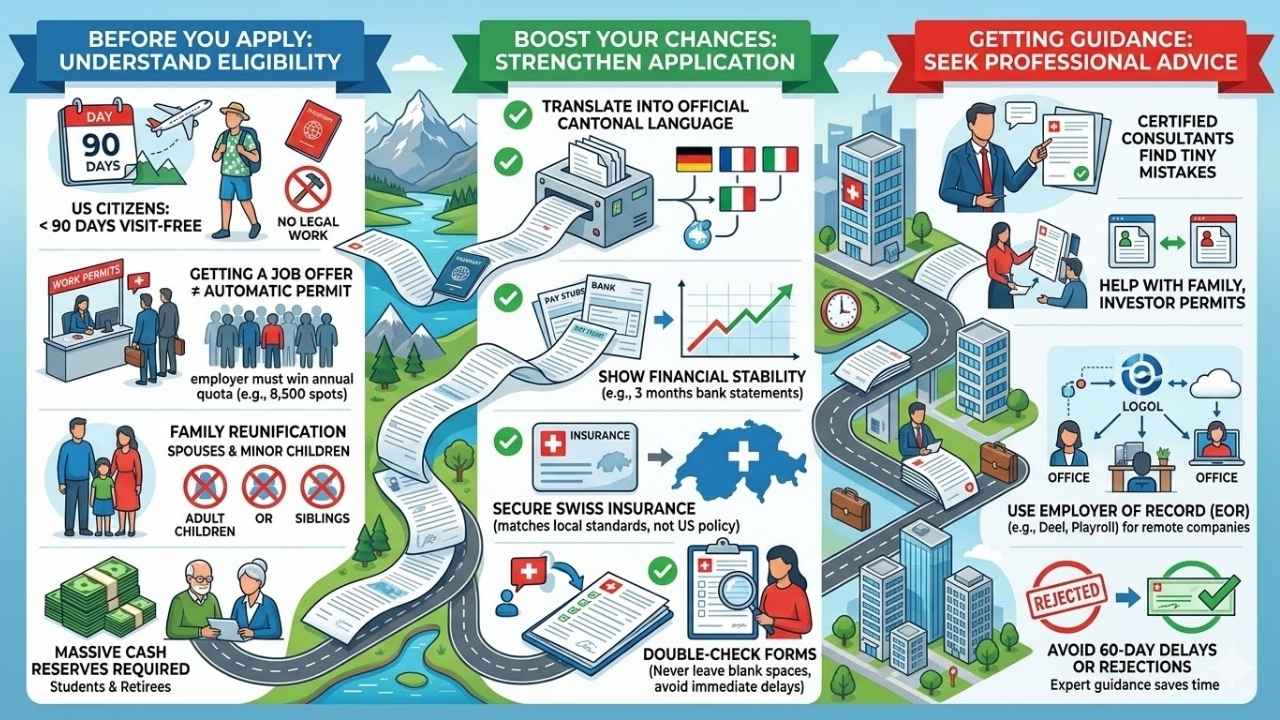
- The 90-Day Rule: US citizens can visit visa-free for under 90 days. You can use this time to interview, but you cannot legally work.
- Work Permit Quotas: Getting a job offer is only step one. Your employer must still win one of the 8,500 annual quota spots for you.
- Family Limitations: Reunification applies to spouses and minor children. Do not expect to easily bring adult children or siblings.
- Financial Scrutiny: Students and retirees must show massive cash reserves to prove they will not burden the state.
Strengthening your application
A strong file stands out immediately to the reviewing authorities. Gather solid proof and present your case as clearly as possible.
Follow these proven steps to avoid common rejection triggers:
- Translate Everything: Get your official papers translated into German, French, or Italian, depending on your canton. This shows immense respect for local laws.
- Show Financial Stability: Include three months of bank statements to prove your steady income.
- Secure Swiss Insurance: You must show proof of health insurance that meets local standards. A standard US policy will not work.
- Double-Check Forms: Never leave a single blank space on your application. Blank spaces are the most common reason for immediate delays.
Seeking professional immigration advice
The rules can leave your head spinning completely. Many Americans think a 90-day visit sounds simple, but the paperwork stacks up fast for longer stays.
Certified consultants can spot tiny errors in your paperwork before you submit it. They help with tricky cases like family permits or investor requirements. Expats also frequently use Employer of Record services like Deel or Playroll if a company does not have a local Swiss office.
A tiny mistake might mean a 60-day delay or a straight rejection. Expert guidance saves a massive amount of time during this stressful process.
Final Thoughts
Moving to Switzerland might seem tough, but understanding the hardest rules helps clear a tricky path. Sticking to each step and organizing your paperwork makes a huge difference. These specific tips mean faster results and fewer headaches as you chase that Alpine dream.
If you feel lost, plenty of trusted advisors can point you in the right direction. Take a deep breath and keep at it with patience. Persistence often opens doors, and we hope this guide to Moving To Switzerland: The Hardest Visas To Get helps you succeed.