Have you ever opened a study app, asked one question, and still felt stuck five minutes later? That is the real AI tutor vs chatbot problem: both use ai, but they help learners in very different ways.
I have tested both kinds of tools, and the gap shows up fast. In June 2026, Stanford’s National Student Support Accelerator reported that giving students access to an ai tutoring platform did not improve reading achievement by itself, partly because many students barely used it, which tells me fit and follow-through matter as much as the technology.
I am going to make this simple, so you can choose the right tool for learning in math, language learning, homework help, and exam prep.
Key Features of Purpose-Built AI Tutors
When I say purpose-built ai tutor, I mean a system designed to teach a subject, not just chat about it. A strong intelligent tutoring system tracks student learning, adjusts difficulty, and uses data to personalize the next step.
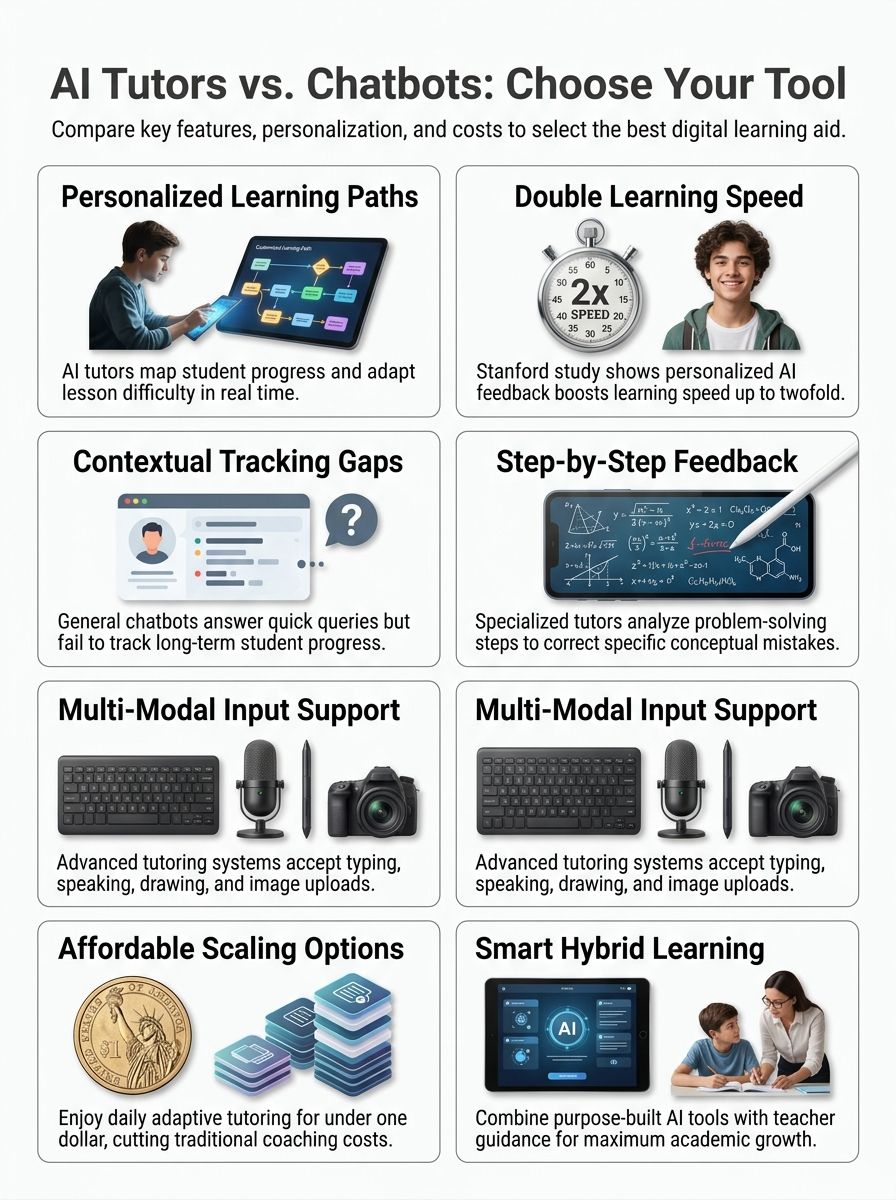
Tailoring Personalized Learning Paths
The best ai tutors do more than answer a question. They build learning paths from a student’s current level, then adapt practice after each success, hesitation, and mistake.
The federal Institute of Education Sciences notes that MATHia is used by over 500,000 middle and high school students each year, and Carnegie Learning says it adapts skill by skill with just-in-time feedback. That matters because a student who keeps missing linear equations should get targeted help on that exact gap, not a random extra worksheet.
DreamBox follows the same idea for K-8 math with real-time dashboards and lesson recommendations for adults. StarSpark uses a parent dashboard, standards-aligned lessons, and multilingual support to keep the path visible instead of mysterious.
- Placement or diagnostic checks: The tool should find the right starting point before practice begins.
- Error tracking: It should remember repeated mistakes and circle back to them.
- Adaptive practice: The next problem should change based on performance, not stay fixed.
- Progress reporting: Parents, teachers, or the learner should be able to see mastery by topic.
For mathematics, this is where purpose-built ai really earns its keep. I want step-by-step feedback that explains why a move works, then builds from easy wins to harder problem-solving.
Enhancing Advanced Assessment Capabilities
If a tool cannot tell you what the student misunderstood, it is not really tutoring.
Advanced assessment is the clearest key difference between an ai tutor and a chatbot. A true tutor checks the work itself, not just the final answer, and it can often accept typed steps, spoken responses, drawings, or uploaded images.
StarSpark is a good example of that model because it lets students type, speak, draw, or upload math work for guided feedback. That kind of multimodal input matters in math and science, where the student’s process is often more important than the final line.
A 2026 Stanford SCALE study of 199 learners adds an important warning. Layered hints felt more supportive, but direct AI feedback led to better learning outcomes than sequenced scaffolds, so I look for a tutor that can switch between a gentle nudge and a clear correction at the right moment.
| Assessment feature | Why it helps | What I check |
| Step-level error analysis | Shows where thinking broke down | I ask the tool to identify the first wrong step, not just the final mistake |
| Multimodal response input | Works better for graphs, handwriting, and diagrams | I test a photo or sketch to see if the feedback stays precise |
| Mastery reporting | Makes future study more focused | I look for weak standards, skills, or topics in a dashboard |
That is how purpose-built ai tutoring platforms move beyond conversation. They assess, adjust, and guide student learning with much more structure.
Key Features of Chatbots for Learning
I still use ai chatbots all the time. A chatbot built on a language model and natural language processing is fast, flexible, and great for one-off help, especially when I need information in real-time.
Providing Instant Query Responses
Chatbots shine when the task is open-ended. I use ChatGPT for brainstorming, quick definitions, outline feedback, coding fixes, and short conversational practice in a new language.
According to July 2026, OpenAI lists ChatGPT Plus at $20 a month, and ChatGPT Voice is available on both free and paid plans with limits that vary by plan. For language learning, Duolingo Max adds Roleplay and Video Call, and Duolingo now offers Explain My Answer for free, which makes quick correction easier even outside its premium tier.
- Homework snags: Good for quick clarification on one concept.
- Writing support: Useful for outlines, revisions, and tone checks.
- Language conversation: Helpful for low-pressure speaking prompts and vocabulary review.
- Coding help: Strong for debugging and explaining isolated errors.
That speed is the biggest advantage of conversational ai. If the learner already has decent judgment and just needs a fast push, a chatbot can be an excellent ai tool.
Addressing Limited Contextual Understanding
The weakness appears after the first good answer. Even when a chatbot can use memory inside a conversation, it usually does not keep a real mastery map, a standards tracker, or an error log that automatically drives the next lesson.
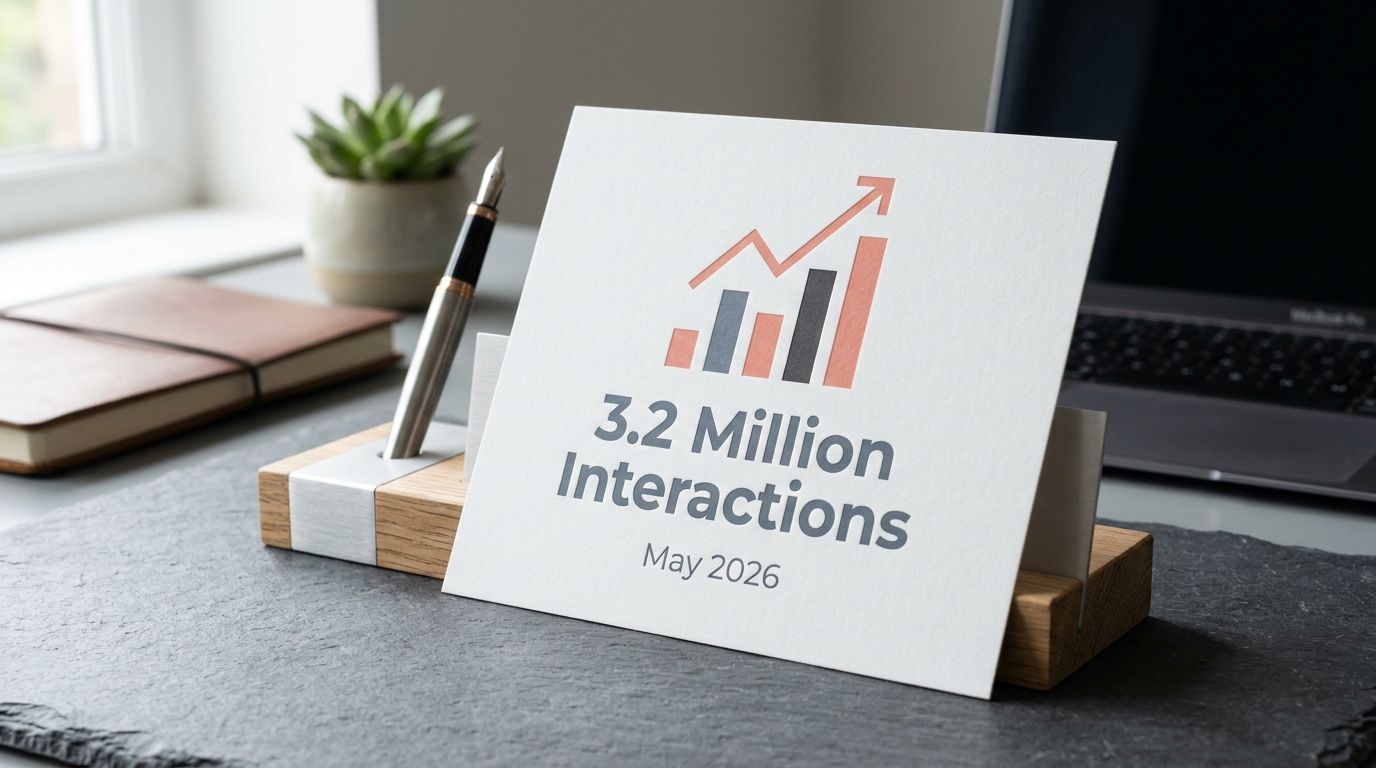
A May 2026 preprint from researchers at the University of California, Irvine and McGraw Hill tracked 3.2 million ALEKS learning interactions and found that time spent on ai-susceptible math problems fell after generative ai became common, while performance on proctored retention items for those same problem types also weakened. Faster completion felt productive, but durable learning did not necessarily improve.
A quick reply can remove friction. It cannot replace a learning plan.
- Too much answer giving: Students can skip productive struggle.
- Weak long-term tracking: The bot may not build a true record of learning patterns.
- Prompt dependence: Results depend heavily on how well the learner asks for help.
- Shallow assessment: Most traditional chatbots do not run built-in mastery checks.
If I use ai chatbots for schoolwork, I force them into tutor mode. I ask for one hint, one question back to me, or a check of my next step instead of a complete solution.
Core Differences Between AI Tutors and Chatbots
The ai tutoring vs chatbot debate gets much clearer once I stop asking which tool is smarter and start asking which tool is built for learning outcomes. The key difference is structure: one system is meant to guide mastery, while the other is meant to respond to prompts.
Level of Personalization
A purpose-built ai tutor personalizes through learning paths, performance history, and ongoing assessment. It can personalize practice, pacing, and review because it knows what the learner has already done.
Khanmigo sits on Khan Academy content, MATHia adapts skill by skill, and StarSpark maps work to standards with guided support. A general chatbot can personalize its tone and examples, but it still depends on what the user asks next.
Contextual Understanding
Contextual support means understanding why a student is stuck, not just what answer they want. That is where ai-powered tutors usually beat traditional chatbots, especially in mathematics and test prep.
Human tutors still matter here because they read body language, hear hesitation, and adjust their teaching style in the moment. That human capabilities layer is still hard for ai systems to simulate.

In June 2026, Stanford’s National Student Support Accelerator reported that adding human support raised engagement with an ai tutor by 71% to 80%. That is why I like a hybrid model for learners who need accountability as much as explanation.
Learning Support Features
Learning support features are where the gap gets practical. A strong ai platform should do more than chat, it should support the full learning experience around the conversation.
- Progress dashboards: Show mastery by skill, strand, or standard.
- Parent or teacher visibility: Make it easier to guide a child without guessing.
- Practice tests and checkpoints: Turn information into measurable progress.
- Multilingual and multimodal support: Help students speak, type, draw, or upload work.
Khan Academy says parents can view a child’s Khanmigo chat history and receive moderation alerts, which is a meaningful safeguard for a child. StarSpark highlights parent dashboards and support for more than 16 languages, which makes learning support broader and easier to supervise.
Scalability and Availability
Scalability is the big reason schools and families use ai solutions in the first place. A human tutor helps one learner at a time, while ai tutoring platforms can guide thousands of students in real-time and stay available around the clock.
According to July 2026, OpenAI lists ChatGPT Plus at $20 a month, Khanmigo lists $4 a month or $44 a year for parents and learners, and current U.S. tutoring marketplaces often list private tutoring around $25 to $80 an hour. That cost spread matters if you want daily help instead of one weekly tutoring session.
| Option | Best use cases | Availability | Tracking depth | Typical U.S. entry cost |
| General chatbot | Brainstorming, quick answers, open-ended conversation | 24/7 | Low | Free to $20 per month |
| Purpose-built ai tutor | Personalized learning, homework, exam prep, guided problem-solving | 24/7 | Medium to high | About $4 per month at the low end, platform dependent |
| Human tutor | Motivation, accountability, complex confusion, emotional support | Scheduled | High interpersonal depth | Often $25 to $80 per hour |
That is why many families use ai and traditional tutoring together. The ai handles daily practice and instant feedback, while the human tutor or teacher handles judgment, motivation, and deeper course correction.
AI Tutor vs Chatbot: Which Should You Choose?
If I need mastery, I choose the purpose-built ai tutor. If I need speed, flexibility, or open-ended conversation, I choose the chatbot.
- Choose an ai tutor for math: It is better for step-by-step reasoning, error tracking, and adaptive learning.
- Choose an ai tutor for younger learners: Parent dashboards, guardrails, and progress visibility matter a lot for a child.
- Choose an ai tutor for exam prep: I want practice tests, mastery checks, and a clear path from weak areas to stronger ones.
- Choose a chatbot for writing and brainstorming: It is faster for idea generation, editing, and conversational help.
- Choose a chatbot for language conversation: It works well for short speaking prompts and casual back-and-forth practice.
- Choose a hybrid model if possible: Use ai for daily reps, then bring in a teacher, parent, or human tutor for motivation and judgment.
For readers making the right choice on budget, structure matters as much as price. A low-cost, purpose-built tool like Khanmigo can be a better tool for learning than a broader chatbot if the student needs guided practice, while free or low-cost chatbot access may be enough for older, independent learners who already know how to ask strong questions.
I also separate subjects in my head. For mathematics, I lean toward intelligent tutoring system features and adaptive learning; for language, I mix conversational practice from tools like ChatGPT or Duolingo Max with structured review from dedicated language apps; for research, coding, and open-ended tasks, general ai chatbots usually win on range.
ChatGPT, Claude, and Gemini are strong for broad text-based conversation, but they are still not substitutes for a purpose-built ai platform that can analyze student performance and guide students through a planned sequence. That is the core of what’s the difference.
Wrapping Up
A real ai tutor is built to teach, measure, and personalize. A chatbot is built to respond quickly and flexibly, which is useful, but it is a different job.
If I am choosing for a child or for serious exam prep, I start with the structured tutor and add chatbots as a secondary layer. Used well, ai can enhance traditional methods, support teachers and parents, and create a clearer learning environment with faster feedback and better long-term progress.
Frequently Asked Questions on AI Tutor vs Chatbot
1. What is the main difference between a purpose-built AI tutor and a chatbot?
A purpose-built AI tutor is a teaching agent that plans lessons, gives practice, and tracks progress. A chatbot, a virtual assistant, answers quick questions and holds a chat, but it may not guide deep learning.
2. How do I decide, when making the right choice?
List your goal, your time, and how much help you want, then match the tool. If you want steady study pick a tutor, if you want fast help pick a chatbot.
3. Can I use a purpose-built AI tutor with khan academy?
Yes, many tutors link to learning sites like khan academy, to pull lessons and exercises. That makes study smoother, and keeps your work in one place.
4. Are chatbots cheaper or faster to set up than tutors?
Yes, chatbots are often cheaper and quicker to launch, they run on scripts and simple data. Tutors need lesson plans, tracking, and more setup, but they teach better over time.