In a significant development in the ongoing AI talent war, Ruoming Pang, Apple’s head of foundation model development, has left the company to join Meta. According to a detailed report by Bloomberg, Pang is the latest high-profile AI expert to be recruited by Meta CEO Mark Zuckerberg for the tech giant’s newly formed Superintelligence Lab, a unit dedicated to advancing Artificial General Intelligence (AGI).
This move marks another blow to Apple’s internal AI ambitions and reflects the growing competition among big tech firms to dominate the next era of artificial intelligence.
Pang’s Role at Apple and His Departure
Ruoming Pang was responsible for leading Apple’s in-house team that developed AI foundation models—the powerful systems behind new features branded under “Apple Intelligence.” These models play a critical role in powering upcoming AI-based functionalities on iPhones, iPads, and Macs, such as personalized notifications, email summarization, real-time writing assistance, and the long-anticipated upgrade to Siri.
However, despite Apple’s branding push, its AI capabilities have faced internal and external criticism. Industry analysts and tech insiders have repeatedly pointed out that Apple’s models lag behind those of OpenAI, Anthropic, Google DeepMind, and even Meta, especially in terms of conversational intelligence, versatility, and speed.
According to Bloomberg sources familiar with the matter, Pang’s exit is being seen as a warning sign that all is not well within Apple’s AI department. Insiders suggest that the AI models team has experienced internal tension, partly due to Apple’s indecision on whether to rely solely on its own models or integrate third-party AI from more advanced providers.
Meta’s Superintelligence Lab and Its Aggressive Hiring Strategy
Pang’s new role at Meta places him in the company’s ambitious AI superintelligence division, which was launched in June 2025 under the leadership of Alexandr Wang, the co-founder and former CEO of Scale AI. The unit is part of Meta’s broader strategy to leap ahead in the race to develop Artificial General Intelligence—AI that can match or surpass human-level cognition across a wide range of tasks.
Zuckerberg’s new lab is not just a research outfit—it’s a tactical initiative to attract the best AI minds from across the tech industry. In recent months, Meta has aggressively hired top-tier experts from OpenAI, Google DeepMind, Anthropic, and other leading firms. Pang now joins this elite team of researchers and engineers, bringing with him a deep understanding of on-device AI models—a niche where Apple still holds a technical edge due to its focus on privacy-preserving, offline computation.
Analysts say Pang’s expertise in designing lightweight AI systems that run locally on smartphones could help Meta accelerate its efforts to build smaller, faster, and more efficient models for applications in VR/AR, smart glasses, and next-gen computing.
A Broader Pattern: Apple’s AI Struggles and Leadership Shake-Ups
While Pang’s departure is grabbing headlines, he is not the first to leave Apple’s AI division in recent months. In fact, his exit follows that of other senior engineers and managers who have either quit or been reassigned. Sources close to the matter say Apple’s internal AI team has been under immense pressure to catch up with industry leaders, yet it remains fragmented in terms of vision and strategy.
Apple has been experimenting with a hybrid model—using both its own AI systems and third-party models from OpenAI and possibly Google—to power features in iOS 18 and macOS Sequoia. This lack of full confidence in its own models is said to be a key reason for growing frustration among the AI teams.
Bloomberg reports that Apple has been in talks with OpenAI to integrate GPT-4 or a customized version into the new Siri, and there are rumors that Google’s Gemini could be used in certain markets. This hybrid approach has led to speculation that Apple may de-emphasize its in-house AI development in the near future—making Pang’s decision to leave seem less surprising in hindsight.
Meta’s Long-Term Vision and Strategic Advantage
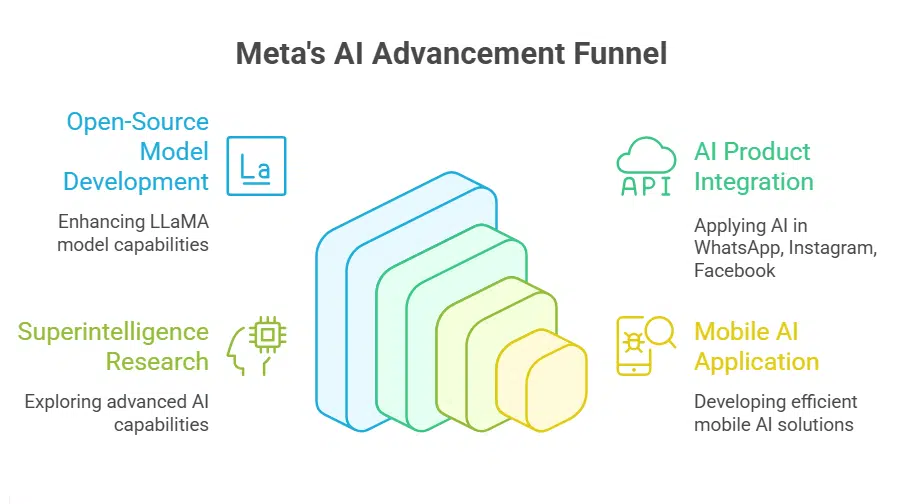
Zuckerberg’s recruitment of Pang fits neatly into Meta’s long-term vision for AI supremacy. The company already has one of the most powerful open-source model families—LLaMA (Large Language Model Meta AI)—and has been scaling up efforts to apply AI in products like WhatsApp, Instagram, Facebook, and the Meta Quest platform.
But the real game-changer is Meta’s move into superintelligence research, a domain that goes beyond chatbot-like performance to aim for general reasoning, learning, and decision-making—qualities that would power autonomous agents, robots, and smarter digital assistants.
By securing talent like Ruoming Pang, Zuckerberg is sending a strong signal that Meta intends to lead—not follow—in the race toward superintelligent AI. With Pang’s skills in compact and efficient model design, Meta could also close the gap on mobile-first AI applications, an area where Apple traditionally excelled.
Industry Reaction and What’s Next
Pang’s move has sparked conversations across Silicon Valley and Wall Street. Some view it as an individual career upgrade, but many see it as a broader reflection of Apple’s stalled AI momentum. Investors are beginning to question Apple’s long-term position in the AI race, especially when rivals are launching major innovations nearly every quarter.
Apple has yet to issue an official statement about Pang’s departure. However, according to internal reports, Zhifeng Chen, another seasoned researcher within Apple, has stepped in to lead the foundation models team. The transition plan is still unclear, and it remains to be seen whether Apple will double down on in-house development or continue to outsource large parts of its AI stack.
Ruoming Pang’s decision to leave Apple and join Meta is more than a personnel shift—it’s a symbolic moment in the tech industry’s battle over AI leadership. As Meta builds out its Superintelligence Lab and continues to pull talent from its competitors, Apple is left reassessing its AI strategy amid internal shake-ups and increasing external pressure.
The coming months will be crucial in determining whether Apple can stabilize its AI unit or whether more high-profile exits will follow. In the meantime, Meta is pressing full speed ahead—armed with deep pockets, elite talent, and a bold vision of the future.