
In a significant stride towards achieving self-reliance in a technology poised to reshape the global economy, the Indian government has launched eight ambitious projects to build indigenous foundational artificial intelligence models. This move, a cornerstone of the Made in India AI strategy, aims to create sovereign capabilities, reduce dependency on foreign technology, and develop AI solutions tailored to India’s unique linguistic diversity and societal needs.
The initiative, announced on September 18 by the Ministry of Electronics and Information Technology (MeitY), falls under the umbrella of the ambitious IndiaAI Mission. It directs substantial resources towards a consortium led by IIT Bombay, tech giant Tech Mahindra, and analytics firm Fractal Analytics, among others, to build a new generation of Large Language Models (LLMs) and domain-specific AI. This concerted push is designed to position India not just as a consumer, but as a creator and exporter of next-generation artificial intelligence.
At the heart of this strategy is the recognition that true digital sovereignty in the 21st century requires control over the fundamental building blocks of AI. By developing its own foundational models, India seeks to ensure its data is processed within its borders, its diverse languages are accurately represented, and its critical sectors—from agriculture to defence—are powered by homegrown, trustworthy technology.
Key Facts & Quick Takes
- Massive Government Investment: The IndiaAI Mission is backed by a total five-year outlay of ₹10,372 crore (approx. $1.24 billion). (Source: Press Information Bureau)
- Flagship Project: A consortium led by IIT Bombay (BharatGen) has been sanctioned ₹988.6 crore to build a state-of-the-art, 1-trillion parameter foundational model, placing it among the most powerful in the world.
- Compute Power Boost: The mission aims to establish a massive public-private AI computing infrastructure of over 10,000 Graphics Processing Units (GPUs), with over 38,000 reportedly already onboarded via the IndiaAI Compute Portal.
- Lagging Private Investment: Despite strong government push, India’s private AI investment in 2023 was $1.4 billion, ranking tenth globally. This is significantly behind the United States’ private investment of $109.1 billion and China’s $9.3 billion in 2024.
- Economic Impact Projection: NASSCOM estimated in 2020 that data and AI could add between $450 billion and $500 billion to India’s GDP by 2025, highlighting the immense economic stakes.
Context: The Global AI Race and India’s Sovereign Strategy
The global landscape of artificial intelligence is currently dominated by a handful of corporations and countries, primarily the United States and China. Foundational models like OpenAI’s GPT series or Google’s Gemini have demonstrated transformative capabilities, but they are trained predominantly on Western data and cultural contexts.
For India, a nation with 22 scheduled languages and thousands of dialects, this presents both a challenge and an opportunity. A core objective of the Made in India AI initiative is to create models that are not only multilingual but also culturally and contextually aware.
This strategic pivot was recently articulated by Shireesh B Kedare, Director of IIT Bombay, the institution leading the most ambitious of the new projects. Speaking to news agency ANI in September 2025, Kedare emphasized the need for technological self-determination.
“Indians should work with Indian languages. Indians should work with Indian concepts. We need not convert everything to English and use the AI models which are basically in English. So this is a sovereignty that I think is very important, and IIT Bombay is committed to that,” Kedare stated. (Source: Awaz The Voice)
His statement underscores the national mission to create AI that is “not owned by any private company” but by an entity under IIT Bombay, ensuring it remains a national resource.
What Happened: The Eight Foundational Projects
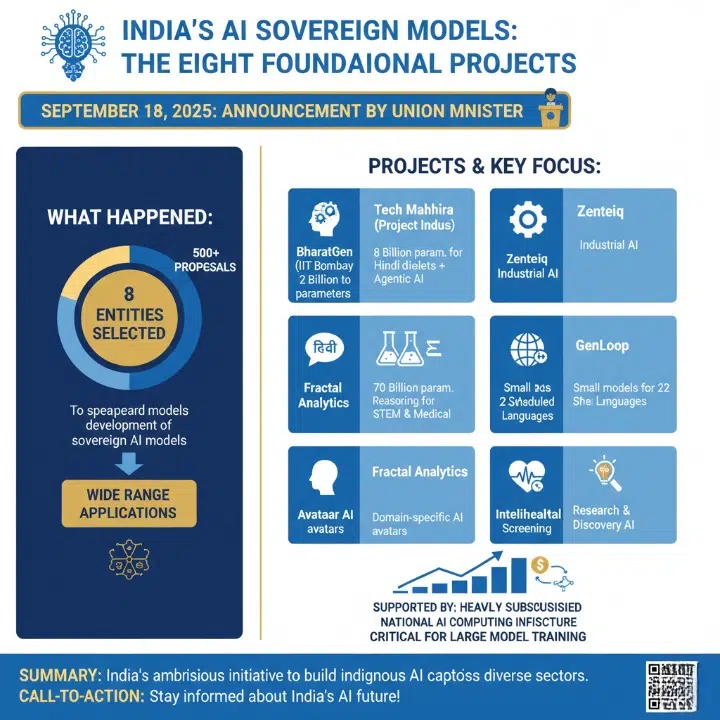
On September 18, 2025, Union Minister for Electronics and IT, Ashwini Vaishnaw, announced the selection of eight entities to spearhead the development of these sovereign models. The projects were chosen from over 500 proposals and span a wide range of applications:
- BharatGen (IIT Bombay Consortium): Tasked with building open-source models ranging from 2 billion to an unprecedented 1 trillion parameters.
- Tech Mahindra (Project Indus): Focusing on an 8-billion parameter model for Hindi dialects and an “agentic AI” platform for government applications.
- Fractal Analytics: Developing a large reasoning model (up to 70 billion parameters) for STEM and medical problem-solving.
- Other key players include Avataar AI (domain-specific AI avatars), Zenteiq (industrial AI), GenLoop (small models for all 22 scheduled languages), Intellihealth (AI for neurological screening), and Shodh AI.
These initiatives will be supported by heavily subsidised access to the national AI computing infrastructure, a critical resource given the immense computational power required to train large models.
Latest Data & Statistics: Bridging the Compute and Investment Gap
India’s commitment to building a robust AI ecosystem is backed by significant public investment.
- Total Mission Outlay: The Union Cabinet approved the IndiaAI Mission in March 2024 with a budget of ₹10,372 crore over five years.
- GPU Infrastructure Target: A core component of the mission is the establishment of a supercomputing capacity comprising over 10,000 GPUs, which will be made accessible to startups, academia, and researchers to democratise AI development. The government aims to make this compute power available at highly subsidised rates.
- Private Investment Landscape (2023-2024): A United Nations (UNCTAD) report from April 2025 places India’s private AI investment at $1.4 billion in 2023. While this makes India a top-ten destination, it pales in comparison to the $109.1 billion in US private investment and $9.3 billion in China during 2024, according to the Stanford AI Index 2025 Report. This highlights a critical gap that the government’s public funding aims to catalyse and close.
| Country | Private AI Investment | Year |
| United States | $109.1 Billion | 2024 |
| China | $9.3 Billion | 2024 |
| India | $1.4 Billion | 2023 |
| Comparison of Private AI Investment. Note the difference in reporting years. |
Impact on People: From Farm to Clinic
While the development of foundational models is a long-term strategic goal, the impact of applied AI is already being felt across India, particularly in agriculture.
In a pilot project in Andhra Pradesh and Karnataka, Microsoft, in collaboration with the International Crops Research Institute for the Semi-Arid Tropics (ICRISAT), developed an AI-powered sowing app. By providing optimal sowing dates based on predictive analytics, the app helped farmers achieve a 10% to 30% increase in crop yield per hectare.Similarly, the “Saagu Baagu” project in Telangana, part of a World Economic Forum initiative, equipped 7,000 chilli farmers with AI-based quality testing and digital marketplace access. The results were transformative: a 21% increase in yield per acre and a 9% reduction in pesticide use.
Krishna Kumar, the founder of agritech firm CropIn, which has digitised over 13 million acres of farmland, explained the vision in an interview with The Enterprise World. “I started CropIn with a vision to improve farmer livelihoods and increase per-acre value for smallholder farmers. The goal is today a reality,” he said, highlighting the tangible benefits of bringing data-driven intelligence to the agricultural heartland.
What to Watch Next
The coming months will be critical for the Made in India AI mission. The first versions of the newly commissioned foundational models are expected to be ready by the India-AI Impact Summit scheduled for February 2026. The successful deployment and adoption of these models by India’s vibrant startup ecosystem will be the true test of this strategy.
Furthermore, NASSCOM, India’s premier tech industry body, is reportedly planning to develop local benchmarks for testing AI models built for Indian languages. This is a crucial step to ensure that homegrown models are accurately evaluated for their effectiveness in the Indian context, rather than being judged solely by Western standards.
However, challenges remain. A significant talent gap in AI skills persists, a concern recently flagged by Finance Minister Nirmala Sitharaman. Bridging this gap through education and reskilling initiatives will be paramount to harnessing the full potential of this technological wave.
India stands at a pivotal moment. With a decisive push from the government, a deep pool of technical talent, and a massive domestic market, the nation is making a bold play for AI sovereignty. The launch of the eight foundational model projects is not merely a technological upgrade; it is a declaration of intent. By building an AI ecosystem that is for India, and ultimately for the world, the country is laying the digital foundations for its ambition to become a leading power in the 21st century.