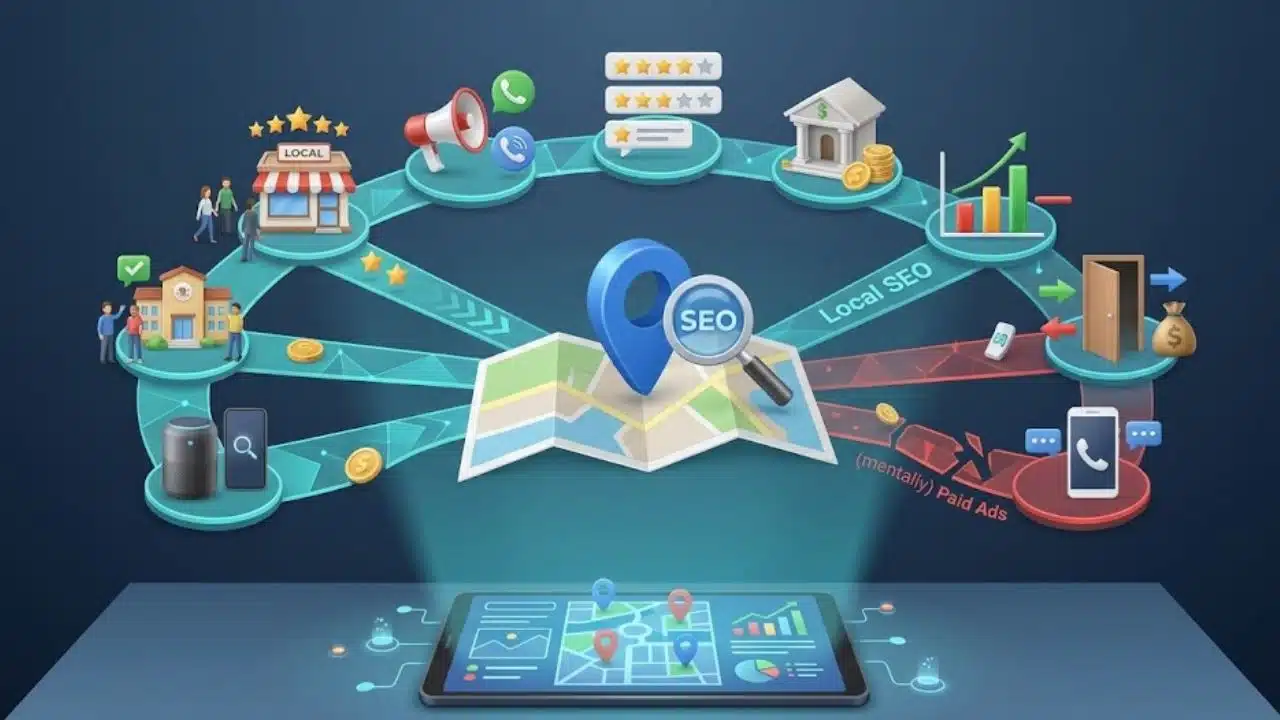
Most small businesses waste weeks building local citations while their Google profile still displays incorrect store hours. The most effective local SEO tactics for small businesses solve this prioritization problem by optimizing three critical search factors: data accuracy, local relevance, and brand prominence.
To rank in Google’s Map Pack and AI Overviews, small businesses must focus on high-impact optimizations: claim and fully complete a Google Business Profile, implement local schema markup, maintain NAP consistency across top directories, optimize location pages, and systematically earn customer reviews. Fixing core profile data first creates the baseline needed for local search visibility.
What Most Local SEO Lists Miss
Local rankings are not fixed across an entire town. Google mainly considers relevance, distance, and popularity, with its detailed guidance describing the third factor as prominence, or how well-known a business is.
A company can improve its relevance and prominence. It cannot change how far it is from the person searching. A respected electrician may appear prominently near its base but become less visible across town. This is normal, not automatic evidence that the SEO campaign has failed.
1. Verify and Complete the Google Business Profile
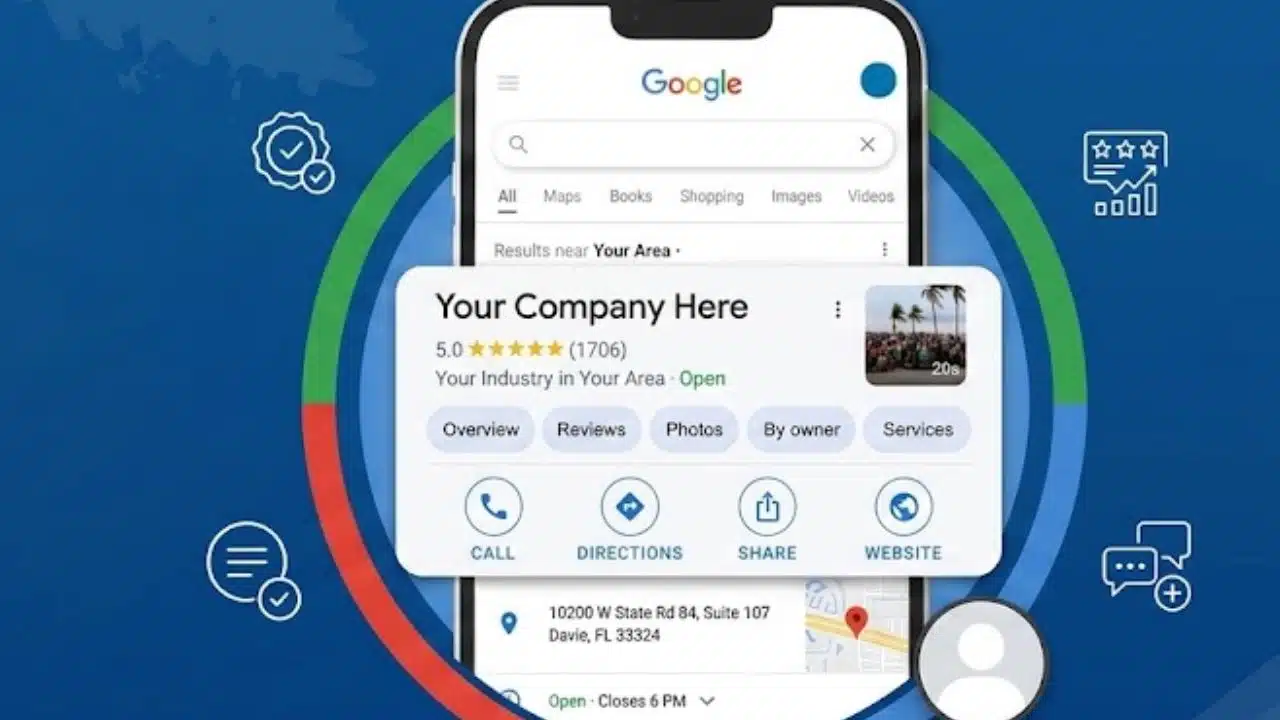
For many prospective customers, the Google Business Profile will be their first substantial contact with the company. Treat it as a working business asset rather than a listing completed once and forgotten.
Use the real name shown on signs and customer-facing materials. Adding services or city names that are not part of the business name can violate Google’s guidelines. Check the phone number, website, category, hours, holiday hours, description, photographs, and available attributes.
A service-area business that visits customers but does not receive them at its address should hide that address. Google currently allows up to 20 service areas and advises keeping the overall boundary within roughly two hours’ driving time of the business base in most cases.
Do not create profiles for virtual offices or rented mailboxes. A co-working location must meet Google’s requirements for signage, staffing, and receiving customers. Photos and posts can help customers understand the business, but neither should be treated as a guaranteed ranking shortcut.
2. Choose the Category That Describes the Core Business
The primary category should explain what the company is, not catalogue everything it sells. A specialist nail salon should choose the closest specific category instead of using a broad salon label. Additional categories can cover genuine secondary operations, but Google recommends using as few as necessary.
Category stuffing is not useful. A bookshop that serves coffee does not automatically need to present itself as a coffee shop, particularly when books remain the main business.
3. Create a Repeatable Review Request Process
Reviews help customers judge a business, and Google confirms that review count and positive ratings can contribute to local prominence.
Make requesting them part of the normal customer follow-up. A direct review link or QR code can be included in:
- Post-service emails
- Receipts or thank-you cards
- Support follow-ups
- A discreet sign near the checkout
The request must remain neutral. Do not offer discounts, gifts, loyalty points, or competition entries. Google also prohibits review gating, such as sending happy customers to Google while directing unhappy customers to a private feedback form.
Avoid pressuring people to leave five stars or mention a particular employee. A legitimate request asks for an honest account of the experience.
Responses should be equally genuine. A brief reply that refers to the customer’s comment is better than repeating the same thank-you message under every review. Complicated complaints and private information belong in a direct conversation.
4. Give Every Genuine Location a Useful Page
A separate page is appropriate for each staffed location. It should contain more than a city name inserted into reused copy. Include the correct address, local phone number, customer-facing hours, available services, directions, parking or accessibility information, and original photographs where possible. A branch that offers fewer services than the main location should say so clearly.
Local details are valuable because they help someone decide whether that branch can solve the immediate problem. They also give search engines a distinct page to associate with the location.
Do not create pages for every surrounding suburb when the business has no presence or useful information there. Substantially similar regional pages that funnel visitors to one destination can fall under Google’s doorway-abuse policy.
5. Match Pages to the Searcher’s Actual Need
Local optimization should make a page clearer, not repetitive. A Manchester emergency plumber page should explain the urgent problems handled, operating hours, realistic coverage, and call-out limitations. Repeating “Manchester plumber” in every paragraph adds no practical value.
Separate pages are justified when the services differ meaningfully. Boiler repair and drain cleaning may need their own pages because the questions and booking decisions are different. Slight keyword variations usually do not deserve separate content.
6. Correct the Listings Customers Are Likely to Use
Google may compile business information from the company website, licensed data, third parties, business owners, and users. Conflicting information can therefore spread beyond one directory.
Claim relevant listings on Apple Maps through Apple Business, Bing Maps through Bing Places, established industry directories, and suitable regional associations.
Concentrate on consequential errors: wrong phone numbers, old addresses, duplicate locations, inaccurate hours, and links to unrelated pages. Spending hours changing “Street” to “St.” across obscure directories is unlikely to be the best use of a small business’s budget.
7. Use LocalBusiness Structured Data Carefully
Structured data gives search engines machine-readable information about a business. Use the most specific appropriate LocalBusiness subtype and include accurate, visible properties such as the name, public address, telephone number, URL, coordinates, and opening hours.
There are two common mistakes here.
First, a service-area business should not publish a private residential address merely to complete the markup. Second, a company should not copy its Google rating into self-serving review markup and expect review stars in organic results. Businesses controlling reviews about themselves are not eligible for Google’s review-star feature on their own LocalBusiness or Organization pages.
Validate the markup with Google’s Rich Results Test after implementation and again after major template changes. Correct schema can clarify information, but it does not guarantee a rich result or higher ranking.
8. Earn Links Through Real Local Relationships
Local link building is often simpler than agencies make it sound. Chambers of commerce, professional associations, suppliers, charities, community events, trade publications, and regional news outlets can all provide relevant mentions.
A neighbourhood accountancy firm may gain more from a legitimate regional business profile and a local newspaper mention than from hundreds of low-quality directory submissions.
Bulk link packages and automated exchanges are poor substitutes. They create links, but not necessarily credibility.
9. Publish Content That Changes With the Location
Local content is worthwhile when geography changes the answer. Useful examples include service boundaries, seasonal conditions, neighbourhood comparisons, event information, regional costs, and local regulations.
A landscaping company could explain which plants cope with the area’s soil and weather. A delivery company could clarify which postal codes qualify for same-day service.
Legal, tax, permit, building, and safety information requires careful sourcing and regular review. One reliable regional resource is more useful than dozens of generic articles with different city names.
10. Measure Enquiries, Not One Ranking Position
A ranking report cannot show the whole result because local visibility changes by place and context. Google Business Profile performance can report website clicks, direction requests, supported bookings, and call-button clicks. That last distinction matters: a recorded call represents a click, not proof that someone connected or became a customer.
Search Console adds query, page, country, device, impression, and click data. Review these alongside:
- Forms, bookings, calls, and direction requests
- Location pages attracting qualified visits
- Incorrect edits, duplicate listings, and unanswered reviews
- Leads and revenue associated with local search where reliable tracking exists
A business can lose impressions and still improve if a greater share of visitors become worthwhile enquiries.
Final Thoughts
Start with the unglamorous work: correct the main profile, choose the right category, fix the website details, and establish an honest review process. These local SEO tactics for small businesses are more valuable than publishing another thin city page or buying another batch of directory links.
Once the foundation is dependable, invest in useful location content, credible local relationships, and measurement tied to real enquiries. Local visibility improves when the business is accurately represented and genuinely useful to nearby customers.
FAQs
How long does local SEO take to work?
There is no reliable universal timeline. Profile corrections may appear before website changes influence organic visibility, while newer businesses and competitive markets often require sustained work. Judge progress over several months using enquiries and visibility trends rather than expecting an immediate response to every edit.
Does a small business need a website for local SEO?
An eligible business can maintain a Google Business Profile without a website. However, a good website provides space to explain services, publish location information, answer detailed questions, earn links, and convert visitors who need more than a profile summary. Relying entirely on one platform also leaves the business with less control over its online presence.
Is paid local listing software necessary?
Usually not for one business with a small number of locations. Owners can manage major profiles directly if they are willing to check them regularly. Listing software becomes more defensible when dozens or hundreds of locations, frequent updates, duplicate suppression, and shared reporting make manual maintenance impractical.